Thursdays With Spurgeon—An Important Distinction

This is a weekly series with things I’m reading and pondering from Charles Spurgeon. You can read the original seed thought here, or type “Thursdays With Spurgeon” in the search box to read more entries.

Listen to the podcast of this post by clicking on the player below, and you can also subscribe on iTunes or Spotify.

An Important Distinction

     Many had been the good works of Abram. It was a good work to leave his country and his father’s house at God’s bidding. It was a good work to separate from Lot in so noble a spirit. It was a good work to follow after the robber-kings with undaunted courage. It was a grand work to refuse to take the spoils of Sodom and to lift up his hand to God that he would not take a thread even to a shoelace. It was a holy work to give to Melchizedek tithes of all that he possessed and to worship the Most High God.

     Yet none of these are mentioned in the text, nor is there a hint given of any other sacred duties as the ground or cause, or part cause, of his justification before God. No, it is said, ‘And he believed in the Lord, and He accounted it to him for righteousness’ (Genesis 15:6). … 

     If there is salvation for the dying thief and others like him, it cannot be of debt, but of grace, seeing they have no good works! If Abram, when full of good works, is not justified by them, but by his faith, how much more we, being full of imperfections, must come to the throne of the heavenly grace and ask that we may be justified by faith that is in Christ Jesus and saved by the free mercy of God! …  

     Always distinguish between the truth of God that living faith always produces works, and the lie that faith and works cooperate to justify the soul. We are made righteous only by an act of faith in the work of Jesus Christ. That faith, if true, always produces holiness of life. But our being righteous before God is not because of our holiness in life in any degree or respect, but simply because of our faith in the divine promise [Romans 4:22-25]. 

From Justification By Faith

“I’ve been made righteous in God’s sight SO THAT I can live a holy life” is vastly different from “I’m living a holy life SO THAT I can be made righteous in God’s sight.” 

None of our good works—no matter how many we do—will ever wipe the slate clean of our sins. It’s an impossibility! That is why faith in the work of Jesus on the Cross is vital. It’s my faith in His substitutionary work that has canceled the record of my sins and made me holy before God, SO THAT now I am free to live out that holy life! 

What freedom there is in allowing our living faith to overflow into our loving deeds! Our holy living is our thankful worship to God for His precious gift of Jesus. 

►► Would you please prayerfully consider supporting this ministry? ◀︎◀︎
 

Thursdays With Spurgeon—The Joyful Journey To Realization

This is a weekly series with things I’m reading and pondering from Charles Spurgeon. You can read the original seed thought here, or type “Thursdays With Spurgeon” in the search box to read more entries.

Listen to the podcast of this post by clicking on the player below, and you can also subscribe on iTunes or Spotify.

The Joyful Journey To Realization

And [Abram] believed in the Lord, and [God] accounted it to him for righteousness. (Genesis 15:6) 

     Brothers and sisters, this everyday faith is the faith of God’s elect! There are persons who imagine saving faith to be a barren conviction of the truth of certain abstract propositions, leading only to a quiet contemplation upon certain delightful topics, or separating ourselves from all sympathy with our fellow creatures. But it is not so! Faith, restricted merely to religious exercise, is not Christian faith. It must show itself in everything. … 

     There may be some of you here today who have been called by divine grace from darkness into marvelous light. You have been led to look to Jesus and you believe you have received pardon of your sin, and yet, for lack of knowledge, you know little of the sweet meaning of such words as these: ‘accepted in the Beloved’ (Ephesians 1:6); ‘perfect in Christ Jesus’ (Colossians 1:28); ‘complete in Him’ (Colossians 2:10). You are doubtless justified, though you scarcely understand what justification means. And you are accepted, though you have not realized your acceptance. And you are complete in Jesus Christ, though you have, today, a far deeper sense of your personal incompleteness than of the all-sufficiency of Jesus. … 

     But there will come a time, beloved, when you who are called will clearly realize your justification and will rejoice in it! It will be intelligently understood by you and will become a matter of transporting delight—lifting you to a higher platform of experience and enabling you to walk with a firmer step, sing with a merrier voice, and triumph with an enlarged heart!  

From Justification By Faith

I was once asked, “If you could have a superpower, what would it be?” After a moment’s thought, I answered, “I’d like the power to just go <poof> for someone and they would be able to fully comprehended God’s love for them, or they would instantly realize how to live out their Christian faith.” 

Alas, there is no such superpower. But you and I have something far, far better: the Holy Spirit! 

Abram (who would later become Abraham) obediently followed God, even though the Bible said he didn’t fully grasp where he was going nor how God was going to give him many descendants. But he followed, and he trusted, and he listened, and slowly God began to reveal more and more to him. 

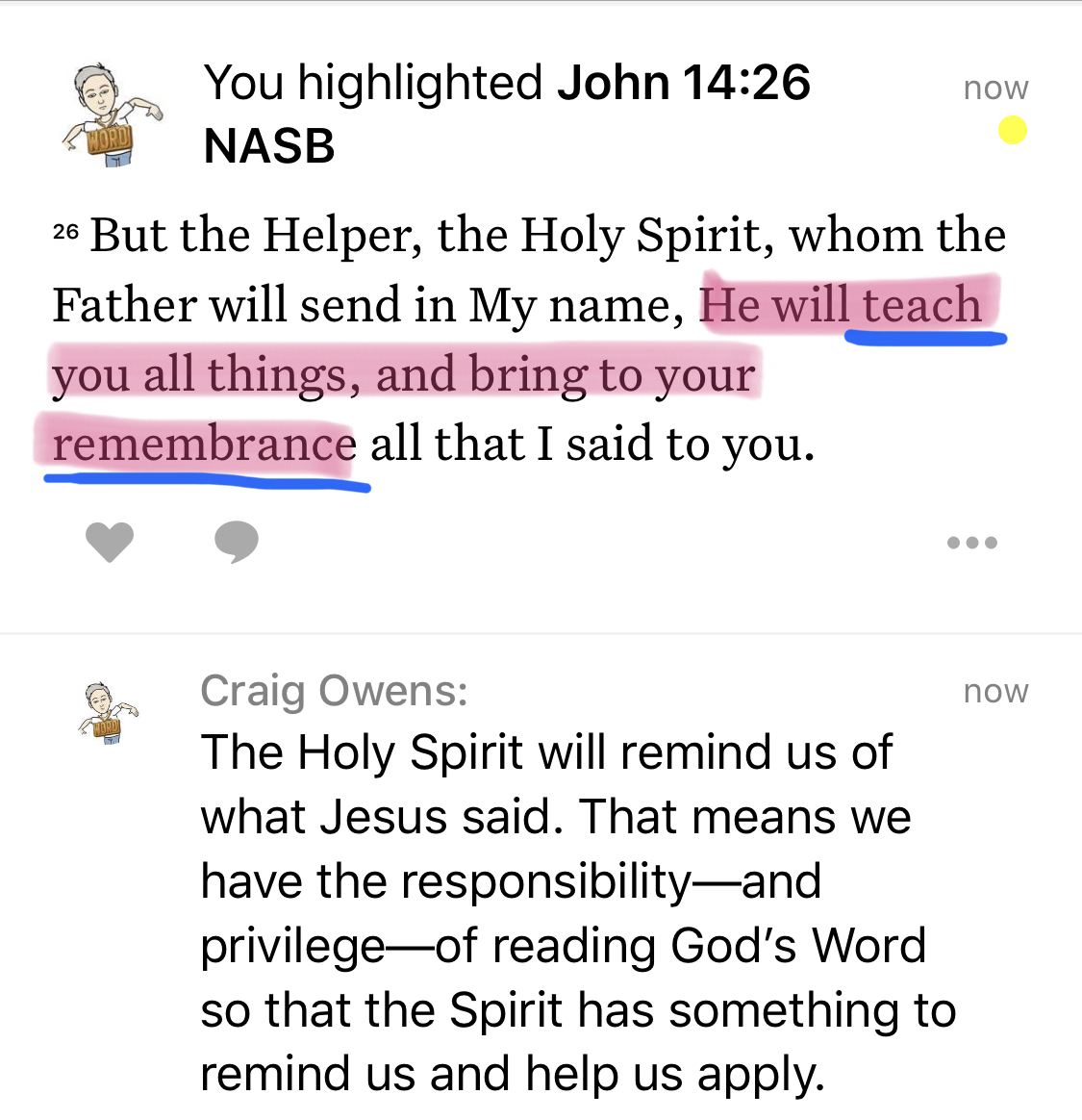
Jesus said the Holy Spirit would guide us into all truth. He didn’t say, “The Holy Spirit will go <poof> and you will immediately and fully understand everything.” Like Abram, we believe what God says about us, we follow, we trust, we listen, we obey, and the Spirit will begin to illuminate God’s Word to us. We’ll discover more each day what He’s asking of us, and we will notice that both our joy in Him and our effectiveness for the Kingdom of God are increasing along the journey! 

Don’t bail out early! Stick with it! I promise you that the joy still to be revealed along this journey is beyond compare with anything which would tempt you to stay behind to acquire.

►► Would you please prayerfully consider supporting this ministry? ◀︎◀︎
 

Thursdays With Spurgeon—Mercy Finds The Loophole

This is a weekly series with things I’m reading and pondering from Charles Spurgeon. You can read the original seed thought here, or type “Thursdays With Spurgeon” in the search box to read more entries.

Listen to the podcast of this post by clicking on the player below, and you can also subscribe on iTunes or Spotify.

Mercy Finds The Loophole

And the Lord smelled a soothing aroma. Then the Lord said in His heart, “I will never again curse the ground for man’s sake, although the imagination of man’s heart is evil from his youth; nor will I again destroy every living thing as I have done.” (Genesis 8:21) 

     To begin, then, with the text, we have here a most painful fact that man’s nature is incurable. ‘The imagination of man’s heart is evil from his youth.’ You will remember, before the flood, in the fifth verse of the sixth chapter, it is written, ‘Then the Lord saw that the wickedness of man was great in the earth, and that every intent of the thoughts of his heart was only evil continually’ (Genesis 6:5). After the flood it was just the same. … 

     You might have hoped that after so terrible a judgment, when only a picked and peculiar few, that is, eight, were saved by water, that man began anew with better stock.… It is not one wit so. The same God who, after looking at men, declared that his imagination was evil before the flood, pronounces the very same verdict upon them afterward. …

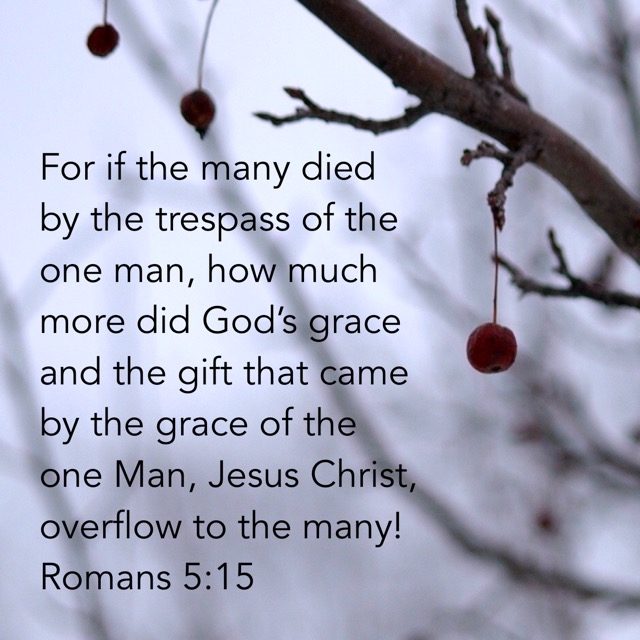
     I believe that God might justly have condemned the whole race of Adam on account of Adam’s sin and their own guilt. But I do think that this was a blessed loophole through which His mercy could, as it were, come fairly to the sons of men. ‘No,’ He says, ‘I made them not distinct individuals but a race. They fell as a race; they will rise as an elect race. “For as in Adam all die, even so in Christ all shall be made alive” (1 Corinthians 15:22). And ‘For as by one man’s disobedience many were made sinners, so also by one Man’s obedience many will be made righteous” (Romans 5:19).’ … 

     I must have more than nature can give me. More than my mother gave me, more than my father gave me, and more than flesh and blood can produce under the most favorable circumstances. I must have the Spirit of God from heaven.

From Human Depravity And Divine Mercy

When Adam and Eve sinned, God wasn’t scrambling to come up with a Plan B. Jesus is described as the Lamb slain from the foundation of the world (Revelation 13:8), meaning that God had His merciful plan of redemption ready before He even created humans! 

The atoning sacrifice Jesus made on the Cross was the “loophole” that God’s mercy used to pardon our sins. We can never earn our salvation because we are still people with evil hearts. But we can put our faith in the One who took our punishment upon Himself so that His righteousness can be our righteousness. 

O what a Savior! O what mercy God has shown! O how great is His love for us! How shall we escape appropriate retribution if we neglect and refuse to pay attention to such a great salvation…? (Hebrews 2:3)

►► Would you please prayerfully consider supporting this ministry? ◀︎◀︎
 

Thursdays With Spurgeon—Our Daily Doctrine Of Experience

This is a weekly series with things I’m reading and pondering from Charles Spurgeon. You can read the original seed thought here, or type “Thursdays With Spurgeon” in the search box to read more entries.

Listen to the podcast of this post by clicking on the player below, and you can also subscribe on iTunes or Spotify.

Our Daily Doctrine Of Experience 

[God] alone is my rock and my salvation (Psalm 62:2).

     Doctrine is nothing unless it is proved in our experience. Most of God’s doctrines are only to be learned by practice—by taking them out into the world and letting them bear the wear and tear of life. …  

     Think how many enemies you have. How many rivers you have to cross, how many mountains to climb, how many dragons to fight, how many lions’ teeth to escape, how many fires to pass through, how many floods to wade. … Can your salvation be of anything except God? … 

     I beseech you, remember this. I hope you know it by experience in the past, but try to remember it in the future—wherever you go, ‘Salvation is of the Lord.’ Do not get to looking at your heart; do not get to examining to see whether you have anything to recommend you; just remember, salvation is of the Lord. ‘He alone is my rock and my salvation.’ … 

     I say, Christian, your highest and noblest experience is not to be groaning about your corruption, is not to be crying about your wanderings, but is to say, ‘With all my sin and care and woe, His Spirit will not let me go.’ ‘Lord, I believe; help my unbelief!’ (Mark 9:24). …  

     Now we must have the great duty. The great duty is this: If God only is our rock and we know it, are we not bound to put all our trust in God, to give all our love to God, to set all our hope upon God, to spend all our life for God, and to devote our whole being to God? … Trace your mercies to God and say perpetually, ‘He alone is my rock and my salvation.’

From God Alone The Salvation Of His People

If you will look through the pages of the Bible, you will see that people struggled when they forgot what God had done for them and therefore they began to take matters into their own hands. In the Old Testament, the prophets called this idolatry and adultery; in the New Testament, Jesus called this a lack of faith. 

An old hymn reminds us:

Oh, to grace how great a debtor
Daily I’m constrained to be!
Let Thy goodness, like a fetter
Bind my wandering heart to Thee
Prone to wander, Lord, I feel it
Prone to leave the God I love
Here’s my heart, Oh, take and seal it
Seal it for Thy courts above (Robert Robinson, Come Thou Fount)

I think this is the reason why Jesus taught us to pray, “Give us today our daily bread.” We need to be perpetually reliant on God’s grace—a perpetual debtor. This posture reminds us, “He alone is my rock and my salvation,” and guards us against the spirit of self-reliance that would lead us astray. 

Let our doctrine be proven in our daily experience of coming to God as our one and only Source again and again and again.

►► Would you please prayerfully consider supporting this ministry? ◀︎◀︎


Thursdays With Spurgeon—Security

This is a weekly series with things I’m reading and pondering from Charles Spurgeon. You can read the original seed thought here, or type “Thursdays With Spurgeon” in the search box to read more entries.

Listen to the podcast of this post by clicking on the player below, and you can also subscribe on iTunes or Spotify.

Security 

[God] alone is my rock and my salvation (Psalm 62:2).

     I do not reckon that is salvation that regenerates me and then puts me in such a position that I may fall out of the covenant and be lost. I cannot call that a bridge that only goes halfway over the stream. I cannot call that salvation that does not carry me all the way to heaven, wash me perfectly clean, and put me among the glorified who sing constant hosannas around the throne. … 

     Do I live to God a holy life? It is not I, but Christ who lives in me. Am I sanctified? I did not sanctify myself. God’s Holy Spirit sanctifies me. Am I weaned from the world? I am weaned by God’s chastisements. Do I grow in knowledge? The great Instructor teaches me.

From God Alone The Salvation Of His People


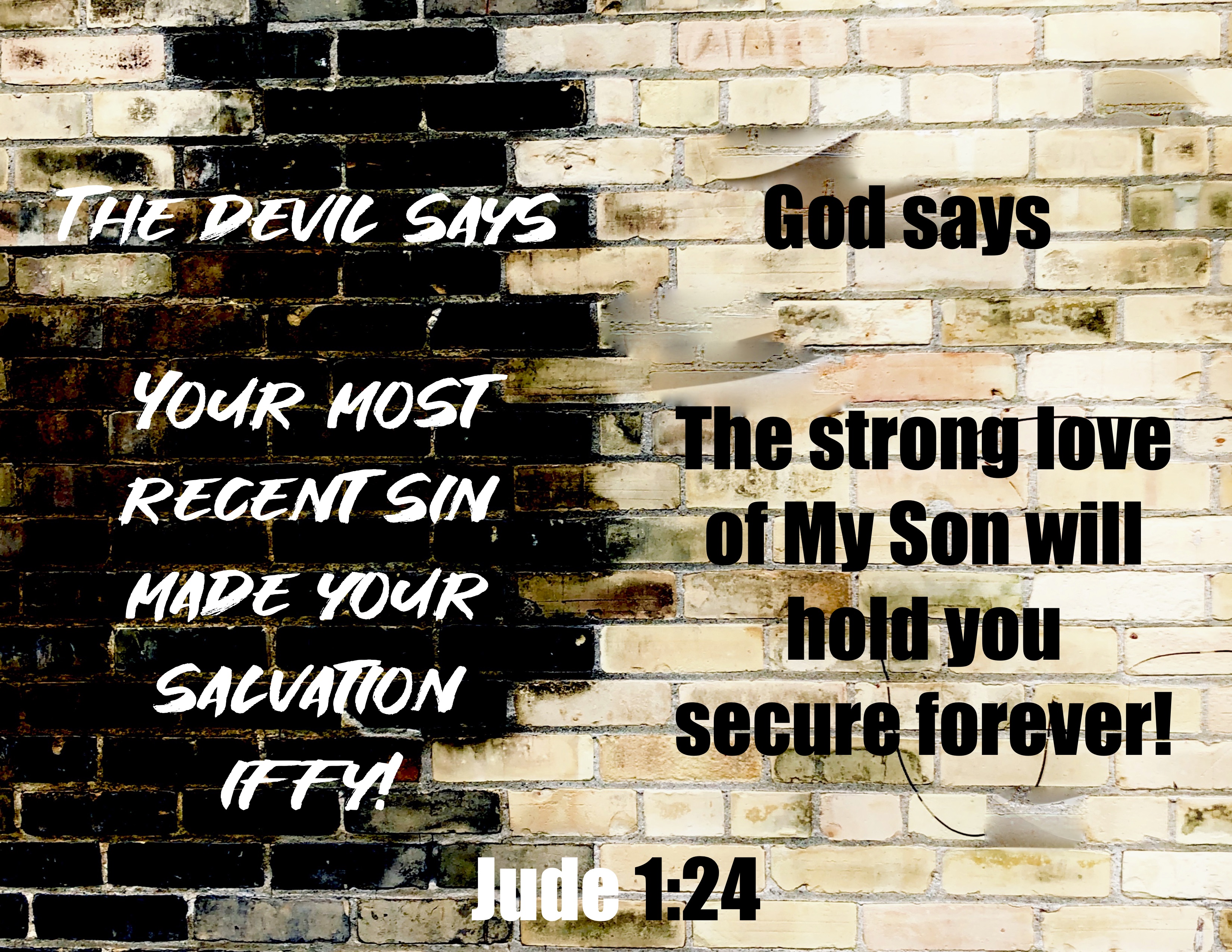
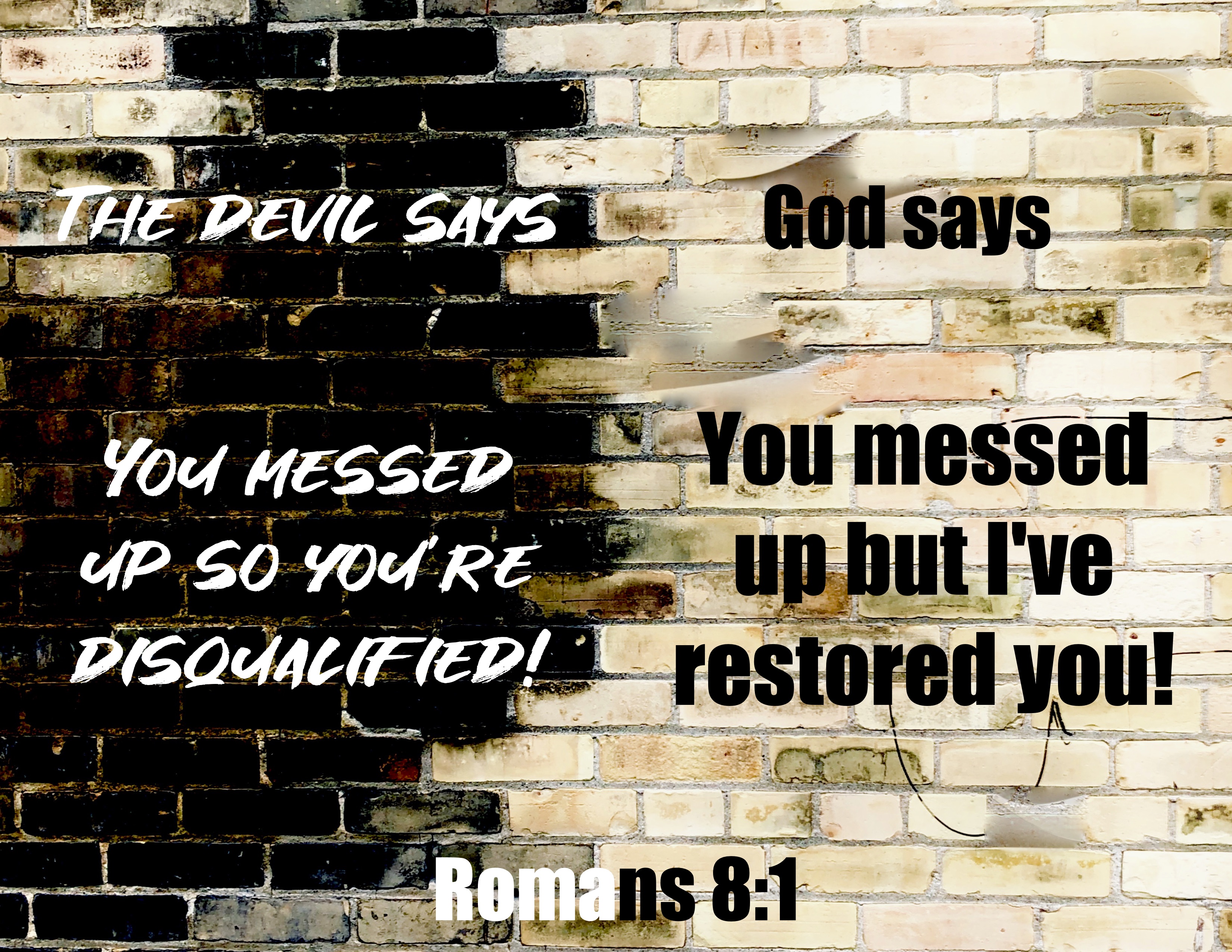
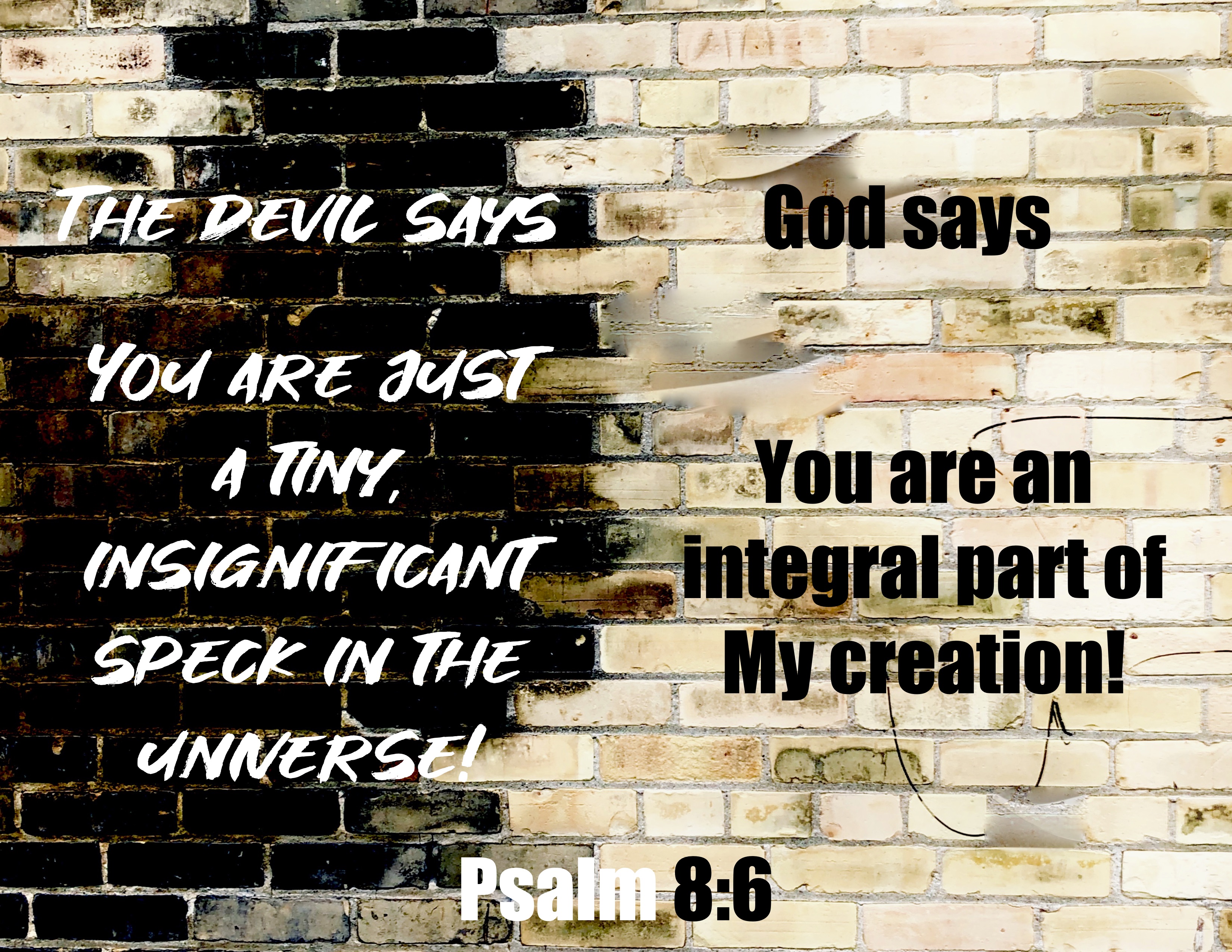
A few months ago I began designing a series of graphics under the heading, “Says who?” I took some of the lies of satan and put them side-by-side with the truth from God’s Word. 

When God is our Savior, we are secure. The devil would love to make us think that our salvation is hanging by a thread, that we have to work harder to make sure we don’t miss out, that a single sin can disqualify us from God’s favor, and a hundred other lies. But they are all just that: lies! 

We have to learn to capture each of these thoughts, and if they are thoughts that don’t align with God’s Word, then we need to confront them with the truth. I have found it very helpful to speak these truths out loud. To see some of the ways I suggested thinking differently about the devil’s lies, check out this post on reversing your thinking.

As the old hymn says, “Jesus paid it all, all to Him I owe.” You don’t have to earn your salvation or make your position secure—your salvation has been paid-in-full and you are perfectly secure! Now what you owe to Jesus is to allow Him to take you safely home. 

►► Would you please prayerfully consider supporting this ministry? ◀︎◀︎

Thursdays With Spurgeon—My Rock

This is a weekly series with things I’m reading and pondering from Charles Spurgeon. You can read the original seed thought here, or type “Thursdays With Spurgeon” in the search box to read more entries.

Listen to the podcast of this post by clicking on the player below, and you can also subscribe on iTunes or Spotify.

My Rock 

[God] alone is my rock and my salvation (Psalm 62:2).

     How noble a title; it is so sublime, suggestive, and overpowering. ‘My rock.’ It is a figure so divine that to God alone will it ever be applied. …  

     Unchangeable He is in His being, firm in His own sufficiency. He keeps Himself immutably the same. And ‘therefore you are not consumed, O sons of Jacob’ (Malachi 3:6). … So is our God a sure defense, and we will not be moved if He has set our feet upon a rock and established our goings (see Psalm 40:2). …  

     ‘He is my rock.’ How glorious a thought! How safe am I and how secure and how may I rejoice in the fact that when I wade through Jordan’s stream He will be my rock! I will not walk upon a slippery foundation, but I will tread on Him who cannot betray my feet. And I may sing when I am dying, ‘He is my rock, and there is no unrighteousness in Him’ (Psalm 92:15).

From God Alone The Salvation Of His People

Spurgeon mentioned singing about God our Rock even when we come to death’s door. Immediately a couple of songs from my childhood sprang to mind.

Rock of Ages, cleft for me,
Let me hide myself in Thee;
Let the water and the blood,
From Thy wounded side which flowed,
Be of sin the double cure,
Save from wrath and make me pure.

While I draw this fleeting breath,
When my eyes shall close in death,
When I rise to worlds unknown,
And behold Thee on Thy throne,
Rock of Ages, cleft for me,
Let me hide myself in Thee. (Augustus Toplady)

Where do I go when there’s nobody else to turn to?
Who do I turn to when nobody wants to listen?
Who do I lean on when there’s no foundation stable?
I go to the Rock, I know He’s able, I go to the Rock.

I go to the Rock of my salvation,
I go to the Stone that the builders rejected,
I run to the Mountain and the Mountain stands by me.
When the earth all around me is sinking sand
On Christ, the Solid Rock, I stand
When I need a shelter, when I need a friend, I go to the Rock. (Dottie Rambo)

My friend, no matter how unstable things may seem, no matter how uncertain the future may appear, remember the One and Only Rock. He alone is my rock and my salvation! Jesus is the same yesterday, today, and forever. Don’t try to make your own secure place, but run to the Rock of Ages, and this immovable Mountain will stand by you and keep you secure for all of eternity! 

Would you please prayerfully consider supporting this ministry? 


Thursdays With Spurgeon—Do I Have Faith?

This is a weekly series with things I’m reading and pondering from Charles Spurgeon. You can read the original seed thought here, or type “Thursdays With Spurgeon” in the search box to read more entries.

Listen to the podcast of this post by clicking on the player below, and you can also subscribe on iTunes or Spotify.

Do I Have Faith? 

     Man cannot please God without bringing to himself a great amount of happiness…. It is because [God] gives him the blessings of adoption, pours upon him the bounties of His grace, makes him a blessed man in this life, and ensures him a crown of everlasting life, which he will wear and which will shine with unfading luster when the wreaths of earth’s glory have all been melted away. … If, then, we are right in saying that to please God is to be happy, the one important question is, how can I please God? … 

     Without faith it is impossible to please [God]’ (Hebrews 11:6). That is to say, do what you may, strive as earnestly as you can, live as excellently as you please, make what sacrifices you choose, be as eminent as you can for everything that is lovely and of good repute—yet none of these things can be pleasing to God unless they are mixed with faith. …  

     Have you faith? Shall I help you to answer that question? I will give you three tests, as briefly as ever I can, not to weary you….

    1. He who has faith has renounced his own righteousness. 
    2. Then true faith may be known by this: It begets a great esteem for the person of Christ. Do you love Christ? Could you die for Him? Do you seek to serve Him? Do you love His people? 
    3. He who has true faith will have true obedience. If a man says he has faith and has no works, he lies. If any man declares that he believes in Christ and yet does not lead a holy life, he lies.

From Faith

Both my parents and my grandparents on both sides of my family tree were Christians. They had faith in the God of the Bible. In my younger years, I thought just believing what they believed was good enough. But I had to come to a point where I could say, “I don’t have faith in God because my parents and grandparents do, but because I really believe it is true.” In other words, not just Jesus is the Savior, but Jesus is MY Savior. 

Does having faith mean I have no doubts? No, there are still things I don’t fully understand. Faith means believing God for the things I do understand and still trusting Him with the things I don’t understand yet. 

That’s pretty much the resume of every person in the great faith chapter of the Bible (Hebrews 11). For instance, Noah didn’t understand what a worldwide flood was, but he built an ark in faith; Abraham didn’t know how God would make him the father of many nations, but he moved from his homeland by faith; Joseph didn’t know how God would deliver the Israelites from Egypt, but he gave instructions by faith; and on and on the list goes. 

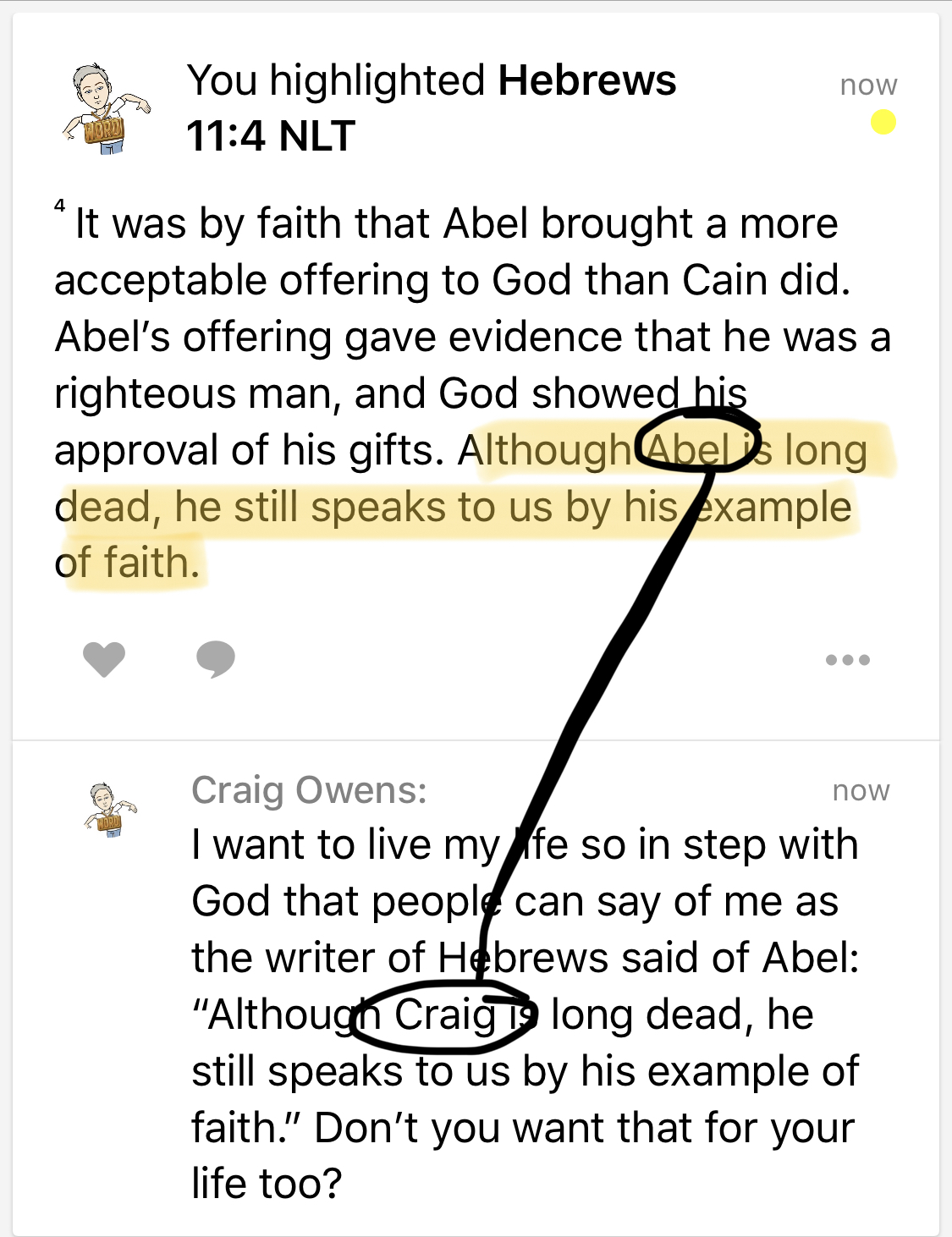
I commented on Hebrews 11:4 on YouVersion, “I want to live my life so in step with God that people can say of me as the writer of Hebrews said of Abel: ‘Although Craig is long dead, he still speaks to us by his example of faith.’ Don’t you want that for your life too?” 

The Bible itself tells us that faith comes into our heart by hearing the Word of God. If your faith is struggling, I would encourage you to open your Bible, ask the Holy Spirit to illuminate the Word to you, and begin reading with an open heart and mind. That’s exactly what I did, and I came to the conclusion that I believed the God of the Bible not because my parents did, but because He showed Himself to me to be Real. 

If you are struggling with your faith in God, I’d love to talk with you. Please get in touch with me and let’s begin a dialogue.

Thursdays With Spurgeon—Talking Back To Your Old Family

This is a weekly series with things I’m reading and pondering from Charles Spurgeon. You can read the original seed thought here, or type “Thursdays With Spurgeon” in the search box to read more entries.

Listen to the podcast of this post by clicking on the player below, and you can also subscribe on iTunes or Spotify.

Talking Back To Your Old Family

     When a man is adopted into a family and comes thereby under the regime of his new father, he has nothing whatever to do with the old family he has left behind and he is released from subjection to those whom he has left. And so, the moment I am taken out of the family of satan, the prince of this world has nothing to do with me as my father and he is no more my father. I am not a son of satan; I am not a child of wrath. 

     …When the law comes to a Christian with all its terrible threats and horrible denunciations, the Christian says, ‘Law! Why do you threaten me? I have nothing to do with you. I follow you as my rule, but I will not have you to be my ruler. I take you to be my pattern and mold, because I cannot find a better code of morality and of life, but I am not under you as my condemning curse.’ …  

     If one man adopts another child into his family, he cannot give it his own nature as his own child would have had. And if that child whom he will adopt should have been a fool, it may still remain so. He cannot make it a child worthy of him. But our heavenly Father, when He comes to carry out adoption, gives us not only the name of children, but the nature of children, too. He gives us a nature like His well-beloved Son, Jesus Christ.

From Adoption

Charles Spurgeon was called “the prince of preachers” for good reason! His word pictures are so biblically-accurate and so easy to recall, that anyone can grasp the concepts he shares from the Scripture. I have two takeaways from this portion of his sermon: 

First, we need to talk back to our old family. The name “satan” means accuser: he accuses, condemns, slanders, and does his best to separate. When a Christian has been adopted into God’s family, there is no condemnation for the one who now calls God, “Abba Father” (see Romans 8:1-17). 

This is where we need to call out satan’s lies. I mean literally call them out. We need to talk back to the devil and tell him the truth, just as Spurgeon said in his example of talking back to the Law. Let me say it again: literally speak the truth out loud. The devil needs to hear it and your own ears need to hear it too: “I am no longer subject to your jurisdiction. You have no say over me any longer. I am a child of God. My sins have been forgiven and forgotten; therefore, there are no grounds left for any condemnation!”


Second, we need to talk back to our old nature. After being adopted into God’s family, the Holy Spirit undertakes a process to conform us to the image of Jesus. This process is called sanctification, but I like to call it saint-ification. 

This is where we call out what we used to be. And, again, I challenge to literally speak these words out loud. Don’t say, “I’m so impatient,” but tell yourself (out loud!), “I am becoming the patient saint Jesus wants me to be.” Don’t say, “I’ll never get this right,” but tell yourself, “I am learning more and more about Christ’s nature with each attempt.” Talk back to these old habits from your old family, and tell them about the new saintly habits the Holy Spirit is developing in you. 

The book of Revelation tells us that the saints overcame the slanderous devil by the blood of Jesus and by the words of their testimony. Speak out those life-affirming words every time that slanderer tries to make you forget into whose family you have been adopted!

Thursdays With Spurgeon—Adopted By God

This is a weekly series with things I’m reading and pondering from Charles Spurgeon. You can read the original seed thought here, or type “Thursdays With Spurgeon” in the search box to read more entries.

Listen to the podcast of this post by clicking on the player below, and you can also subscribe on iTunes or Spotify.

Adopted By God

Blessed be the God and Father of our Lord Jesus Christ, who has blessed us with every spiritual blessing in the heavenly places in Christ, just as He chose us in Him before the foundation of the world, that we should be holy and without blame before Him in love, having predestined us to adoption as sons by Jesus Christ to Himself, according to the good pleasure of His will. (Ephesians 1:3-5) 

     It is at once a doctrine of Scripture and of common sense that whatever God does in time, He predestined to do in eternity. …  

     Adoption is that act of God whereby men who were by nature the children of wrath, even as others, and were of the lost and ruined family of Adam, are from no reason in themselves, but entirely of the pure grace of God, translated out of the evil and dark family of satan and brought actually and virtually into the family of God. … This is an act of pure grace. …  

     [God] found a rebellious child, a filthy, frightful, ugly child. He took him to His bosom and said, ‘Evil though you are, you are comely in my eyes through my Son Jesus. Unworthy though you are, yet I cover you with His robe, and in your Brother’s garments I accept you.’ …  

     His only begotten and well-beloved Son was quite enough for Him. … And His own omnipotence was adequate enough to have created a race of beings far superior to us. He stood in no need whatever of any to be His darlings. It was, then, an act of simple, pure, gratuitous grace—and of nothing else—because He will have mercy on whom He will have mercy and because He delights to show the marvelous character of His condescension.

From Adoption

I love that thought that “whatever God does in time, He predestined to do in eternity.” When Adam and Eve sinned, God wasn’t scrambling to fix the sin problem. When He said that a remedy for sin was coming (Genesis 3:15), He was talking about a plan that was already in place. 

When John the Baptist said of Jesus, “Behold the Lamb of God who takes away the sin of the world!” (John 1:29), he was only announcing what was a fact from before time began, where the apostle John described Jesus as “the Lamb slain from the foundation of the world” (Revelation 5:12, 13:8)! And the apostle Paul said God “chose us in [Jesus] before the foundation of the world”! 

Friends, think of what this means: God saw a relationship with you—saw you adopted into His family—before you were born, even before the universe was created! What indescribable love! What amazing grace! 

Do you realize your value in God’s eyes? He didn’t have to send Jesus, but He did. He didn’t have to lavish His love on you, but He does. He didn’t have to adopt you into His family, but what He has done in time, He predestined to do in eternity—from before He even said, “Let there be light” at the moment of creation. 

Don’t ever buy into the lies of satan that you’re nothing special, when, in fact, you mean more to God than you can possibly comprehend!

Thursdays With Spurgeon—God Wants To Bless You

This is a weekly series with things I’m reading and pondering from Charles Spurgeon. You can read the original seed thought here, or type “Thursdays With Spurgeon” in the search box to read more entries.

Listen to the podcast of this post by clicking on the player below, and you can also subscribe on iTunes or Spotify.

God Wants To Bless You

     It delights God to bestow His goodness. The cost was paid long ago on Calvary’s Cross, and that is over. Since the great sacrifice has been presented, God freely gives all the blessings of divine grace to us with a willingness that shows that His heart goes with them. …  

     Come along with you, you needy saint or sinner. The more you can take in, the better pleased will the Lord be with you. … The Lord desires you to open your mouth wide and He will fill it—it is easier for Him to give than for you to open your mouth. He encourages and requests you to bring large petitions with you when you come before His mercy seat. …  

     ‘How can I apprehend these blessings and make them my own?’ … ‘The natural man does not receive the things of the Spirit of God’ (1 Corinthians 2:14). The power to receive the things of God lies not in high gifts or attainments. … Do not sit down and say, ‘I am a poor stupid man and cannot be taught of God.’ Or, ‘I am a humble countryman, or a poor woman keeping house for others. I cannot know these precious things.’ It is not so. Read the words of Paul in the first chapter of this Epistle: ‘For you see your calling, brethren, that not many wise according to the flesh, not many mighty, not many noble, are called’ (1 Corinthians 1:26). The power to receive the blessings of God does not lie in talent at all, but it lies in the Spirit of God. …

     Grace is not tied to the rare gifts of genius, nor to the precious acquirements of experience, nor to the high attainments of learning. … The power to receive is still of the Holy Spirit, and the Holy Spirit does not find good in us but brings it to us.

From Grace For Grace

I truly believe that God wants to bless us more than we want to receive God’s blessings. Far too many times I encounter people who want to talk themselves out of their worthiness to receive anything from God. 

But remember this verse: Since He did not spare even His own Son but gave Him up for us all, won’t He also give us everything else? (Romans 8:32). If God the Father would give up His Son to make it possible for you to be reconciled to Him, why would He hold anything back from you. 

God’s doesn’t want to blast you, He wants to bless you!

Please, my friend, let Him bless you. His blessings aren’t because of anything you or I have done to deserve them. The definition of “grace” is an undeserved gift. God gives and He enables us to receive. Let Him pour out His blessings on you today!