The Christian’s Secret Of A Happy Life (book review)

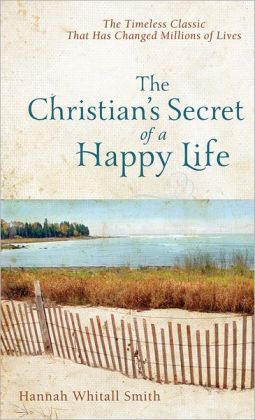
The Christian's SecretAlthough originally written in 1875, The Christian’s Secret Of A Happy Life by Hannah Whitall Smith is as relevant today as it was 140 years ago.

Hannah is quick to point out that happiness is not the goal for a Christian, but a closer walk with Jesus Christ is. When we are walking close with Him, happiness that comes from peace, security, and consistent growth in faith is the natural byproduct.

Hannah is a Quaker and she wrote nearly two centuries ago, so some language differences are to be expected. But I found that when the “old English” began to show up more liberally in certain passages, it was the author’s way of really getting excited about what she had to say! Other than that, the principles and the examples she uses to make her points are fairly timeless.

The book is divided into three sections, and the middle section—called Difficulties—was one of my favorites. What made it so intriguing was the practical and biblical way Hannah explained the difficulties Christians face, and the God-honoring way out of those problems.

This is an excellent devotional-style book for both new and experienced Christians.

“The Lord’s part is to do the thing entrusted to Him. He disciplines and trains by inward exercises and outward providences. He brings to bear upon us all the refining and purifying resources of His wisdom and His love. He makes everything in our lives and circumstances subservient to the one great purpose of causing us to grow in grace, and of conforming us, day by day and hour by hour, to the image of Christ.” —Hannah Whitall Smith

13 Quotes From “Yawning At Tigers”

Yawning At TigersYawning At Tigers by Drew Dyck is a wake-up call to any who view God as tame or Christianity as boring. As I read this book I found myself frequently saying, “Yes!” out loud to the truths Drew has shared. I loved this book! You can read my full book review by clicking here. Below are a few of the quotes I highlighted (unless otherwise noted, the quotes are from the author).

“We can’t truly appreciate God’s grace until we glimpse His greatness. We won’t be lifted by His love until we are humbled by His holiness.” 

“Here, the contrast between God and an idol couldn’t be clearer. We are told that after offering sacrifices to the golden calf, the Israelites ‘sat down to eat and drink and got up to indulge in revelry’ (Exodus 32:6). But when God descended on Mount Sinai, ‘everyone in the camp trembled’ (Exodus 19:16). You don’t tremble before an idol. … An idol is safe. It never challenges you. It isn’t threatening. It doesn’t judge sin or demand loyalty. But the Holy One of Israel is a jealous God—passionate and loving, yes, but unspeakably dangerous too.”

“The language we use reveals an awful lot about how we think about God. A cursory examination of the way we speak exposes how pervasive this Jesus-as-my-nonjudgmental-buddy attitude is in the church.” 

“While we know enough about God to receive salvation and enter into a relationship with Him, our knowledge of Him is still far from complete. Our intelligence is too small, our languages too limited. When it comes to God, we are all beginners.”

“So soon as we become satisfied with any picture of God, we are in danger of idolatry.” —Victor White 

“Unfortunately, in our efforts to make the Bible interesting and relevant, we try to normalize God. We become experts at taking something lofty, so unfathomable and incomprehensible, and dragging it down to the lowest shelf. We failed to account for the fact that God is neither completely knowable nor remotely manageable.”

“We lack a practice of personal holiness because we’ve lost a theology of divine holiness. When we neglect a part of God’s nature, we shouldn’t be surprised when that same attribute goes missing in our lives. … The Bible repeatedly makes explicit the connection between God’s holiness and ours. ‘Be holy,’ God says, ‘because I… am holy’ (Leviticus 19:2). The New Testament echoes this theme. ‘Just as He who called you is holy, so be holy in all you do’ (1 Peter 1:15).” 

“Only a God who punishes evil and rights wrongs is ultimately a God of love. … To fear the Lord is not to suggest God is callous or cool. Just the opposite, in fact. It is God’s consuming love that makes Him so dangerous. Because He cares deeply for His creation, He will not tolerate evil and injustice forever.”

“The evidence of the Christian’s zeal and piety was made clear to all the pagans. For example, they alone in such a catastrophic state of affairs gave practical evidence of their sympathy and philanthropy works. All day long some of them would diligently persevere in performing the last offices for the dying and burying them (for there were countless numbers, and no one to look after them). While others gathered together in a single assemblage all who were afflicted by famine throughout the whole city, and would distribute bread to them all. When this became known, people glorified the God of the Christians, and, convinced by the deeds themselves, confessed the Christians alone were truly pious and God-fearing.” —Eusebius

“When we root our sense of identity in God, everything changes. Once our vertical connection is healthy, the horizontal ones tend to thrive. However, a cruel irony comes into play when we seek validation from others that only God can provide. When we lean too heavily on human relationships, we actually end up sabotaging them. We become clingy, controlling. We find ourselves piling expectations on people they were never meant to bear.”

“This doesn’t mean the New Testament is solely about God’s intimacy. Nor does the Old Testament speak strictly about God’s transcendence. The entire Bible speaks of both. All through Scripture we are reminded that God is both great and near.” 

“For people in the throes of suffering, the Bible offers something much different than an answer—it offers a Person.”

“We shall never succeed in knowing ourselves unless we seek to know God.” —Teresa of Avila

Yawning At Tigers (book review)

Yawning At TigersI’ve been longing for a book like Yawning At Tigers to be published! For years I have been concerned with the “taming” of God that I see among so many in our culture, so the subtitle of Drew Dyck’s book nails it: You Can’t Tame God, So Stop Trying!

Drew opens with a real-life story of exotic animals which were set loose in a small town in the midwest. Where people had viewed the animals behind bars and plexiglass before and found them tame, their attitude was completely changed when those same animals were walking down their street! Drew uses this story to draw an analogy to the way people view a “tame God” contained behind stained glass windows, as opposed to the true God set loose in their neighborhoods.

Drew writes, “Even when we see evidence of God in our midst, when we glimpse His holiness, we’re more likely to yawn than yell. Somehow we’ve succeeded in making the strange ordinary.” It’s sad, but true in far too many settings.

Yawning At Tigers is an impassioned call to open the Scriptures up and really see God. He is awesome, He is ferocious, He is a warrior, He is white-hot love! Until we really see God, others will yawn at the thought of Christians or church. Again Drew gets it right when he says, “Only when we gain a proper understanding of God’s identity can we begin to appreciate the implications of His love.”

If you are desirous to see God revealed in all His fullness in your life, in your church, in your community, then you will resonate with the message of Yawning At Tigers.

I am a Thomas Nelson book reviewer.

5 Noteworthy Quotes In “Stand Strong”

Stand StrongNick Vujicic does an excellent job in his book Stand Strong in helping students, parents, and teachers learn how to overcome bullies. You can read my full review of Stand Strong by clicking here.

I have already shared some of Nick’s quotes from this book, and some quotes specifically relating to the emotional toll bullying can have on those being picked on. Nick also makes the point that there are some invaluable lessons to be learned by overcoming adversity in our lives. Here are some of the quotes that Nick shared in his excellent book.

“You don’t develop courage by being happy in your relationships every day. You develop it by surviving difficult times and challenging adversity.” —Epicurus

“All the adversity I’ve had in my life, all my troubles and obstacles, have strengthened me. … You may not realize it when it happens, but a kick in the teeth may be the best thing in the world for you.” —Walt Disney

“Comfort and prosperity have never enriched the world as much as adversity has.” —Billy Graham

“Most of the verses written about praise in God’s Word were voiced by people who were faced with crushing heartaches, injustice, treachery, slander, and scores of other difficult situations.” —Joni Eareckson Tada

“Friendships provide a context in which children develop, but of course so do negative peer relations. … We should expect that both types of relationships, as different as they are, present opportunities for growth.” — psychologist Maurissa Abecassis

4 Quotes About Emotional Health In “Stand Strong”

Stand StrongIn Stand Strong, Nick Vujicic shares the hard-won strategies he learned to overcome bullies. You can read my full review of Stand Strong by clicking here.

I already shared some of Nick’s quotes from this book, but I wanted a separate post to highlighted a key issue in bullying. One of the biggest tolls on a person being bullied is in their emotional health. One of the chapters I highlighted the most had to do with this important area, so below are a few good reminders.

“I encourage you to keep this phrase in your mind when faced with bullying: You can say terrible things to me, but you can’t touch who I am inside. You can’t make me feel badly about myself. I know who I am, and I stand on my own.”

“We have emotions for a reason. They don’t just come over us by chance, even though it sometimes may seem that way. Asking where your emotions come from and assessing why you feel the way you feel are critical parts of creating self-awareness and asserting self-control over your actions. It’s important to know what triggers your emotions so you can better control your responses in ways that benefit you over the long term. Managing negative emotions is an important part of your bully defense system, and it is also a key to living a more successful life. People who let their negative emotions control their actions tend to feel out of control, insecure, and unhappy. Those who act based on a thoughtful process for monitoring and managing such emotions tend to be more successful, more confident, and happier.”

“Emotions are natural and you feel what you feel. But the quality of your life is greatly affected by the choices you make in responding to your feelings. You see, a space, a time interval, and an opportunity between the point at which you feel something and the point at which you act on that feeling. This space is a gift. … Psychologists say people who learn to use this space wisely are generally much more successful in life than those who either ignore it or don’t use it well. This is the space where you can take control, make smart decisions, and put yourself in a position to determine your own destiny. … When you use the space to think about your response and to decide what is best for you over the long term, you are practicing self-awareness and self-control. This is called ‘response flexibility,’ and it is a sign of emotional intelligence.”

“Here’s something to consider: your negative emotions can be like bullies inside you. They try to provoke a response from you that may not be in your best interest. So if you simply do what those bad feelings stir you to do, you are just giving in to another bully in your life.”

11 Quotes From Nick Vujicic In “Stand Strong”

Stand StrongStand Strong is an invaluable resource for school-age students, their parents, and teachers and principals in our schools. Nick Vujicic uses his own life as an example of how to overcome bullies. You can read my full book review by clicking here. Below are some quotes from the author I highlighted in this book.

“If someone hurt you, then become the person who reaches out to others who are hurting. If you were not treated with compassion, then change that pattern by offering compassion to others. If no one stood up for you, then stand up for someone else.” 

“What happens in our lives isn’t about chance. It’s about choice. You and I may not be able to stop bullies and thoughtless people from saying and doing hurtful things, but we do have the ultimate power—the power to choose how we respond and how we live.”

“There is nothing wrong with wanting to fit in and be accepted, but there is something wrong with abandoning your values and beliefs to do it. … Try this instead: Be so comfortable with yourself that other people feel comfortable with you too. Create a life that makes you so joyful that they will want to share in your happiness.” 

“Being secure and comfortable in your identity, trusting that you have value, and having a strong sense of your purpose are important in every aspect of life. Those qualities also help make you less vulnerable to bullying. … If we let bullies drag us down with their cruelty and meanness, why can’t we pull ourselves back up by being friends to ourselves and building up our confidence and spirits when we need a boost? … So here’s my suggestion for a simple, easy-to-apply, no muss, no fuss first step to building your antibully 1.0 operating system. Be a friend to yourself. Forgive your mistakes, your flaws, and your failures. Be kind to yourself instead. Focus on the good.”

“What’s easier to hit, a sitting duck or a rabbit on the run? If bullies are looking for someone to hit, their last choice will be a moving target, someone who has it in gear with the pedal to the metal on the road to a better life.” 

“If you are generous to others, you will feel better about yourself, and that makes it more difficult for bullies or anyone else to get to you.”

“Being gentle isn’t about being weak. … Being gentle is more about practicing humility, giving up the need to be right, putting other people first, being a good listener and a good friend, protecting those who are being abused, and comforting those in need. … Many of the strongest and most admirable people I know are gentle spirits who don’t have to prove how tough they are on the outside because they are so strong on the inside.” 

“Psychologists say the more social interactions we have—the closer we are to family members, and the more friends and acquaintances we have—the less likely it is that a bully can isolate us as targets.”

“One of the key facts about relationships: people respond to you and treat you according to the way you act, not the way you think or feel.” 

“The people I want to keep close and trust the most are those who make me want to be better, smarter, more loving, more open minded, more collaborative, more trustworthy, more empathetic, more faith filled, more God loving, more grateful, more forgiving, and more open to opportunities to serve God and those around me. These are the type of friends that will make you and me bully proof.”

“I encourage you to develop empathy for others, like the Good Samaritan showed. Please do everything you can to protect others from emotional and physical harm caused by bullies. … Stand together so no one will stand alone!” 


Stand Strong (book review)

Stand StrongNick Vujicic was born without arms or legs, as a result, he said he grew up being a “bully’s dream.” But Nick is an overcomer! He conquered his bullies, and in his book Stand Strong he wants to help students learn to conquer their bullies too.

Nick explains, “Your bully’s motives don’t matter. You do. Your safety and your happiness are more important to me and everyone else who loves and cares about you; so instead of focusing on why a bully is picking on you, let’s focus on helping you feel secure and happy again. … I will help you build your antibully antibodies.”

Using his own life as an example, Nick shares the raw emotions he felt when he was picked on by bullies. He is also transparent enough to share all the wrong ways he tried to avoid being bullied, and ultimately how he discovered the pattern for successfully navigating the bullies that come along all our paths. As Nick wraps up the book he observes, “Seriously, here is the idea I’m asking you to consider: what if you could find ways to learn and grow from being bullied? What if you took a bully’s hurtful actions and turn them into lessons learned so that you became stronger, wiser, and more confident?”

I found the steps in Nick’s Antibullying system to be steps that can be immediately applied. They are very do-able! And they will indeed make students stronger, wiser, and more confident.

This is a book I would recommend to not only school-aged students, but also parents, teachers, and school principals. If everyone could get together on the same program, the results would lead to a completely new environment in our schools.

I am a Waterbook book reviewer.

7 Bible Study Ideas From D.L. Moody

Pleasure & ProfitAs I read D.L. Moody’s book Pleasure & Profit In Bible Study, I made note of several ideas that could stimulate a great Bible study. Check out my review of this book by clicking here, then check out these great study-starters:

“If you are impatient, sit down quietly and commune with Job. If you are strong-headed, read of Moses and Peter. If you are weak-kneed, look at Elijah. If there is no song in your heart, listen to David. If you are a politician, read Daniel. If you are getting sordid, read Isaiah. If you are chilly, read of the beloved disciple. If your faith is low, read Paul. If you are getting lazy, watch James. If you are losing sight of the future, read in Revelation of the promised land.” —Richard Baxter 

“Every chapter [of Mark] but the first, seventh, eighth and fourteenth begins with ‘And,’ as if there was no pause in Christ’s ministry.”

“Matthew begins with Abraham; Mark with Malachi; Luke with John the Baptist; but John with God Himself. Matthew sets forth Christ as the Jew’s Messiah. Mark as the active worker. Luke as a man. John as a personal Savior.”

“[In John’s Gospel] the word repent does not occur once, but the word believe occurs ninety-eight times.”

“Dr. A. T. Pierson says: Let the introduction cover five P’s; place where written; person by whom written; people to whom written; purpose for which written; period at which written.” 

“Some time ago a man wanted to take my Bible home to get a few things out of it, and when it came back I found this noted in it:

  • Justification, a change of state, a new standing before God.
  • Repentance, a change of mind, a new mind about God.
  • Regeneration, a change of nature, a new heart from God.
  • Conversion, a change of life, a new life for God.
  • Adoption, a change of family, new relationship towards God.
  • Sanctification, a change of service, separation unto God.
  • Glorification, a new state, a new condition with God.”

“I was wonderfully blessed by taking the seven ‘Blesseds’ of the Revelation. … Or you may take the eight ‘overcomes’ in Revelation…. I have been greatly blessed by going through the ‘believings’ of John. Every chapter but two speaks of believing. … Take the six ‘precious’ things in Peter’s Epistles. And the seven ‘walks’ of the Epistle to the Ephesians. And the five ‘much mores’ of Romans 5. Or the two ‘receiveds’ of John 1. Or the seven ‘hearts’ in Proverbs 13, and especially an eighth. Or ‘the fear of the Lord’ in Proverbs.” 

“No scripture is exhausted by a single explanation. The flowers of God’s garden bloom, not only double, but seven-fold: they are continually pouring forth fresh fragrance.” —Charles Spurgeon

11 Quotes From “Pleasure & Profit In Bible Study”

Pleasure & ProfitD.L. Moody’s book Pleasure & Profit In Bible Study is a Bible study rejuvenator for both the novice and experienced reader of the Bible. You can read my full book review by clicking here. Below are some of the quotes I especially appreciated in this book.

“The more you love the Scriptures, the firmer will be your faith. There is little backsliding when people love the Scriptures.” 

“I believe we should know better how to pray if we knew our Bibles better. … And if we feed on the Word, it will be so easy then to speak to others; and not only that, but we shall be growing in grace all the while, and others will take notice of our walk and conversation.”

“It is a very interesting fact that of the thirty-nine books of the Old Testament, it is recorded that our Lord made quotations from no less than twenty-two. … About 850 passages in the Old Testament are quoted or alluded to in the New…. In the Gospel by Matthew there are over a hundred quotations from twenty of the books in the Old Testament. In the Gospel of Mark there are fifteen quotations taken from thirteen of the books. In the Gospel of Luke there are thirty-four quotations from thirteen books. In the Gospel of John there are eleven quotations from six books. In the four Gospels alone there are more than 160 quotations from the Old Testament. … In Paul’s letter to the Corinthians there are fifty-three quotations from the Old Testament; sometimes he takes whole paragraphs from it. In Hebrews there are eighty-five quotations, in that one book of thirteen chapters. In Galatians, sixteen quotations. In the book of Revelation alone, there are 245 quotations and allusions.”

“It is very important that every Christian should not only know what the Old Testament teaches, but he should accept its truths, because it is upon this that truth is based. Peter said the Scriptures are not given for any private interpretation, and in speaking of the Scriptures, referred to the Old Testament and not to the New. … If the Old Testament Scriptures are not true, do you think Christ would have so often referred to them, and said the Scriptures must be fulfilled? When told by the tempter that He might call down the angels from heaven to interpose in His behalf, he said: ‘Thus it is written.’ Christ gave Himself up as a sacrifice that the Scriptures might be fulfilled. Was it not said that He was numbered with the transgressors? And when He talked with two of His disciples by the way journeying to Emmaus, after His resurrection, did He not say: ‘Ought not these things to be? am I not to suffer?’ And beginning at Moses He explained unto them in all the Scriptures concerning Himself, for the one theme of the Old Testament is the Messiah. … Christ referred to the Scriptures and their fulfillment in Him, not only after He arose from the dead, but in the book of Revelation He used them in Heaven. He spoke to John of them on the Isle of Patmos, and used the very things in them that men are trying to cast out. He never found fault with or rejected them.”

“Prophecy is history unfulfilled, and history is prophecy fulfilled. … Between 500 and 600 hundred Old Testament prophecies have been remarkably and literally fulfilled, and 200 in regard to Jesus Christ alone. Not a thing happened to Jesus Christ that was not prophesied from 1700 to 400 years before He was born.”

“Someone has said that there are four things necessary in studying the Bible: Admit, submit, commit and transmit. First, admit its truth; second, submit to its teachings; third, commit it to memory; and fourth, transmit it. If the Christian life is a good thing for you, pass it on to some one else.”

“Application to the Word will tend to its growth within and its multiplication without.”

“We learn that Christ prayed when he was baptized, and nearly every great event in His ministry was preceded by prayer. If you want to hear from Heaven you must seek it on your knees.”

“If you want to reach people that do not agree with you, do not take a club to knock them down and then try to pick them up. When Jesus Christ dealt with the erring and the sinners, He was as tender with them as a mother is with her sick child.” 

“Let us go to the Bible and see what that old Book teaches. Let us believe it, and go and act as if we believed it, too.”

“But we can not be ready if we do not study the Bible. So whenever you hear a good thing, just put it down, because if it is good for you it will be good for somebody else; and we should pass the coin of heaven around just as we do the coin of the realm.”

12 Noteworthy Quotes From “There Is A God”

There Is A GodAs I said in my book review of Anthony Flew’s There Is A God, the real value of this book is in the arguments which contributed to Flew’s shift from atheism to theism. You can read my full book review by clicking here.

Frankly, it’s hard to share a lot of the quotes because the context of the full argument would be lacking, but I’ve been sharing a few of them over several posts. To wrap up this series, here are several other noteworthy quotes from this thought-provoking book.

“I would have liked to convince my father that I had found what he had been looking for, the ineffable something he had longed for all his life. I would have liked to persuade him that the search for God does not have to be in vain. But it was hopeless. He had known too many blind Christians, bleak moralists who sucked the joy from life and persuaded their opponents; he would never have been able to see the truth they were hiding.” —Katherine Tait, daughter of Bertrand Russell 

“Nothing can penetrate the loneliness of the human heart except the highest intensity of the sort of love the religious teachers have preached.” —Bertrand Russell

“In sum, to the Being who he considered to be the explanation of the world and its broad form, Aristotle ascribed the following attributes: immutability, immateriality, omnipotence, omniscience, oneness or indivisibility, perfect goodness and necessary existence. There is an impressive correspondence between this set of attributes and those traditionally ascribed to God within the Judaeo-Christian tradition. It is one that fully justifies us in viewing Aristotle as having had the same Divine Being in mind as the cause of the world that is the object of worship of these two religions.” —David Conway

“There can never be any real opposition between religion and science; for the one is the complement of the other. … Religion and natural science are fighting the joint battle in an incessant, never relaxing crusade against skepticism and against dogmatism, against unbelief and superstition … and therefore ‘On to God!’” —Max Planck

“God is a mathematician of a very high order and He used advanced mathematics in constructing the universe.” —Paul A.M. Dirac 

“Reason tells me of the extreme difficulty or rather impossibility of conceiving this immense and wonderful universe, including man with his capability of looking far backwards and far into the futurity, as a result of blind chance or necessity. When thus reflecting I feel compelled to look to a First Cause having an intelligent mind in some degree analogous to that of mine; and I deserve to be called a Theist.” —Charles Darwin

“Science can proceed only if the scientist adopts an essentially theological worldview. … Even the most atheistic scientist accepts as an act of faith the existence of a lawlike order in nature that is at least in part comprehensible to us.” —Paul Davies, Templeton Prize winner 

“It is crazy to postulate a trillion (casually unconnected) universes to explain the features of one universe, when postulating one entity (God) will do the job.” —Richard Swinburne

“The problem of how meaningful or semantic information can emerge spontaneously from a collection of mindless molecules subject to blind and purposeless forces percents a deep conceptual challenge.” —Paul Davies 

“One feature of life, though, remains certain: Life could not have evolved without a genetic mechanism—one able to store, replicate, and transmit to its progeny information that can change with time. … Precisely how the first genetic machinery involved also persists as an unresolved issue.” —Antonia Lazcano

“The world is rational. The order of the world reflects the order of the supreme mind governing it.” —Kurt Gödel

“The reality of rationality cannot be evaded with any appeal to natural selection. Natural selection presupposes the existence of physical entities that interact according to specific laws and of a code that manages the processes of life. And to talk of natural selection is to assume that there is some logic to what is happening in nature (adaptation) and that we are capable of understanding this logic.” —Roy Abraham Varghese

  • You can read some direct quotes from Anthony Flew by clicking here.
  • Some Albert Einstein quotes can be found by clicking here.
  • A fascinating mathematical explanation from Gerald Schroeder is found by clicking here.