As a young person, I would hear pastors talking about their Thompson Chain-Reference Bible, so I always assumed this was merely a “preacher’s Bible,” and as a result, I never really looked into it. Now I’m kicking myself as I think about all of the rich study material I had missed out on previously.
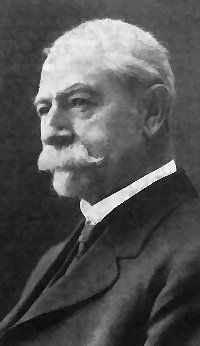
Check this out: the back portion of this Bible contains 800 pages of cross-referenced study materials! Dr. Frank Charles Thompson (after whom this study Bible is named) spent almost 20 years compiling the notes that went into this Bible’s first printing in 1908. Since then, the improvements have only made using this study tool a richer experience. Because of Dr. Thompson’s detailed work, following the “chain” of scriptural references for a biblical character or a biblical theme is literally at your fingertips. There are even “chains” you can follow within each book of the Bible.
If you love studying the Bible as much as I do, this fascinating work is a must-have for your library.
This is a weekly series with things I’m reading and pondering from Charles Spurgeon. You can read the original seed thought here, or type “Thursdays With Spurgeon” in the search box to read more entries.
Listen to the podcast of this post by clicking on the player below, and you can also subscribe on iTunes or Spotify.
Context Is King
And the glory that You gave Me I have given them, that they may be one just as We are One: I in them, and You in Me; that they may be made perfect in one, and that the world may know that You have sent Me, and have loved them as You have loved Me. (Jesus in John 17:22-23)
Some words serve many uses and have many meanings. We are very apt to make mistakes if we give the same sense in all places to the same word. The word world throughout Scripture is used with a very remarkable variety of meaning, and one had need to have his wits about him and to read carefully in order to know what is the precise source of the term in each place where it occurs. …
I say again, the word world, therefore, has many shades of meaning ranging from that jet black meaning in which the world lies in the wicked one—‘Love not the world, neither the things that are in the world’ (1 John 2:15)—upward to the milder sense in John 1:10, ‘He was in the world, and the world was made through Him, and the world did not know Him.’ And yet higher to the bright meaning, ‘The kingdoms of this world have become the kingdoms of our Lord and of His Christ’ (Revelation 11:15). It is not in the worst sense that our text speaks of the world, but in the same manner as we find it used in such passages as these: ‘The Lamb of God who takes away the sin of the world!’ (John 1:29). ‘God was in Christ reconciling the world to Himself, not imputing their trespasses to them’ (2 Corinthians 5:19). And again in 1 John 2:2, ‘And He Himself is the propitiation for our sins, and not for ours only but also for the whole world.’
It is certain that ‘God so loved the world that He gave His only begotten Son, that whoever believes in Him should not perish but have everlasting life’ (John 3:16), and we cannot suppose that the great Redeemer would refuse to pray for those whom He was given. I understand in this particular place by the word world the whole mass of mankind upon the face of the earth who are not as yet converted. …
For the sake of the world, He would have the church in a high state of holy beauty and strength. May His gracious prayer be answered in all of us by the working of the Holy Spirit! … Our wish is to bring multitudes to the Savior and to conquer province after province of this revolted world for King Jesus. ‘Let the whole earth be filled with His glory’ (Psalm 72:19) is a prayer that we cannot, we dare not, we would not fail to pray!
From The Glory, Unity, And Triumph Of The Church
When we are studying our Bibles, we must remember that context is so vital. We have to read each inspired word in its proper context so that we know how to believe, think, live, and pray. I urge you to slow down in your Bible reading—aim for better and richer comprehension than to just try to read a lot in one sitting. Sometimes in my own personal Bible study time, I may spend several minutes just thinking about one phrase, and that may be the only part that I read on that particular morning.
However you read your Bible, make sure you are reading each part in its proper context. Pray before you begin reading and ask the Holy Spirit—Who inspired the Scriptures—to illuminate them to your heart and mind. These thoughtful Bible studies will do more to grow your spiritual maturity than simply rushing through your reading time.
This is a weekly series with things I’m reading and pondering from Charles Spurgeon. You can read the original seed thought here, or type “Thursdays With Spurgeon” in the search box to read more entries.
Listen to the podcast of this post by clicking on the player below, and you can also subscribe on iTunes or Spotify.
The Basis Of Our Hope
If there is no resurrection, apostolic preaching fails. ‘If Christ is not risen, then our preaching is empty’ [1 Corinthians 15:12-22]. … If Christ was not raised, the apostles were false witnesses. When a man bears false witness, he usually has a motive for doing so. What motive had these men? What did they gain by bearing false witness to Christ’s resurrection? It was all loss and no profit to them if He had not risen. They declared in Jerusalem that He had risen from the dead, and straightway men began to haul them to prison and to put them to death! Those of them who survived bore the same testimony. They were so full of the conviction of it that they went into distant countries to tell the story of Jesus and His resurrection from the dead. … They were brought before Roman emperors again and again, and before the proconsuls, and threatened with the most painful of deaths, but not one of them ever withdrew his testimony concerning Christ’s resurrection! …
If Christ is not raised, your faith is in vain. If it is in vain, give it up! Do not hold on to a thing that is not true! I would sooner plunge into the water and swim or wade through the river than I would trust myself to a rotten bridge that would break down in the middle. If Christ did not rise, do not trust Him, for such faith is in vain! But if you believe that He did die for you and did rise again for you, then believe in Him, joyfully confident that such a fact as this affords a solid basis for your belief! …
If [Jesus] died for you and rose again for you, that is the groundwork of your confidence, and I pray you keep to it. … Go your way and sing, ‘The Lord is risen indeed,’ and be happy as all the birds in the air, till you are, by and by, as happy as the angels in heaven through Jesus Christ our Lord. Amen.
From If There Is No Resurrection
I shared a series of messages that said, “I know Jesus is A.L.I.V.E. because of…” and each of the letters of ALIVE reminded us of a convincing proof of His resurrection. I would especially direct your attention to two of those letters.
The “L” stands for lives changed. When someone has a complete about-face life change because of their interaction with Jesus, that is pretty strong proof that their encounter was with a living Savior.
And the “E” stands for the engagement of Christ’s followers. It’s astounding to see how much of our world’s history has been positively impacted because of the influence of Christians. Their lives had become so radically different because of the life of Jesus in them that they could not help but change the culture around them.
As I said last in the last Thursdays with Spurgeon installment, always remember that the one with a personal experience is never at the mercy of the one with an argument. If your life has been changed by personal and ongoing interactions with Jesus Christ, don’t keep that good news to yourself. Let that assurance you have be a bright and winsome witness to all who are around you.
This is a weekly series with things I’m reading and pondering from Charles Spurgeon. You can read the original seed thought here, or type “Thursdays With Spurgeon” in the search box to read more entries.
Listen to the podcast of this post by clicking on the player below, and you can also subscribe on iTunes or Spotify.
Stop Arguing
Our religion is not based upon opinions, but upon facts. We hear persons sometimes saying, ‘Those are your views, and these are ours.’ Whatever your views may be is a small matter; what are the facts of the case? We must, after all, if we want a firm foundation, come down to matters of fact. …
Beloved friends, let us never tamper with the truth of God. I find it is as much as I can do to enjoy the comfort of the truth and to learn the spiritual lessons of God’s Word without setting up to be a critic upon it. And I find it immeasurably more profitable to my own soul to believingly adore than unbelievingly to invent objections, or even industriously to try to meet them. The meeting of objections is an endless work. When you have killed one regiment of them, there is another regiment coming on, and when you have put to the sword whole legions of doubts, doubters still swarm upon you like the frogs of Egypt! It is a poor business. It answers no practical end. It is far better to firmly believe what you profess to believe and to follow out to all the blessed consequences all of the truths of God that, in your own heart and soul, you have received of the Lord.
From If There Is No Resurrection
I have presented evidence numerous times that makes it reasonable to believe that the Bible is God’s inspired Word (check out my posts here, here, here, and here). And yet there are still people who stubbornly want to argue that the Bible is made-up stories, or that there was no such person as Jesus, or that if there were a Jesus, He was just a good man but not God Himself who was raised from the dead. These arguments are nothing new. Paul had to address them just a few years after Jesus had ascended back to heaven, so what would make us think that we would escape those doubters?
As Spurgeon says, there is so much more joy when we simply “believingly adore” the God who is revealed to us on the pages of Scripture than it is to address such flimsy arguments. So that is what I typically do. Trying to debate with someone who won’t even accept basic facts is typically an unprofitable use of my efforts because they usually aren’t open to listening to what I have to say.
Instead, I simply remember this: The one with a personal experience of a life-changing encounter with a risen Savior is never at the mercy of the critic with only a handful of arguments! So you can simply say to that argumentative critic, “I know how different my life is because Jesus is in me and I am in Him.”
Stop arguing with close-minded critics and start adoring the God who loves you!
Listen to the podcast of this post by clicking on the player below, and you can also subscribe on Apple or Spotify.
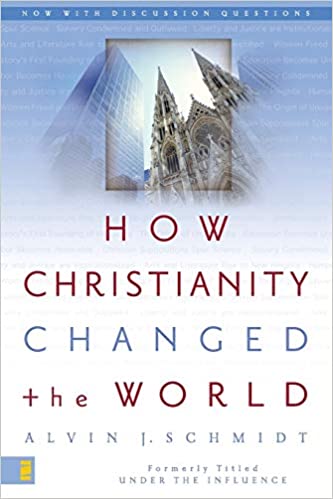
Alvin Schmidt claims, “No other religion, philosophy, teaching, nation, movement—whatever—has so changed the world for the better as Christianity has done.” And I quite believe him. He lays out the evidence to back up this bold claim in his book How Christianity Changed The World.
A few years ago I presented a series of messages to make the case for the resurrection of Jesus. One of the pieces of evidence I presented was the cultural engagement of Christians whose lives had been transformed by a personal relationship with the resurrected Jesus Christ. Alvin Schmidt’s book is like taking this single point of mine and putting it on steroids!
Using the reports of first-person observers from the first century all the way through present day, Mr. Schmidt shows how there is not a single part of the culture that hasn’t benefitted from the involvement of those who live out the Christian principles they have discovered in the Bible. From the care of the sick and elderly, to the elevation of women and marriage, to art, and architecture, and music, and medicine, and science, and education—every sphere of life has been improved by practicing Christians.
I would highly recommend reading this book and then keeping it close at hand to share with those ignorant or skeptical of the claims of Christianity. As William Barclay noted, “Anyone who asks the question, ‘What has Christianity done for the world?’ has delivered himself into a Christian debater’s hands. There is nothing in history so unanswerably demonstrable as the transforming power of Christianity and of Christ on the individual life and on the life of society.” To that, I add a hearty Amen!
Please get a copy of How Christianity Changed The World for your library.
Listen to the podcast of this post by clicking on the player below, and you can also subscribe on Apple or Spotify.
You know how they say, “Never judge a book by its cover?” Well, I did that with Reading The Bible With The Founding Fathers, and I judged incorrectly. My son gave me this book as a gift and I thought I would be reading passages of Scripture that our founding fathers had highlighted in their Bibles. Although that wasn’t the case at all, I was delighted to be wrong. What Daniel Dreisbach has given us in this book is a masterpiece of American history that I so thoroughly enjoyed devouring.
This book is about the Bible’s influence on not only the founders’ thought process as they contemplated independence from Great Britain, but also as they formed our own republican form of government. It’s also about the common lexicon that the colonists had with each other because the Bible was the most well-read book in the American colonies. This allowed our founding fathers to speak in figurative language that rang true to the hearts of their fellow Americans.
Mr. Dreisbach often takes us back to Europe and the Protestant Reformation era to help us understand how biblical thinking had coalesced and gained strength in the minds of the mid-eighteenth century Americans. Things like did the Bible sanction rebellion against the king of England, or could principles for a sound government structure be found in the pages of Scripture?
Reading The Bible With The Founding Fathers is a fascinating and eye-opening read. Not only to help us understand the foundational thoughts of our great country but also to see the role that biblical literacy still plays in our governmental operations today. This book is extensively footnoted, so the curious reader can dig even deeper than Mr. Dreisbach has already taken these topics.
For Christians who want a better understanding of the Bible’s place in the republican form of government in these United States of America, I would recommend reading this book alongside your Bible so you may ponder for yourself how much of our civic framework is supported by a proper understanding of Scripture.
I grew up reading the King James Version of the Bible. So naturally, this was the version I also memorized. Even to this day (all these many, many[!] years later), many of the verses I memorized still come back to my mind in that Olde English slant.
A few years ago we celebrated the 400th anniversary of the King James authorized translation of the Bible into English. It’s astounding to realize how many words, phrases, and concepts from this version have become mainstays in the English language. From Shakespeare’s plays right down to current writings, this “Book of books” infiltrates our thoughts and our vocabulary.
Here is an outstanding poem Glen Scrivener put together to honor the 400th anniversary of the KJV, where he attempts to share 100 phrases from this translation in 3 minutes. Enjoy!
…with Your mouth You have promised and with Your hand You have fulfilled it… (2 Chronicles 6:15).
I rest solely on what God says—He says it and He fulfills it.
I can live on “every Word” He speaks (Deuteronomy 8:3).
“Every Word” of God is flawless and is a protection for me (Proverbs 30:5).
None of God’s Word ever fail (Isaiah 55:11).
God gives us His Word to speak (Jeremiah 26:12; John 12:49; Luke 21:15).
We defeat our enemies by God’s Word in our mouth (Matthew 4:4, 7, 10; Revelation 12:11).
Every Word of God gives life because of the Holy Spirit’s anointing on it (John 6:63).
Every Word of God is a sword (Hebrews 4:12; Revelation 1:16; 2:12, 16; 19:15). Or as my friend Sasha reminds me God’s Word is our S(word)!
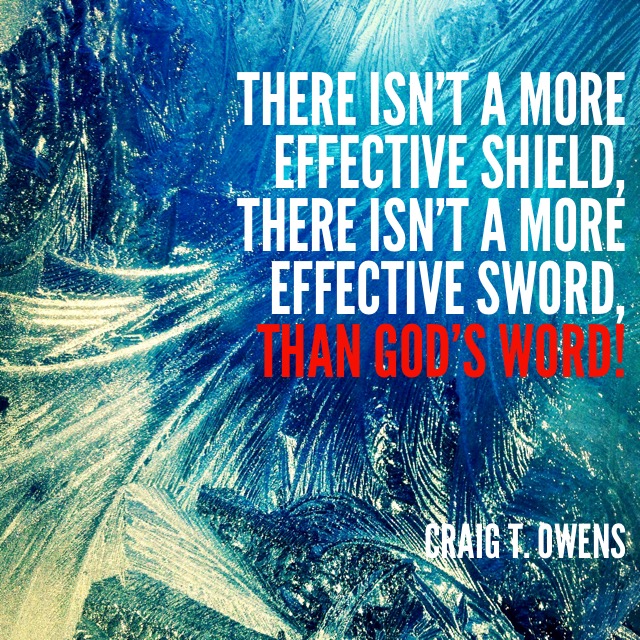
There isn’t a more effective shield against enemies, there isn’t a more deadly weapon against temptation, there isn’t a more sure foundation in storms than the Word spoken and fulfilled by God!



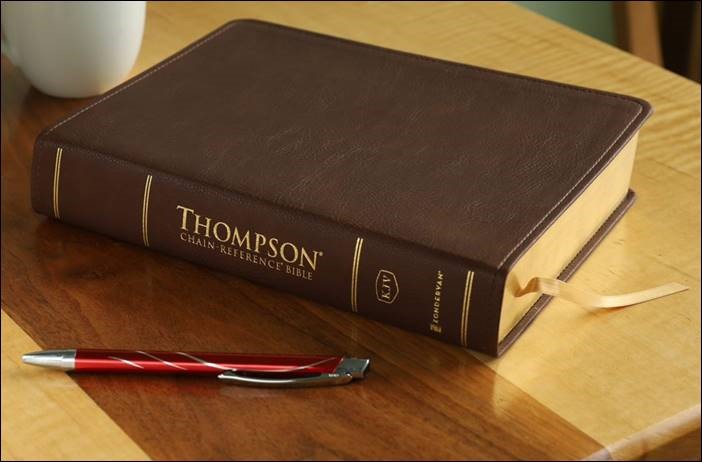 Full disclosure: I’m a bonafide Bible study geek! I’m always on the hunt for any study tool I can get my hands on that will help me dive deeper into God’s Word. Quite possibly the gold standard for biblical study aids is The Thompson Chain-Reference Bible.





 Craig T. Owens