Supernatural Logic

Listen to the podcast of this post by clicking on the player below, and you can also subscribe on AppleSpotify, or Audible. 

One of my favorite classes that I took in college was a philosophy class where we studied the rules of logic. I found it so intriguing to learn how to construct or deconstruct an argument by looking at the premises and its conclusion.

One of the keywords that we would look at is “therefore.” This helped us understand what the conclusion of an argument was. If the argument was made well, what came after the “therefore” was a natural progression from the premises. With that in mind, I always keep an eye out for the “therefores” when I am reading my Bible. 

Except I have noticed that God frequently uses “therefore” in unexpected ways.

The classic rules of logic lay out connecting and supporting premises that flow to a natural “therefore” conclusion. But God’s conclusions typically defy natural, conventional logic. His conclusions are frequently supernatural! 

Notice a couple of examples from Isaiah. God’s people are suffering the natural consequences for their open rebellion against God. In my mind, the natural “therefore” would be: “You are getting what you deserve.” However, God’s supernatural “therefore” is: “I have taken this cup of My wrath from you” (Isaiah 51:21–22). 

In another example, the way God’s people were behaving and the way the enemies of God’s people were treating them, the natural “therefore” that I would expect is: “No one revered God’s name any longer.” But God’s supernatural “therefore” declares: “All people will know My name. All people will know I have fulfilled what I foretold, and all will revere Me” (Isaiah 52:6). 

Ultimately, these supernatural conclusions were proven true by Jesus. Our Savior drank our cup of wrath on our behalf and gave us His cup of righteousness in its place. The natural conclusion of Christ’s work for us is also God’s supernatural conclusion: God exalted Jesus to the highest place of honor and reverence (Philippians 2:5–11). 

My natural logic fails. God’s supernatural logic succeeds. Always! 

His supernatural conclusions should always lead to my revering and glorifying Him even more. Let me encourage you in your Bible study time to pay close attention to God’s “therefores” and rejoice in His Christ-exalting supernatural work. 

►► Would you please prayerfully consider supporting this ministry? My Patreon supporters get behind-the-scenes access to exclusive materials. ◀︎◀︎
The Power Of Both-And Thinking

Friends, this is something that helped me with the apparent controversies not only in the Bible but in conversations with those who have differing opinions from me. I hope this helps you too!

You can help me help others by becoming one of my Patreon supporters. As my thanks for that support, you will receive exclusive content that only my supporters get access to. Please check out my Patreon page and support this ministry at just $5/month.

Name-It-Claim-It?

Listen to the podcast of this post by clicking on the player below, and you can also subscribe on AppleSpotify, or Audible.

This is part 4 in our series “Is that in the Bible?” 

Statement #4—Name it and claim it. Is that in the Bible? No! 

But in fairness, even the proponents of this belief don’t usually say it this way. Instead they quote words from Jesus like: “I will do whatever you ask in My name” (John 14:13) or “Ask whatever you wish, and it will be given you” (John 15:7). 

They really want this to be true, I think, because in their minds happy, prosperous Christians make God look good. On the other hand, struggling Christians make God look bad. There is a whole branch of theology called theodicy which literally means: “a defense of God’s goodness and omnipotence in view of the existence of evil.” 

This is nothing new. Religious people have always tried to have pat answers. In the oldest book of the Bible, Job’s friends were convinced that suffering results from sin and blessing results from righteousness. And yet according to God, Job was a righteous man (Job 1:1, 8, 20-21). 

At the advent of Jesus, the chief priests and scribes want the Messiah to be heroic so they modified a prophecy to make Bethlehem sound more impressive (compare Micah 5:2 with Matthew 2:6). 

So it follows that this name-it-claim-it group wants God to look good because His people look good, dress well, drive nice cars, live in big homes, fly private jets, and never get sick.

But Jesus Himself told His followers to, “Sell your possessions and give to the poor” (Luke 12:33). And He said, “Blessed are you when people insult you, persecute you and falsely say all kinds of evil against you because of Me” (Matthew 5:11). And Jesus also said, “In this world you will have trouble” (John 16:33). 

This is not to say that God opposes wealth: He gave wealth to His leaders, Job was doubly-wealthy after his trial, and wealthy people funded the ministry of Jesus and the early church. But this isn’t the same as pursuing—or even demanding—wealth, or of making the erroneous connection that poor people are somehow out of favor with God. 

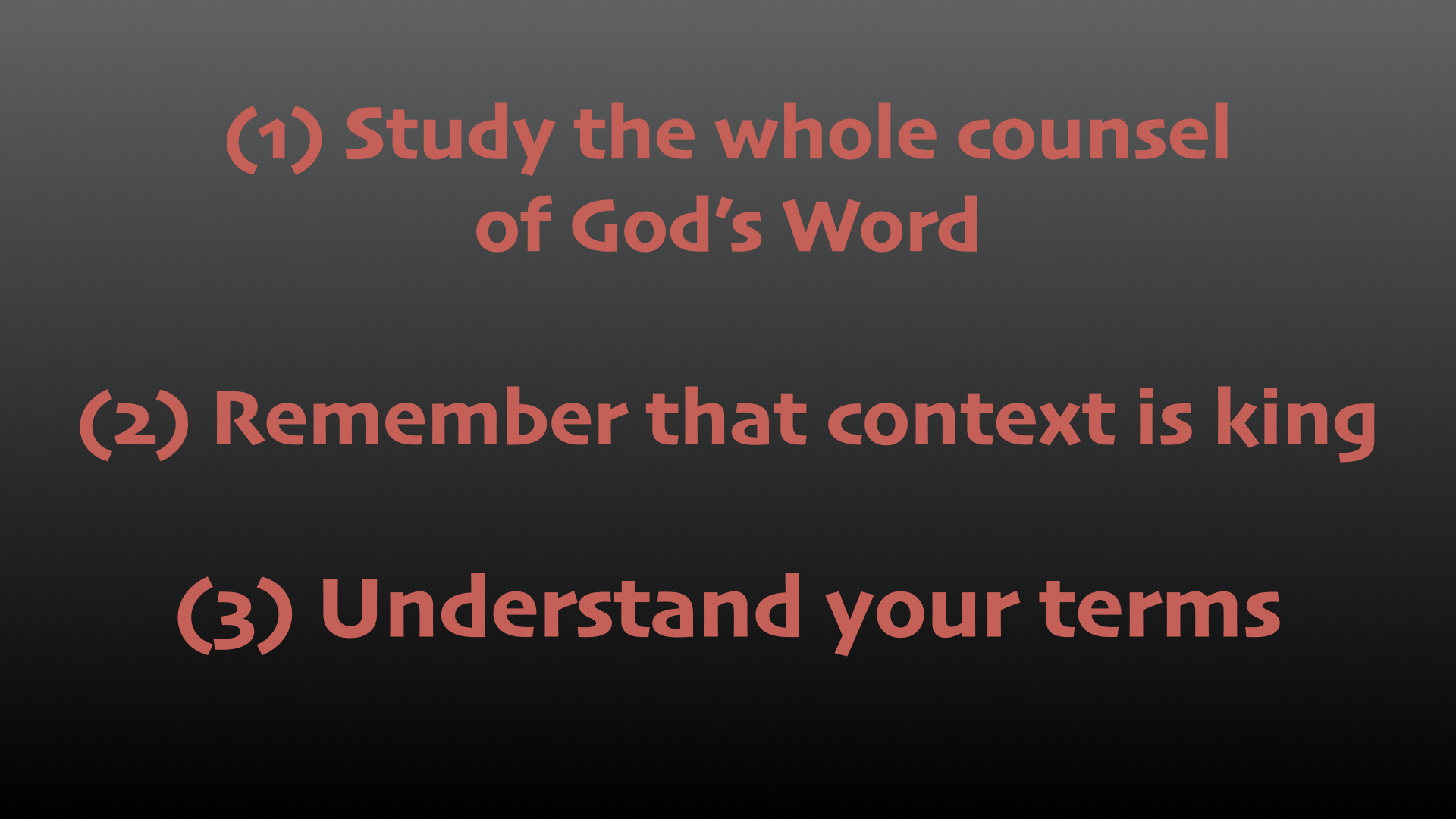
How do we avoid these errors? Here are three thoughts: 

(1) Study the whole counsel of God’s Word.  

Don’t just read your favorite passages, or the ones that make you feel good, but read all of the Bible. Jesus frequently had to correct the religious leaders’ beliefs by sending them back to the Scripture (Matthew 21:15-16; Mark 12:18-27; Luke 6:3). Jesus called the Holy Spirit the Spirit of truth (John 16:12-15). The Holy Spirit that inspired the Bible is the same Holy Spirit in a Christian that can illuminate the Bible as you read it.  

(2) Remember that context is king.  

The word “eisegesis” means to read something into the Word. But that is like creating your own beliefs and then going to the Bible to find phrases that support what you already believe. On the other hand “exegesis” is to read the Bible and have it speak to us by the Holy Spirit. 

Two of the phrases from Jesus that the name-it-and-claim-it folks use (John 14:13 and John 15:7) turn out to mean something entirely different than, “God will give me all of the things I demand from Him” when they are read within the context of the things Jesus was teaching at that time (see John 14:9-14 and 15:1-8). 

(3) Understand your terms.

If something is biblical, that is something the Bible says yes to. Unbiblical things the Bible says no to. But non-biblical are those the Bible doesn’t explicitly address. We have to be very careful of trying to make non-biblical things sound biblical or it may lead to some unbiblical attitudes and actions. 

This is exactly what the Pharisees did by giving their non-biblical traditions the weight of biblical statements, and then looking down on others in a very unbiblical way. 

God is sovereign. We do not tell Him what to do. We do not demand Him to respond to our needs. We trust Him and and we abide in Him. Then in the abiding, asking and understanding and fruitfulness are as natural as a flower sprouting from a branch that is attached to the vine. We don’t name things and claim things for our personal comfort, but we desire solely for God’s glory to be seen—whether in wealth or poverty, health or sickness, peaceful times or tribulation. 

Evaluating all biblical sounding statements by those three items—studying the whole counsel of God’s Word, understanding the context, and knowing our terms—will guide us from going astray. 

If you’ve missed any of the messages in our series Is That In The Bible?, you can get a list of all of the messages by clicking here.

►► Would you please prayerfully consider supporting this ministry? My Patreon supporters get behind-the-scenes access to exclusive materials. ◀︎◀︎
Is That In The Bible?

Listen to the podcast of this post by clicking on the player below, and you can also subscribe on AppleSpotify, or Audible.

A meme that makes me chuckle every time I see it is a “quote” attributed to Abraham Lincoln in which he says, “The problem with quotes found on the internet is that they are often not true.” 

(Not to spoil the joke for you, but unless Lincoln knew how to time travel to the future, I don’t think he knew about the modern internet! 😂) 

I love this meme because it captures something that so many people fall into: a quick acceptance of a statement without verifying its source or thinking through the implications of the statement’s truthfulness. 

Some insightful comments sound Shakespearean, but William never wrote them. 

Some pieces of wisdom sound Socratic, but Socrates never taught them. 

Some religious maxims sound godly, but the Bible never recorded them. 

I would like to invite you to join me as we relaunch this series called Is That In The Bible? I think you may be surprised to discover just how many phrases we call biblical aren’t, and how many phrases there are that we never realized are actually in the Bible. 

By the way, if you have a phrase that you would like to have us explore in this series, please leave it in a comment below. If you would like to check out the questions we addressed previously, please click here

In this installment of this series we asked: Is this in the Bible…

Links & Quotes

“While grief is expressed in words, its resolution is in God and the hope He gives for the future. In a way, the lamentation process is one of coming to grips with all that God wants us to see about our present circumstances.” —Dr. Henry Halley

Welsh dinosaur tracks found in flood rocks: “The evidence continues to stack up in support of the global Flood. The rocks don’t lie!”

In this video, J. Warner Wallace addresses how we can reconcile variations between biblical manuscripts.

My friend Greg Heeres and I have a brand new episode in our leadership podcast called The Craig And Greg Show. This discussion is all about setting good priorities.

Links & Quotes

I love Charle Spurgeon’s definition of godliness: “God Himself is the power of godliness. The Holy Spirit is the life and force of it. Godliness is the power that brings a man to God and bind him to Him. Godliness is that which creates repentance toward God and faith in Him. Godliness is the result of a great change of heart and reference to God and His character. Godliness looks toward God and mourns its distance from Him. Godliness hastens to draw near and rests not till it is at home with God. 

“Godliness makes a man like God. Godliness leads a man to love God and to serve God. It brings the fear of God before his eyes and the love of God into his heart. Godliness leads to consecration, to sanctification, to concentration. The godly man seeks first the kingdom of God and His righteousness and expects other things to be added to him. Godliness makes a man commune with God and gives him a partnership with God in His glorious designs. And so it prepares him to dwell with God forever.”

Viz.Bible has a great way of portraying the data of the Bible in very picturesque ways. Check out this link to see an overview of the Bible like I have bever seen before!

The folks at Axis Ministry provide some amazing insights for parents (and youth pastors) of pre-teens through the early college years. I would highly recommend subscribing to their free weekly email. Here is their Parent’s Guide To Teen Emotions, which is a free PDF for you to download.

Links & Quotes

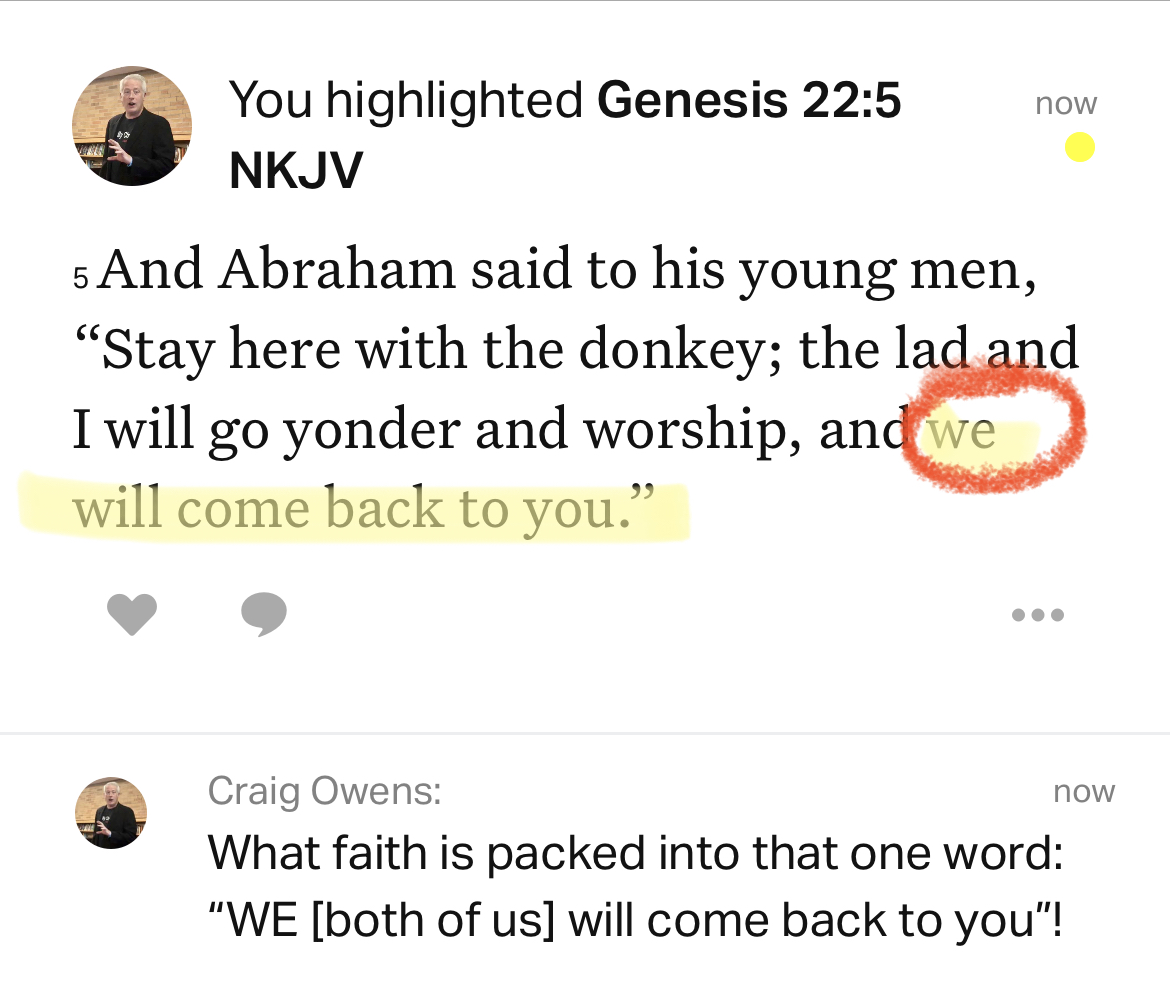
Abraham is commanded by God to sacrifice his son Isaac. Look at Abraham’s faith in just one word: “WE will come back to you.”

Follow me on YouVersion so we can share more thoughts on God’s Word with each other.

Wil Robinson shares a fable from Leo Tolstoy with the three most important questions everyone should ask themselves. The three questions are: How can I learn to do the right thing at the right time? Who are the people I most need, and to whom should I, therefore, pay more attention than to the rest? And, what affairs are the most important and need my first attention?

T.M. Moore reminds us how the promises of God can build courage in us. Check out all of the posts in his series called Brave Heart.

“Faithfulness is displayed in both word and deed—seen best by combining the Great Commission’s instruction to ‘make disciples’ with the second greatest commandment to ‘love thy neighbor.’ The beauty of the Gospel is found in both proclamation and demonstration. Neither comes first; neither comes second. Like the perfect marriage, it’s the duty of the Christians to take on each, giving 100 percent effort to both.” —Gabe Lyons, The Next Christians 

Fight The New Drug shared the results of a study of over 11,000 releationships, the five things the happiest couples have in common, and how pornography can undermine those relationships.

“Oh, that the eyes of sinners may be speedily opened—that they may see the difference of things, the beauty which is in holiness, and the astonishing madness that is in sin!” —Thomas Watson

Science is an important component in seeking truth. The Institute for Creation Research has an excellent perspective on the role of science for a Christian: “While the pursuit of science is certainly noble, it should be situated in its proper context and tackle matters within its empirically defined framework.”

John Piper observes, “The number-one reason why people in such seemingly hopeless situations purchase scratch-offs is because things already look so hopeless for improvement that the so-called ‘stupidity’ of wasting this dollar won’t really make anything worse.” This post elaborates on how the lottery preys on the poor.

No Contradictions

Listen to the podcast of this post by clicking on the player below, and you can also subscribe on AppleSpotify, or Audible. 

…I will hide My face from this city because of all its wickedness. Nevertheless, I will bring health and healing to it… (Jeremiah 33:5-6) 

God’s anger at Judah’s sin is blazing hot! And rightly so: Dr. Henry Halley points out, “Most of the 20 Davidic kings who reigned over Judah during the 400 years between David and the Babylonian exile were very bad. Only a few were worthy of the name of David.” So it is understandable that God would need to punish that sinful nation. 

Then comes that word “nevertheless.” In spite of the rampant sin, God’s promise of restoration is even greater than the pain of His punishment. 

God promises healing, restoration, complete cleansing from sin, and more descendants of David and Levi than can be counted. And He promises this to the exact same people that He promised to punish. 

I don’t know about you, but to me this almost seems like a contradiction. Does God want to punish them or does He want to bless them? 

The apparent contradiction is hard for our finite brains to comprehend. That’s why God makes an important statement to Jeremiah before He begins describing the punishment and the blessings: “Call to Me and I will answer you and tell you great and unsearchable things you do not know” (v. 3). 

Aha! When we call on God to help us with unsearchable things, we find there are no contradictions in God nor in the Bible itself. 

If you feel stumped on a text of Scripture, I have previously shared how I handle the tough texts, but step number one is always calling on God to help. 

C.S. Lewis wrote, “Heaven will solve our problems, but not, I think, by showing us subtle reconciliations between all our apparently contradictory notions. The notions will all be knocked from under our feet. We shall see that there never was any problem”—or any contradiction at all. 

►► Would you please prayerfully consider supporting this ministry? ◀︎◀︎

Bible Translations

There are so many quality translations of the Bible to help us read God’s Word profitably, but many people ask me about the origin of each of these translations. I have shared three views of biblical translations below—two serious and one comical way of looking at them.

They only caution I would point out is a translation or paraphrase that is from a single person’s point of view. The Bible itself talks about success that comes from the combined wisdom of counselors, so a single-person paraphrase does open itself up more to the author’s whims than to true scholarship.

I shared a series of posts about my favorite book, and I have also shared some Bible studies that you may want to try with your favorite translation, or perhaps a new one that you are exploring.

Links & Quotes

One of the last pictures I took with my Mom ♥

“Love of the Word appears preeminently in our Lord and Savior Jesus Christ. He read it publicly. He quoted it continually. He expounded it frequently. He advised the Jews to search it. He used it as His weapon to resist the devil. He repeatedly said, ‘The Scripture must be fulfilled.’ Almost the last thing He did was to ‘open their minds so they could understand the Scriptures’ (Luke 24:45). I am afraid that man cannot be a true servant of Christ, who has not something of his Master’s mind and feeling towards the Bible.” —J.C. Ryle, Bible Reading 

“The character of our praying will determine the character of our preaching. Light praying will make light preaching. …The preacher must be preeminently a man of prayer. His heart must graduate in the school of prayer. In the school of prayer only can the heart learn to preach.” —E.M. Bounds, Power Through Prayer 

I have blogged several thoughts about the historicity of the Bible. Here’s a post on Breakpoint about yet another archeological discovery that once again vindicates the Bible’s trustworthiness.

“Some pastors and preachers are lazy and no good. They do not pray; they do not read; they do not search the Scripture. … The call is: watch, study, attend to reading. In truth you cannot read too much in Scripture; and what you read you cannot read too carefully, and what you read carefully you cannot understand too well, and what you understand well you cannot teach too well, and what you teach well you cannot live too well. … The devil … the world … and our flesh are raging and raving against us. Therefore, dear sirs and brothers, pastors and preachers, pray, read, study, be diligent.” —Martin Luther

Looking at God’s awesomeness brings a peace that nothing else can.

A very thought-provoking Q&A with Sean McDowell and Dr. Stephen Meyer: Does Science Point to God?