
Winning The Argument Or The Battle

When I entered college, I did so as a science major: pre-med biomedical chemistry, to be exact. I still really enjoy all of the medical sciences: biology, microbiology, organic chemistry, inorganic chemistry, and the like.

As you might be aware many of the scientists today have a bent toward the theory of evolution. That means that a few of my professors and several of the authors I was reading taught and wrote from that paradigm.

This set up the environment for me to want to debate for my Creationist beliefs.

I had one professor who would specifically challenge me during lectures to refute what he had just said about evolution. An author who wrote a lengthy book about evolution carried on a year-long correspondence with me where we each brought out our best arguments. In all instances—although we believed passionately in our positions and could adequately defend them—the discussions never became shouting matches.

The Bible taught me how to do this.

(This week I’m discussing my favorite book—the Bible—from a couple of different aspects. You can read some of those thoughts here, here and here.)

At times I was tempted to “cross the line” to win the argument. And I may have won the argument, but I would have put myself in a position to lose the overall battle. There are two key passages of Scripture that I keep in mind to help me with this.

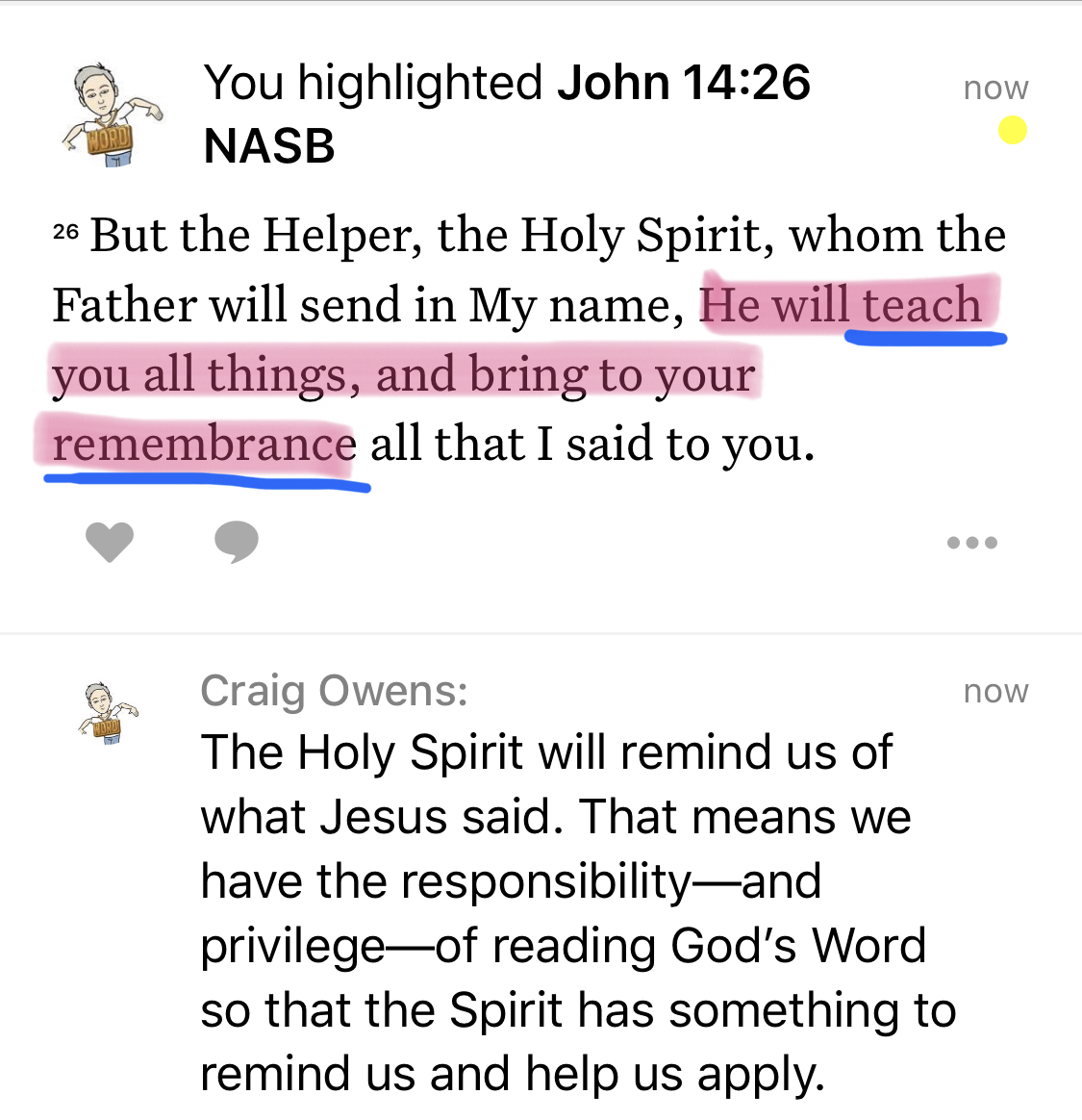
(1) In telling His followers about the Holy Spirit (John 14-16), Jesus said, “But when He, the Spirit of truth, comes, He will guide you into all truth” (John 16:13). And also, “But the Counselor, the Holy Spirit, whom the Father will send in My name, will teach you all things and will remind you of everything I have said to you” (John 14:26).

The Holy Spirit helps me apply biblical truths and principles to my everyday life. He guides me and reminds me of what I have studied.

(2) The second key passage is, “But in your hearts set apart Christ as Lord. Always be prepared to give an answer to everyone who asks you to give the reason for the hope that you have. But do this with gentleness and respect, keeping a clear conscience, so that those who speak maliciously against your good behavior in Christ may be ashamed of their slander” (1 Peter 3:15-16).

Yes, it is important for me to be prepared to give an answer, but this is the middle thought. First, I have to make sure what I’m saying is exalting Christ as Lord. Then I do my best to study and prepare to give an answer, but I must give that answer gently and respectfully.

Allowing the Holy Spirit to help you prepare from the Bible, and allowing Him to guide you into answering questions/critics gently and respectfully honors Christ. And that always wins the battle.
The Thinking Book

“The book to read is not the one which thinks for you, but the one which makes you think. No book in the world equals the Bible for that.” —James McCosh

My kids recently returned from a PK (Pastor’s Kids) Retreat weekend. Our Michigan Assembly of God District Youth Director Jeff Kennedy coordinates this weekend every year. A fun part of their time together is a take-off of Jeff Foxworthy’s “You might be a redneck if…” routine. It’s called “You might be a PK if….” Here are a couple of my favorites—

  • You might be a PK if you’ve used the church sound system as your personal stereo.
  • You might be a PK if National Take Your Kid To Work Day is any day you don’t have school.
  • You might be a PK if you’ve ever taken a bath in the baptismal tank.
  • You might be a PK if you occasionally take Sunday afternoon naps on a church pew.
  • You might be a PK if every answer your Dad gives you comes from the Bible.

Cute! And, for the most part, dead-on accurate!

But that last one got me thinking: do I do this? I sincerely hope (not just because I’m a pastor) that the answer is always “yes.”

I agree with James McCosh that no other book in the world compares to the Bible for challenging me to think. In the King James Version of the Bible, there is a phrase that James uses about God’s Word: he says that we should “receive with meekness the engrafted Word” (James 1:21).

The more I read the Bible, the more its principles become engrafted into my thought patterns. The more I think about the Bible, the more my attitude about life conforms to God’s attitude. And the more my attitude conforms to God, the more my actions and words align with the Bible.

You don’t have to read much every day for God’s Word to make a difference in your life. If you are honest with the Holy Spirit as He illuminates a passage of Scripture to you, you will see how God’s Word can be applied to your life today.

“The Bible is…a chart by which the Christian sails to eternity, the map by which he daily walks; the sundial by which he sets his life; the balance in which he weighs his actions.” —Thomas Watson

To be successful make sure you are looking often at the chart, the map, the sundial, and the balance of God’s Word.

A Powerful Prayer

“Bible study is love reading its Lover’s letters. Prayer is love keeping tryst.” —S.D. Gordon

The Bible is God’s love letter to humanity; more specifically, to you and me. But did you know that the Bible can also be used as our love letter to God?

If you’re a parent, you know how powerful it is when one of your children quote you back to you. Like when my daughter reminds me, “Dad, you said that you would….” Even if I haven’t forgotten what I said, it’s still so nice to know that she was listening to me and remembered what I promised her.

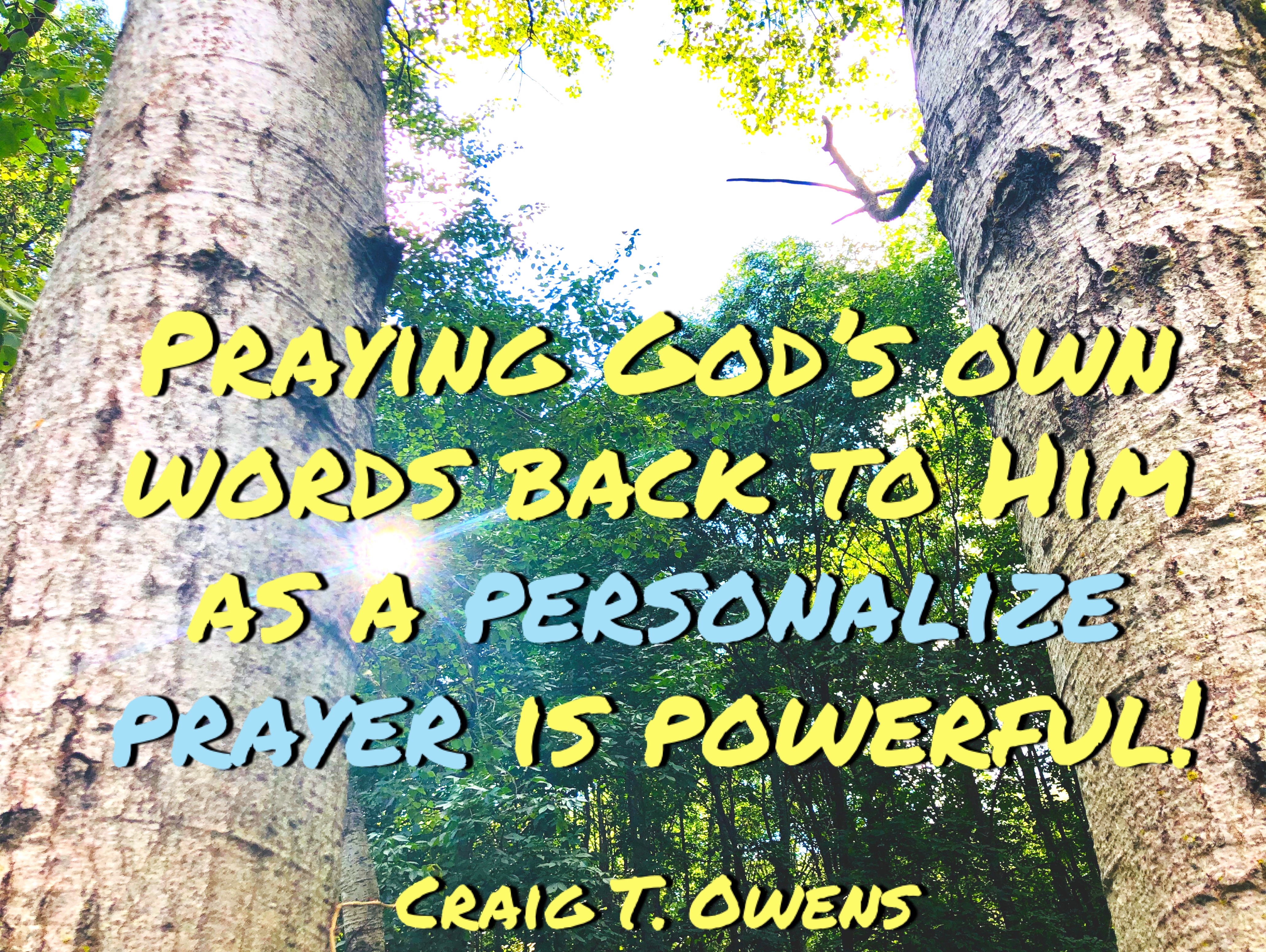
God has never, ever forgotten His word to us. But as our Heavenly Father, He loves to know that we hear His words, that we remember His promises, and that we love Him. So one of the most powerful prayers you can pray is when you pray God’s own words back to Him.

Personalized prayer based on God’s Word is a powerful prayer.

Let me give you an example. Here’s a prayer I wrote out the other day from 1 Chronicles 22:19—

Now…

There is no time to wait, I have to begin now. I cannot put it off a moment longer. It’s never an interruption of my day for me to draw closer to You, my God. Now I come to You in love.

devote…

This is not a partial commitment. I’m giving You my all. I’m laying all of me on Your altar. I’m not holding anything back. It’s all Yours, God, all of me.

your…

This is mine to give, and I’m choosing to give it to You. I’m not living for someone else; I’m not riding anyone’s coattails. I’m giving You what is mine to give. I’m giving you me.

heart…

My dreams, my passions, my desires. They’re all Yours, Heavenly Father. I reserve no passions for my own selfish pursuits, but I only have passion for You.

soul…

My inmost being—who I really am—the part of me that’s truly me is all Yours. My mind, my will, my emotions, my personality is only alive because of You.

seeking…

My longing, my soul’s craving is for You. I look for You’re everywhere and in everything. I seek You in the bird’s song, in the ocean’s roar, in the mountain’s majesty, in the midnight’s silence, in the bee’s buzz, in my children’s laughter, in my wife’s kiss, in my friend’s counsel, in Your love letter to me.

the Lord…

You are Lord over all. There is not now, nor ever will there be, anyone to take Your place in my heart.

your God…

You are mine and I am Yours. Forever. Because You loved me I love You, my God.

Now devote your heart and soul to seeking the Lord your God (1 Chronicles 22:19).

Use your Bible to form your own powerfully intimate prayers to the Lover of your soul.

My Favorite Book

Listen to the podcast of this post by clicking on the player below, and you can also subscribe on Apple or Spotify.

“The Bible is alive, it speaks to me; it has feet, it runs after me; it has hands, it lays hold on me.” —Martin Luther

I love to read. So I read a whole lot of books every year. It’s not unusual for me to be working my way through four or five books at a time. I read the classics, poetry, history, biographies, autobiographies, devotionals, leadership training, personal development, marriage and parenting skills, and many other genres. I don’t have enough shelf space for all of the books I have!

But when people ask me my all-time favorite book, I don’t even have to hesitate. The book that is in a category all by itself is my Bible.

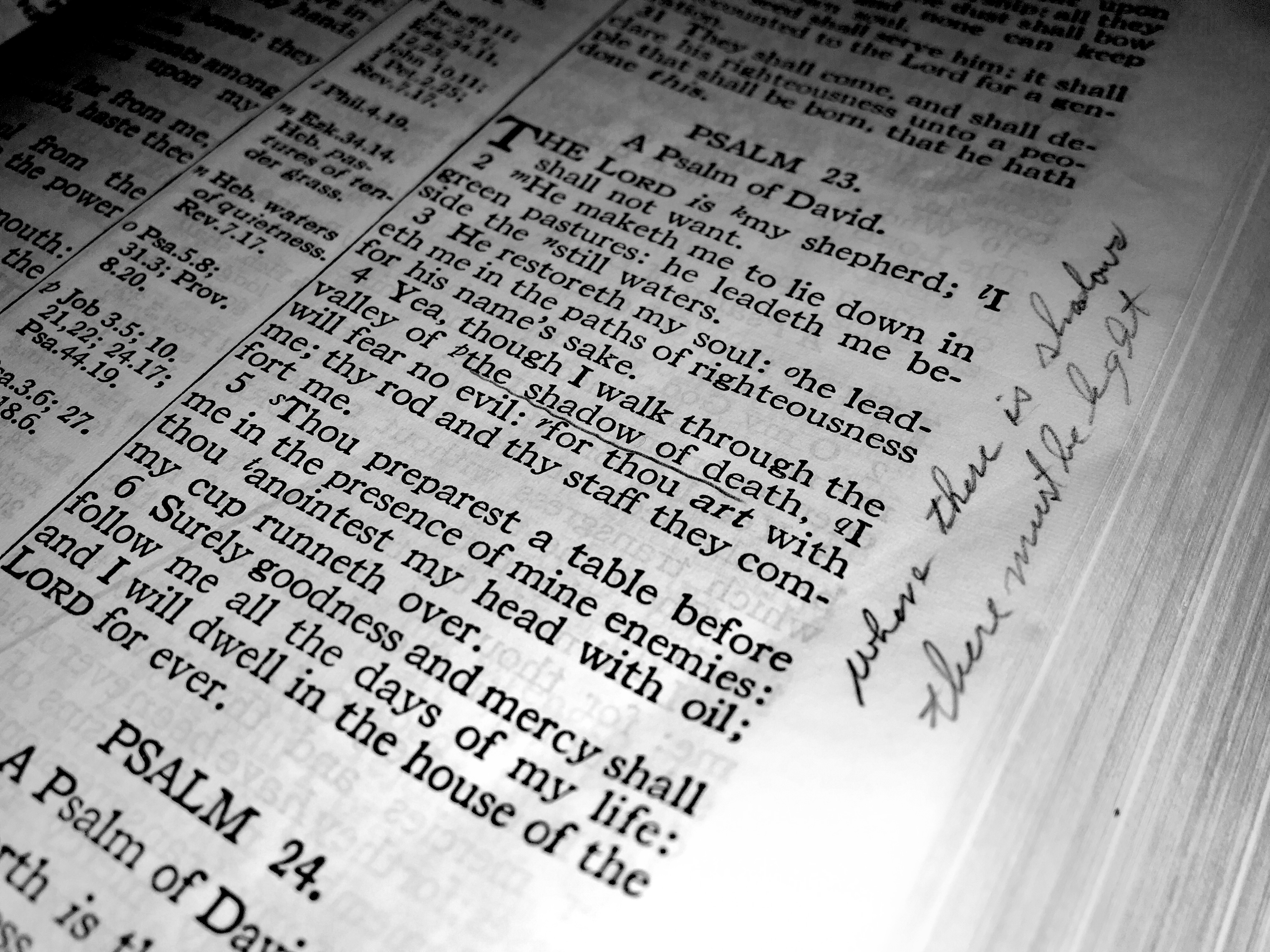
I say my Bible because I have made it my own. I highlight, I underline, I star, I jot notes in the margin, I circle keywords. Sometimes I even mark all the question marks in a passage!

My study Bible is one I’ve had for over 20 years. Each time I read through my Bible I use a different color or style of highlighter. So as I look at different highlighted passages I can remember back to where I was in my life, what I was going through, the struggles I was having. Sometimes I smile when I remember what the Holy Spirit revealed to me in my Bible at that time, and how I’ve grown. Sometimes I remember the deep emotion as I see where a teardrop caused the highlighter to run, and recall the comfort my Bible brought to me.

Psalm 119 (the longest chapter in the Bible) is a poem of love to God for His Word. In 176 verses the psalmist refers to God’s Word in 172 verses. Here are just a few—

  • I have hidden Your word in my heart that I might not sin against You (v. 11)
  • I rejoice in following Your statutes as one rejoices in great riches (v. 14)
  • Open my eyes that I may see wonderful things in Your law (v. 18)
  • Your statutes are my delight; they are my counselors (v. 24)
  • I run in the path of Your commands, for You have set my heart free (v. 32)

If you haven’t made Bible reading a part of your daily schedule, Psalm 119 is a good place to start. Scientists tell us that you only have to do something for 21 days in a row for it to become a habit. Psalm 119 is divided into 22 sections. And each section is just eight verses long.

You can find the time to read just eight verses a day, can’t you? If you do, you will have established one of the greatest habits in your life: daily Bible reading. 

I spent a whole week writing more about my favorite Book, so check out these posts too:

►► Would you please prayerfully consider supporting this ministry? ◀︎◀︎

Still Learning

I live by the axiom, “If you’re through learning, you’re through.” So I try to learn something new every day.

I just finished a class called New Testament Survey: a quick overview of the 27 books that compromise the New Testament of the Bible. Here’s a couple of interesting factoids I picked up from my studies:

  • The earliest-written book was James. Interesting, because at one point James thought Jesus (his half-brother) was nuts.
  • Only Matthew uses the term kingdom of heaven; all of the other writers use kingdom of God.
  • Mark uses the word immediately more times than anyone else. Perhaps because his source (Peter) was always doing things so quickly… sort of a ready, FIRE!, aim kinda guy.
  • Luke wrote what is called “the global gospel” for everyone, so he included 45 teachings/events that no one else records.
  • John doesn’t record any of Jesus’ parables.
  • John uses the word believe nearly 100 times— way more than any other writer.
  • Luke talks about the Holy Spirit nearly 60 times in the 28 chapters of Acts.
  • Romans is the longest of Paul’s epistles with 7101 words; Philemon is the shortest with just 355 words.
  • With the exception of the pastoral epistles (1 Timothy, 2 Timothy, Titus) Paul’s letters are arranged in the Bible from longest to shortest.
  • In 1 & 2 Thessalonians (only 136 verses) Paul refers to God, Christ, the Holy Spirit, or a combination thereof more than 150 times.
  • Paul gives Timothy seven word pictures to describe the kind of pastor he should be: son, soldier, athlete, farmer, workman, instrument, and servant.
  • Hebrews is called “the book of better things” so better is used 13 times. This word is used only six times in the remaining 26 books of the New Testament.
  • James wrote 108 verses but issues 50+ direct commands.
  • In John’s three short epistles he uses the word know 33 times, and the word dear ten times.

Keep on learning! There’s a lot of good stuff out there. What have you learned lately?

The One Who Is To Come

the-one-who-is-to-come

We just started a new Bible study on Wednesday nights, and it’s revolutionizing my thinking about Jesus the Messiah.

In this series we’re looking at prophesies given in the Old Testament book of Isaiah, and then looking at the New Testament to see how Jesus Christ fulfilled those prophesies 700 years later when He came to earth. Then we’re also looking even further ahead at the prophesies that Jesus will fulfill when He comes back to earth again.

The more I study the life of Jesus, the more deeply I fall in love with Him!