The Pastor And The Holy Spirit

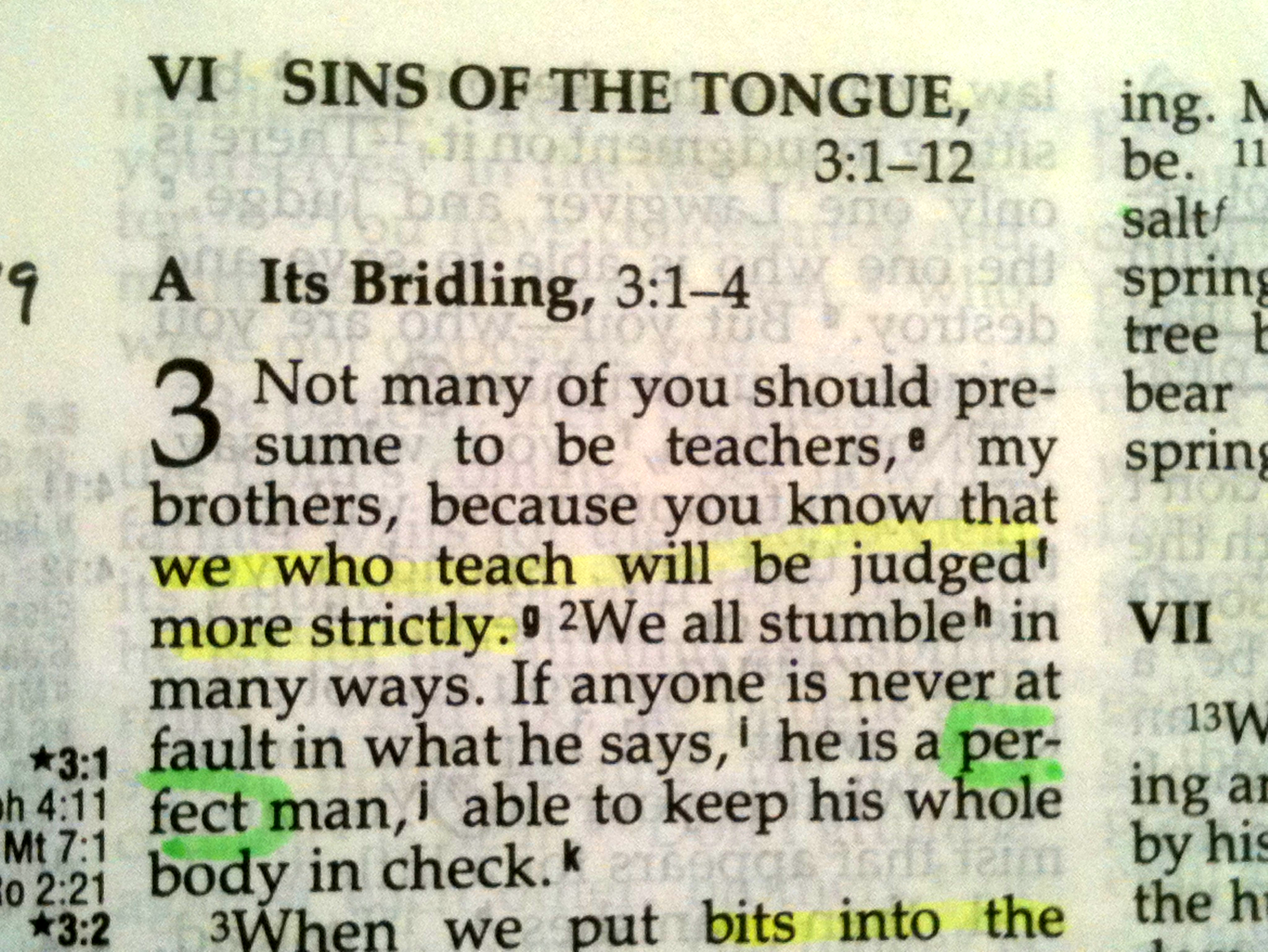
I’m sure I’m not the only pastor that feels occasionally (all right: frequently) overwhelmed by the heavy responsibility of sharing God’s Word with others. After all, the Apostle James said it pretty clearly: Not many of you should presume to be teachers, my brothers, because you know that we who teach will be judged more strictly (James 3:1).

“Judged more strictly”? Yikes!

But I take great consolation in knowing that if God called me, He will equip me. Just as He did with Jeremiah—The Lord reached out His hand, then He touched my mouth and said, “I am giving you the words to say” (Jeremiah 1:8)—I know He will do for me.

I also draw great confidence in knowing the Holy Spirit is helping me. Check out these words from Francois Fénelon:

“Of what efficacy would be the exterior word of pastors, or even the Scriptures themselves, if we had not within the word of the Holy Spirit giving to others all their vitality? The outward word, even of the Gospel, without the fecundating, vivifying, interior word would be but an empty sound. It is the letter that alone kills (2 Corinthians 3:6), and the Spirit alone can give us life.”

Then A.B. Simpson shares this encouraging story of the Holy Spirit’s help:

“They that possess this power will not always be popular preachers, but they will always be effectual workers. Sometimes the hearer will almost think that they are personal, and that someone has disclosed to them his secret sins. Speaking of such a sermon, one of our most honored evangelists said that he felt so indignant with the preacher under whom he was converted that he waited for some time near the door for the purpose of giving him a trashing for daring to expose him in the way he had done, thinking that someone had informed on him. Let us covet this power. It is the very stamp and seal of the Holy Spirit on a faithful minister.”

YES! I do covet this power of the Holy Spirit in my life. Without His help, I would be fearful to ever open my mouth to speak to others about the things of God.
Glorify God Where You Are

20110627-105609.jpg

I love this word from Charles Spurgeon—

“Some persons have the foolish notion that the only way in which they can live for God is by becoming ministers, missionaries, or Bible women. … Every lawful trade may be sanctified by the gospel to noblest ends. … Therefore be not discontented with your calling. Whatever God has made your position, or your work, abide in that, unless you are quite sure that He calls you to something else. Let your first care be to glorify God to the utmost of your power where you are.”

No matter what you are doing, if you’re doing it to glorify God, that is your ministry.

You don’t have to be a pastor/missionary to be a great minister!

My People

The prophet Jeremiah is often called “the weeping prophet.” Perhaps if we wept a bit more over the lost souls who are staggering toward Hell, we would be compelled to do more to rescue them.

What I love about Jeremiah is his identification with lost humanity. God called Jeremiah to be His prophet, so if anyone could have the opportunity to feel special or superior, it might be Jeremiah. But when the prophet heard about the approaching judgment, he called the residents of Jerusalem my people. Did you get that: MY people.

Not only did he call them my people, but his heart broke for them:

  • My heart is faint within me (Jeremiah 8:18)
  • I am crushed (8:21)
  • I mourn … horror grips me (8:21)
  • I weep day and night (9:1)
  • I weep and wail and take up a lament (9:10)

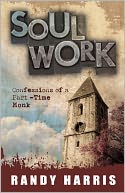
In Soul Work, Randy Harris has a passage that has been pounding on my heart—

Why don’t we cancel all those [church] meetings and make a field trip to the laundromat and the bars and the streets and listen to what makes sinners tick until we love them. I don’t mean try to convert anybody; I mean listen to them until we love them. Listen until we find ourselves in them. Listen to what they’re afraid of, listen to what they hope for, listen to what hurts, until we love them. And then we can try to be the church again. (emphasis added)

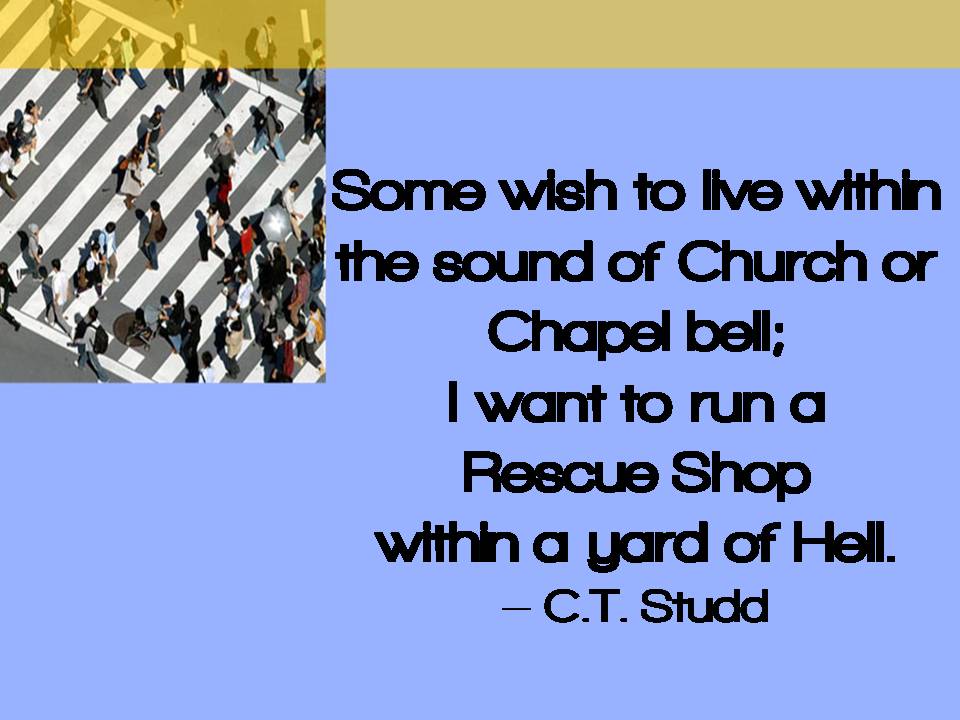
Or as C.T. Studd famously said:

“Some wish to live within the sound of Church or Chapel bell;

I want to run a Rescue Shop within a yard of Hell.”

Soul Work (book review)

You probably think that being a monk is a full-time occupation, right? But what if you could learn from the most committed monks, without actually moving to a monastery? That’s exactly what Randy Harris shows us in Soul Work: Confessions of a Part-Time Monk.

I’ll admit that I was hooked more by the subtitle of this book. After all, whoever heard of a part-time monk. Randy Harris set out to find out more about the deep spiritual walk for which so many monks and hermits are renowned. In the beginning of the book, Randy states that there was something he disagreed with in almost every monastery or hermitage he visited. But he culled through all they had to offer, and presented the best practices in Soul Work.

In short, there is much to learn from the unhurried, quiet, peaceful, and deeply-abiding lives of those who separate themselves from general society. What a huge contrast with our frantic, noisy, stressful, superficial lives. Randy shares what he learned about…

  • Deeper intimacy with God
  • A more refreshed outlook on life
  • A life infused with hope
  • More meaningful prayer times
  • Greater levels of obedience
  • God-honoring humility
  • A more satisfying relationship with God

But we won’t pursue any of these things unless we are truly dissatisfied with our current spiritual level. As Randy wrote,

“We do not move in our spiritual lives until we experience some dissatisfaction with what we’ve got. … The first step toward living an intimate life with God is to realize our own desperation, and that desperation comes largely by developing some sense of God’s holiness.”

This is not a casual read. It’s a book that forced me to confront how much more of God I really wanted in my life, and if I was willing to make the necessary changes to achieve greater intimacy. I was challenged by Soul Work, and I think you will be too.

I am an ACU Press book reviewer.

My Blind Spot

Listen to the podcast of this post by clicking on the player below, and you can also subscribe on AppleSpotify, or Audible.

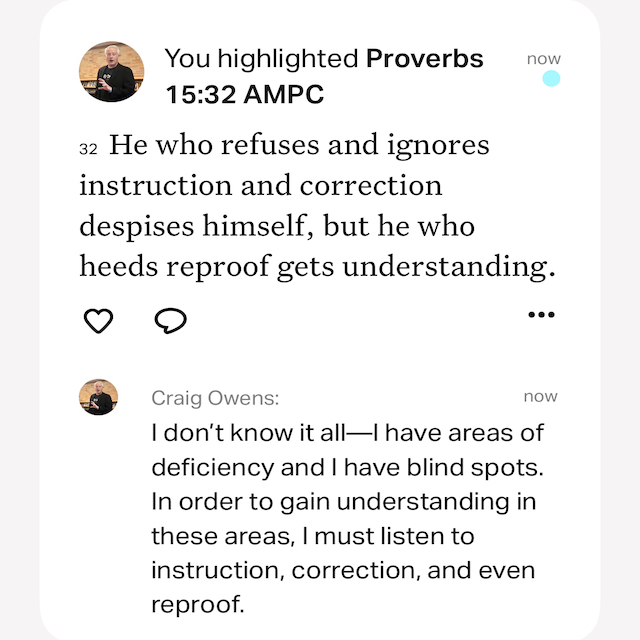
Blind spots can be deadly. I simply don’t see what’s right there until—wham!—it crashes into me.

These blind spots have been called our “unconscious incompetence” zone. I’m not doing well in a certain area, but I just don’t know it yet until—wham!

Up to that point everything seems fine, but wise King Solomon said, “Smugness will destroy fools” (Proverbs 1:32).

It seems there are two ways I could deal with my unconscious incompetencies. (1) I could wait until I get blindsided by one of them; or (2) I could ask the Holy Spirit to reveal them to me. Neither option seems very pleasant, but if I’m going to get hit—wham!—it seems like a better option to let Someone who loves me, and wants the best for me, to do it (see Hebrews 12:5-11).

David thought so too. He prayed—

Search me thoroughly, O God, and know my heart! Try me and know my thoughts! And see if there is any wicked or hurtful way in me, and lead me in the way everlasting. (Psalm 139:23-24)

Or, how about Sir Francis Drake’s prayer:

Disturb us, Lord, when
We are too well pleased with ourselves,
When our dreams have come true
Because we have dreamed too little,
When we arrived safely
Because we sailed too close to the shore.

Disturb us, Lord, when
With the abundance of things we possess
We have lost our thirst
For the waters of life;
Having fallen in love with life,
We have ceased to dream of eternity
And in our efforts to build a new earth,
We have allowed our vision
Of the new Heaven to dim.

Disturb us, Lord, to dare more boldly,
To venture on wider seas
Where storms will show Your mastery;
Where losing sight of land,
We shall find the stars.

We ask You to push back
The horizons of our hopes;
And to push us into the future
In strength, courage, hope, and love.

The wham! moments will come. The question is how do you want them to come?

►► Would you please prayerfully consider supporting this ministry? My Patreon supporters get behind-the-scenes access to exclusive materials. ◀︎◀︎

Thursdays With Oswald—Your Theology May Be Wrong

This is a weekly series with things I’m reading and pondering from Oswald Chambers. You can read the original seed thought here, or type “Thursdays With Oswald” in the search box to read more entries.

Your Theology May Be Wrong

     Never be afraid if your circumstances dispute what you have been taught about God; be willing to examine what you have been taught, and never take the conception of a theologian as infallible; it is simply an attempt to state things. … Theology is the science of religion, an intellectual attempt to systematize the consciousness of God.

From Baffled To Fight Better

Far too many times I catch myself believing something just because someone else told me that was the right way to do things. I’m sure my teachers and pastors were well intentioned, but that doesn’t make them infallible.

Only the Word of God is infallible.

When someone asks you, “Why do you do that?” or “Why do you believe that?” the unacceptable response is, “Someone told me this was the way.” Get into God’s Word and find out for yourself. A theologian may start you off on a path, but allow the Holy Spirit to illuminate God’s infallible truth to you personally.

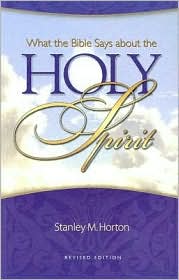
What The Bible Says About The Holy Spirit (book review)

I know a lot of people get uneasy when people starting talking about the Holy Spirit. But what about when the Bible talks about the Holy Spirit? In Dr. Stanley M. Horton’s book, What The Bible Says About The Holy Spirit, you won’t get opinion, just Scripture.

I’m a fourth generation Pentecostal, which means I’ve grown up in an environment where the discussions about the Holy Spirit were numerous and candid. As a result, I thought I knew quite a bit about Him, but it turns out I was so wrong! Dr. Horton is a brilliant scholar, and his knowledge of Scripture is wonderfully on display in this book.

Dr. Horton begins with the Pentateuch and progresses all the way through the Bible, showing exactly what the Bible says about the Holy Spirit. Other books I have read talk more about what the Holy Spirit does, but Dr. Horton pulls out the Scriptures to show Who the Holy Spirit is. And, believe me, there’s a huge difference! The first approach broadens your mind; the second approach deepens your relationship.

If you want to go deeper in your relationship with the Holy Spirit, or if you are simply interested in learning more about (as Francis Chan calls Him) the Forgotten God, then check out What The Bible Says About The Holy Spirit.

Empowering The Team

In reading Leadership Is Dead, one passage particularly stood out to me:

“The wise leader understands that sharing the burden benefits the entire team over the long term. Empowering others makes tasks manageable while also allowing team members to sharpen their skills and build upon their strengths. When a leader refuses to share the load, he brings disservice to the organization because those on his team are not allowed to develop their own leadership skills, and the next generation of leaders are not developed properly for future organizational success.”

Think back to the first two kings in Israel’s history: Saul and David. Both stood out from everyone around them as a strong leader. But only one of them left behind a lasting leadership legacy.

Both Saul and David had men who were immediately attracted to them. Saul was surrounded by valiant men, while David was surrounded by society’s rejects. But clearly David was an empowering leader, and Saul was not. Want proof?

The Bible gives a lengthy list of David’s mighty men, along with quite a résumé of their heroic accomplishments. The list of Saul’s mighty men is: .

I think David was secure in the fact that God called him to lead, while Saul was constantly second-guessing.

  • This made David generous, and Saul jealous.
  • David liberated his men, and Saul contained his men.
  • David encouraged, and Saul controlled.

In the end: David left a legacy, and Saul did not.

What kind of leader do you want to be?

UPDATE: Being secure to serve is one of the main points I tackle in my book Shepherd Leadership: The Metrics That Really Matter. Check out this short clip—

Leadership Is Dead (book review)

It’s not that we don’t need leaders anymore; actually, we need more leaders. But we also need the right kind of leaders. It is exactly those right kinds of leaders that Jeremie Kubicek calls upon in Leadership Is Dead: How Influence Is Reviving It.

Many leadership books tend to be very head-oriented. That is, most leadership books give you the how to’s. Jeremie takes a different approach. Instead of leading with the how to’s, he leads with the why. From the opening chapter Jeremie wants his readers to look deep inside to find out why they want to be a leader, or a better leader. Then once that is firmly in mind, he begins to dismantle all of the self-serving motivations, and replace them with the ultimate tool for effective leadership: influence.

In many ways this book is as much a people-skills book as it is a leadership book. But, after all, unless you are leading sheep, you need to know about interacting with people. Rest assured, Leadership Is Dead is not a touchy-feely book; it is an in-your-face confrontation about doing reviving true leadership.

The last chapter is called “Why You Probably Won’t Do This.” In this chapter, Jeremie says, “Most leaders never reach the levels of significant influence because their instincts for self-preservation are too strong.” And then he adds, “True influence comes when you change yourself to change the world.”

Do you want to make a lasting impact on your world? It starts when you can make the changes in yourself that will lead to greater levels of influence on those around you. Because in order to change your world, you’re going to need a lot of help from a lot of other people! This book can help.

(Special thanks to Michael Hyatt for selecting me as a winner on his blog, so that I could get a copy of this book. And thank you as well to Howard Books for making these books available to Michael Hyatt.)

(Dis)Approval

Have you ever been doing or saying something, and then “the look” on someone’s face caused you to stop or change what you were saying/doing? We often look to certain people for their (dis)approval to gauge how we’re doing.

But what if we’re looking at the wrong faces?

God called Jeremiah to be a prophet while he was still fairly young. So when this young man starts saying, “This is what God says,” can you imagine the looks he’s going to get?!

So right out of the gate, God says two things to Jeremiah: Do not be afraid of them … Do not be terrified by them (Jeremiah 1:8, 17). I like how the King James Version renders these verses: Do not be afraid of their faces … Do not be dismayed by their faces.

  • Afraid means to look at faces for approval.
  • Dismayed or terrified means to look at faces for disapproval.

But people’s faces aren’t the faces Jeremiah—or you or I—should be looking at. The only face that matters is God’s! Look how many “I” statements God makes about Himself in this chapter:

  • I formed you (v. 5a)
  • I knew you in advance (v. 5b)
  • I set you apart (v. 5c)
  • I appointed you (v. 5d, 10)
  • I am sending you (v. 7a)
  • I give you the words to say (v. 7b, 17)
  • I am with you (v. 8a, 19a)
  • I will rescue you (v. 8b, 19b)
  • I will put my words in your mouth (v. 9)
  • I am watching over you (v. 12)
  • I am making you strong (v. 18)

The faces of people are not how you and I should gauge (dis)approval.

How sad to look at other faces for approval, only to hear God say, “Depart from Me. I never knew you!

How liberating to know that even though other faces may disapprove me, I can still hear my Master say, “Well done, good and faithful servant!

Whose face are you looking at today?