You cannot get Scripture from the Bible into your heart and mind by osmosis! To develop a biblical worldview, we have to put the Word in so the Holy Spirit can help us work it out.
“Without goals, training has no direction.” —Natalie Coughlin
John Piper saures 12 resolves for Christians to fortify them against viewing pornography. In the post called The High Price of Watching Nudity, Piper says, “I want to invite, frankly, all Christians to join me in this pursuit of greater purity of heart and mind. In our day, when entertainment media is virtually the lingua franca of the world, this is an invitation to be an alien. And I believe with all my heart that what the world needs is radically bold, sacrificially loving, God-besotted freaks, aliens.”
“Accountability closes the gap between intentions and actions.” —Craig Groeschel
T.M. Moore wrote, “Who are your ten most admired pastors? Probably we could all make a list. Why do we admire them? Because their churches are growing? Would they want you to say of them that they really know how to grow a church? We make two mistakes here. First, we mistake big numbers with real growth. The Bible’s view of growth is much more qualitative than quantitative. Second, we think we can get ‘growth’—in numbers—by simple mechanics: Find the right combination of programs, the latest in worship music, and a nice refreshment area. That won’t get the growth Jesus is seeking.”
Listen to the podcast of this post by clicking on the player below, and you can also subscribe on Apple, Spotify, or Audible.
I am so excited to announce that my co-host Greg has written a new book called Sales Armageddon. As anyone in the profession knows, sales can be a battlefield. Through fables and insightful teaching Greg’s book will equip you with new strategies you can implement right away to keep yourself and your team in the fight.
[0:30] Greg’s new book is out.
[1:40] The book contains a business fable based on real people.
[3:39] Salespeople can learn from this book how to work well and grow because of others.
[5:52] This is a very entertaining book that helps us learn.
[7:16] All salespeople need o learn to work with their peers.
[8:40] Sales Armageddon is not just a soft story but it shares the science of sales as well.
[9:35] Here is a teaser of a key chapter on developing a robust sales pipeline.
[12:46] This book has both the emotion and the hard skills of excelling in sales.
[14:47] Greg says that each chapter is going to remind you of someone you’ve worked with before, or it may even remind you or yourself!
[16:37] This is not a “heavy” read, but this is something that you are going to be able to immediately apply to your sales work.
Listen to the podcast of this post by clicking on the player below, and you can also subscribe on Apple, Spotify, or Audible.
When you’ve been hurt, you probably want someone to tell you that it was all the other person’s fault. That’s what you may want, but a true friend will tell you what you need to hear.
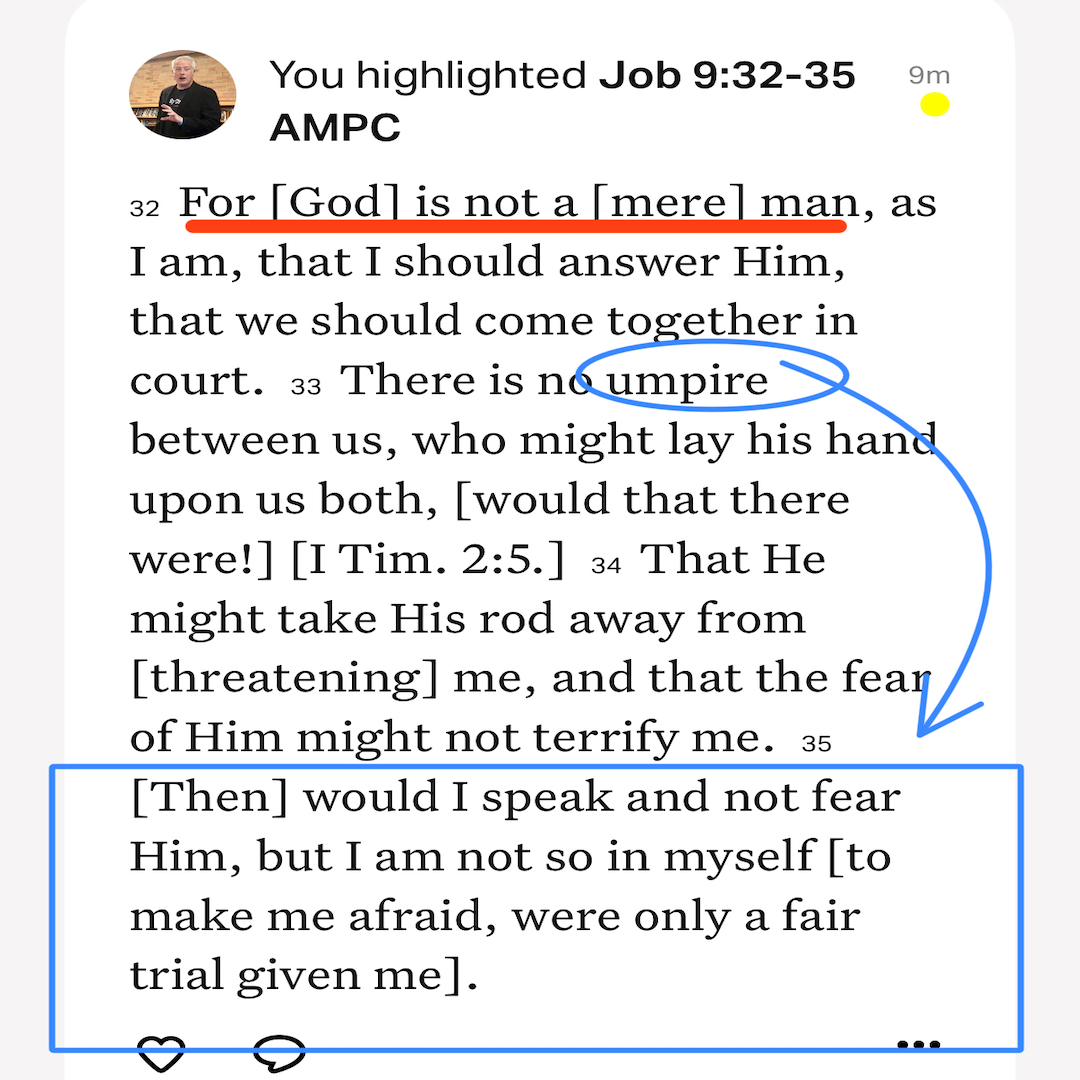
For God is not a mere man, as I am, that I should answer Him, that we should come together in court. There is no umpire between us, who might lay his hand upon us both—would that there were! That He might take His rod away from threatening me, and that the fear of Him might not terrify me. Then would I speak and not fear Him, but I am not so in myself to make me afraid, were only a fair trial given me. (Job 9:32-35 AMPC)
The “umpire” or mediator for whom Job was longing is Jesus.
Both Paul (Galatians 3:19-20; 1 Timothy 2:5) and the writer of Hebrews (8:6, 9:15, 12:24) make it clear that what Job said was true: Man cannot come before God on his own, let alone attempt to argue his case.
Listen to the podcast of this post by clicking on the player below, and you can also subscribe on Apple, Spotify, or Audible.
Comfort is an important word in the apostle Paul’s letter to the saints at Corinth. In just five verses in the opening of his second letter to the Corinthians, he uses the word “comfort” nine times!
Praise be to the God and Father of our Lord Jesus Christ, the Father of compassion and the God of all comfort, who comforts us in all our troubles, so that we can comfort those in any trouble with the comfort we ourselves receive from God. For just as we share abundantly in the sufferings of Christ, so also our comfort abounds through Christ. If we are distressed, it is for your comfort and salvation; if we are comforted, it is for your comfort, which produces in you patient endurance of the same sufferings we suffer. And our hope for you is firm, because we know that just as you share in our sufferings, so also you share in our comfort. (2 Corinthians 1:3-7)
The Greek word conveys the sense of someone who comes near to help us. They come physically near, their heart draws near to us in empathy, and even their words are right on target to provide the help we need.
If that description sounds familiar, it may be because it comes from the same Greek word that Jesus uses for the Holy Spirit—
And I will ask the Father, and He will give you another Comforter (Counselor, Helper, Intercessor, Advocate, Strengthener, and Standby), that He may remain with you forever. (John 14:16 AMPC)
As Paul says, God is “the God of all comfort,” which we would expect. But notice that Paul also says that the Comforter comforts us for a specific purpose: “so that we can comfort those in any trouble with the comfort we ourselves receive from God.”
We cannot give to others what we do not have.
How do we get comfort? The Holy Spirit—the Comforter—comforts us.
When does He comfort us? When we are in distress.
What happens with this comfort we receive? Three things:
We have something to give to others who are in distress
It builds patient endurance in us
It makes our hope in God more firm
Perhaps you’re in a time of distress right now and you’re wondering why you are going through this difficulty. Can I challenge you to reframe this thought: You are going through this so that you may increase your capacity to be a comforter to others. Your comforted distress is allowing you to come alongside another struggling saint with greater empathy and patience and understanding and strength than you would have had before your time of distress.
This is why Paul says, “Praise be to the God and Father of our Lord Jesus Christ.” He is trying to help us see the blessings that can come from this time of distress that could have come in no other way. Don’t allow self-pity to rob you of the comfort the Comforter wants to give to youso that you are able to be a comforter to others who are in distress.
Listen to the podcast of this post by clicking on the player below, and you can also subscribe on Apple, Spotify, or Audible.
The definition of salvation comes from Romans 10:9. When we believe in our heart that Jesus paid the penalty for our sins and we confess that with our mouth, we are now justified. I can now stand before God just as if I had never sinned. But the Christian life is more than merely going to heaven at some point. It’s about glorifying God and pointing others to Jesus while we’re on our way to heaven.
Paul wrote to saints in Corinth (1 Corinthians 1:2; 2 Corinthians 1:1) but he also called them “mere human beings” in 1 Corinthians 3:1-3. Paul points out that there is a difference between viewing this life from a worldly viewpoint and a biblical viewpoint (2 Corinthians 5:16).
A naturalistic world view is constantly shifting as new discoveries are made. A biblical worldview knows there is nothing new under the sun, that everything is addressed in Scripture.
In order to not view this world through the lens of “mere human beings” we have to read, study, meditate on, and apply the whole counsel of God’s Word. We put it in and the Holy Spirit helps us live it out. Just like our prescription glasses won’t do a thing to correct our vision of they aren’t on our face, Scripture won’t help us navigate this world in a God-glorifying way if we haven’t put it in our heart.
Each day before I ready my Bible I pray Psalm 119:18, which asks the Holy Spirit to open my eyes to the amazing things in Scripture. I read, I journal, and I pray over the passage that I have read. Then the Holy Spirit makes good application of that Scripture (John 14:26, 16:13; 1 John 4:6). I want to be sure to read the whole counsel of God’s Word, not just cherrypicking my favorite parts. And I always want to be going deeper (Hebrews 6:1).
One place that we see contrasting world views—the natural worldview versus the biblical worldview—is in 2 Timothy 2:14-19.
Natural worldview #1—quarreling about words
Biblical worldview #1—correctly handling the Word of truth
Natural worldview #2—engaging in godless chatter
Biblical worldview #2—standing on the firm foundation of Scripture
The results of a biblical worldview are amazing:
A sure foundation (Matthew 7:24-27)
The attention of others (Matthew 7:28-29)
Useful treasures to share with others (Matthew 13:52)
A strong defense against critics (Acts 6:9-10; Psalm 119:99)
Let’s not get stuck in the “mere human being” level of a natural worldview, but let’s commit to studying our Bibles diligently so that the Holy Spirit can develop a robust biblical worldview in us. This worldview is fruitful, joyful, and enhances our testimony.
Follow along with all the other messages in our series on B.A.S.I.C. Christianity by clicking here.
When someone invites Jesus into their heart, they are immediately justified in God’s sight and have the assurance of Heaven as their eternal home. But then the question comes, “Now what?”
Our justification is immediate but our sanctification is an ongoing, lifelong process. Sanctification is what brings fruitfulness to a Christian’s life and what allows that fruitful life to be a testimony to others. The Bible gives us the B.A.S.I.C.s of this Christian life, and that’s what we will be exploring over the next few weeks.
If you want your heart to be able to perform better, you are going to have to stress it a bit—that’s called exercise. The same thing is true for the heart of leadership—we have to exercise our leadership so that it can rise to the challenge later.
J. Warner Wallace wrote, “Everyone, whether they realize it or not, is engaged in worship. We all adore something, elevating it above the rest, sometimes so much that we overlook its flaws.” Check out this post about being careful about what we worship.
“Nothing teaches us about the preciousness of the Creator as much as when we learn the emptiness of everything else.” —Charles Spurgeon
“We should avoid end-time hysteria and ‘not grow weary in doing good’ (2 Thessalonians 3:13). There will be good work to do (vocationally and socially and personally) right up to the Lord’s coming. Our normal earthly duties will not end until the Lord appears. The rule then, until he comes, is, ‘Whatever you do, work heartily, as for the Lord and not for men’ (Colossians 3:23).” —John Piper
Greg Morse has a fascinating post connecting the fable of Chicken Little with the historical account of Noah and the imminent return of Jesus. “I hope an acorn falls afresh on our heads as we observe an Old Testament saint who was the Chicken Little of his day. A man who remained awake and faithful with his back against the end of the world: a man named Noah.”
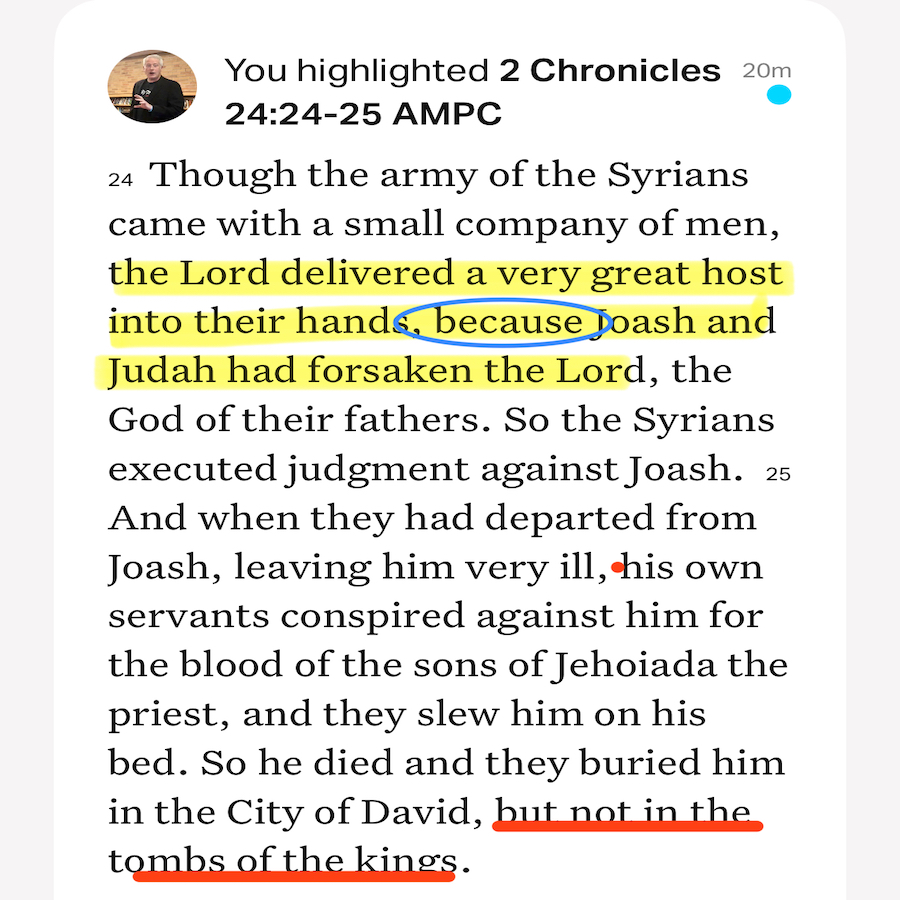
Though the army of the Syrians came with a small company of men, the Lord delivered a very great host into their hands, because Joash and Judah had forsaken the Lord, the God of their fathers. So the Syrians executed judgment against Joash. And when they had departed from Joash, leaving him very ill, his own servants conspired against him for the blood of the sons of Jehoiada the priest, and they slew him on his bed. So he died and they buried him in the City of David, but not in the tombs of the kings. (2 Chronicles 24:24-25 AMPC)
Joash started well when he listened to the godly counsel of Jehoiada. But he made a 180-degree turn when he listened to ungodly counselors. Joash, it seems, couldn’t commit to a godly or ungodly lifestyle on his own; instead, he lived as those around him did—always giving in to the loudest voice at that particular moment.
We are prone to follow the voices around us, too, which is why Paul urges us to make a commitment to follow God regardless of how others are living:
I appeal to you therefore, brethren, and beg of you in view of all the mercies of God, to make a decisive dedication of your bodies—presenting all your members and faculties—as a living sacrifice…. Do not be conformed to this world (this age)—fashioned after and adapted to its external, superficial customs—but be transformed (changed) by the entire renewal of your mind…. (Romans 12:1-2 AMPC).
A life fully committed to living God’s precepts is red hot in its passions—“Let your love be sincere (a real thing); hate what is evil—loathe all ungodliness, turn in horror from wickedness—but hold fast to that which is good” (Romans 12:9 AMPC).














 Craig T. Owens