While I was reading Firsthand by Ryan & Josh Shook, I felt a little bit like I was reading my own autobiography. Ryan & Josh write about their journey to embrace faith in God as something personal for them—something firsthand. Prior to this point in their lives, these brothers felt like they were living and believing in a secondhand relationship with God.
I can relate. I’m a fourth-generation Christian, with my parents, grandparents, and great-grandparents professing a relationship with Jesus Christ. I remember vividly my “crisis of faith” as I wrestled with my burning questions: Do I believe what the Bible says about God just because my parents believed it, or do I believe it because it’s true?
I would encourage all Christian parents to purchase a copy of this book for their kids. Ryan & Josh’s words will resonate with them, and will prepare them for their own journey of discovery. We Christian parents must do all we can to help our children successfully navigate this crucial time in their lives, and Firsthand will be an invaluable resource.
Here’s a video review I did for WaterBrook Multnomah Publishers—
Listen to the podcast of this post by clicking on the player below, and you can also subscribe on Apple, Spotify, or Audible.
A quick survey: Please raise your hand if any of these pertain to you:
Have you ever had a disagreement with someone?
Have you had a disagreement with someone you love?
Have you had a disagreement with someone you love, who also called themself a Christian?
If you raised your hand, you joined 100% of my congregation who answered “yes” to all three.
When we are in close proximity to anyone, there will be conflict. In fact, close proximity usually leads to more conflict because closeness increases friction. For a Christian the issue is not if we will have conflict with others in the Church, but how will we navigate and resolve these conflicts.
The apostle Paul wrote a thank you letter to the church at Philippi, in which he speaks in some of the most glowingly loving terms of any of his letters. Clearly, this was a group of people close to his heart. So when he heard about a conflict between two ladies in this congregation, he took time to address it publicly in his letter—
I plead with Euodia and I plead with Syntyche to be of the same mind in the Lord. (Philippians 4:2)
We don’t know why these ladies were arguing but notice that Paul doesn’t take sides. He simply says, “I please with Euodia AND I plead with Syntyche.” The word for plead means someone who comes alongside to help. In using this terminology, Paul gives us an important principle:
We can come alongside those in conflict without taking sides with either one of those in conflict.
In the next verse, Paul implores the rest of the church to join him in this alongsided-ness—
And I exhort you too, my genuine yokefellow, help these two women to keep on cooperating…. (v. 3 in the Amplified Bible)
In other words, Paul wants the rest of the church to embrace these at-odds sisters, also without taking sides. He addresses the members of the church as yokefellow. It’s not a word we use too often today (although it is still in the dictionary), but it paints a crystal clear picture of our role. Here’s what we CAN’T do as yokefellow:
Look away
Mind our own business
Hope the situation will work itself out
Try to navigate around the problem
Instead, we embrace the conflict by embracing those in the conflict. We help them to cooperate and to work in harmony in the Lord (v. 2 in the Amplified Bible). It’s our responsibility to help maintain the bonds of peace so that the Body of Christ can grow in a way that is healthy and God-honoring.
Do you know someone in conflict right now? Are you in the conflict yourself? Ask God to show you how you can come alongside—not take sides—with those in this conflict so that you can help bring about peace.
“Never has a teacher taken such trouble with his scholars as Jesus Christ will with those who preach His Word. He will spare no pain; no time will be too limited or too long for Him. In the love that took Him to the Cross, He wants to fellowship and converse with us, fashion us, sanctify us, and make us fit for His holy service. Will we not commit ourselves entirely to the love that gave up all for us and look upon it as our greatest joy to have daily fellowship with Him? All you who long for blessing in your ministry, He calls you to abide in Him. Let it be the greatest delight of your life to spend time with God; it will be the surest preparation for fruitful service.” —Andrew Murray
This is a weekly series with things I’m reading and pondering from Oswald Chambers. You can read the original seed thought here, or type “Thursdays With Oswald” in the search box to read more entries.
Overcoming Temptation
In the silent years Our Lord learned how to be; at His Baptism He had revealed to Him what He had to do; in the Temptation what to avoid.
…The word “temptation” is built on a Latin word meaning “to stretch.” … Temptation is the test by an alien power of the possession held by a personality.
…Every temptation of satan is perfectly wise. The wisest, shrewdest, subtlest things are said by satan, and they are accepted by everybody as the acme of human philosophy; but when the Spirit of God is at work in a man, instantly the hollow mockery at the heart of what satan is trying to do, is seen. When we understand the inwardness of the temptation we see how satan’s strategy is turned into confusion by the Spirit of God.
We, just like Jesus, can be victorious over these temptations by doing what Jesus did. (1) He was fully submitted to His Heavenly Father, (2) He was sensitive to go where the Holy Spirit led Him, and (3) He uncovered the shrewd and subtle arguments of satan by using the Word of God.
The One who overcame satan’s temptations wants to help you overcome as well—
For because He Himself [in His humanity] has suffered in being tempted (tested and tried), He is able [immediately] to run to the cry of (assist, relieve) those who are being tempted and tested and tried [and who therefore are being exposed to suffering].(Hebrews 2:18, Amplified Bible)
When God created the earth, He directed Adam and Eve to care for His creation. Today it’s just as important for us to be good stewards of our Heavenly Father’s beautiful world.
So I’m excited that Calvary Assembly of God is going to be involved in the cleanup efforts in our hometown of Cedar Springs. For the fourth year in a row we’ll be picking up the junk that seems to accumulate around our waterways and in our public areas. We’ll be pulling on our waders so we can walk into Cedar Creek to remove the things that shouldn’t be in there. The fish and wildlife will be happier, and I bet our Creator will be too!
We’re meeting behind the fire station off of Main Street on Saturday, April 27, at 10am. If you are in the area, please come join us.
Although all of the cleanup efforts are concentrated on one day, my hope is that it will become an ongoing lifestyle for us to always be caring for our community.
Listen to the podcast of this post by clicking on the player below, and you can also subscribe on Apple, Spotify, or Audible.
Look up.
See all those stars? Even all the stars our most sophisticated telescopes can see don’t even come close to showing us all the stars in our universe.
And yet of all the stars and all the planets, our Earth is perfectly positioned by our Sun. If our Sun was any bigger, we’d get too much radiation and heat. If our Earth was any farther away, we’d be too cold to survive.
God placed Sun, Earth, moon, and stars perfectly.
Look down.
Way down. All the way to the sub-atomic level.
Neutrons, protons, electrons all arranged perfectly. Too many protons or electrons—or too few—and matter wouldn’t hold together properly.
God placed those components of our atoms together perfectly.
Look in.
Right into your heart.
Gifts, talents, passions, insight, personality, temperament. All of those things in a perfect blend to make you.
You are unique. There’s never been anyone like you before, and there never will be another like you in the future.
God placed those attributes together in a perfect mixture to make you. Too much of this, or too little of that, and you wouldn’t be you.
What are you going to do with your you-ness? How about letting your Creator tell you exactly why He made you the way He did:
For YOU are God’s handiwork, perfectly created in Christ Jesus to do good works, which God prepared in advance for YOU to do. (Ephesians 2:10, with a slight change to personalize it)
God knows what He’s doing. He created the big universe perfectly. He created the sub-atomic universe perfectly. And He also created you perfectly.
This post originally appeared on the Live Dead website. It is reproduced here by permission.
My selfish ambition sets sail
Down the hidden rivers of rebellion in my heart,
Secret tunnels obscure things not yet ready to reveal.
I’ve come this far,
given You most.
Why can’t You be satisfied with that?
No, all is what You want.
And every atom of my being is restless,
defensive,
Silent tantrums heard only by You swallow my energy.
The war for my heart—all my heart—
is one you won’t relent.
But I don’t give up easily.
Logic says I’m Yours anyway
But You ask that I should offer,
voluntarily surrender
Even those things, Lord? That too?
I willfully give You…
some.
much.
most.
All? Must You really require all?
I fall to my knees in humble—exhausted—surrender
Tell me again: What great thing was I fighting so valiantly for?
Ah. My heart.
[Our souls are restless until they find rest in You.]
I am continually astounded at the insight Oswald Chambers has on the Scripture and its practical applications to our lives! In He Shall Glorify Me, Chambers elaborates on the immensely important role the Holy Spirit plays in the lives of Christians.
The title of the book is taken from a statement Jesus made about the Holy Spirit: He will glorify Me because it is from Me that He will receive what He will make known to you (John 16:14). Chambers begins with the advent of the Holy Spirit, leads us through a thorough doctrine of the Spirit, and then shares practical applications for Spirit-directed living.
These were originally lectures he gave at college, then they were turned into articles for a magazine, and finally complied into a book form. As far as we know, Oswald Chambers didn’t plan for these lectures to be published as a book, so he had no say in a proposed title. But the title—He Shall Glorify Me—is perfect, as every single lecture/chapter shows us how the Holy Spirit wants to bring out of our lives only what will bring glory to Jesus.
For anyone serious about allowing the Holy Spirit to work more deeply in their lives, He Shall Glorify Me is an indispensable resource.
Listen to the podcast of this post by clicking on the player below, and you can also subscribe on Apple, Spotify, or Audible.
I remember when I was a teenager having such an ache in my legs at night. I’d be laying on my bed trying to sleep, but I couldn’t get comfortable because of that dull, unrelenting ache in my legs. I’d go ask my Mom what was going on, and her reply was simple: “Those are growing pains.”
In order to grow in any area of our lives—physically, emotionally, mentally, relationally—we have to go through a certain amount of pain.
No pain, no gain.
The process is not always a lot of fun, but that’s why we have to keep our eyes on the goal. The process may not be something we like, but the end results will make the pain worth it.
For instance, you may not like dieting but you like the weight loss or lower cholesterol numbers, so you stick with it. You may not like saying, “I’m sorry, I was wrong, please forgive me” but you like the healed relationship, so you say it.
Throughout the New Testament the phrase one another is frequently used to address how members of the Body of Christ should relate to each other. God desires that all of us operate interdependently with one another. In order to get there, we must get ready for some growing pains!
In Ephesians 4:2, Paul tells us what is required to get to a place of unity and maturity in the Church:
Be completely humble (the King James Version says lowliness). This Greek word means not letting our thoughts rise far from the ground. In other words, we are thinking of ourselves as God thinks of us, not independently as a self-made man or woman, but viewing all of my success as God-appointed. This process toward interdependence starts in our thoughts—in our attitudes about ourselves and about others.
Gentle means strength under control. Gentleness says, “I could do this, but for your sake I won’t.”
Patient interaction (KJV: longsuffering) with others is allowing them the freedom to grow just as others allowed me the freedom to grow.
Bearing with one another in love. Think of a load-bearing wall in a building that is holding up the weight of the roof and walls. When we bear with one another we are helping to share the burdens.
Being humble with ourselves and gentle and patient with others is the way we go through the growing pains of bearing with one another in love. The process may not be a lot of fun, but the end result is something that glorifies God, that’s why we must stick with one another through all our growing pains.
Check out all of the other messages in our series Live Togetherby clicking here.
I wrote to the church, but Diotrephes who loves to be first, will have nothing to do with us. (3 John 9)
The King James Versions says that Diotrephes loveth to have the preeminence. He loved his title, his position of authority, and having everything in the church flow through him.
He wanted not only to approve who spoke in the church, but even with whom church people could socialize outside of church. He wielded his positional authority like a sword and cut off people from the fellowship of the church if they didn’t join lockstep with him.
He used fear and intimidation to demand people follow him, and wouldn’t receive a loving letter from the Apostle John. To counteract any who would question him, Diotrephes engaged in gossip and character assassination of any he perceived to be a threat to his position as pastor.
My fellow pastor, having the title of pastor doesn’t mean I’m the smartest person in the room, or that I have all the answers. I am one member of the Body of Christ. Each member of the Body needs all the other members of the Body. I should humbly serve, never demanding allegiance to me or blind obedience to my wishes. I should never try to hide behind my title, but be the most transparent, the most willing to admit my mistakes, and the first to forgive and to ask forgiveness.
Lord, guard my heart against the spirit of Diotrephes!!
UPDATE: This is one of the seed thoughts that went into my book Shepherd Leadership.



 While I was reading Firsthand by Ryan & Josh Shook, I felt a little bit like I was reading my own autobiography. Ryan & Josh write about their journey to embrace faith in God as something personal for them—something firsthand. Prior to this point in their lives, these brothers felt like they were living and believing in a secondhand relationship with God.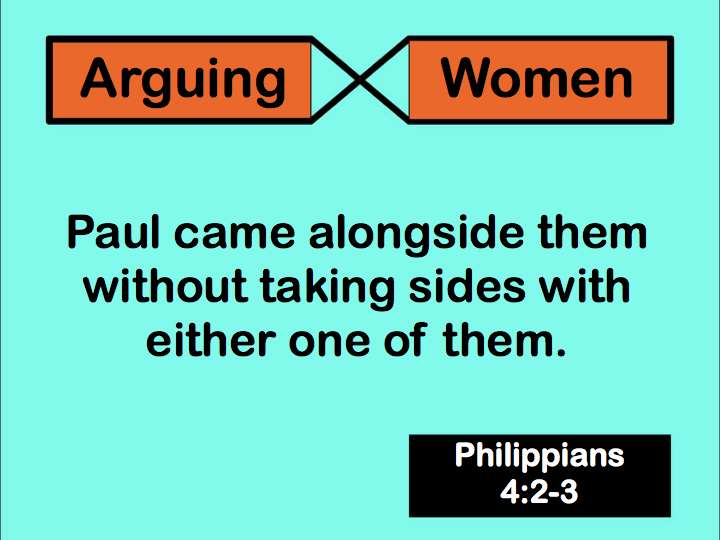









 Craig T. Owens