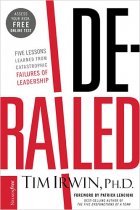
Derailed (book review)

Derailed

As I read Dr. Tim Irwin’s latest book, Derailed, I thought about a quote from John Maxwell: “A wise man learns from his mistakes. A wiser man learns from others’ mistakes. The wisest man learns from others’ successes.”

The subtitle of this book is “Five lessons learned from catastrophic failures of leadership.” In this, we learn from others’ mistakes. But then Dr. Irwin goes on to show us successes that we can learn from as well. Combining the insight from successful—or should I say “non-derailed” leaders—with his own discernment, Dr. Irwin shows us how to stay on the rails.

When I first noticed that the examples in the book were all high-profile CEOs, I thought, “What could I learn from them? After all, I’m not the CEO of a Fortune 500 company.” But Dr. Irwin does an excellent job of bringing the four qualities of character—authenticity, self-management, humility, and courage—down to a pedestrian level where even we non-CEO-types can benefit from his wisdom.

Although the principles in Derailed can benefit anyone in leadership, or aspiring to a leadership position, this book still might not be for everyone. The six case studies in the book are all derailed CEOs, and unless you have a penchant for the business world, you might not find them very enjoyable reading. However, for those of you who enjoy business history, there is much to gain from a careful reading of Derailed.

I am a Thomas Nelson book reviewer.

Be Real

Superheroes

Masks just for fun

A quick show of hands: how many of you like a phony? Uh-huh, I didn’t think I’d see any hands raised on that one. We may like to see our favorite actor/actress play a convincing role on stage or on screen, but when it comes to real people we interact with on a daily basis, we want the real deal.

Sadly, the people who have the most “realness” to offer often go about it in a phony way. I’ve observed way too many people who claim to be followers of Christ put their masks on:

  • They put on their laughing mask when their coworkers are telling crude jokes. Then switch to their disgusted mask when they tell their church friends how vulgar their coworkers are.
  • They put on their silent mask when someone talks about how they don’t really believe in God. Then they switch to their wise counselor mask when they tell someone else what they should have said.
  • They put on their fake smile mask when someone asks what they think of the boss’s announcement about possible layoffs. Then they put on their pray-for-me mask when they ask someone in church to intercede for them about their future.

Instead

Since God has so generously let us in on what He is doing, we’re not about to throw up our hands and walk off the job just because we run into occasional hard times. We refuse to wear masks and play games. We don’t maneuver and manipulate behind the scenes. And we don’t twist God’s Word to suit ourselves. Rather, we keep everything we do and say out in the open, the whole truth on display, so that those who want to can see and judge for themselves in the presence of God.

Be real. Always. In all circumstances. Masks are for parties. Realness is for people’s souls.

Learning Tough Lessons

In my role as a book reviewer, I am presently reading Derailed. This book has really jolted me wide awake!

Dr. Tim Irwin is walking through the profiles of six high-profile business leaders who got derailed on their path to success. These CEOs seemed to have everything: talent, opportunity, great ideas, a proven track record of success. In short, everything they would need to be successful.

Yet they got derailed.

Here’s the wake-up call for me: The same thing can happen to me. The Apostle Paul wrote his own “derailed” story about the Israelite leaders:

These are all warning markers—danger!—in our history books, written down so that we don’t repeat their mistakes. Our positions in the story are parallel—they at the beginning, we at the end—and we are just as capable of messing it up as they were. Don’t be so naive and self-confident. You’re not exempt. You could fall flat on your face as easily as anyone else. Forget about self-confidence; it’s useless. Cultivate God-confidence.

I don’t want to get derailed, so I’m focusing on God-confidence today.

How Do You Study?

In our Impact youth service, we’re exploring the study of the Bible. To help me with a little “sermon prep,” can you please comment below to tell me how do you study your Bible:

  • Do you highlight?
  • Underline?
  • Write notes?
  • Read a chapter at a time?
  • Systematically go through the Bible?
  • Read from the same translation every time?
  • Write in a journal?
  • Memorize verses?

Anything you would like to share would be very helpful.

Lots Of Stairs

Sometimes it’s hard to find a block of time to set aside exclusively for exercise, so I try to build some exercise opportunities into my day. My during-the-day exercise usually is trying to find more ways to walk. Like…

  • Parking at the back of the parking lot
  • Walking down the hall to someone’s office instead of sending an email
  • Taking the stairs

Lately, I’ve been in lots of places with stairs, and yesterday my legs were really feeling it. I learned something from climbing all those stairs: It’s a lot easier going down than it is going up.

Up gets my heart pumping more. Up works up a sweat. Up makes me breathe deeper. Up builds my leg muscles. Up is painful (but it’s a good pain).

The soreness in my legs is a reminder that I’ve exercised, that I’ve done something that’s giving me long-term benefits, that I’ve prepared myself for a healthier future.

Solomon wrote, “The path of life leads upward for the wise to keep him from going down to the grave.”

Spiritually, I can say up brings life.

Up makes me wiser. Up keeps me from going down. Up is painful (but it’s a good pain).

If you haven’t been spiritually sore lately, perhaps you’re shying away from a healthy workout.

Let God take you up today. You might be a little sore tomorrow, but the soreness will remind you that you’ve exercised, that you’ve done something that’s giving you long-term benefits, that you’ve prepared yourself for a heavenly future.

Satisfied Service

I started a conversation last week about being a servant (you can catch up here).

Serving should be a two-way street. Contrary to the way that some people look at servanthood, being a servant is not the same thing as being a doormat. Consider two key verses:

  • Each of you should look not only to your own interests, but also to the interests of others. (Philippians 2:4)
  • Submit to one another out of reverence for Christ. (Ephesians 5:21)

We should look equally to others’ needs as well as our own needs. Zig Ziglar says it this way, “You can have everything in life you want, if you will just help other people get what they want.”

This can be manipulation if you’re simply looking to someone else’s interests as a form of flattery or as a quid pro quo. But if you are truly serving—if you truly have the other person’s best interests in mind—if you are willing to submit to them out of reverence for Christ, serving can be liberating.

Last week Rick Warren tweeted, “The more self-centered I am, the more unsatisfied I’ll be.” I retweeted with this addition, “So the more I serve, the more satisfied I’ll be.” I believe that.

Try it for yourself—it works!

Loving Servanthood

Over the past couple of days I’ve been thinking a lot about something: What does it mean to serve? Or more specifically, what does God say about how we should serve?

The typical image that comes to mind when someone says “servant” is a person of lower status—someone who is at the lower end of the organizational chart, someone who is expected to do more with less, someone who doesn’t have many opportunities for advancement (or even a day off), or maybe someone who is expected to be tuned into everyone else’s needs but seldom has his own needs met.

Is being a servant the same thing as being a doormat?

Consider Jesus:

He now showed them the full extent of His love…. Jesus knew that the Father had put all things under His power, and that He had come from God and was returning to God; so He got up from the meal, took off His outer clothing, and wrapped a towel around His waist. After that, He poured water into a basin and began to wash His disciples’ feet, drying them with the towel that was wrapped around Him.

Jesus was the most important person in the room: Jesus KNEW that the Father had put all things under His power. He was also the most love-filled person in the room. What did He do with all of His love and power? He served others.

When He finished, John writes that He returned to His place, and asked His disciples a question, “Do you understand what I just did?” Then in the only instance of Scripture where Jesus Himself said this, “I have set you an example that you should do as I have done.”

Servants are people who use the power they have to lovingly serve others.

Servants don’t serve because someone else forces them to serve. Servants serve because the love of God empowers them to serve.

Do you love your spouse enough to serve him/her? Do you love your family enough to serve them? Do you love your coworkers enough to serve them? The greater the love we have for others, the greater the empowerment to serve. Love empowers us for service.

Oh, So That’s How It Works

Sometimes we make connecting with God way too complicated. If I’m reading my Bible accurately, I think He just wants us to approach Him in the way we are naturally wired to connect. Not every husband interacts with his wife the same way, nor every wife with her husband. We connect with different friends in different ways. But somehow we in the church have come up with a set of “rules” about the right way we should be worshipping God.

So here’s a fun and “informative” video on the rules of worship.

Enjoy!

Surprise!

Last night I went to a surprise party for a great guy in our church. His sons initiated the idea on Sunday evening, and we all went into action to figure out when, where, and (most importantly) what food we were going to bring. After just a few minutes of discussion, everything was in place, and it all came together pretty smoothly.

I think the birthday boy was genuinely surprised. And pleased. And everyone had a fun evening.

But I got to thinking, “Should it really be a surprise that we want to express our appreciation, love, and respect to someone?” Hmmm.

Perhaps today—and every day—we could find a way to “surprise” someone we love or appreciate. You know, just find an unexpected way to let someone know they’re special.

  • A surprise note/text/email
  • A surprise gift
  • A surprise hug
  • A surprise phone call
  • A surprise lunch invitation
  • A surprise cup of coffee or favorite treat

It’s amazing what happens inside people’s hearts when we go out of our way to express our love. Try it, and see what happens.

Make today a surprise day for the people you love and appreciate.

Do It

Here’s what God said to His people through the prophet Ezekiel, “I will judge you according to your conduct.” God says the same thing in the New Testament too.

It’s not what I believe. It’s not what I discuss. It’s not what I intend to do. It’s not what I know is right and wrong. It’s what I do.

I have to give an account of my conduct. I have to answer to God for how I lived out my beliefs. I have to show God what I did with what I believe about Him. I have to put into practice what’s in my heart.

Do I believe God is God? Do I have idols?

Do I believe God is holy? Do I sin?

Do I believe God forgives? Do I repent?

Do I believe God looks after orphans and widows? Do I?

Do I believe God is my Provider? Do I steal?

Do I believe He is Lord? Do I give Him control of everything?

Do I believe I should do something for the hungry, thirsty, naked, sick, and imprisoned? Do I do something?

This is what God judges: belief put into action. Not just beliefs, but godly actions motivated by those godly beliefs.

Faith without works is just wishful dreaming. Works without faith is just religious posturing. Works with faith is God-glorifying!

Don’t just believe it… do it.