The Truth About Wise Counsel

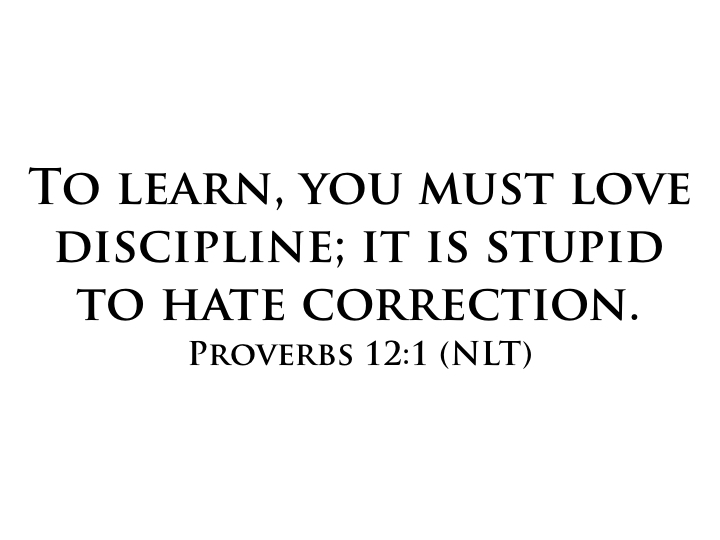
proverbs-12-1Pastor Josh Schram shared with us the lessons he’s appreciated about receiving wise counsel from those around him. One of Josh’s opening remarks really hit home with me, because it’s something I still struggle with at times: I have to get beyond thinking that those who are trying to speak into my life are somehow trying to meddle in my life!

A couple of other thoughts that really made me pause and reflect were—

“Ignorance may be bliss, but it won’t last.” How true! I may cover my eyes and ears to the truth, but my ignorance will ultimately lead to my downfall.

“People who will speak truth into my life care more about me than about my feelings.” As Proverbs says, “Wounds from a friend can be trusted, but an enemy multiplies kisses” (27:6).

Josh closed with these challenging questions:

  • Am I open to correction from wise counsel?
  • When I am corrected, do I feel like I must defend myself?
  • Are my ears open and am I really listening?

Check out this helpful message for yourself…

9 Quotes From “Of Antichrist And His Ruin”

Of Antichrist And His RuinJohn Bunyan’s works are steeped in Scripture. His thoughts about the Antichrist and other end times events are either directly taken from biblical passages, or else his line of reasoning fits perfectly with the intent of the Scriptures. You can read my full book review by clicking here. Below are some quotes I found enlightening.

“Coercion, in anything connected with religion, whether it imposes creeds, liturgies, or modes of worship, is Antichrist: whom to obey, is spiritual desolation, and if knowingly persevered in, leads to death.” —George Offor, editor

“As God therefore did put it into the hearts of the wicked kings of Babylon, to distress in His church and people for their sins; so He put it into the hearts of the kings of the Medes and Persians, who were to be, in a sense, their saviors; to ease them of those distresses, to take off the yoke, and let them go free.”

“This twenty years we have been degenerating, both as to principles, and as to practice; and have grown at last into an amazing likeness to the world, both as to religion and civil demeanor.” 

“Take heed in laying the cause of your troubles in the badness of the temper of governors. … God is the chief, and has the hearts of all, even of the worst of men, in His hand. Good tempered men have sometimes brought trouble; and bad tempered man have sometimes brought enlargement to the churches of God: Saul brought enlargement (1 Samuel 14:28). David brought trouble (2 Samuel 12:10).) Ahab brought enlargement (1 Kings 21:29). Jehoshaphat and Hezekiah did both sometimes bring trouble (2 Chronicles 19:2; 20:35; 32:25). Therefore, the good or bad tempers of men sway nothing with God in this matter; they are the sins or repentances of His people, that make the church either happy or miserable upon earth.”

“Antichrist is the adversary of Christ; an adversary really, a friend pretendedly. So then, Antichrist is one that is against Christ; one that is for Christ, and one that is contrary to Him (and this is that mystery of iniquity [2 Thessalonians 2:7]). Against Him in deed; for Him in word, and contrary to Him in practice. … Christ prefereth His Father’s will above heaven and earth: Antichrist prefereth himself and his traditions above all that is written, or that is called God, or worshiped.”

“Nor can all the fallen angels, with all the members and limbs of Antichrist, cause that their brat should abide so much as one day longer than our God’s prefixed time.”

“Now, by ordinances of Antichrist, I do not intend things that only respect matters of worship in Antichrist’s kingdom, but those civil laws that impose and enforce them also; yea, that enforce that worship with pains and penalties, as in the Spanish Inquisition. … What could the king of Babylon’s golden image have done, had it not been for the burning fiery furnace that stood within view of the worshipers (Daniel 3)? Yea, what could that horrible command, to pray for thirty days to neither God nor man, but to the king, have done, had it not been for the dark den and the roaring lions therein ready to devour those that disobeyed it (Daniel 6)? … For as the furnace would have been next to nothing, if void of fire; and the den as little frightful, if destitute of lions; so these laws will be as insignificant, when Christ has slain that spirit that is in them; that spirit that causes that as many as will not worship the image of the beast, should be killed.”

“What say ye now, ye sons of God! Will you learn to make a judgment of things according to the mystery of the wisdom of God, or will ye longer conclude according to sense and reason?”

“Cold blasts in November are not received with that gentleness as are colder in March and April; for that these last cold ones are but the farewell notes of a piercing winter; they also bring with them the signs and tokens of a comfortable summer. Why, the church is now at the rising of the year; let then the blasts at present, or to come, be what they will, Antichrist is assuredly drawing towards his downfall.”

20 More Useful Maxims

Useful MaximsI have already shared two sets of maxims from Brian Ridolfi’s great book Useful Maxims (you can read them here and here). These are some additional maxims targeting particular topics…

Maxims On Sex & Relationships

  1. When two lovers give, they each receive.
  2. Loveless sex is listless sex, and commoditized sex is lobotomized sex.
  3. Women are the gatekeepers of virtue; lost women make lost civilizations.

Maxims On Science & Philosophy

  1. The difference between science and philosophy: science attempts to answer the how questions, and philosophy the why questions.
  2. The difference between sound and unsound philosophy: good philosophy justifies itself, bad philosophy justifies the philosopher.
  3. When science becomes a god, science becomes a fraud.
  4. Atheistic theories are not necessarily scientific, and theistic theories are not necessarily unscientific.
  5. In science, the facts make the case, but in evolution, the case makes the facts.
  6. What came first, the cell or the DNA?
  7. Creationism is the enemy of scientists, not science.
  8. The theory of evolution evolved from moral devolution.

Maxims On satan & Evil

  1. A godless world is a joyless world.
  2. All is rotten after God is forgotten, and all goes sour that is under satanic power.
  3. satan is no threat to God, he is a threat to man. He is not God’s adversary, he is man’s adversary.
  4. The devil cannot make you do anything; he just makes you believe you can do anything.
  5. The way to spot satan is to know Christ.
  6. satan is not to be feared, he is to be avoided.
  7. Evil which appears godly is the most insidious form of evil.
  8. The difference between evil spirits and evil men: evil spirits know they are dead, and evil men are dead because they do not know.
  9. Allowing evil to continue is the most evil act of all.

To read some of the other quotes from Useful Maxims that I am sharing, be sure to follow me on Twitter and on Tumblr, and check out my review of Useful Maxims here.

20 More Useful Maxims

Useful MaximsFor anyone who would like to get your message to “stick” with others—like parents, pastors, teachers, coaches, mentors—I highly recommend Useful Maxims by Brian Ridolfi. You can read my book review to get more background info on this innovative book.

I previously shared 20 useful maxims from Brian’s book, and now here is my next set of 20…

  1. Strong men do not always lift weak men, but weak men always bring down strong men. The lowest common denominator dominates.
  2. You cannot force someone to be tolerant without being intolerant toward their intolerance.
  3. Offending the truth for the sake of the offended is most offensive.
  4. Just fitting in fits in with just giving in.
  5. Prayer is a slayer. To not pray is to become prey.
  6. People aligned with good are maligned by evil.
  7. There is little success when little is involved.
  8. Better to make the last move than to make the first one.
  9. Smart men run from danger; wise men avoid it altogether. Better to prevent than to lament.
  10. Your life becomes a job whenever a job becomes your life.
  11. Those with no time to spare have no time to care.
  12. Wisdom becomes foolishness when foolishness becomes wisdom.
  13. A Christian without a Bible is like a knight without a sword.
  14. Relativists believe in relativism until they or their loved ones are victims.
  15. Vinegar is not bitter to those who have not tasted honey.
  16. Questions cannot be answered if answers cannot be questioned.
  17. Sound wisdom sounds odd in a world deaf to God.
  18. Bad entertainment entertains bad behavior.
  19. Good guys look bad when bad guys look good.
  20. To help the helpers is to help the helpless.

To read some of the other quotes from Useful Maxims that I am sharing, be sure to follow me on Twitter and on Tumblr.

20 Useful Maxims

Useful MaximsI thoroughly enjoyed reading Useful Maxims by Brian Ridolfi (check out my review of his book by clicking here). Here are 20 of Brian’s useful maxims that caught my highlighter.

  1. Going to church is good; going to God is better.
  2. Progress is not good if you are progressing in the wrong direction.
  3. Good demeanor does not validate bad behavior.
  4. Broken commandments break down integrity.
  5. The Bible’s meaning is not hidden from men; men hide from its meaning.
  6. Actions are better indicators of character than rhetoric.
  7. The indifferent make no difference.
  8. Remaining weak takes strength. It takes power not to use power.
  9. Great men step in when everyone else steps out.
  10. Moral arguments which are entirely material are entirely immaterial.
  11. Peacemakers and saltshakers dispense enrichment.
  12. A grudge will keep you deep in sludge. Points of contention are points of retention.
  13. Revenge is hard to reverse.
  14. Never put faith in people who have no faith.
  15. Everything goes when anything goes.
  16. Your sin is not just your problem.
  17. Parental neglect prompts government parenting.
  18. Where no one fears God, everyone fears man.
  19. The right battle is lost with the wrong weapon.
  20. Insecurity secures instability.

Watch for more maxims soon. Or follow me on Twitter and Tumblr to read some of Brian Ridolfi’s maxims.

Useful Maxims (book review)

Useful MaximsKing Solomon had his maxims—Wounds from a friend can be trusted, but an enemy multiplies kisses. Benjamin Franklin had his maxims—A stitch in time saves nine. And now Brian Ridolfi gives us a book of fresh Useful Maxims.

Maxims are short, catchy, and very memorable; a brief, succinct statement that captures profound wisdom in a way that’s easy to recall at the appropriate time. Parents, teachers, pastors, and coaches have all sought ways to get their message across to their young charges, and have those messages come back to the forefront of their mind at crucial moments. This is where an appropriate maxim can be so helpful.

Useful Maxims is organized in broad chapter headings, and then the individual maxims are grouped together in various sub-headings throughout each chapter. Most of them are short—He who exalts himself halts himself—but occasionally Brian shares a short parable along with its memorable meaning.

If you are involved with instructing others, and want to find a way to have your point “stick” in their memory, Useful Maxims will become an invaluable, go-to tool for your lesson plans.

5 Differences Between Wisdom And Folly

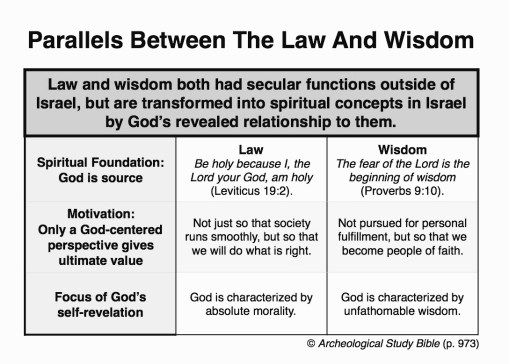
Parallels between law and wisdomIn Proverbs 9, Wisdom and Folly are both personified as women. And both of them call out the same thing to their would-be followers: “Let all who are simple come in here!” (vv. 4, 16). They both claim to have ‘the goods’ for those searching for truth, but here are five things that separate them.

  1. Wisdom has built her own house (v. 1); but Folly merely occupies someone else’s house (v. 14).
  2. Wisdom has like-minded “maids” who support her (v. 3); but Folly has no supporters.
  3. Wisdom serves what she has prepared herself (vv. 2, 5); but Folly steals from others because she has nothing original to offer (v. 17).
  4. Wisdom corrects, and that correction leads to deeper knowledge (vv. 8-10); but Folly lets people do whatever they wish, which only leads to deeper suffering (v. 13).
  5. Wisdom offers life (vv. 6, 11), insight (v. 9), the fear of God (v. 10), and rewards (v. 12); but Folly only offers suffering (v. 12) and death (v. 18).

How ironic that some people respond to Folly’s call, “Let all who are simple come in here,” and yet they act like they know it all already, not wanting to learn anything new.

Bottom line: If you are willing to learn, Wisdom has much to teach you. But if you know it all already, best to just hang out with Folly.

Links & Quotes

link quote

“Christ did not risk death. He embraced it. That is precisely why He came: not to be served but to serve and give His life a ransom for many (Mark 10:45). … Christmas is for freedom. Freedom from the fear of death. Jesus took our nature in Bethlehem, to die our death in Jerusalem, that we might be fearless in our city. Yes, fearless. Because if the biggest threat to my joy is gone, then why should I fret over the little ones?” —John Piper

“The danger of all dangers would be to lose trust and confidence in the mercy of God. … To distrust Him would be a far more terrible thing than any physical evil which all the enemies of God put together could inflict on us, for without God’s permission neither the devils nor their human ministers could hinder us in the slightest degree.” —Francis Xavier

“Each instant of present labor is to be graciously repaid with a million ages of glory.” —J.W. Alexander

“If God did so much for us when enemies, what will He do, or rather, what will He not do, for us now that we are friends? … If Christ’s death did so much for us, what will not His life do?” —Horatius Bonar

“Ignorant men raise questions that wise men answered a thousand years ago.” —Goethe

[VIDEO] Tim Dilena shares some practical keys for a consistent prayer life.

“I would exhort those who have entertained an hope of their being true converts, and yet since their supposed conversion have left off the duty of secret prayer, and do ordinarily allow themselves in the omission of it, to throw away their hope. If you have left off calling upon God, it is time for you to leave off hoping and flattering yourselves with an imagination that you are the children of God.” —Jonathan Edwards

“For too many of us, Christian experience is episodic rather than continuous, with a few religious experiences interspersed throughout our lives, which are otherwise lived on our own terms. Such people can see little need or use for prayer.” —Ralph Lehman

Eric Metaxas helps us get ready for Religious Freedom Day on January 16.

[VIDEO] Not just at Christmas when you are receiving gifts, but all year long we should be people of appreciation. Check out John Maxwell’s short video—

Christmas Wisdom From Ebenezer Scrooge

Scrooge and ghostI have been listening to an audio production of Charles Dickens’ Christmas Carol. The one I’m listening to is a podcast performed by Patrick Horgan (very well done!).

Two things have stood out to me—

(1) The genius of Charles Dickens. Check out this brilliant piece of wit.

“Marley was dead, to begin with. There is no doubt whatever about that. The register of his burial was signed by the clergyman, the clerk, the undertaker, and the chief mourner. Scrooge signed it. And Scrooge’s name was good upon change for anything he chose to put his hand to. Old Marley was as dead as a door-nail. Mind! I don’t mean to say that I know, of my own knowledge, what there is particularly dead about a door-nail. I might have been inclined, myself, to regard a coffin-nail as the deadest piece of ironmongery in the trade. But the wisdom of our ancestors is in the simile; and my unhallowed hand shall not disturb it, or the Country’s done for. You will, therefore, permit me to repeat, emphatically, that Marley was as dead as a door-nail.”

(2) The biblical message which comes through so vividly.

“But you were always a good man of business, Jacob,” faltered Scrooge, who now begin to apply this to himself.

“Business!” cried the Ghost, ringing its hands again. “Mankind was my business. The common welfare was my business; charity, mercy, forbearance, and benevolence were, all, my business. The dealings of my trade were but a drop of water in the comprehensive ocean of my business!”

It held up its chain at arm’s length, as if that were the cause of all its unavailing grief, and flung it heavily upon the ground again.

“At this time of the rolling year,” the spectre said, “I suffer most. Why did I walk through crowds of fellow-beings with my eyes turned down, and never raise them to that blessed Star which led the Wise Men to a poor abode? Were there no poor homes in which its light would have conducted me?” (emphasis mine)

How To Be Wise With Your Mouth And Ears

A fool finds no pleasure in understanding but delights in airing his own opinion. (Proverbs 18:2)

One’s open mouth—and closed ears and mind—says a lot of one’s heart! In this 18th chapter of Proverbs, Solomon draws a pretty stark contrast between the mouth and ears of a fool and of a wise person. Check out the links on each of the verses to Bible Gateway to get a full picture of both the fool and the wise person.

Big MouthThe fool…

  • His lips bring him trouble, a smack on the jaw, and may even cost him his life. And yet he keeps on spouting foolishness. He’s not interested in getting any better (vv. 6, 7).
  • His ears gobble up the latest gossip (v. 8).
  • He fires off an answer before really listening (v. 13).
  • His quick, careless words creates the poison food that he continues to eat (v. 21).

The wise…

  • He is always learning how to use his words in a God-honoring, soul-benefitting way (v. 4).
  • He avoids “cheap candy” gossip (v. 8).
  • He listens fully before trying to respond (v. 13).
  • He asks good, clarifying questions (v. 17).
  • His wise words creates the healthy food that nourishes him (v. 20).

So… are you being wise or foolish with your mouth and ears?