Gentle Correction

As a parent (and a pastor), delivering correction is one of my least favorite things to do. But it must be done.

The apostle Paul seemed to feel the same way. We get some insight into his heart in his letter to the Corinthians, where he reminds them of why he had to write such a stern letter of correction.

For I wrote to you out of great distress and anguish of heart and with many tears, not to grieve you but to let you know the depth of my love for you. (2 Corinthians 2:4)

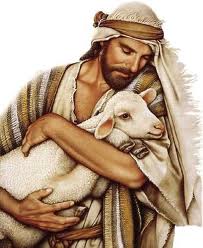
The loving shepherd’s heart longs for the advancement, the betterment, of all the sheep under his care. He is hurt when his sheep are wounded. His approach to discipline is always gentle; not weak, but strength lovingly applied.

The loving shepherd looks at his own life first, before correcting the sheep, to address anything he may have done or failed to do which caused the sheep to stray.

The loving shepherd knows that discipline may be painful for a moment, but it is to bring greater life. Just as a parent will allow a child to suffer the momentary pain of an immunization injection, to spare that child the unbearable pain of a disease later on.

And the loving shepherd always approaches a time of correction with “confidence in all of you, that you would all share my joy” (v. 3). The shepherd doesn’t view them as “dumb sheep” that cannot improve; rather, he is confident and assured that they will receive loving correction and make the change that leads to joy for all.

UPDATE: If you want to dive deeper into the ideas of being a shepherd leader, please check out my book Shepherd Leadership: The Metrics That Really Matter.

What Is Successful Church Ministry?

I like to keep asking myself and my leadership team this question: How do we know if our church is successful? 

The apostle Paul uses two words to help answer these questions: Quality and Faithfulness.

But each one’s work will be shown for what it is; the Day will disclose it, because it will be revealed by fire—the fire will test the quality of each one’s work. (1 Corinthians 3:13)

Now it is required that those who have been given a trust must prove faithful. (1 Corinthians 4:2)

So here are two important questions we need to ask ourselves:

  • Am I doing quality work?
  • Am I faithfully doing my work?

To help answer those questions, I like this thought from Leonard Sweet’s book I Am A Follower:

“The most important metrics we must rely on, the crucial ‘deliverables’ we can present, must focus on the newly formed lives of the disciples we are making, the followers who are following Christ into a place of serving Him by serving others. The most important measure of our faithfulness to Christ must be the extent of transformation into the living image of Christ Himself. …

The quantifiable fruit of our church is not found in the number of people we can gather on a weekly basis. What counts is what is happening in the lives of those who have gathered. …It is quite possible to have a ‘successful’ life—and a ‘successful’ church—without God. But it is absolutely impossible to have a truly fruitful one.”

Again, Paul’s advice here is invaluable:

My conscience is clear, but that does not make me innocent. It is the Lord who judges me. Therefore judge nothing before the appointed time; wait till the Lord comes…. (1 Corinthians 4:4, 5)

Pastor, you need to think about these questions about “success.” But they should be questions framed around your quality and faithfulness of work as revealed to you by the Holy Spirit, not by some “expert” or anyone else.

(By the way, if you’re interested in exploring this further, I framed this question a different way in this post.)

UPDATE: This post was one of the seed thoughts that went into fashioning my book Shepherd Leadership: The Metrics That Really Matter.
A Warning To Shepherds

If you are a pastor, God sees you as a shepherd (see John 21:15-17; 1 Peter 5:1-4).

If you are a shepherd, there is a heavy responsibility on you to lovingly, attentively care for God’s precious sheep. We cannot shirk this responsibility for even a moment.

God loves His sheep so much that He gave His sheep YOU!

God loves His sheep so much that He will remove you, if He has to.

Consider this:

“What sorrow awaits the leaders of My people—the shepherds of My sheep—for they have destroyed and scattered the very ones they were expected to care for,” says the Lord. Therefore, this is what the Lord, the God of Israel, says to these shepherds: “Instead of caring for My flock and leading them to safety, you have deserted them and driven them to destruction. Now I will pour out judgment on you for the evil you have done to them. …Then I will appoint responsible shepherds who will care for them, and they will never be afraid again. Not a single one will be lost or missing. I, the Lord have spoken!” (Jeremiah 23:1, 2, 4)

This is a HEAVY word, and should not be taken lightly.

Pastor, never assume you are leading God’s sheep in the right paths. Ask the Holy Spirit to tell you if you are leading God’s sheep in the right paths!

UPDATE: This post was one of the seed thoughts that went into fashioning my book Shepherd Leadership: The Metrics That Really Matter.

What Is “Success” For A Church?

“How’s it going,” a fellow pastor asked me. “How’s your church doing?”

If you’re a pastor, you probably get asked this often. How do you answer this question? Do you tell them what your attendance was on Sunday morning? Or about the newest program you’ve started?

When you look in the mirror and ask yourself, “How’s it going,” is your answer related to nickels and noses (offerings and attendance)? Is it how many people complimented your last sermon?

Listen to these sobering words:

Worldliness is not the trap that most endangers us as Christian workers; nor is it sin. The trap we fall into is extravagantly desiring spiritual success; that is, success measured by, and patterned after, the form set by this religious age in which we now live. 

We have a commercialized view—we count how many souls have been saved and sanctified, we thank God, and then we think everything is all right. (Oswald Chambers)

We need to be very careful about how we define “success” in a church setting. Let’s use Jesus as our example:

  • How big was His congregation? Twelve men. One betrayed Him, nine ran away when the going got tough, and one denied he even knew Him. Even after being raised from the dead (!) there were only 120 people in the upper room.
  • How much money did His church have? Not even enough to buy a gravesite for the Messiah.
  • What did people think of His sermons? Some of His sermons made people so mad they wanted to stone Him. And after one sermon the Bible says: From this time many of His disciples turned back and no longer followed Him (John 6:66).

Maybe “success” in the church is more like…

  • …people being reconciled to God. Remembering that “our work is not to save souls, but to disciple them” (Chambers).
  • …seeing disengaged people becoming actively involved in engaging others with the Gospel.
  • …“Never seek[ing] after anything other than the approval of God” (Chambers).
  • …to say with Jesus, “The Spirit of the Lord is on Me, because He has anointed Me to preach good news to the poor. He has sent Me to proclaim freedom for the prisoners and recovery of sight for the blind, to release the oppressed, to proclaim the year of the Lord’s favor” (Luke 4:18-19).

These are just some of my thoughts. What else should be on this list? How would you define “success” in the church?

I have also shared some questions that can help pastors and ministry leaders better gauge the level of effectiveness in their ministry.

UPDATE: This post was one of the seed thoughts that went into fashioning my book Shepherd Leadership: The Metrics That Really Matter.
Pet (Pastoral) Peeve

One of my biggest pet peeves is hearing pastors say, “Ministry would be great if it weren’t for the people.”

Pastor: People ARE your ministry!

After Christ’s resurrection, He wanted to help restore Peter. Jesus asked Peter a simple question, “Do you love Me?” When Peter acknowledged that he did, Jesus gave Peter a way to show it: “Feed My sheep.” I believe this exchange is what Peter had in mind when he penned the words,

Be shepherds of God’s flock that is under your care, serving as overseers—not because you must, but because you are willing, as God wants you to be; not greedy for money, but eager to serve; not lording it over those entrusted to you, but being examples to the flock. (1 Peter 5:2-3)

Is it hard to be a shepherd? Yes.

Are some sheep difficult to shepherd? Yes.

Is it worth it to shepherd them? Yes, yes, YES!!

I love Oswald Chambers’ insight on this:

“Jesus has some extraordinarily peculiar sheep: some that are unkempt and dirty, some that are awkward or pushy, and some that have gone astray! But it is impossible to exhaust God’s love, and it is impossible to exhaust my love if it flows from the Spirit of God within me. The love of God pays no attention to my prejudices caused by my natural individuality. If I love my Lord, I have no business being guided by natural emotions—I have to feed His sheep.”

Jesus, increase my capacity to love Your sheep. All of Your sheep—the ones that bite; the ones that are nice; the ones that are untidy; the ones that are clean; the ones that are thankful; the ones that are ungrateful; the ones that “get it”; the ones that don’t. All of YOUR sheep. Thank You, Lord, for the supreme honor and heavy responsibility of serving as Your under-shepherd.

UPDATE: This idea of pastors as shepherds is what drove me to write my book Shepherd Leadership: The Metrics That Really Matter. I hope you will pick up a copy today!
Was Your Church Successful?

These thoughts are especially for my fellow pastors (although I think they pertain to anyone who attended a church service recently).

So… how successful was your church gathering this weekend?

Was it successful because lots of people were there? Or because the pastor preached a good sermon? Or maybe the offering was better than usual? Or because you could feel something special as the worship team sang and played their instruments?

How about these measurements:

“The great business of the church is not our number by addition, but by grace, by growing up in Christ.” (John Owen)

“The perfect church service would be one we were almost unaware of. Our attention would have been on God.” (C.S. Lewis)

“Revival is the church getting back to ‘normal.’” (A.W. Tozer)

I hope these quotes have you thinking about church “success” as much as they are working on me!

UPDATE: This post was one of the seed thoughts that went into fashioning my book Shepherd Leadership: The Metrics That Really Matter.
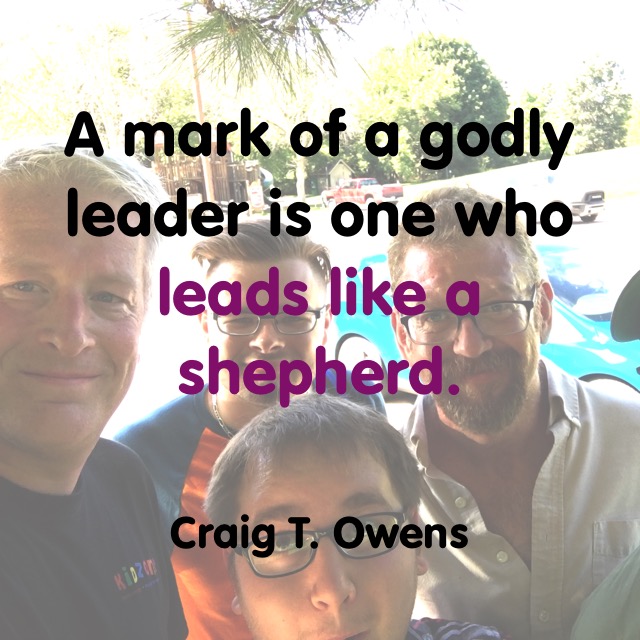
Baaaa!

Listen to the podcast of this post by clicking on the player below, and you can also subscribe on AppleSpotify, or Audible.

Of all the things God could have used as a picture of our relationship with Him, He used an animal. And, no, it wasn’t an animal that seems particularly powerful or smart or noble.

He picked a sheep.

A fuzzy, sometimes dimwitted, needs-a-lot-of-help animal.

I’m a sheep. Baaaa!

But then I have the great picture of God as my loving Shepherd. How wonderful to know that the Lord is my Shepherd, I shall not be in want!

As a pastor I am called to be the shepherd to God’s flock of sheep under my watchful eye. Jesus set the example for me:

But the one who enters through the gate is the shepherd of the sheep. The gatekeeper opens the gate for him, and the sheep recognize his voice and come to him. He calls his own sheep by name and leads them out. After he has gathered his own flock, he walks ahead of them, and they follow him because they know his voice.

And Solomon said:

Be sure you know the condition of your flocks, give careful attention to your herds.

Pastors, here are the questions I’m asking of myself, and I invite you to ask them of yourself too:

  • Do my sheep recognize my voice? Or am I trying to sound like someone else?
  • Do I know all my sheep by name?
  • Are my sheep following me as I follow Jesus?
  • Am I willing to go first?
  • Do I find fresh pastures and clean water for my sheep? Or is it recycled food I’m serving them?
  • Am I spending enough time with my sheep to know the condition of each one?
  • Do my sheep get my undivided attention?

What a privilege to be a pastor! What a responsibility! What a joy to know my sheep and to be known by them!

Baaaa!

UPDATE: This post was one of the seed thoughts that went into fashioning my book Shepherd Leadership: The Metrics That Really Matter.
►► Would you please prayerfully consider supporting this ministry? ◀︎◀︎

An Extra Hour Of Sleep

I’m a morning person. I absolutely love getting up early and spending some quiet time alone with my Bible. This is the time of day I most absorb all that God is saying to me. It’s my most creative time too. In fact, I so love getting up early that most mornings I’m awake before my alarm clock goes off.

But not this morning.

Today my alarm clock began playing Way-FM and I felt like I was in a fog. It took me a minute or so to even open my eyes and sit up.

I was about to press ahead with my morning, when I thought, “I should sleep some more.”

You see, I’ve learned a few things about myself. When I’m tired…

  • I have a shorter attention span.
  • I’m not as creative.
  • I’m not as patient.
  • I am more prone to give in to temptation.
  • I make decisions that are too short-sighted.
  • I’m more susceptible to colds and flu.

So I re-set the alarm and slept another hour.

Sometimes a little extra sleep is one of the most important things you can do to improve your physical health, your emotional stamina, and your spiritual maturity.

UPDATE: In my book Shepherd Leadership: The Metrics That Really Matter I have five chapters about a leader’s health—mental, physical, spiritual, and emotional health is vital to a leader’s effectiveness and longevity.

Tick, Tock! Drip, Drop!

Tick, Tock! “There just is never enough time in my day!”

Tick, Tock! “Wow, this day has just flown by and I got nothing done!”

Tick, Tock! “Why do I always have so much To Do List left at the end of my week?”

May I suggest that instead of Tick, Tock! you focus on Drip, Drop!

(The data compiling website Flowing Data has a fascinating look at how men and women of all ages spend their time throughout the day.)

I’ve gotten some great insight on time usage from Paul Meyer. Check it out:

“Most time is wasted, not in hours, but in minutes. A bucket with a small hole in the bottom gets just as empty as a bucket that is deliberately emptied.”

Usually our time doesn’t just Tick! by, it Drips! by. In other words, it’s really easy to spot the huge time-wasters; it’s much more difficult to find the time-leakers. But they can be found and plugged. Listen to more good advice from Dr. Meyer:

“Time is usually wasted in the same way every day.”

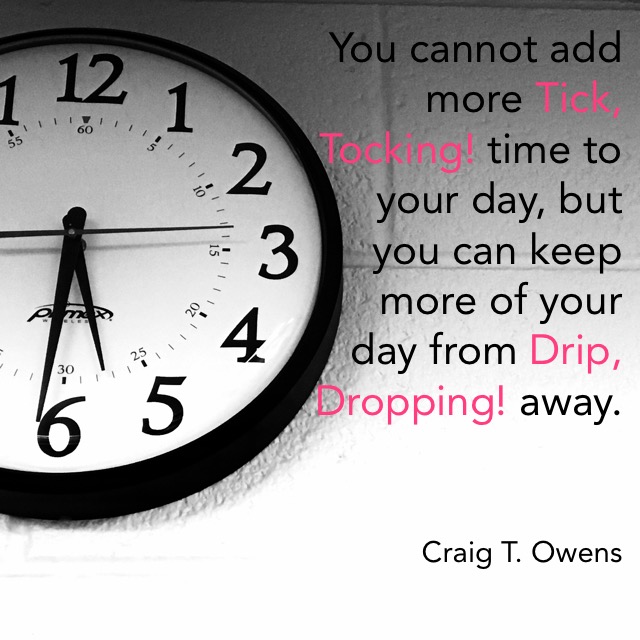
You cannot add more Tick, Tocking! time to your day, but you can keep more of your day from Drip, Dropping! away. Here are two things I’ve done which have really helped me:

  1. For one week (7 full days) I kept a log of how I spent every 15-minute increment. This might sound like a Drip, Drop! thing to do, but I was amazed at how many leaks I discovered after a week of doing this.
  2. Then I prayed the same prayer Moses prayed, “Give me wisdom to use my days the right way.”

If you can identify the time leaks, God can give you the wisdom to help you plug them. When you can control the Drip, Drop! you’ll get more out of your Tick, Tock! each day.

UPDATE: The thoughts in this chapter became a whole chapter in my book Shepherd Leadership. The chapter is called ‘Can’t, Won’t, or Don’t,’ and it addresses the three attitudes that hold us back from stewarding our time.