Preying Or Praying

Listen to the podcast of this post by clicking on the player below, and you can also subscribe on AppleSpotify, or Audible.

I wrapped up our Ticked Off! series yesterday with a sad story. It appears right in the opening pages of the Bible, and it’s a story where one man’s anger preys on him, like a lion on a wounded animal.

Now Able kept flocks, and Cain worked the soil. In the course of time Cain brought some of the fruits of the soil as an offering to the Lord. But Able brought fat portions from some of the firstborn of his flock. The Lord looked with favor on Able and his offering, but on Cain and his offering He did not look with favor. So Cain was very angry, and his face was downcast. 

Then the Lord said to Cain, “Why are you angry? Why is your face downcast?” If you do what is right, will you not be accepted? But if you do not do what is right, sin is crouching at your door; it desires to have you, but YOU MUST MASTER IT.” (Genesis 4:2-7, emphasis added)

We’re not sure exactly why “the Lord looked with favor on Able and his offering, but not on Cain and his offering.” Except we know that the Bible says obedience is better than sacrifice. In other words, it’s not what they brought as a sacrifice, but how they brought their sacrifice. Apparently, Able’s heart was worshipful and Cain’s was begrudging.

Able’s heart was focused on God; Cain’s heart was focused on himself. That’s why Cain became so selfishly angry, because he wasn’t getting what he thought he deserved!

This anger was setting up Cain for disaster. Anger itself is not a sin, but unaddressed anger can put us on a slippery slope toward sin!

Notice God told Cain, “YOU must master it.” God can’t help us until we stop trying to help ourselves. God wants to help us defeat the crouching lion of sin, but we have to ask him to help us.

Sadly, there is no biblical record of Cain asking God for His help. Instead in the next verses Cain—so consumed by his anger that he cannot think straight—murders his own brother. Cain was preyed upon by anger because Cain didn’t pray about his anger.

The devil is looking for any opening at all where he can pounce on you. And Ephesians 4:26-27 says that unaddressed anger is just such an opening. Don’t let your anger defeat you as it did Cain. Confess your anger to God (Psalm 32:1-5) and let God help you defeat the crouching lion of anger.

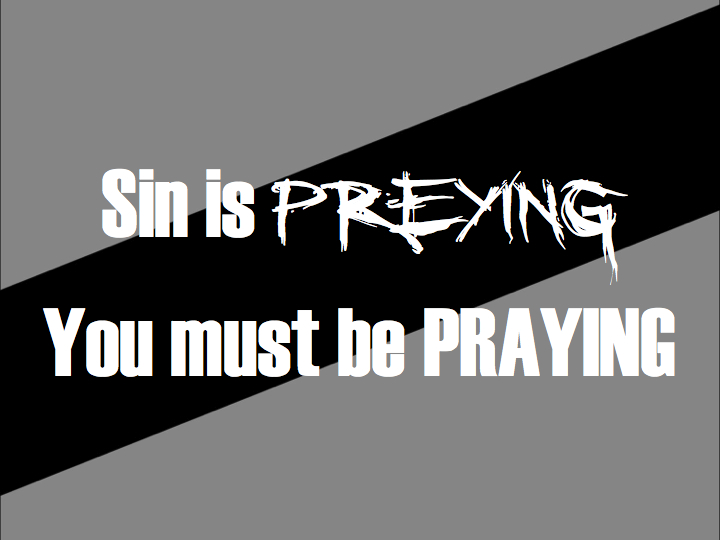
Sin is PREYing. You must be PRAYing.

If you want to check out the other messages in our series called Ticked Off! you may click here.

►► Would you please prayerfully consider supporting this ministry? My Patreon supporters get behind-the-scenes access to exclusive materials. ◀︎◀︎

Don’t Play The Fool

Listen to the podcast of this post by clicking on the player below, and you can also subscribe on AppleSpotify, or Audible.

You probably know this already: Once you get boiling mad, it’s hard to see things objectively anymore. You get steamed up—ticked off!—and you are on a no-detours course to “make things right.”

You might say things like…

  • “They need to know what they did wrong!”
  • “He’s got this coming to him!”
  • “She needs to get a taste of her own medicine!”

The unspoken completion of all of those phrases is the dangerous part. What we’re really saying is, “He needs to know what he did wrong, and I’m just the one to tell him!” Or, “She needs to get a taste of her own medicine, and I’m just the one to dispense that prescription to her!

It’s been said that action has killed its thousands; reaction its tens of thousands.

Did he hurt you? Yes!

Is he a jerk for doing so? Absolutely!

Should he get punished for it? Probably!

Are you the one to do it? No. No! NO!

He played the fool… Don’t sink to his level and play the fool yourself! 

Wise King Solomon said:

Do not answer a fool according to his folly, or you will be like him yourself. (Proverbs 26:4)

A fool gives full vent to his anger, but a wise man keeps himself under control. (Proverbs 29:11)

So what can you do to the one who injured you?

The best thing you can do is to FORGIVE HIM!

That’s right: leave him in God’s hands. Let the All-Righteous Judge deal with him. Don’t stay wounded, because you are continuing to allow your injurer to keep you trapped, to keep you wounded. Leave him in God’s hands by taking your hands off of him!

Never pay back evil with more evil. Do things in such a way that everyone can see you are honorable. Do all that you can to live in peace with everyone. Dear friends, never take revenge. Leave that to the righteous anger of God. (Romans 12:17-19)

Don’t play the fool! Forgive him and let God take it from there.

If you want to check out the other messages in our series called Ticked Off! you may click here.

►► Would you please prayerfully consider supporting this ministry? My Patreon supporters get behind-the-scenes access to exclusive materials. ◀︎◀︎

It’s Not Anger Management

Listen to the podcast of this post by clicking on the player below, and you can also subscribe on AppleSpotify, or Audible.

Aristotle had an insightful quote that was almost accurate—

“Anybody can become angry—that is easy; but to be angry with the right person, and to the right degree, and at the right time, and for the right purpose, and in the right way—that is not within everybody’s power and is not easy.”

I agree with most of this, but I would argue that it’s not within anybody’s power to express their anger in the right way.

The Bible says that our challenge is to not sin when we are angry (Ephesians 4:26). But most anger is selfishly provoked. That means, I’m angry because I have been offended, or my “rights” have been violated, or someone injured me.

If my anger has been selfishly provoked, how can I be expected to express my anger in any other fashion but selfishly?!

Instead of me trying to manage my anger, I need to listen to the Holy Spirit’s voice. There is one important question the Spirit asks us (which comes from Jonah 4:9)—

Do you do well to be angry?

  • Is it good for me to be angry with this? or should I let this go?
  • Is my anger righteously provoked? or is it selfishly provoked?
  • Does this grieve the Holy Spirit (Isaiah 63:10)?

God’s Spirit within you is never silent. He will either confirm that your anger is righteously provoked (as it was with Jesus in John 2:13-17), or it’s selfishly provoked (as it was with Jonah). That’s why you must ask yourself that question and allow the Holy Spirit to help you answer it: Do I do well to be angry?

If you answer “yes,” and the Holy Spirit confirms this in your heart, then He will help you to be angry with the right person, and to the right degree, and at the right time, and for the right purpose, and in the right way (as Aristotle said).

And if you answer “no,” the Holy Spirit is the only one who can help put out the flames of your anger in a healthy way.

So don’t try to manage your temper. Listen to the Holy Spirit asking you, “Do you do well to be angry?” And let Him guide you from there.

If you want to check out the other messages in our series called Ticked Off! you may click here.

►► Would you please prayerfully consider supporting this ministry? My Patreon supporters get behind-the-scenes access to exclusive materials. ◀︎◀︎

4 Myths About Your Temper

This morning I shared with my congregation—in part one of our Ticked Off! series—three myths about anger. I want to add a fourth here…

1.  Anger is a sin. 

God is angry numerous times; in fact, the Old Testament alone has hundreds of verses that mention God’s anger. In the New Testament, Ephesians 4:26 says, “…in your anger do not sin….” It doesn’t say, “don’t get angry,” but “when you’re angry, don’t sin.”

2.  Anger is always destructive. 

Some great advances have been brought about by people who got angry. For instance, Martin Luther, the father of the reformation, wrote, “When I am angry I can write, pray, and preach well, for then my whole temperament is quickened, my understanding sharpened, and all mundane vexations and temptations gone.”

3.  Anger doesn’t affect me.

Anger affects you physically. In one medical study researchers found that people who had strokes were more likely to have experienced anger in the two hours prior to having their stroke. It also affects your relationships. After you blow up, people close to you are injured and began to distance themselves from you.

4.  I can manage my anger.

Anger has a tendency to completely seize you, making it next to impossible to manage the furnace of emotions that is raging inside you. You cannot manage your anger! Instead, you need God’s help.

Check out the messages in this series by clicking here.

Ticked Off!

Have you ever been so angry that you couldn’t see straight?

Has someone ever pushed all your buttons?

Have you ever worked with someone who knew how to get on your very last nerve?

I can’t imagine anyone answering “No” to these questions. Of course, we all get mad. The real issue is what do we do when we get there?

More specifically: what’s a Christian to do when he or she gets thoroughly ticked off?

Starting this Sunday, I’m going to be exploring this topic, and I hope you can join me. We’ll be looking at what the Bible has to say about what we are supposed to do with these strong emotions. If you missed any of these messages, check them out here:

Prayer Before Words, Prayer After Words

Pastor, as you are putting the finishing touches on your message for Sunday, even as you are getting ready to begin the service, consider this counsel from Augustine of Hippo—

“He should be in no doubt that any ability he has and however much he has derives more from his devotion to prayer than his dedication to oratory; and so, by praying for himself and for those he is about to address, he must become a man of prayer before becoming a man of words. As the hour of his address approaches, before he opens his thrusting lips he should lift his thirsting soul to God so that he may utter what he has drunk in and pour out what has filled him.”

Pray for yourself—that you would be a living example of what you preach.

Pray for your vocabulary—that the Holy Spirit would direct your words.

Pray for your ego—that you would not be puffed up nor brought down by the people’s response.

Pray for your congregation—that they would receive and apply the Word of God.

Pray for your community—that they would desire the life of Christ that is evident in you and your congregation.

And on Monday morning perhaps you will pray this prayer of commitment from Augustine—

Breathe in me, O Holy Spirit, that my thoughts may all be holy. 

Act in me, O Holy Spirit, that my work, too, may be holy. 

Draw my heart, O Holy Spirit, that I love but what is holy. 

Strengthen me, O Holy Spirit, to defend all that is holy. 

Guard me, then, O Holy Spirit, that I always may be holy. 

Amen.

I’m praying for you this weekend!

Counsel From Billy Graham

There are very few people who bring to mind such a picture of ministry success, passion for lost souls, and total integrity like Billy Graham.

So for my pastor friends, here are a few quotes from this renowned preacher about study habits, sermon preparation, and message delivery.

“The sword of the Spirit—the Bible—is the weapon God has provided for us to use in this battle between truth and deception. Make it a priority to wield that sword skillfully.”

“If I stick to the Bible and preach the principles and the teachings of the Bible, and quote the Bible, it has an impact of its own.”

“The fact that God is infinite makes the study of His Word a lifetime occupation.”

“A seminary professor I once knew told his students, ‘Never preach about hell without tears in your eyes.’”

“Our preaching emerges out of what we are.”

“Sometimes I’m asked to list the most important steps in preparing for an evangelistic mission, and my reply is always the same: prayer . . . prayer . . . prayer.”

“Preach with authority. The authority for us is the Word of God. Preach with simplicity . . . Preach with urgency . . . Heaven and Hell are at stake. Preach for a decision.”

“Proclaiming ‘the whole will of God’ should be the goal—and the joy— of every church and every preacher.”

“When we preach or teach the Scripture, we open the door for the Holy Spirit to do His work. God has not promised to bless oratory or clever preaching. He has promised to bless His Word.”

“It is vitally important for local church leaders to keep in touch with the spiritual state of their members, to discuss their level of biblical knowledge, and to teach them how to study God’s Word and pray.”

Why Do You Read The Bible?

Do you exercise? Why? What’s the purpose of all of your exercises? To get stronger? To last longer? To get or stay healthy? Yes! But to what end? Why do you want to be stronger, have greater endurance, or better health?

I could ask the same question regarding the spiritual realm: Why would you want to do a spiritual workout? To quote more Bible verses? To have more endurance in prayer? But why do you want to know more of the Bible, or pray better or longer?

Our goal should be simply this: To know God more intimately.

We have to be careful about being so focused on the workout that we miss the purpose (or should I say the Person). Andrew Murray wrote this:

“Christian! there is a terrible danger to which you stand exposed in your inner chamber. You are in danger of substituting Prayer and Bible Study for living fellowship with God, the living interchange of giving Him your love, your heart, and your life, and receiving from Him His love, His life, and His spirit. Your needs and their expression, your desire to pray humbly and earnestly and believingly, may so occupy you, that the light of His countenance and the joy of His love cannot enter you. Your Bible Study may so interest you, and so waken pleasing religious sentiment, that—yes—the very Word of God may become a substitute for God Himself, the greatest hindrance to fellowship because it keeps the soul occupied instead of leading it to God Himself.”

Our spiritual workouts should help us integrate God’s presence into our souls. He is not just someone that we know about; He is the One we know. The One we have let into our hearts. The One who is at the very center of our being. He is the CORE of who we are.

So then, just as you received Christ Jesus as Lord, continue to live in Him. Have the roots [of your being] firmly and deeply planted [in Him, fixed and founded in Him], being continually built up in Him, becoming increasingly more confirmed and established in the faith, just as you were taught, and abounding and overflowing in it with thanksgiving. (Colossians 2:6-7 AMP)

Don’t lose sight of WHY you read the Bible, and respond in prayer; of why you glorify God and enjoy Him forever; of why you go through your spiritual workouts. You do all of this because Christ is in you, and you are in Christ, and you want to strengthen this core relationship, and let everything else that you do flow out from this core!

If you have missed any of the messages in our P119 series, you can access them all by clicking here.

Saint Augustine And My Prezi

Several people have asked for some of the materials I shared this morning in our final installment of the P119 Spiritual Workout series.

Two quotes from Augustine—

“You stir us up to take delight in Your praise.”

“O Lord, my God, tell me what You are to me. Say to my soul, I am your salvation. Say it so that I can hear it. My heart is listening, Lord; open the ears of my heart and say to my soul, You are my salvation. Let me run toward this Voice and seize hold of You.”

And the link to the Prezi we used this morning can be found by clicking here.

I absolutely loved diving into Psalm 119 with my church! It’s a fascinating chapter, that I hope everyone will continue to use as their spiritual workout.

Insights From Oswald Chambers On Sermon Preparation

When Oswald Chambers taught at the Bible Training College in London, he frequently presented his lectures in a short, bullet-point format to give his students something to ponder.

Here are some of the “bullet points” he shared for sermon preparation:

“The greatest thing is not to hunt for texts, but to live in the big comprehensive truth of the Bible and the texts will hunt you.”

“To talk about ‘getting a message,’ is a mistake. It is preparation of myself that is required more than of my message.”

“To develop your expression in public you must do a vast amount of writing in private. Write out your problems before God. Go directly to Him about everything.”

“The work we do in preparation is meant to get our minds into such order that they are the service of God for His inspiration.”

“Conscious inspiration is mercifully rare or we would make inspiration our god.”

“Spiritual insight is in accordance with the development of heart-purity.”

“Spiritual sloth must be the greatest grief to the Holy Ghost.”

“In order to expound a passage, live in it well beforehand. Keep yourself full with reading. Reading gives you a vocabulary. Don’t read to remember; read to realize.”

“Get moved by your message, and it will move others in a corresponding way.”

I found these very thought-provoking. What did you learn?