12 Quotes From “12 Huge Mistakes Parents Can Avoid”

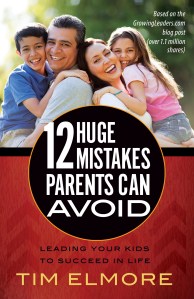
12 Huge MistakesI highlighted a lot in Tim Elmore’s newest book 12 Huge Mistakes Parents Can Avoid … a lot! This is book that every parent (or grandparent) should read because it’s never too late to invest the best in our (grand)children. You can read my full book review of this must-read book by clicking here. Below are just a few of the quotes I highlighted in this book.

“I believe we have under-challenged kids with meaningful work to accomplish. We have overwhelmed them with tests, recitals, and practices, and kids report being stressed-out by these activities. But they are essentially virtual activities. Adults often don’t give significant work to students—work that is relevant to life and could actually improve the world if the kids rose to the challenge. We just don’t have many expectations of our kids today.” 

“Every parent and teacher wants to see their kids succeed in school, in sports, and in life, but making it impossible to fail isn’t the answer. Removing failure, in fact, is a terrific way to stunt maturity. … As parents, we’ve given them lots of possessions but not much perspective. As educators, we’ve given them plenty of schools but not plenty of skills. As coaches, we’ve taught them how to win games but not how to win in life. As youth workers, we provide lots of explanations but not enough experiences. As employers, we’ve mentored them in profit and loss but haven’t shown them how to profit from loss.”

“Truth be told, when kids have heard they are excellent without working hard or truly adding value to a team, the praise rings hollow to them. Our affirmation must match their performance.”  

“When people—especially young people—know they are free to try something and fail, their performance usually improves. It brings out the best in them. But if they are preoccupied with trying not to fail, they become paralyzed:

  • Failure can create resilience.
  • Failure can force us to evaluate.
  • Failure can motivate us to better performance.
  • Failure prompts creativity and discovery.
  • Failure can develop maturity.”

“Our constant caving begins to foster a constant craving in them. They want clarity. With boundaries unclear, they need more direct attention from Mom or Dad. Unwittingly, we actually breed insecurity and instability in our kids. This may sound strange, but consistency may be your best friend as a parent because it aids in your authority and in your child’s development.” 

“Removing the consequences takes one of two roads. We either excuse their behavior and remove negative outcomes, or we actually step in and pay the consequence for them. When we do this, we frequently relieve the stress. We bring immediate peace to the situation, so we get addicted to this pattern. Unfortunately, we don’t see the long-term problems we are causing. Removing the consequences from our children’s lives brings short-term tranquility but long-term trouble.”

“‘You can do anything you want.’ I recognize why we say this, but as our kids grow older, we must help them to see what we really meant. … We really meant, if they set their mind to do something, they’ll be amazed at what they can pull off. The catch is, it needs to be something with in their gift area. They cannot simply make up a dream or copy a friend’s dream and call it theirs. Dreams should be attached to strengths.” 

“We have created a world of conveniences, filled with smart phones, microwaves, Internet shopping, and online banking. The subtle message is that struggles are to be avoided. We want as much convenience as possible. In fact, we feel entitled to it. But we failed to see that when we remove the struggles from our children’s lives, we begin to render them helpless. They don’t have the opportunity to develop the life skills they’ll need later on. Further, when we step in to control their levels of struggle, they don’t learn how to be in control or under control themselves. In fact, all they learn is how to be controlled.”

“Ironically, the things young people want to avoid are necessary for them to mature authentically. Slow, hard, boring, risky, laborious… these are the very challenges that prepare me to become a good man, a good husband, a good father, a good employee, a good employer. Many life skills that once naturally developed in us now atrophy in today’s culture. So we must be far more intentional about leading our kids into opportunities to build these skills.” 

“When we affirm looks or clothing—external matters instead of internal virtues—kids values become skewed. Remember, what gets rewarded gets repeated. Without realizing it, we are reinforcing cosmetic features—usually features that are not in their control. … We should be doing just the opposite. We must affirm effort and behavior, which are in their control, instead of characteristics that are out of their control. If we do this, we begin to foster a growth mindset instead of a fixed mindset.”

“We mistake hurtful with harmful. Many times, hurting helps us. In fact, removing the hurt may be harmful. … When we hurt, we can learn important truths about ourselves and about others, truth that will be beneficial later in our lives. … We confuse disturbance with damage. We hate being disturbed. Our days are so full, we often hope and pray we won’t face any unexpected disturbances as we pursue our goals. The fact is, however, that on our way to those goals, we fall into unhealthy ruts. Interruptions force us out of those ruts. Interruptions are not damaging at all. They are the very items that save us from our tunnel vision. We need to be disturbed from time to time. Interruptions are wake-up calls that rouse us from our apathy or complacency.” 

“I know you think kids are tired of you talking about the good old days. But I’ve found most kids love hearing stories of how we adults struggled to learn the same life skills when we were young. It’s all part of growing up.”

11 Quotes From Nick Vujicic In “Stand Strong”

Stand StrongStand Strong is an invaluable resource for school-age students, their parents, and teachers and principals in our schools. Nick Vujicic uses his own life as an example of how to overcome bullies. You can read my full book review by clicking here. Below are some quotes from the author I highlighted in this book.

“If someone hurt you, then become the person who reaches out to others who are hurting. If you were not treated with compassion, then change that pattern by offering compassion to others. If no one stood up for you, then stand up for someone else.” 

“What happens in our lives isn’t about chance. It’s about choice. You and I may not be able to stop bullies and thoughtless people from saying and doing hurtful things, but we do have the ultimate power—the power to choose how we respond and how we live.”

“There is nothing wrong with wanting to fit in and be accepted, but there is something wrong with abandoning your values and beliefs to do it. … Try this instead: Be so comfortable with yourself that other people feel comfortable with you too. Create a life that makes you so joyful that they will want to share in your happiness.” 

“Being secure and comfortable in your identity, trusting that you have value, and having a strong sense of your purpose are important in every aspect of life. Those qualities also help make you less vulnerable to bullying. … If we let bullies drag us down with their cruelty and meanness, why can’t we pull ourselves back up by being friends to ourselves and building up our confidence and spirits when we need a boost? … So here’s my suggestion for a simple, easy-to-apply, no muss, no fuss first step to building your antibully 1.0 operating system. Be a friend to yourself. Forgive your mistakes, your flaws, and your failures. Be kind to yourself instead. Focus on the good.”

“What’s easier to hit, a sitting duck or a rabbit on the run? If bullies are looking for someone to hit, their last choice will be a moving target, someone who has it in gear with the pedal to the metal on the road to a better life.” 

“If you are generous to others, you will feel better about yourself, and that makes it more difficult for bullies or anyone else to get to you.”

“Being gentle isn’t about being weak. … Being gentle is more about practicing humility, giving up the need to be right, putting other people first, being a good listener and a good friend, protecting those who are being abused, and comforting those in need. … Many of the strongest and most admirable people I know are gentle spirits who don’t have to prove how tough they are on the outside because they are so strong on the inside.” 

“Psychologists say the more social interactions we have—the closer we are to family members, and the more friends and acquaintances we have—the less likely it is that a bully can isolate us as targets.”

“One of the key facts about relationships: people respond to you and treat you according to the way you act, not the way you think or feel.” 

“The people I want to keep close and trust the most are those who make me want to be better, smarter, more loving, more open minded, more collaborative, more trustworthy, more empathetic, more faith filled, more God loving, more grateful, more forgiving, and more open to opportunities to serve God and those around me. These are the type of friends that will make you and me bully proof.”

“I encourage you to develop empathy for others, like the Good Samaritan showed. Please do everything you can to protect others from emotional and physical harm caused by bullies. … Stand together so no one will stand alone!” 


Links & Quotes

link quote

Some great reading (and watching) from the past couple of days.

“This generation has yet to prove all that prayer can do for believing men and women.” —A.W. Tozer

Come, my heart, be calm and hopeful today. Clouds together, but the Lord can blow them away. Since God will not fail me, my faith shall not fail; and as He will not forsake me, neither will I forsake Him.” —Charles Spurgeon

[VIDEO] This is priceless! Watch as a young man with Down Syndrome reads a special letter.

John Piper shares The Greatest Prayer In The World.

Tim Elmore discussing Generation Y: The Inverse Relationship Between Empathy And Narcissism.

This is why I love loving on our missionaries: Home Without A Home.

Some powerful Good Friday quotes compiled by Chilly Chilton in his post Cross Walk.

“Right now you may feel abused and unloved. The devil would have you believe that God has left you to your own devices—that you deserve to suffer, that it’s all over for you, that there is no hope. Beloved, those are lies from hell. God wants more than anything else to rid you of your perverted concept of Him.” —David Wilkerson

Poetry Saturday—“I Stand” by C.B. Bubier

Oh this is lifeI stand upon the mount of God,
With sunlight in my soul;
I hear the storms in vales beneath,
I hear the thunder’s roll.

But I am calm with Thee, my God,
Beneath these glorious skies;
And to the height on which I stand
No storms nor cloud can rise.

Oh! this is life! oh, this is joy!
My God to find Thee so;
Thy face to see, Thy voice to hear,
And all Thy love to know! —C.B. Bubier

Yeah, But…

You know the story, or maybe you’ve even seen it portrayed on the big screen, where God appears to Moses in the burning bush. God handpicks Moses to lead His people to freedom. He assures Moses, “I AM the One who is sending you with My authority.” God shows Moses these miracles that He is going to do through him.

And how does Moses respond? “Yeah, but….” Sadly, this is how I usually respond too.

“Yeah, but who am I that You would handpick me?”

  • I don’t have the right credentials.
  • My family is dysfunctional.
  • I’m not comfortable with risk.
  • I’ve never done anything like this before.

“Yeah, but how do I really know this is You, God?”

  • I need a sign.
  • I’ve made mistakes before when I thought I was following You.
  • Have I mentioned I’ve never done anything like this before?

“Yeah, but what if this doesn’t work out?”

  • I need assurance.
  • I want to know where this is going to end up before I get started.
  • What happens next?

“Yeah, but how will I know what to say or do?”

  • I don’t want to look like a fool.
  • I don’t want to be embarrassed.
  • I want to be in control.

It’s interesting to see that God patiently answered all of Moses’ “Yeah, but” questions. It was only when Moses reached the conclusion “You’ve got the wrong guy” that God became angry.

Moses’ first response was his best response: Here I am.

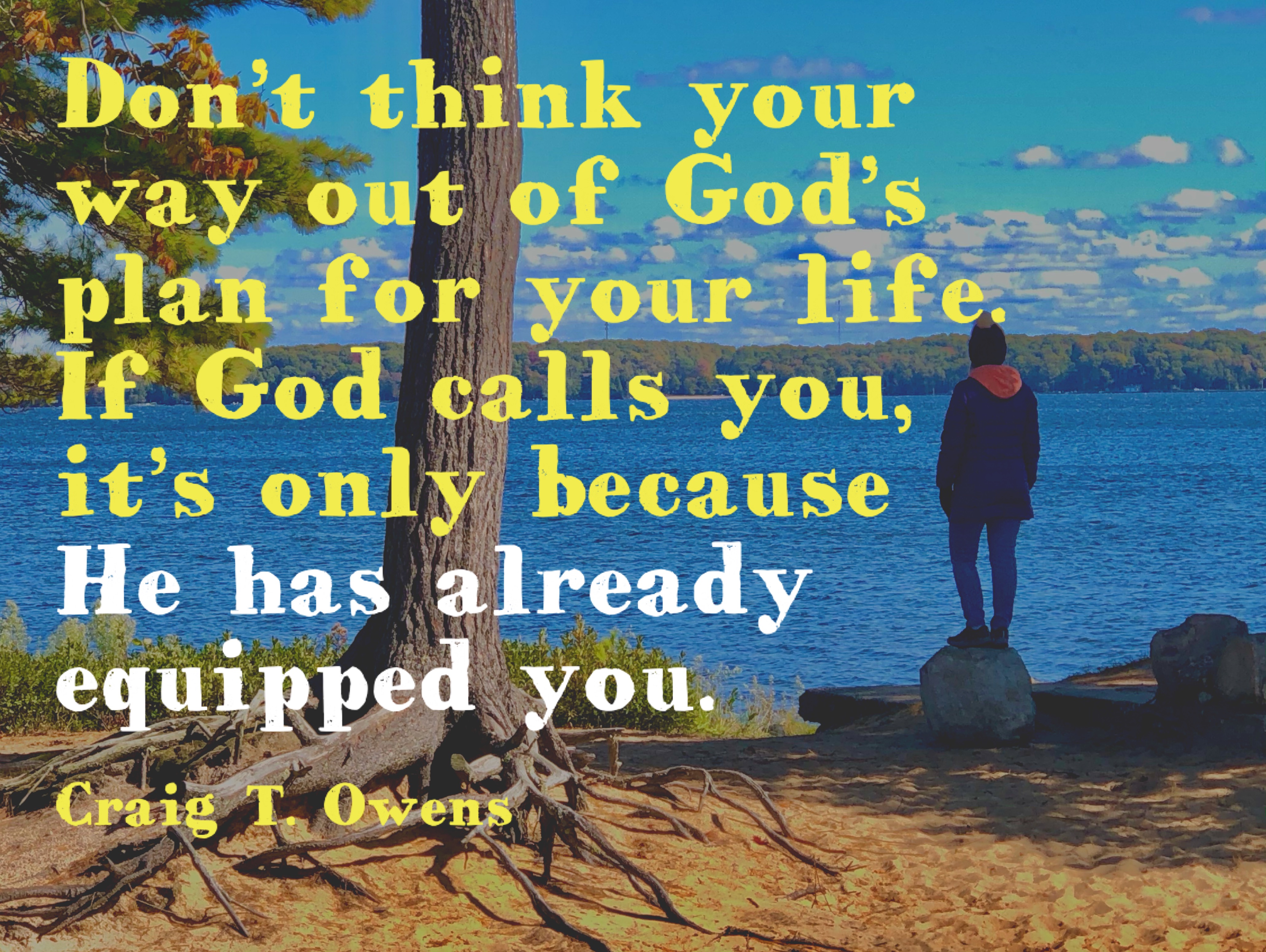
This is what usually happens to me. God calls me to do something or say something for Him, and I immediately say, “Here I am.” Then I begin to think about what I just committed to. It’s then that I come up with all my “Yeah, but” reasons why I can’t be the guy God thinks I am. In other words, I think my way out of God’s plan for me.

Here’s what I need to remember: If God calls me, it’s only because He has already equipped me.

For we are God’s workmanship, created in Christ Jesus to do good works, which God prepared in advance for us to do. (Ephesians 2:10)

No more “Yeah, but” second-guessing, I’m just sticking with “Here I am.”