“Believer, you do not make use of Christ as you ought to do. When you are in trouble, why do you not tell Him all your grief? Has He not a sympathizing heart, and can He not comfort and relieve you? No, you are going about to all your friends, save your best Friend, and telling your tale everywhere except into the bosom of your Lord. … There is nothing Christ dislikes more than for His people to make a show-thing of Him, and not to use Him. He loves to be employed by us. The more burdens we put on His shoulders, the more precious will He be to us.” —Charles Spurgeon
My son is playing baseball for his high school this season. Whether I’m at a game or a practice, whether the Red Hawks are up to bat or out in the field, I hear the phrase over and over again: Keep your eye on the ball!
Pretty good advice.
It’s awfully hard to field the ball when you are distracted by something else. It’s next to impossible to hit the ball when you don’t watch it all the way from the pitcher’s hand.
As a pastor, people tell me frequently about a stumble into sin, a failure in their marriage, a relapse into their addiction, a slip of the tongue. And I want to repeat the phrase over and over again: Keep your eyes on Jesus!
It’s awfully hard to say no to sin that seems so attractive when you aren’t looking at the surpassing beauty of Christ.
It’s really hard to stay committed in your marriage when you don’t look at the perfect Bridegroom.
It’s almost impossible to stay morally clean unless your eyes are fixed on the perfect Savior.
Charles Spurgeon gave this warning—
“Some creature steals away your heart, and you are unmindful of Christ upon whom youraffectionoughttobeset. Some earthly business engrosses your attention when you should fixyour eye steadily upon the Cross. It is the incessant turmoil of the world, the constant attraction of earthly things which takes away the soul from Christ.”
I love the chorus of the old hymn:
Turn your eyes upon JesusLook full in His wonderful faceAnd the things of earth will grow strangely dimIn the light of His glory and grace
In answering questions that have been submitted for The Q Series, I noticed a recurring trend: How much of our “conventional thought” in church circles is not revelation, but speculation.
Yesterday I had some tough questions on Heaven, Hell, suicide, our resurrected bodies, the after-life, and so on. In answering these questions, I used many passages from the Bible, but I also quoted from Charles Spurgeon, Charles Dickens, and C.S. Lewis. There’s nothing wrong, per se, with quoting from extra-biblical sources, but we have to be very careful what we do with those.
I once heard renowned evangelist C.M. Ward say something like this:
“The Word of God is completely good; you can devour all of it. But reading anything else is like eating chicken. There is some meat that’s good, and there are some bones, and gristle, and fat that you should spit out. Be very careful of what you take in, unless it is the pure Word of God.”
The Bible reveals so much for our lives, and we put ourselves in a place God can bless us when we are obedient to the revelation of His Word. But we put ourselves on shaky ground when we live by speculation of what we think may be truth.
The Apostle Peter said it this way:
For no prophecy ever originated because some man willed it [to do so — it never came by human impulse], but men spoke from God who were borne along (moved and impelled) by the Holy Spirit. (2 Peter 1:21 AMP)
Listen to the podcast of this post by clicking on the player below, and you can also subscribe on Apple, Spotify, or Audible.
In Romans 1, the word exchanged shows up three times in just one passage (Romans 1:22-32). Quite simply, this means every encounter with God’s presence requires me to make a choice, to exchange something.
I cannot remain neutral. The interaction with God is not static, but dynamic.
There are two forces at work in my life: sin and the Holy Spirit.
Sin wants me to exchange…
…the creation for the Creator (Romans 1:23)
…lies for truth (v. 25)
…pleasure for purity (v. 26)
…depravity for holiness (v. 28)
One exchange toward sin makes the next one that much easier. Soon the downward spiral can be pulling me faster and faster until: it’s not as if they don’t know better. They know perfectly well they’re spitting in God’s face. And they don’t care—worse, they hand out prizes to those who do the worst things best! (v. 32, The Message)
C.S. Lewis said it this way:
“Good and evil both increase at compound interest. That is why the little decisions you and I make every day are of such infinite importance. The smallest good act today is the capture of a strategic point from which, a few months later, you may be able to go on to victories you never dreamed of. An apparently trivial indulgence in lust or anger today is the loss of a ridge or railway line or bridgehead from which the enemy may launch an attack otherwise impossible.”
The Holy Spirit also asks for an exchange. He wants me to exchange…
…the momentary for the eternal
…self-gratification for God’s glory
…my desire for God’s will
You will encounter God today. The choice is yours: What exchange will you make?
Easter is over. Some people may have come to a church yesterday and may have even stepped into a relationship with the Risen Savior Jesus Christ. Wow, what a day!
Now what?
Is it back to church as usual?
What’s different because Jesus arose?
More specifically, what’s different about my life because I encountered Christ?
I don’t think Jesus suffered, died, and arose from the grave so we could maintain the status quo, or so that we could return to our normal humdrum lives, or so that church could become ‘the usual weekend routine.’
Dorothy Sayers said it this way:
“To do them justice, the people who crucified Jesus did not do so because He was a bore. Quite the contrary; He was too dynamic to be safe. It has been left for later generations to muffle up that shattering personality and surround Him with an atmosphere of tedium. We have declawed the Lion of Judah and made Him a housecat for pale priests and pious old ladies.”
Although Easter is over, I pray my life with Christ is never tedious, never boring, never predictable, never as tame as a housecat.
I want to know and see firsthand in my life that the Lion of Judah is not safe, but that He is good (thanks to C.S. Lewis for that wording)!
Jesus conquered death so that you and I could really live. Don’t ever settle for the boring, humdrum, usual routine. Discover the exciting life Jesus has for you!
“Too long.” You’re going to hear that more and more often.
The movie, the book, the meeting, the memo… few people will tell you that they ran short.
(Shorter, though, doesn’t mean less responsibility, less insight or less power. It means less fluff and less hiding.)
As a pastor, I laughed when I read few people will tell you that [your sermon] ran short. That is so true!
But Seth’s conclusion is right on target. In the attempt to keep our message at just the right length, we must be cautious of reducing the insight or the power. Instead, get rid of the fluff and the posturing.
Listen to the podcast of this post by clicking on the player below, and you can also subscribe on Apple, Spotify, or Audible.
As a pastor, one of your responsibilities is to point out what may be harmful in someone’s life. We have a word for that: confrontation.
Handled correctly, confrontation can lead to restoration and newfound maturity. Handled incorrectly, and, well, let’s just say it can get very ugly!
I just heard the story of a pastor who felt like he needed to confront one of his board members. I don’t really know this pastor, nor do I know the board member; I don’t know what was said in their meeting, but I have heard about the outcome, and it got ugly.
Samuel was going to be sent by God to confront King Saul about the sin he had committed. Look at this passage:
Then the word of the Lord came to Samuel: “I am grieved that I have made Saul king, because he has turned away from Me and has not carried out My instructions.” Samuel was troubled, and he cried out to the Lord all that night. (1 Samuel 15:10-11)
Did you catch how Samuel responded? He cried out to the Lord all that night.
Perhaps if we, as pastors, cried before we confronted the results might be more healthy.
“Tears shed for self are tears of weakness, but tears shed for others are a sign of strength.” —Billy Graham
Nehemiah was another pastoral/prophetic figure that was going to confront the inhabitants of Jerusalem about their sin.
When I heard these things, I sat down and wept. For some days I mourned and fasted and prayed before the God of heaven. Then I said: …I confess the sins we Israelites, including myself and my father’s house, have committed against You. (Nehemiah 1:4-6)
Before Nehemiah confronted the sins of the people, he tearfully took a hard look at himself, and then asked for forgiveness. Jesus shared this same concept with these words:
Why do you look at the speck of sawdust in your brother’s eye and pay no attention to the plank in your own eye? How can you say to your brother, “Let me take the speck out of your eye,” when all the time there is a plank in your own eye? You hypocrite, first take the plank out of your own eye, and then you will see clearly to remove the speck from your brother’s eye. (Matthew 7:3-5)
So before you confront your brother or sister, let the Holy Spirit confront you. Then, if it’s needed, confess your sin and ask God’s forgiveness. Let the Holy Spirit remove things in your life so that you can see clearly how to lovingly confront your brother.
Cry before you confront. Cry over your sin. Cry over the sinful state of your brother or sister. Plead with the Lord for this time of confrontation to lead to restoration and maturity.
Each morning T.M. Moore shares a verse of Scripture, a quote from a trusted author, and his application of that quote to the pastoral setting. For instance, after quoting a passage from John R.W. Stott, Moore’s thought this morning was:
“Good preachers are good learners, and not just of the Scriptures. They need to understand the times and the ways the times impact the people they are called to serve. Preachers who know their sheep well, as our Good Shepherd exemplified for us, will hear their concerns, understand their thoughts, discern their hopes and fears, and be able to preach in a way that speaks directly to their souls with transforming grace and power. Let us strive to be sons of Issachar when it comes to the ministry of God’s Word.”
UPDATE: Pastor, T.M. Moore has established his own ministry with vastly more resources for us than he had at the Colson Center. Please check out the Fellowship of Ailbe.
As I am preparing my message for each Sunday, I have one point that I want everyone to have clear in their hearts and minds when they leave. It’s sort of my “finish line.” I say, “If they get only one thing from this message, what should it be?” This is the part where I spend quite a bit of time.
Then I read this from the Apostle Paul:
When I came to you, brothers, I did not come with eloquence or superior wisdom as I proclaimed to you the testimony about God. For I resolved to know nothing while I was with you except Jesus Christ and Him crucified. (1 Corinthians 2:1-2)
So what’s my point?
Something clever and witty?
Something that shows how eloquent I am?
Perhaps another rule to follow?
Or another application to make?
Oswald Chambers says, “To say that we are called to preach holiness or sanctification is to miss the main point. We are called to proclaim Jesus Christ….” (emphasis mine)
My point should be only this:
To help people see Jesus more clearly.
Anything less than this is to miss the point.
Anything more than this is attempting to make myself sound eloquent.
One of my biggest pet peeves is hearing pastors say, “Ministry would be great if it weren’t for the people.”
Pastor: PeopleAREyour ministry!
After Christ’s resurrection, He wanted to help restore Peter. Jesus asked Peter a simple question, “Do you love Me?” When Peter acknowledged that he did, Jesus gave Peter a way to show it: “Feed My sheep.” I believe this exchange is what Peter had in mind when he penned the words,
Be shepherds of God’s flock that is under your care, serving as overseers—not because you must, but because you are willing, as God wants you to be; not greedy for money, but eager to serve; not lording it over those entrusted to you, but being examples to the flock. (1 Peter 5:2-3)
Is it hard to be a shepherd? Yes.
Are some sheep difficult to shepherd? Yes.
Is it worth it to shepherd them? Yes, yes, YES!!
I love Oswald Chambers’ insight on this:
“Jesus has some extraordinarily peculiar sheep: some that are unkempt and dirty, some that are awkward or pushy, and some that have gone astray! But it is impossible to exhaust God’s love, and it is impossible to exhaust my love if it flows from the Spirit of God within me. The love of God pays no attention to my prejudices caused by my natural individuality. If I love my Lord, I have no business being guided by natural emotions—I have to feed His sheep.”
Jesus, increase my capacity to love Your sheep. All of Your sheep—the ones that bite; the ones that are nice; the ones that are untidy; the ones that are clean; the ones that are thankful; the ones that are ungrateful; the ones that “get it”; the ones that don’t. All of YOUR sheep. Thank You, Lord, for the supreme honor and heavy responsibility of serving as Your under-shepherd.











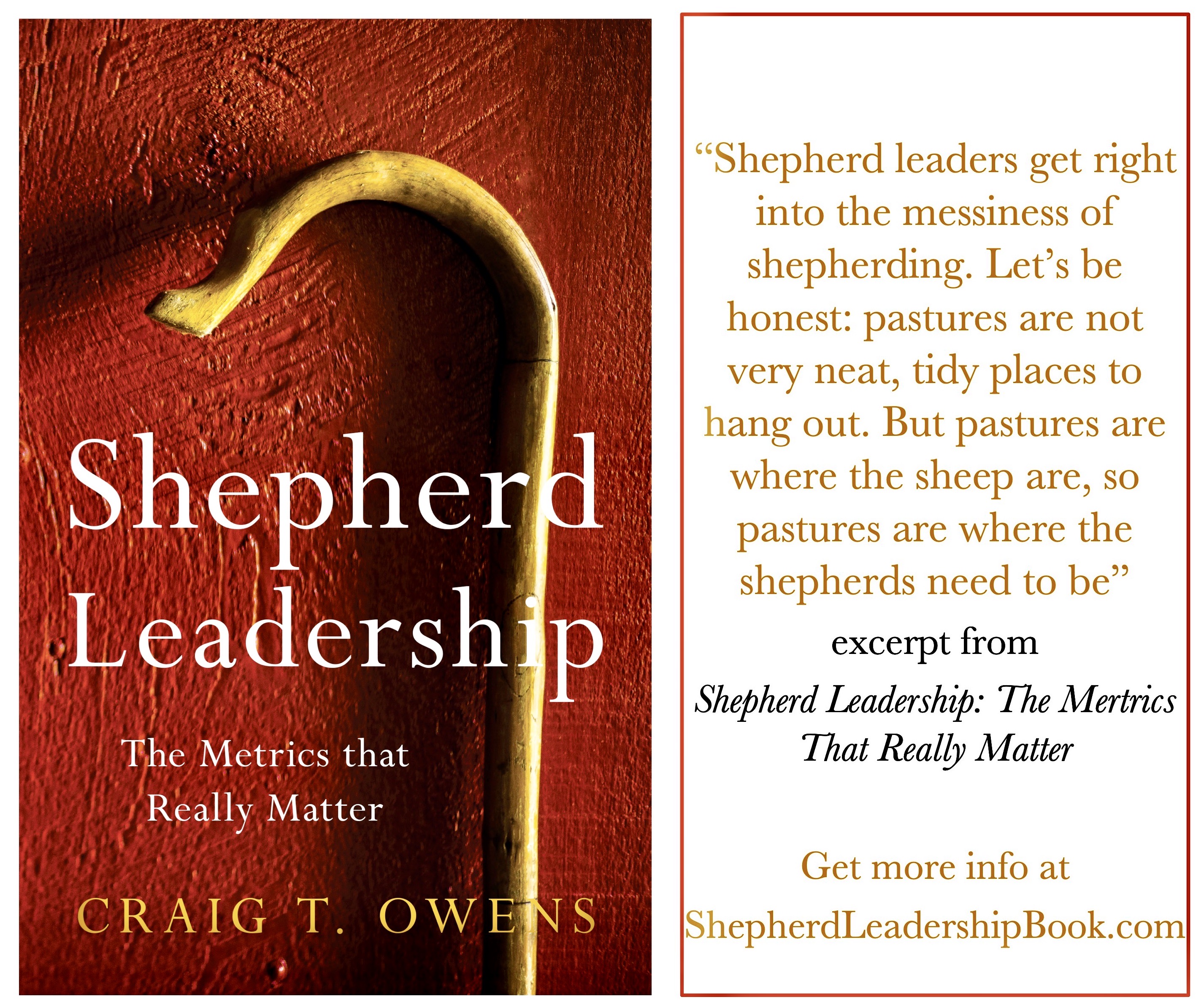


 Craig T. Owens