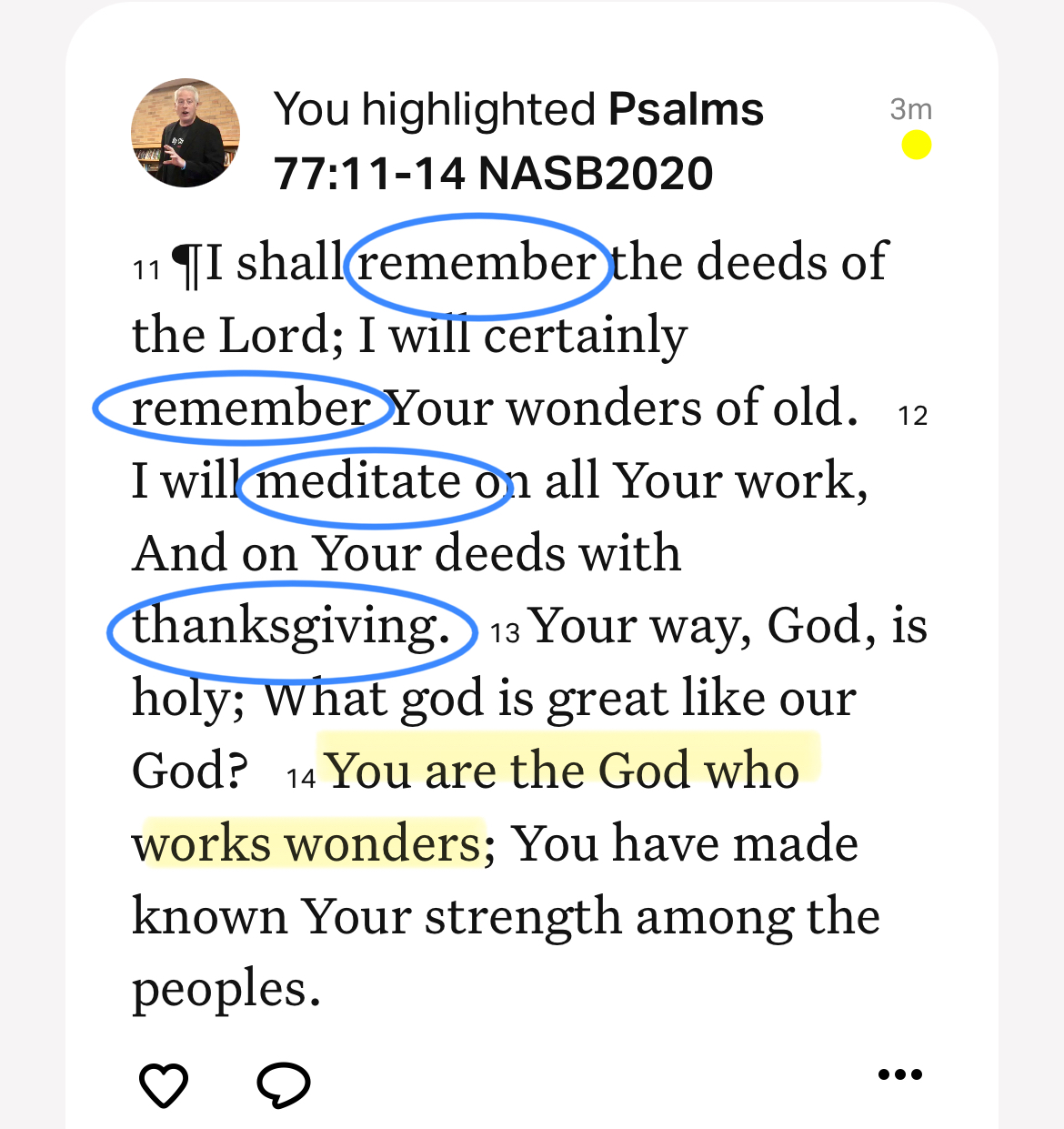
Remembering all God has done is the antidote to any fear or anxiety that we may feel. Recalling who God is and what He has done cannot help but lead us into worship of our awesome King! Then, as the words of an old chorus remind us—
🎶 In the presence of Jehovah
God Almighty, Prince of Peace
Troubles vanish, hearts are mended
In the presence of the King 🎶
I have shared a couple of other insights from Psalm 77 here:
“God, do not remain quiet; do not be silent and, God, do not be still. For behold, Your enemies make an uproar, and those who hate You have exalted themselves. They make shrewd plans against Your people, and conspire together against Your treasured ones. They have said, “Come, and let’s wipe them out as a nation, so that the name of Israel will no longer be remembered.” … Fill their faces with dishonor, so that they will seek Your name, Lord. May they be ashamed and dismayed forever, and may they be humiliated and perish, so that they will know that You alone, whose name is the Lord, are the Most High over all the earth.” (Psalm 83:1-4, 16-18 NASB2020)
Even God’s punishment on the enemies of His people has a redemptive purpose: “So that they will seek Your name … So that they will know that You alone, whose name is the Lord, are the Most High over all the earth.”
Yes, we should pray as this psalmist’s Holy Spirit-inspired words direct us. Pray for protection for God’s people, pray for punishment for God’s enemies, but also pray that all of this brings about the “so thats” that will lead these enemies of God to accept His forgiveness that Jesus paid for on the Cross.
Shepherd leaders do know the voice of their sheep, and the sheep know the voice of their shepherd. Leaders, this is the value of regularly being around all the people on your team. Check out this full conversation Greg and I had on our leadership podcast. This idea is central to my book Shepherd Leadership.
I have lots of new content every week, which you can check out on my YouTube channel.
“Alice Reynolds Flower (1890-1991), the wife of [Assembly of God] pioneer J. Roswell Flower, is a shining example of motherhood. Affectionately known as ‘Mother Flower,’ she preached, taught Sunday School, led prayer meetings, wrote articles, penned poetry, authored books, and lived a godly example in front of her six children and everyone she came in contact with. As Mother’s Day approaches, it is good to consider an article that Mother Flower wrote for the Pentecostal Evangel in May 1952.” Check out Alice Flowers’ article here.
Kenneth Blanchard discusses when it is and isn’t a good time for a leader to be a micromanager. He concludes this insightful post by saying, “The best leaders know how to continually adjust their leadership style to fit each situation, helping to develop individuals who will ultimately achieve each goal and perform well on each task with little direction or support.”
“The pre-Flood world had some truly massive dinosaurs, and the largest of them were in the group Sauropodomorpha. Within this group were titanosaurs, which include the gigantic Argentinosaurus that is estimated to have weighed over 100 tons.” Read more about titanosaurs here.
What is it about morality that points humans higher and higher to find the Source? J. Warner Wallace, in this video based on his book God’s Crime Scene, makes the case that objective, transcendent morality is good proof for God. This reminds me of C.S. Lewis’ similar argument: “My argument against God was that the universe seemed so cruel and unjust. But how had I got this idea of just and unjust? A man does not call a line crooked unless he has some idea of a straight line. What was I comparing this universe with when I called it unjust? If the whole show was bad and senseless from A to Z, so to speak, why did I, who was supposed to be part of the show, find myself in such a violent reaction against it?”
Pastors, listen to this call to revival from the pen of Jonathan Edwards. Let us seek in prayer for a revival in our day! “The Scripture gives us great reason to think, that when once there comes to appear much of a spirit of prayer in the church of God for this mercy, then it will soon be accomplished…Spiritual waters and rivers are explained by the apostle John, to be the Holy Spirit…It is now a time of scarcity of these spiritual waters; there are, as it were, none. If God’s people, in this time of great drought, were but made sensitive of this calamity, and their own emptiness and necessity, and brought earnestly to thirst and cry for needed supplies, God would, doubtless, soon fulfill this blessed promise.”
“The God who is our salvation” is on each side of this sacred pause. What can we consider from this?
God is my salvation
God is for me
God is my daily provision
God is my light and my life
God is my escape from death
God is worthy of all my worship
Let’s take time to slow down and truly savor the inspired thoughts when the Holy Spirit moved the biblical author to pause. There are powerful, encouraging, life-changing truths just waiting to burst into our heart and mind!
Answer me when I call, God of my righteousness! You have relieved me in my distress; be gracious to me and hear my prayer. … But know that the Lord has set apart the godly person for Himself; the Lord hears when I call to Him. (Psalm 4:1, 3)
I can’t come into God’s presence in my own strength. But when I am clothed in the righteousness of Jesus, the distress of my sin is relieved and I am joyfully welcomed into the awesome presence of my Heavenly Father! He longs to hear my voice, and He loves to be gracious to me!
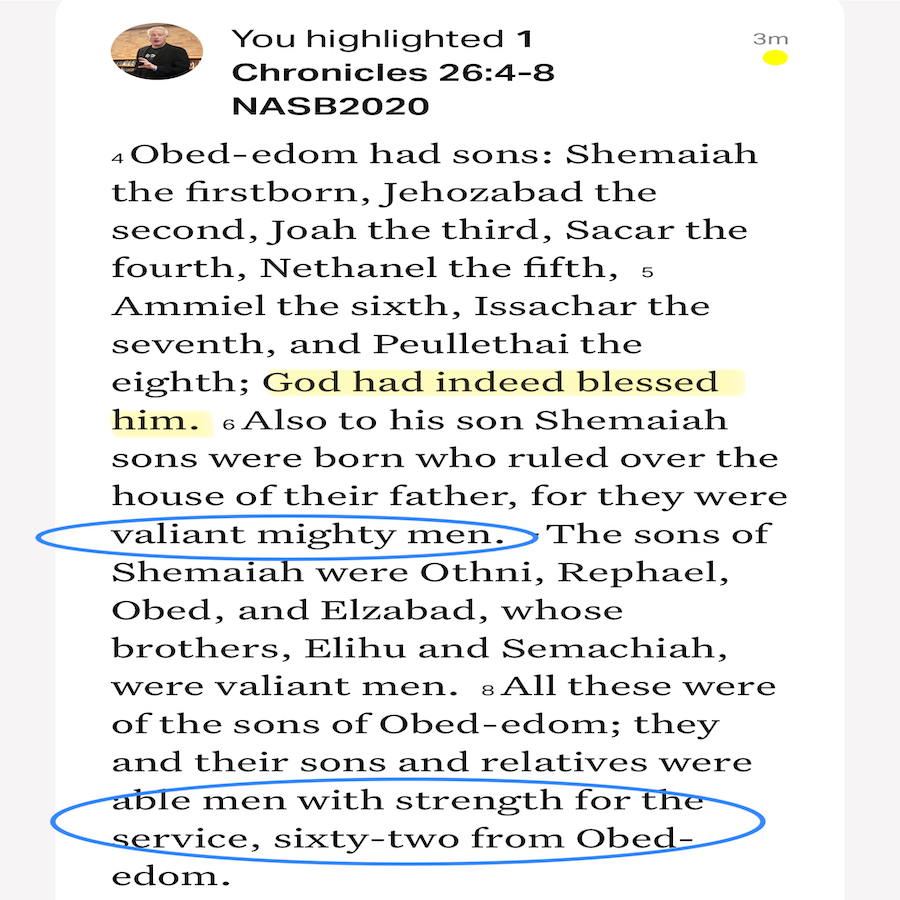
Every historical mention of Obed-Edom shows him serving God: as the guardian of the ark of the covenant of the Lord, as a gatekeeper, and as a worship leader. Here in this genealogy we learn that he faithfully served his family in a God-honoring way as well.
“God had indeed blessed him” so that his future generations were also known as valiant men of service before the Lord.
Obed-Edom demonstrates something I unpack in my book Shepherd Leadership. I wrote—
Humility is often misunderstood as allowing others to advance, and in so doing, I am completely overlooked. Others get the accolades and I get nothing. As a result, humility has gotten a bad reputation. People begin to think of a humble person as someone who never speaks up for himself, someone who can be taken advantage of, someone who becomes a doormat for everyone else. But the picture of a humble person in the Bible couldn’t be more different!
We all have to bow to someone or something. The humble shepherd leader has chosen to bow to God and to follow God’s righteous standards. One name for God is Jehovah Tsidkenu, which means God is righteous (see Psalm 119:137). The Hebrew letter tsadhe is a part of God’s righteous title, and it’s how we are called to live. Tsadhe means the humble, faithful servant. …
When you zoom in on the Hebrew letter tsadhe, you will see that the faithful, humble, kneeling servant is depicted with a crown. Far from being pushed down, left behind, or left unrewarded, the humble person is the one God delights to exalt!
Listen to the podcast of this post by clicking on the player below, and you can also subscribe on Apple, Spotify, or Audible.
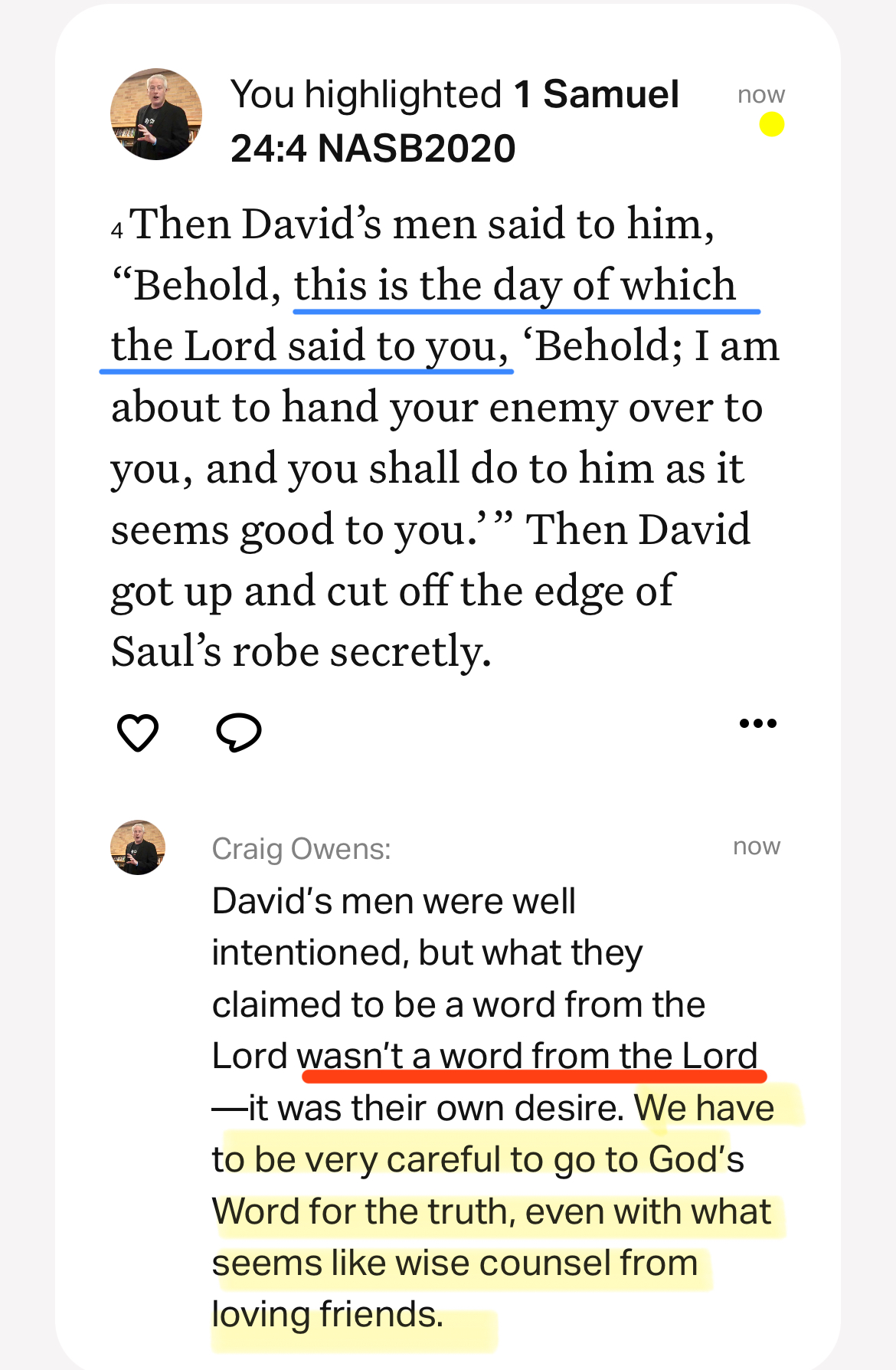
David was hiding from Saul in a cave when Saul walked into the same cave, totally oblivious to the danger that awaited him! David’s men tried to spur him to action by whispering, “Isn’t this what God said, that He would hand your enemy over to you?” (see 1 Samuel 24).
David momentarily listened to his men and then acted on their words. He crept forward to cut off a corner of Saul’s robe. But then the Holy Spirit pricked his conscience.
Why?
Because God never said those words!
From what David has learned, he now speaks this same lesson to Saul. He in essence asks Saul, “Are you listening to men or to God?” (vv. 9-11).
David learned that without God as his Guide, he could easily be persuaded to act in a way that seemed right to men but was wrong before God.
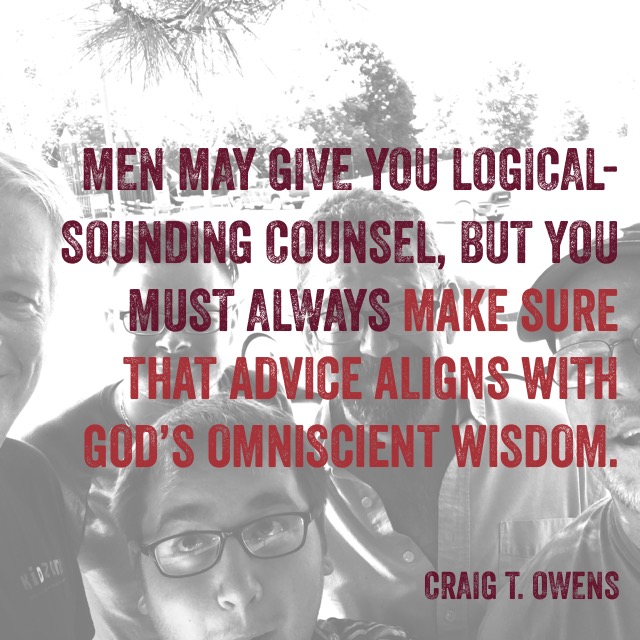
It’s still true for all of us today: Men may give you logical-sounding counsel, but you must always make sure that advice aligns with God’s omniscient wisdom. That means you need to be reading, studying, meditating on, and thinking about God’s Word.
✔️ Keep God always before you
✔️ Know His voice intimately
✔️ Compare every word of man with God’s infallible Word
🙏🏻 “Hear my prayer for help, O God, for I look to You alone as my Helper and the Sustainer of my soul. You will deal with my enemies as You know best, and You will deliver me from my troubles” (see David’s prayer in Psalm 54).
Listen to the podcast of this post by clicking on the player below, and you can also subscribe on Apple, Spotify, or Audible.
Just as assuredly as Jesus fulfilled God’s promise of His crucifixion and resurrection, we Christians are fulfilling God’s promise that we would take the message of forgiveness of sins to the whole world (Luke 24:45-48). We are taking Him to every street where God sends us. There is a song written by Michael McDonald called “Takin’ it to the streets.” One verse says—
Take this message to my brother
You will find him everywhere
Wherever people live together
Tied in poverty’s despair
We know what the “it” is. He is a Savior, a God, a Redeemer, a Father who has made it possible for everyone everywhere to be in a personal relationship with Him for all of eternity!
When anyone talks about taking the Good News of Jesus to people, our minds typically think “missionary.”
What is a missionary? What comes to mind when you think of a missionary?
Quite simply, a missionary is a person sent on a mission (see Luke 24:47; Matthew 28:19-20).
We are not sent on our mission unprepared, but Jesus promised us both His authority and the indwelling power of the Holy Spirit (Matthew 28:18-19; Luke 24:49; Acts 1:8). In both Luke and Acts, Jesus says that our witness is to begin in Jerusalem.
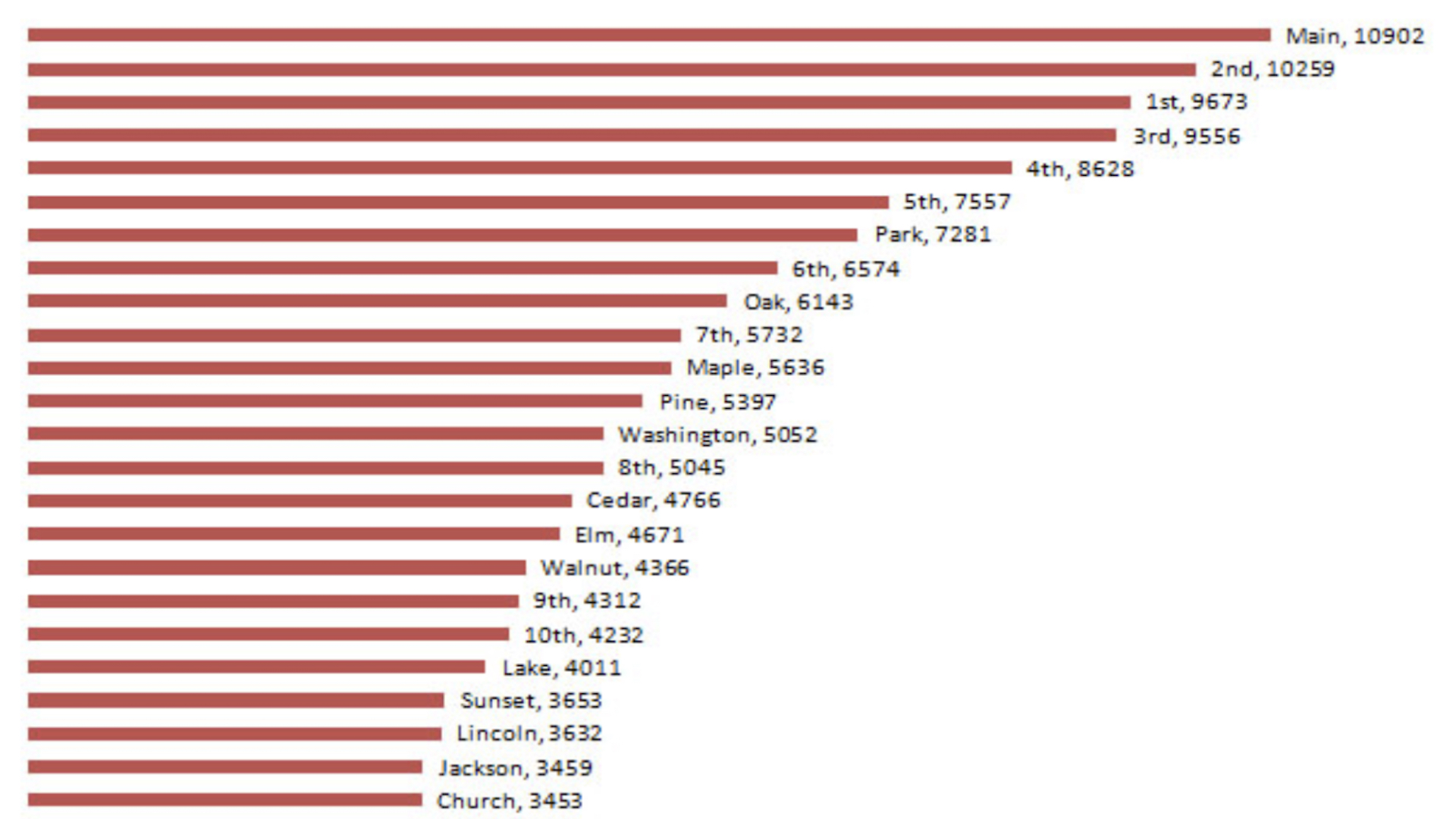
I recently looked up a list of the most common street names in America. I found that the most common street name is “Main Street.” But Main Street is also used as a way for people to describe the average setting in the USA.
Going to “Jerusalem” or “Main Street” first is foretold in the Old Testament (Ezekiel 3:4-5). We’re not first sent to people with an unknown language or obscure customs, but to people we know and understand. These are people to whom we can easily find common interests.
There are two simple steps when we take Jesus to our Main Street.
Ask the Holy Spirit to reveal truth to you today and every day.
You cannot give to others what you do not first have yourself, so you need to hear what the Holy Spirit is saying to you first. Pray before reading the Bible to ask the Spirit to give you insight (Psalm 119:18).
Find a friend and tell them what was revealed to you.
After Jesus was revealed to Andrew, he found Peter and told him what he had discovered. And after Philip met Jesus, he found Nathanael and brought him to Jesus (John 1:35-46).
Every person with whom you interact today is precious to God. Our mission is to help them realize that awesome truth.
So get filled up with the wisdom from the Spirit and then find a friend on Main Street and bring them to Jesus!
Follow along with all of the messages in this series Takin’ Him To The Streets by clicking here.
I cry out with my voice to the Lord; with my voice I implore the Lord for compassion. I pour out my complaint before Him; I declare my trouble before Him. (Psalm 142:2)
David knew the release and healing that would come after he poured out his complaint in God’s presence. The injuries others have done to us afflict our thoughts and emotions, and we need a safe place to get that poison out of our mind and heart.
God’s presence is that safe place, that healing place.



 Remembering all God has done is the antidote to any fear or anxiety that we may feel. Recalling who God is and what He has done cannot help but lead us into worship of our awesome King! Then, as the words of an old chorus remind us—








 Craig T. Owens