Rewards For Faithfulness

NunI unabashedly tell anyone who asks me what my favorite book is … It’s the Bible. I have yet to find such a collection of writings that work every single time they’re applied.

Two summers ago we began a series of messages on the 119th Psalm. It appears that the psalmist shares my passion for God’s Word, as he writes time and time again the difference Scripture makes in his life.

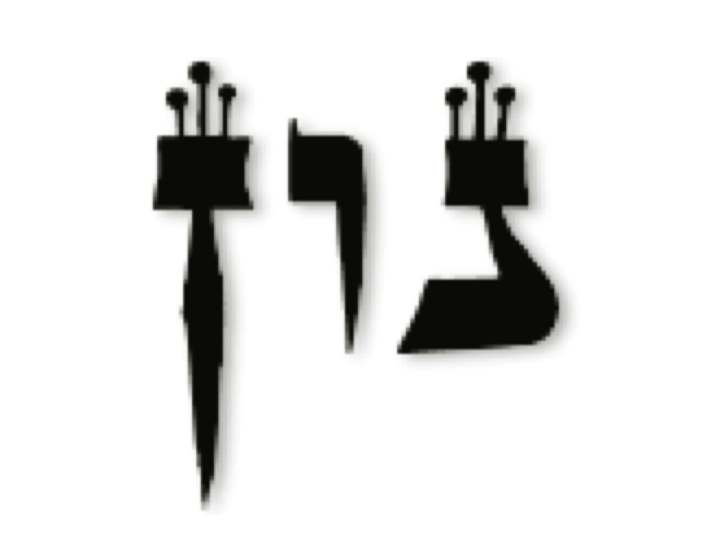
The other thing that makes this psalm so cool to me is the organization of the 176 verses into twenty-two 8-verse segments, with each verse in a segment beginning with the the same Hebrew letter as its title. In the Hebrew language, the letters in the alphabet had their own meaning. In English an “n” is simply spelled “n.” It has no other definition or meaning. But in Hebrew the letter nun has both a spelling and a meaning. Nun is spelled nun-vav-nun (final), and it means both faithfulness and the reward for faithfulness.

Look at the three Hebrew characters that spell nun. Reading right to left it tells a story and gives the meaning of the letter/word—the one who is humbled in faithfulness will be the one who stands in righteousness. The perfect example of this is Jesus, Who humbled Himself when He came to earth and to the Cross, and then was exalted by the Heavenly Father to wear the crown of righteousness (see Philippians 2:5-11 and Revelation 14:14). Paul starts this passage by calling on us to “have the same attitude as that of Jesus” (v. 5), and concludes with the call to stick with it all the way to the end (see vv. 12-13).
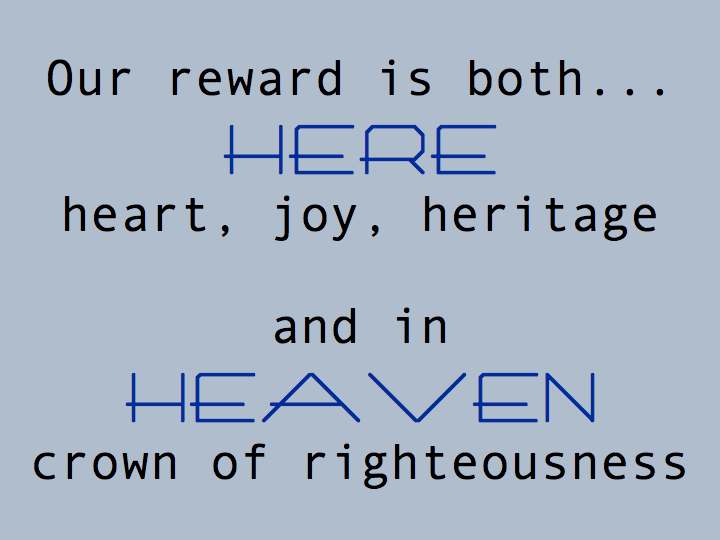
RewardsThe psalmist calls us to this same thing in nun (Psalm 119:105-112). The “bookend” verses say, “Your Word is a lamp for me… so my heart is set on keeping Your Word” (vv. 105 and 112). In between the psalmist commits himself to a life of humbly persevering to God’s ways, and reaps the rewards of a changed heart, the joy of the Lord, and a heritage to pass on to others.

I have fought the good fight, I have finished the race, I have kept the faith. Now there is in store for me the crown of righteousness, which the Lord, the righteous Judge, will award me on that day—and not only to me, but also TO ALL who have longed for His appearing (2 Timothy 4:7-8).

Humble yourself before the Lord, and He will lift you up (James 4:10).

My heart is set on keeping Your decrees to the very end (Psalm 119:112).

Rewards here (new heart, joy, heritage) AND rewards in Heaven (a crown of righteousness). How awesome is that!!

If you have missed any of the messages in our P119 series, you can access them all by clicking here.

867-5309

MeditatingI know I’m showing my age with this example: But how many of you remember the song by Tommy Tutone that contained Jenny’s phone number. That song hit #4 on the charts in 1982, and yet after all of these years if you start singing the song, people can tell you that Jenny’s number is 867-5309.

Why do we remember such trivial things?!

The way God designed the human brain is absolutely astounding! Electrical impulses from our five senses filter into the brain and are saved as short-term memories, with the emphasis on short. Short-term memories usually last 20-30 seconds. But we can reset the timer by repeating the information again and again.

If we repeat it enough or think about it more, our brain realizes that it has some significance to us, and begins to “solidify” the information in our intermediate memory banks. These intermediary memories last 5-8 hours.

But in order for the intermediary memories to be stored away in our long-term memory—where they can be stored indefinitely—there needs to be an added component from us. That component is emotion.

The more important the information is to us, the greater the likelihood it will be filed in the “do not delete” section of our brain.

People tell me all the time how difficult it is for them to memorize Scripture, but the keys to memorization are built into the Scripture itself.

First, you have to approach it with a passion. Oh, how I love your law! … Therefore I hate every wrong path (Psalm 119:97, 104). The “bookends” of this section show passionate emotion.

Second, you need to sing the Word. Twice the psalmist said he mediated on God’s Word all day long (vv. 97, 99). At the root of this word is to hum. Singing God’s Word attaches emotion to it, and the emotion tells your brain to move it to long-term storage.

Third, you need to realize just how important it is to have the Scripture stored away in your memory banks. In one section of the 119th Psalm we see benefits like: makes me wiser, gives me more insight, I have greater understanding, I can avoid evil paths (vv. 98-102).

C.S. Lewis commented, “All that is not eternal is eternally useless.” Jenny’s phone number won’t keep us out of trouble, or draw us closer to God, or even give us insight into helping a friend. But God’s Word will do all of those things … and so much more!

These steps will help you store and retrieve eternally useful truths, and not just fictional phone numbers! Try it and let me know how it works for you.

If you have missed any of the messages in our P119 series, you can access them all by clicking here.

Learning & Teaching

LamedhI’ve been leading my congregation through a spiritual workout from the 119th Psalm. This psalm is unique for a couple of reasons: (1) It’s the longest chapter in the Bible; (2) It’s divided into twenty-two 8-verse segments, with each segment beginning with its own Hebrew letter; and (3) All but four of the 176 verses directly mention God’s Word (using words like command, precept, statues, commands, etc.).

Something else that makes this psalm interesting to study is the Hebrew alphabet itself. In our western world, a letter is just a letter: an L is just an L. But in the Hebrew language, the letters have a name, a meaning, and even a numeric value. So the Hebrew equivalent to our English L is the letter/word lamedh.

Lamedh is the tallest of all the Hebrew letters, so that means it stands out. The section called lamedh in Psalm 119 is one of big proportions. Words like eternal, boundless, established, enduring, and forever are prominent in these eight verses. The psalmist is inviting us to climb up into God’s Word and get a bigger view, a higher vantage point of who God is.

When we are in difficult places, we tend to focus more on our problems, and less on God’s awesomeness. So lamedh is a call to shift our gaze.

But this letter/word also has a definition, and lamedh is a double-edged definition. This word can mean to learn. Indeed, as we gaze upon God’s majesty, we learn so much more about Him! But lamedh also means to teach.

I have found that as I go through difficult times and choose to change my focus from my situation to my Savior, that I learn more about His faithfulness. But at the same time, others are learning from that decision to switch my gaze to God.

So I’ve got one word of advice for you if you feel like your problem is too big and you’re thinking about throwing in the towel: DON’T!!

By focusing on God’s bigness instead of your circumstance, you will learn to grow in faith. And at the same times you will be teaching others to place their faith in God too.

Those who wait on God will soar to new heights!

If you have missed any of the messages in our P119 series, you can access them all by clicking here.

Why Do You Read The Bible?

Do you exercise? Why? What’s the purpose of all of your exercises? To get stronger? To last longer? To get or stay healthy? Yes! But to what end? Why do you want to be stronger, have greater endurance, or better health?

I could ask the same question regarding the spiritual realm: Why would you want to do a spiritual workout? To quote more Bible verses? To have more endurance in prayer? But why do you want to know more of the Bible, or pray better or longer?

Our goal should be simply this: To know God more intimately.

We have to be careful about being so focused on the workout that we miss the purpose (or should I say the Person). Andrew Murray wrote this:

“Christian! there is a terrible danger to which you stand exposed in your inner chamber. You are in danger of substituting Prayer and Bible Study for living fellowship with God, the living interchange of giving Him your love, your heart, and your life, and receiving from Him His love, His life, and His spirit. Your needs and their expression, your desire to pray humbly and earnestly and believingly, may so occupy you, that the light of His countenance and the joy of His love cannot enter you. Your Bible Study may so interest you, and so waken pleasing religious sentiment, that—yes—the very Word of God may become a substitute for God Himself, the greatest hindrance to fellowship because it keeps the soul occupied instead of leading it to God Himself.”

Our spiritual workouts should help us integrate God’s presence into our souls. He is not just someone that we know about; He is the One we know. The One we have let into our hearts. The One who is at the very center of our being. He is the CORE of who we are.

So then, just as you received Christ Jesus as Lord, continue to live in Him. Have the roots [of your being] firmly and deeply planted [in Him, fixed and founded in Him], being continually built up in Him, becoming increasingly more confirmed and established in the faith, just as you were taught, and abounding and overflowing in it with thanksgiving. (Colossians 2:6-7 AMP)

Don’t lose sight of WHY you read the Bible, and respond in prayer; of why you glorify God and enjoy Him forever; of why you go through your spiritual workouts. You do all of this because Christ is in you, and you are in Christ, and you want to strengthen this core relationship, and let everything else that you do flow out from this core!

If you have missed any of the messages in our P119 series, you can access them all by clicking here.
From A Frustrating Life To An Exciting Life

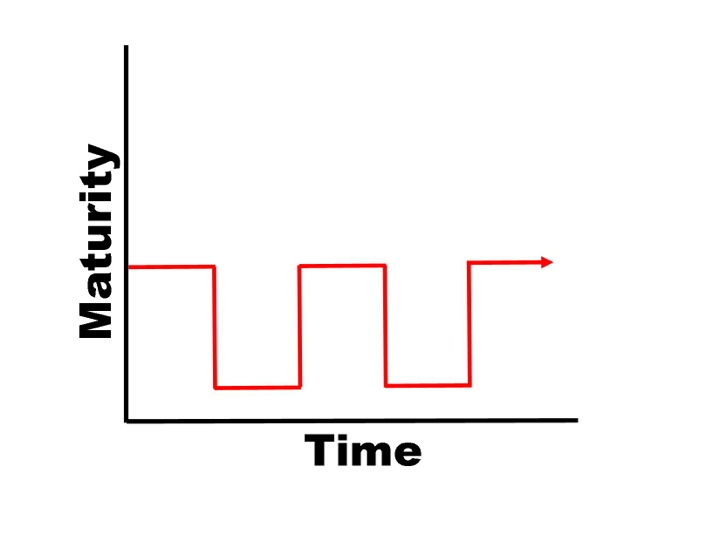
In our P119 Spiritual Workout series, we’ve looked at the similarities between an exercise program for our physical bodies, and spiritual growth for our souls. There are so many parallels for us to look at, but one of them that rings true for everyone is the up-and-down, on-and-off cycles that so many of us experience.

You know how it goes…

  • Your diet is going great and you are dropping some pounds (yea!), and then you go on vacation and all of your gains are lost (boo!).
  • You are doing really well at sticking with your new exercise routine (yea!), and then a head cold and some rainy weather knock you off your plan and it’s really hard to start back up again (boo!).
  • You are reading your Bible, and praying, and feeling so close to God (yea!), and then relationship issues, trouble at work, and a leaky hot water tank send you reeling (boo!).

We all hope our spiritual growth (or diet or exercise routine) would take us to new heights, but this up-and-down again cycle makes it feel like we aren’t getting anywhere:

In Psalm 119:49-56 the psalmist experienced this exact same up-and-down cycle:

  • He’s tight with God (v. 49)
  • Then he experiences suffering (v. 50a)
  • Only to recall God’s promises (v. 50b)
  • And then he’s getting mocked for this faith (v. 51)
  • But he’s quick to remember God and find comfort in Him (v. 52)
  • Only to get his eyes off of God and onto the godless, which causes him trouble (v. 53)
  • But he remembers God’s ways again and is comforted by singing songs about God (vv. 54-55)

Sound familiar? Up-and-down. Close-to-God-and-far-away. On-and-off. Yea!-and-Boo!

HOW DO WE BREAK OUT OF THIS?!?

The key is found in the final verse—This has been my practice: I obey Your precepts (v. 56, NIV). Look how some other translations render this verse:

  • This I had, because I kept Thy precepts (KJV).
  • This is how I spend my life: obeying Your commandments (NLT).
  • This I have had [as the gift of Your grace and as my reward]: that I have kept Your precepts… (AMP).

When we put this all together we get the solution that helps us break free from the up-and-down again cycle—

It’s ONLY by focusing on God’s GRACE everyday!

When we focus on God and His gift of grace to us, we minimize the ups-and-downs. How? Because the focus is not on what I’m doing or what others aren’t doing, but on God, His faithfulness, and His grace to us.

When God’s grace becomes our focus, we can break free from the up-and-down cycle—

If you have missed any of the messages in our P119 series, you can access them all by clicking here.

Taunting

Coaches and parents especially don’t encourage those under their care to taunt their opponents. But the Bible does!

Seriously!

As a part of our P119 Spiritual Workout series, we looked at the section called Waw yesterday—

May Your unfailing love come to me, O Lord, Your salvation according to Your promise; then I will answer the one who taunts me, for I trust in Your Word. (Psalm 119:41-42)

“I will answer the one who taunts me.” How exactly do you answer the taunter? The word for answer here in Hebrew comes from the idea of “singing tunefully.”

You know how it feels when you have that perfect zinger—that great one-liner as a comeback to someone who’s tweaked you?

And you know how you don’t just say that zinger, but you add a musical note to it as well, just to add a little emphasis?

Well, this is what Christians can do to the devil when he taunts them! The book of Revelation tells us that satan is the accuser (the taunter) of the Christians, and that we overcome him by the blood of Jesus and the word of our testimony. But the psalmist says it’s not just plain old words, but the lilting sing-song, tuneful reply to his taunt.

We reply to our enemy’s taunts with a Scriptural-based tweak of our own. We can remind him of our total forgiveness in Christ. We can tell him how God loves us, and sent His Son to die for our sins, and how the Holy Spirit has been given to us as a deposit guaranteeing that we are now in Christ. We can use the Bible to tunefully taunt the taunter with the truth of God’s Word.

Don’t just silently take it when the enemy accuses you. Don’t get mad. But shut him up by answering him with a song right from God’s Word!

If you have missed any of the messages in our P119 series, you can access them all by clicking here.

Reading The Bible Isn’t Enough

I had to give my congregation a heads-up that I was going to say something that sounded a little like heresy, so they wouldn’t throw me out of the church. So I’m giving you a similar heads-up now: Read this all the way through before you label me a heretic.

Our P119 spiritual workout relies heavily on the Word of God. If we are going to grow as Christians, here’s what I believe:

There is no substitute for the Bible, but the Bible is not enough.

The Pharisees of Jesus’ day knew the Scriptures better than anyone, but they misapplied those Scriptures, using them as billy clubs wielded by the sin police. When we read the Scripture, we must respond to what we read. Prayer is an indispensable part of our spiritual workout because prayer is how we properly respond to God’s Word.

Check this out—

In the He section of Psalm 119 (verses 33-40), you will read words that sound more like a prayer than any of the sections before it. You will hear the psalmist crying out to God as he is confronted by his lack of proper application of God’s Word. As he reads the Scriptures, he asks God to:

  • Teach him what the Scriptures are saying
  • Help him discern the truths found in God’s Word
  • Lead him in the right path
  • Turn his heart away from his natural selfish bent
  • Allow him to see the futility of pursuing earthly possessions
  • Give him boldness in standing up for God’s glory
  • Remove the fear of man that would paralyze his pursuit of God

The last verse of this section is the cycle of read the word → respond in prayer in miniature. How I long for Your precepts! Preserve my life in Your righteousness. Do you see the reading of the Word (Your precepts), and the prayerful response (preserve my life)?

The Bible can be an incredible prayer book for us! Get into the Word, and let the Holy Spirit get the Word into you. You will then be able to respond back to God in His own words! And then I think you will be astounded at how your spiritual life grows!

If you have missed any of the messages in our P119 series, you can access them all by clicking here.

Getting Back Up When Life Has Knocked You Down

The Bible never presents life as some sort of pie-in-the-sky, walk-in-the-park, everyday-is-always-rosy picture. If it did, we would reject the Bible because our experiences would immediately tell us otherwise. Instead, the Bible realistically portrays the challenges, and the pain, and the heartache, and the disappointments of life. But as it does so it also shows us that God’s way is the only way out of our sorrow and into His joy!

In our P119 Spiritual Workout series, we saw the bookends of the section daleth (Psalm 119:25-32) are:

I am laid low in the dust (v. 25) → You have set my heart free (v. 32).

How do we get this freedom when we are knocked down and laid low in the dust?

The Jews saw the Hebrew letter daleth as a door. Specifically, a door through which humble people stepped into a greater realization that He is God, and I’m not … that He has the answers, and I don’t … that He is in control, and I’m not. So part of going from down in the dust to a free heart is humbly acknowledging that you need God’s help!

In verses 26 and 27, the psalmist recalls his past history, and in so doing he is reminded that God has always been there. God has never left him nor forsaken him, so here’s what the psalmist resolves to do:

  • Teach me = I learned something before, so let me learn again.
  • Let me understand = help me to discern, distinguish; tell things apart. This word is used for things that are divinely disclosed; in other words, they’re things you and I cannot figure out on our own.
  • Meditate = talk with my soul about these new things the Holy Spirit has disclosed to me.

In verse 28, the psalmist says that his soul is weary with sorrow (or as the King James Version states it: my soul melteth for heaviness). The only way to overcome this is to ask for God’s help to energize us to go forward.

In the final four verses of this section you can sense the psalmist’s strength returning as he makes these bold statements:

  • keep me from deceitful ways (v. 29a) = keep me from lying to myself (NLT).
  • be gracious to me (v. 29b) = give me the privilege of knowing Your instructions (NLT).
  • I have chosen (v. 30a) = I have determined (NLT).
  • I have set (v. 30b) = I am long-sighted (on God), not short-sighted (on my problems).
  • I hold fast (v. 31) = the KJV says I have stuck to it!
  • I run (v. 32) = I will [not merely walk, but] run the way of Your commandments (AMP).

So when you are sad/disappointed/injured, run TO God. Don’t cling to your own (old) ways of thinking. Let Him take you from I am laid lowYou have set my heart free.

If you have missed any of the messages in our P119 series, you can access them all by clicking here.

Discovering Your Spiritual Center (book review)

I enjoy books and commentaries that help me study the Bible in a different way. Discovering Your Spiritual Center by David Teems is a unique angle at one chapter of the Psalms that I have never seen before.

The big idea of this book is to take a long, introspective look at Psalm 119. It’s the longest chapter in the Bible (at 176 verses), but it is conveniently divided into 22 eight-verse sections, with each section corresponding to a letter of the Hebrew alphabet. David Teems makes the case that rabbis considered the Hebrew letters to be living things, so that there is a significance to why each of these eight verses are grouped together.

The next idea of this book is to take a 22-day journey of rediscovering the power of the Scripture, by reading one 8-verse section each day. Then to take time to reflect on each day’s passage. It’s a good idea to use this one psalm to (re)awaken a passion for Scripture, as all but four of the verses mention God’s Word (law, statutes, commands, etc.).

So far, so good.

However, I did find some of the author’s fascination with the Hebrew letters—like their shape, or their placement in the alphabetic order—a bit unsettling. I also thought at times his pointing out other words in Scripture that start with the same letter of the Hebrew alphabet a bit stretched. So although the concept is good in theory (taking a 22-day journey through this psalm), I found the approach a bit, well, creepy.

I am a Leafwood book reviewer.

Soap Opera Drift

Listen to the podcast of this post by clicking on the player below, and you can also subscribe on AppleSpotify, or Audible.

Disclaimer: My aggregate soap opera viewing time for my entire life is about 52 minutes, but I still think I know what I’m talking about <grin!>.

Soap operas are usually pretty predictable. If you’ve watched them for even a short time it’s not hard to figure out who’s who and what’s what. In fact, the plot lines are typically so predictable that you can stop watching a particular soap opera for months—or even years—and when you tune in again it will only take a day or so to once again know who’s who and what’s what.

One of the main reasons for this is the simplicity of the plot lines. There are three types of characters: good guys, bad guys, and wishy-washy guys that are swayed by the good guys or bad guys.

We applaud when the good guys win and the bad guys get what’s coming to them. We groan when the good guys get unfairly treated and the bad guys seem to get away with their badness. If we could give advice to the soap opera characters it would be pretty straightforward: “If you’re a good guy, we’ll cheer for you!”

But here’s the problem: it’s becoming harder and harder to tell the difference between the good guys and bad guys. It seems like more of them fall into the wishy-washy category. Over time, the characters have become mostly good but can be swayed to take revenge or cut corners. Or they’re mostly bad but still have a soft place in their heart to help the little orphan child.

There are very few really good guys left.

There’s a drift from good to mostly good. But mostly good is only one step away from mostly bad. And only one more step from mostly bad to just-plain-bad.

I’ve been reading through the soap opera history of the kings of Israel and Judah. Like our modern soap operas there are three types of kings: (a) the good kings did what was right in God’s eyes; (b) the bad kings did what was evil in the God’s eyes; and (c) the wishy-washy kings usually did what was right but had a “however” attached to their reign.

Unfortunately, most of the good kings tended to drift from good to mostly good, and eventually to mostly bad. The drift continued each generation toward mostly bad until God was hard-pressed to find any king who wasn’t bad. How sad: God’s blessing was right there for any good king to claim, but they kept drifting away!

Drifting happens so easily, which is why we have to be so diligent.

     You’re blessed when you stay on course, walking steadily on the road revealed by GOD. You’re blessed when you follow His directions, doing your best to find Him. That’s right—you don’t go off on your own; you walk straight along the road He set. You, GOD, prescribed the right way to live; now You expect us to live it. Oh, that my steps might be steady, keeping to the course You set; then I’d never have any regrets in comparing my life with Your counsel. I thank You for speaking straight from Your heart; I learn the pattern of Your righteous ways. (Psalm 119:1-7, The Message paraphrase)

Just like those soap opera characters or soap opera kings, we can get some pretty straightforward advice from the Bible: “If you stay on course, walk straight along the road God set for you, He will bless your life.”

Don’t drift.

Don’t settle for mostly good.

Don’t assume you’re doing right in God’s eyes; KNOW that you’re doing right in God’s eyes by following His Word.

►► Would you please prayerfully consider supporting this ministry? My Patreon supporters get behind-the-scenes access to exclusive materials. ◀︎◀︎