Listen to the podcast of this post by clicking on the player below, and you can also subscribe on Apple, Spotify, or Audible.
►► Would you please prayerfully consider supporting this ministry? ◀︎◀︎
Listen to the podcast of this post by clicking on the player below, and you can also subscribe on Apple, Spotify, or Audible.
►► Would you please prayerfully consider supporting this ministry? ◀︎◀︎
Listen to the podcast of this post by clicking on the player below, and you can also subscribe on Apple, Spotify, or Audible.
Psalm 119 is divided into twenty-two 8-verse segments, with each verse of the segments beginning with its own Hebrew letter. Lamedh is found in verses 89-96, and lamedh is the tallest of all the Hebrew letters, so that means it stands out.
Lamedh shows us big proportions. Words like eternal, boundless, established, enduring, and forever are prominent in these eight verses. The psalmist is inviting us to climb up into God’s Word and get a bigger view, a higher vantage point of who God is.
Consider the opening verse of this section: Your Word, O LORD, is eternal; it stands firm in the heavens. Eternal—think of the implications! If what God says—His Word—is eternal, then…
At every single moment in my life, my eternal, enduring, limitless God knows the outcome or consequence of each option I could choose. His Word can so transform my mind that I can always choose the most Christ-glorifying option. The Spirit of Truth—my eternal Counselor—can guide me with God’s Word.
I never have to be at a loss. I am never stumped. I always have access to eternal Truth.
The psalmist got this: If Your law had not been my delight, I would have perished in my affliction (v. 92).
Through God’s firmly-established Word I have—
And you have all of this, too, through God’s Word!
Psalm 119 is a great place to start to make Bible reading a daily habit. Scientists tell us that you only need 21 days to make a new habit, and in Psalm 119 you have 22 days of daily reading that will transform your heart and mind.
►► Would you please prayerfully consider supporting this ministry? ◀︎◀︎
Listen to the podcast of this post by clicking on the player below, and you can also subscribe on Apple or Spotify.

For they have devoured Jacob and devastated his homeland. (Psalm 79:9)
This verse is at the middle of this psalm, which in Hebrew literature makes it the central theme of this psalm. Asaph describes something that is not a very pretty situation.
Asaph says “they” have done this. But to whom have they done it? To the Israelites? Yes, but it goes deeper than that. Or should I say it goes higher than that? “They” have actually done these terrible things to God Himself—
In the New Testament, Jesus said His followers should expect persecution. But notice that Jesus said this persecution was because of Him. “They” are not really attacking Christians, but “They” are attacking Jesus Himself. When Jesus revealed Himself to the persecutor of Christians named Saul of Tarsus, He said to him, “Saul, why do you persecute Me?”
Asaph recognizes “They” are attacking God, so he also expects that God will deal with them—
When—not if—persecution comes our way, we must remember to shift our paradigm from “They” to “You.” “They” are not to be feared, but God is to be feared and reverenced. “They” don’t get the final word, but God, “You” get the final and decisive word. When the attacks come because you stand for Christ, take your eyes off of your persecutors and put them on your God.
►► Would you please prayerfully consider supporting this ministry? ◀︎◀︎
Listen to the podcast of this post by clicking on the player below, and you can also subscribe on Apple or Spotify.
When I was 4 years old, I heard my echo for the first time as I yelled “Hello!” to a barn on the other side of a pasture. I was totally convinced that I had a friend in that barn yelling back to me, and I ended up being a bit disappointed later when I discovered that it was just my own sound waves bouncing back to me.
To my 4-year-old brain, a little friend yelling back from the barn was absolutely true. It was maturity and new information that taught me differently. Isn’t this an ongoing story for all of us? Many things seem true from our current perspective, but then as we get older or smarter we realize that our original belief—what we really believed to be true—is now invalidated.
Rarely does anyone admit, “I was immature back then,” but we usually try to justify ourselves by saying, “If I would have known back then what I know now….” But the fact is it will always be an impossibility for you to know then what you know now.
In 1880, Edwin A. Abbott wrote Flatland, a favorite book of Albert Einstein. Abbott was a college-trained mathematician and theologian; in fact, he was actually better known for his theological writings than for this book. In this fabulous little book, Square, who lives in two-dimensional Flatland, cannot perceive height or depth. So what appears to him to be a wall, would merely be a line to you and me. One day Sphere from three-dimensional Spaceland visits Flatland, trying to explain to Square what his world was really like, but Square and his other Flatlanders could never fully grasp the idea.
When Jesus was interviewed by Pilate, it sounds as though Pilate is missing a “dimension.” Pilate tries to state things the way that he understands them, but Jesus is revealing to him a whole new dimension (see John 18:33-38). The word Jesus uses for “truth” in this conversation means objective truth: something that is always true, regardless of where or when we live. Jesus explained that He as God IS objective truth. Any of our truth statements that aren’t grounded in God are subjective truth statements at best.
Listen to how John describes Jesus: In the beginning—before all time—was the Word (Christ), and the Word was with God, and the Word was God Himself. He was continually existing in the beginning co-eternally with God. All things were made and came into existence through Him; and without Him not even one thing was made that has come into being. In Him was life and the power to bestow life, and the life was the Light of men. The Light shines on in the darkness, and the darkness did not understand it or overpower it or appropriate it or absorb it and is unreceptive to it. (John 1:1-5 AMP)
Here’s the absolutely amazing thing: Jesus wants us to have this same insight into heavenly dimensions! Jesus said He would ask the Father to send us the Holy Spirit, Whom He called “the Spirit of Truth” (John 14:6, 16-17; 15:26; 16:12-13).
The Spirit of Truth…
[Check out all of these Scriptures by clicking here.]
I love the King James Version of 1 John 2:20—But ye have an unction from the Holy One, and ye know all things. Being baptized in the Spirit of Truth means that you have access to an eternal perspective. You are no longer bound by the dimensions and paradigms of this “Flatland” but you are seeing things from God’s transcendent perspective.
If you’ve missed any of the messages in our series We Are: Pentecostal, you can access the full list by clicking here.
►► Would you please prayerfully consider supporting this ministry? ◀︎◀︎
Listen to the podcast of this post by clicking on the player below, and you can also subscribe on Apple or Spotify.
Have you ever read the children’s book Alexander and the Terrible, Horrible, No Good, Very Bad Day? Poor Alexander, his day just seemed to get worse—nothing was going right. He wakes up with gum in his hair, trips on his skateboard, and drops his favorite sweater in the sink filled with water. Breakfast doesn’t get any better, things go sideways at school, his least-favorite food is served for dinner, his nightlight burns out. And if all that’s not bad enough, the cat decides to sleep with his brother instead of with him.
Can you relate to Alexander?
Doesn’t it seem like when one thing goes wrong, everything goes wrong? And if things go wrong for too many days in a row, it seems like the bad times are lasting forever! All of us have a tendency to exaggerate during the dark days.
A psalmist named Asaph seemed to be having a terrible, horrible, no good, very bad day of his own. Listen to some of his words, including the exaggerations of how bad he thought everything was:
Why have You rejected us forever, O God? … Your foes roared in the place where You met us… They said in their hearts, “We will crush them completely!” They burned every place where God was worshiped in the land. … How long will the enemy mock you, O God? Will the foe revile Your name forever? Why do You hold back Your hand? (Psalm 74:1, 4, 8, 10, 11)
In the middle of the storm, we tend to not only exaggerate how bad things are but we also seem to lose our bearings and we can even lose sight of God. I think that’s what was happening to Asaph in the first half of his lament. But then we come to the middle verse of this psalm and we notice the beginning of a change in perspective: “But You, O God, are my King from of old; You bring salvation upon the earth” (v. 12).
Aha! In the middle of his terrible, horrible, no good, very bad day, Asaph stopped looking at all the bad things around him and turned his gaze upward. “Look,” he tells himself, “there is God still reigning as the Supreme King!” Asaph begins to recount all that God has done, using the phrase “It was You” who did these miraculous things five times in the next five verses.
In the middle of the storm, Asaph has to remind himself…
My friend, I implore you to remember these words of Asaph. Commit them to your memory now, so that when your terrible, horrible, no good, very bad day happens—when it seems like everything is going to go wrong forever—that you can spot those lying exaggerations, you can turn your gaze upward, and you can find hope in knowing your God not only has all power to save you in the storm, but He has unlimited love that wants to save you through the storm.
Look up, look up, look up and see your God reigning supremely over even the worst terrible, horrible, no good, very bad day.
►► Would you please prayerfully consider supporting this ministry? ◀︎◀︎
Listen to the podcast of this post by clicking on the player below, and you can also subscribe on Apple or Spotify.
Would you please prayerfully consider supporting this ministry?
Listen to the podcast of this post by clicking on the player below, and you can also subscribe on Apple or Spotify.
The Lord is my light and my salvation—whom shall I fear? The Lord is the stronghold of my life—of whom shall I be afraid? (Psalm 27:1)
How many of my daily choices are affected by fear?
David begins this psalm with the same kinds of questions, as he battles enemies surrounding him, the possibility of his family rejecting him, false witnesses speaking lies against him, and foes closing in from every side.
In the middle of all of these swirling issues, David exhibits a confidence that starkly stands out:
How can David respond this way? He kept turning his thoughts from the temporal to the eternal—
It may seem dark now, but God is light.
People may be fickle, but God is unchanging.
Foes may be strong, but God is the strongest.
People are mean, but God is good.
Both David’s opening and closing thoughts in this psalm are really a conversation with himself: The Lord is my light and my salvation—whom shall I fear? The Lord is the stronghold of my life—of whom shall I be afraid? … I am still confident of this: I will see the goodness of the Lord in the land of the living. Wait for the Lord; be strong and take heart and wait for the Lord. (vv. 1, 13, 14)
My friends, don’t let fear drive your decisions. Let confidence in God drive your decisions. Talk back to your fearful thoughts like David did and remind them of the great and loving God that cares for you. Don’t take matters into your own hand, but wait for the Lord; be strong and take heart and wait for the Lord.
I used Psalm 27 as a teaching example of how to turn passages from the Bible into our own personalized prayers. Check out this 5-minute video here:
Would you please prayerfully consider supporting this ministry?
Do these phrases sound familiar?
This could be said today in my neighborhood. And 20 years ago in Washington DC. And 500 years ago in Europe. But it was said over 3000 years ago!
In times like these it’s important to remember that there have always been times like these!
In the United States, elections bring regular changes in leadership. Around the world and throughout history violent dictators are toppled, benevolent monarchies fall, dominate personalities shine brightly and fade from the scene, even people who called themselves “Great” or “the king of kings” have disappeared. What should our perspective be in changing cultures—whether they are good or evil?
In Psalms 9-12, David shares some timeless reminders.
In Psalm 9, he contrasts the temporary track record of mortals with the transcendency of Yahweh. His Selah pauses in this psalm invite us to consider the question: Who benefits me ultimately and affects me eternally: mortals or God?
In the Septuagint, Psalms 9 and 10 make up one psalm. In our English Bible, Psalm 9 closes with the phrase “they are but men” and Psalm 10 closes by calling mankind “mere earthly mortals.” Contrast that with Yahweh who is described as “the LORD reigns forever” and “the LORD is King for ever and ever.”
In between these eternal affirmations of God, mere earthly mortals are described as:
Literally this mere earthly mortal thinks of himself as god! But even as he says “nothing will ever hurt me while I’m alive” he acknowledges his mortality, admitting that he is indeed finite.
In Psalms 11 and 12, David gives the righteous the proper perspective to handle all of this. In a word, David wants the godly to remember:
Christians can only live exemplary, anxiety-free, and God-honoring lives when we stay focused on the Infinite, on the Eternal God. With this perspective we can live out our roles as “aliens and strangers”—as the apostle Peter calls us—while we live in this evil culture.
Where is God in our trials? When we call, Jesus runs to our cry. He is able to help us because He knows exactly what our cries sound like. Aren’t you glad He does?!
While we are in these difficult times, you might find yourself asking a question I have asked, “Okay, God, I believe You are doing something, but what exactly are You doing?”
I can’t tell you specifically what God is doing in your life, because your story is unique and special. But I can tell you that during the hard, painful chapters of our lives, God is accomplishing at least five things in all of us.
We will learn lessons in these fiery trials that we couldn’t possibly learn any other way.
One dictionary defines empathy as “the power of understanding and imaginatively entering into another person’s feelings.” It’s only because of our trials that we no longer have to imagine what someone else is feeling, but instead we know exactly what they’re feeling and how we can help.
It’s been said that patience is the “mother of all other virtues.” Paul said that “these troubles produce patience” (Romans 5:3). As God grows your patience, He will also help you to grow all of the other Christlike virtues.
Paul went on to add that not only does trouble produce patience, but “patience produces character” (Romans 5:4). During the times of difficulty and uncertainty, we become more aware of deficiencies in our character.
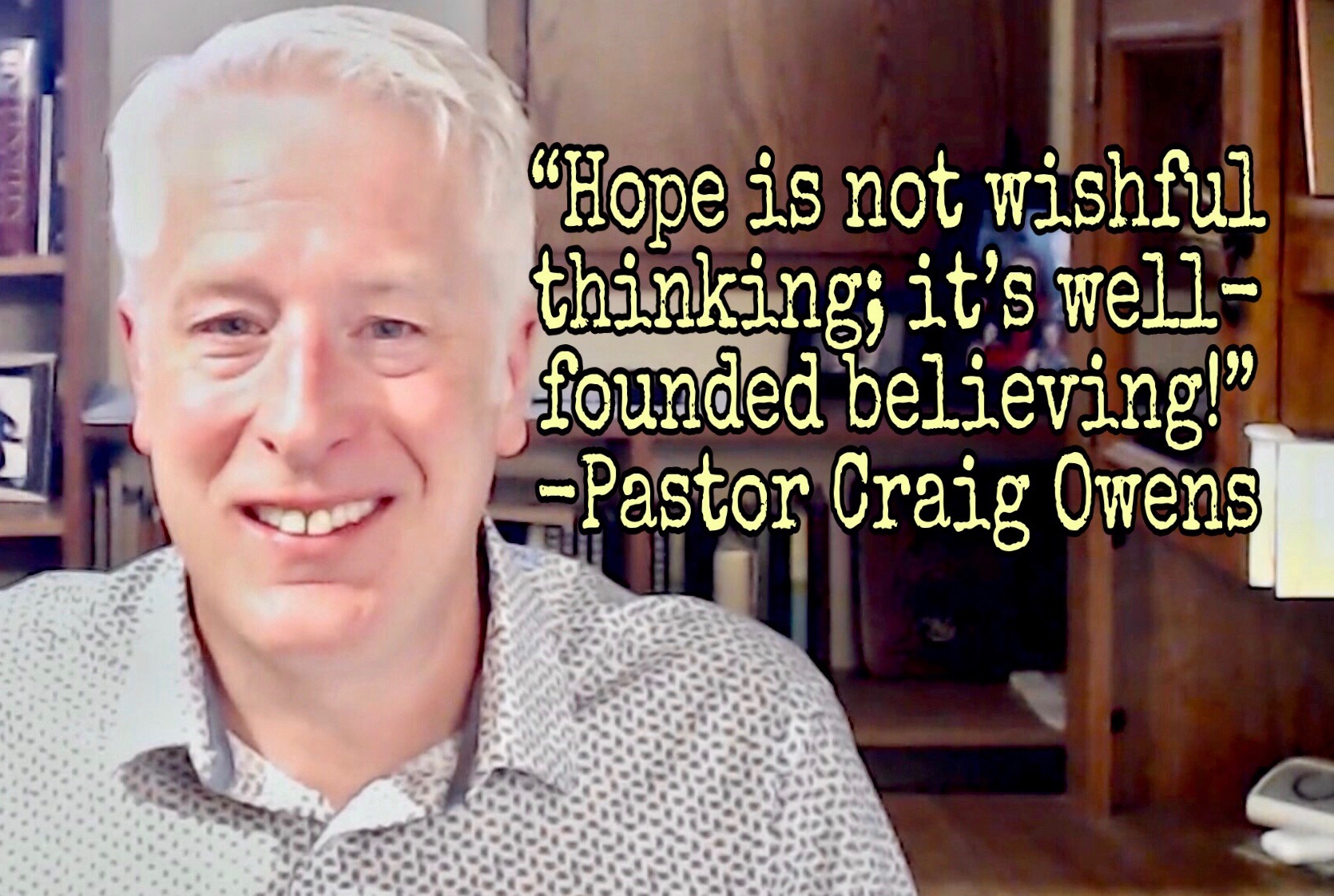
Hope is not wishful thinking; it’s well-founded believing!
I want to circle back to that word refining because I think that best sums up what God is doing in our painful times. Romans 8 tells us—The Spirit Himself thus testifies together with our own spirit, assuring us that we are children of God. And if we are His children, then we are His heirs also: heirs of God and fellow heirs with Christ—sharing His inheritance with Him; only we must share His suffering if we are to share His glory. But what of that? For I consider that the sufferings of this present time—this present life—are not worth being compared with the glory that is about to be revealed to us and in us and for us and conferred on us! (Romans 8:15-18)
So where’s God in this time of fire? He is overseeing our trial as a Perfect Refiner. Do you know how the silversmith knows he has purified the impurities from the silver ore? The silver is pure when he can see his own reflection in the silver!
In the heat of your trial, God is close to you. He knows the perfect temperature and the precise time that it will take to allow His face to be seen in you!
Sometimes you will see what God is doing through your furnace time, sometimes you won’t. But don’t ever bail out! God IS working! He is giving you a new perspective, a deeper empathy, more patience, an unshakable hope, and most of all—He is removing the impurities that will allow His face to be seen more clearly in you!
Join me this Sunday as we continue to learn where God is in our darkest times. And if you didn’t catch the previous messages in this series, please check out The God That Runs To You and How Long Will This Last?