You Do Not Make Use Of Christ As You Ought To Do…

“Believer, you do not make use of Christ as you ought to do. When you are in trouble, why do you not tell Him all your grief? Has He not a sympathizing heart, and can He not comfort and relieve you? No, you are going about to all your friends, save your best Friend, and telling your tale everywhere except into the bosom of your Lord. … There is nothing Christ dislikes more than for His people to make a show-thing of Him, and not to use Him. He loves to be employed by us. The more burdens we put on His shoulders, the more precious will He be to us.” —Charles Spurgeon

My Mediator

If anyone ever felt his pain was undeserved, it was Job! His life is so invaluable for us to be able to answer the question, “Where’s God in the midst of my dark times?”

Job tried to makes sense of what was happening to him. Sometimes he thought God was so awesome and so powerful that He was completely unknowable. God was a faceless, unapproachable Being. At other times Job thought God was so righteous that He would have nothing to do with him. So in the depth of his despair he called out for someone to be his mediator (see Job 9:33-35).

An effective mediator has to be someone who can understand and relate to both parties. He cannot be partial to one side, nor unsympathetic to one side. He has to be able to relate to both parties. In this case, he would have to be able to relate to both God and man—he would have to be able to be able to understand this Indefinable Power and this Supreme Morality and man’s struggle to come to grips with both of these views of God. Jesus is that Mediator.

[Jesus] gave up His divine privileges; He took the humble position of a slave and was born as a human being. (Philippians 2:7)

God Himself chose to step into all of our pain!!

The Bible describes Jesus as a Man of sorrows, One familiar with suffering, One acquainted with grief.

Jesus knows your pain even more acutely than you know it yourself. He wants to take all of your pain, and bear it for you. Jesus is not some faceless, unknowable Entity; He’s not aloof, He’s not unapproachable, He’s not unmoved by your pain. Will you let Him carry your pain?

He wants you to know Him as your Mediator:

Jesus understands every weakness of ours, because He was tempted in every way that we are. But He did not sin! So whenever we are in need, we should come bravely before the throne of our merciful God. There we will be treated with undeserved kindness, and we will find help. (Hebrews 4:15-16)

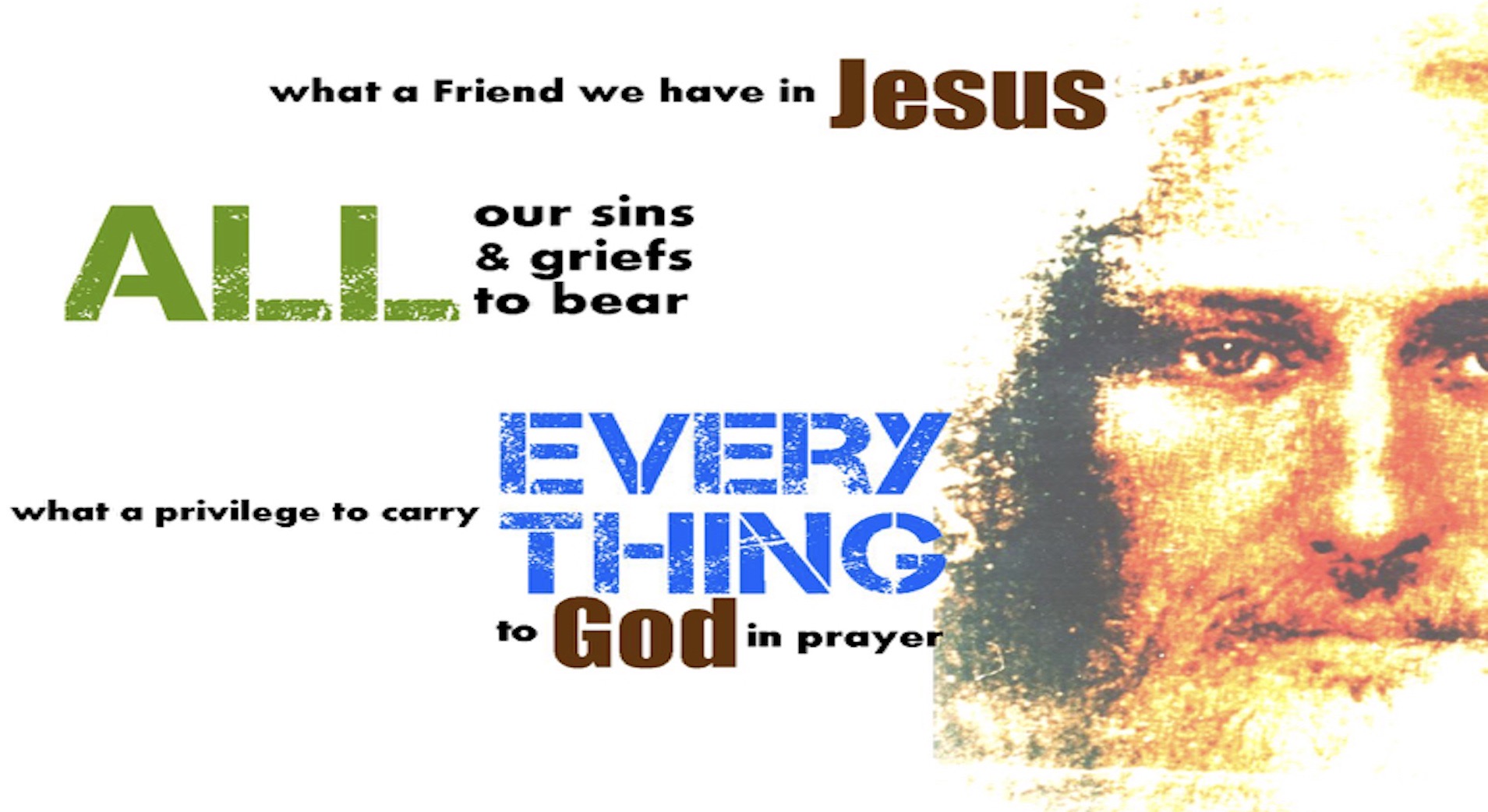
What a Friend we have in Jesus

All our sins and griefs to bear

What a privilege to carry

Everything to God in prayer

Where’s God?

It is one of the most painful, gut-wrenching cries in all of history. Hanging on the Cross, suspended between Heaven and earth, Jesus Christ cries out, “My God! My God! Why have You forsaken Me?!”

Ever been there?

Ever been in such a dark, painful place that you wonder if God has abandoned you?

You are not alone.

We’ve all been there. And best of all, Jesus Himself has been there. The Bible tells us that because Jesus has been there—where your pain is so intense, and the darkness is pitch-black—that He is the best One to help you.

Next Sunday we are kicking off a brand new series called Where’s God? In the darkest moments of our lives, where is God? what is He doing? how can anything good come from this? Please come join us.

If you’ve missed any of the messages in this series, check them our here:

Books I Read In 2010

What Good Is God? (book review)

Philip Yancey always makes me think. He explores the edges of Christian faith, not content just to walk down the safe paths of well-worn, traditional preaching. Just the title of his latest book—What Good Is God?—tells you that this book will be no exception.

This book is laid out in ten sections, each with two chapters. The first chapter in each section gives you the setting, the second chapter is a speech that Yancey gave in that setting. And, wow, what tough settings they are! Every setting is one that makes you wonder, “Where was God in that?!?”

What Good Is God? will take you to settings like…

  • The campus of Virginia Tech after a gunman opened fire on faculty and students.
  • The secret house churches in Communist China.
  • The post-apartheid South Africa where wounds of hate are still healing.
  • The volatile Middle East where religious beliefs violently collide.
  • The middle of a terrorist attack in Mumbai, India.

In every section, Philip Yancey masterfully and empathetically takes us on a journey of discovery that shows that God is still God and that He is good. He does this through personal example, Biblical references, and always with a heart that seems to know his audience.

It’s a challenging read, but well worth your time.

I am a Faith Words book reviewer.

The Refinement Of Pain

I was recently invited to join a bunch of guys—mostly staff in the Cedar Springs schools—for some early morning basketball. I love playing basketball, I’m a morning guy, and getting to know new people in Cedar Springs made this an invitation I couldn’t refuse. So I started hoopin’ this week. It was nice to get back on the hardwood floor!

Yesterday morning, I jumped in my car to come home to shower. It’s a mile from the school to my house, but by the time I got home, my back muscles had seized up and I was barely able to stand up to get out of the car. I’ve had this happen to me once before, and it’s a whole lot of no fun!

So all day yesterday my schedule had to be modified, as it hurt to move, it hurt to stand for too long, and it hurt to sit for too long. I couldn’t get in the car. In fact, I couldn’t even bend over far enough to put my own socks on! All my plans for the day were shot.

But here’s what I learned: my day wasn’t shot. My plans may not have worked out, but it was still a good day. Pain has a tendency to refine what’s really important out of all the trivial stuff.

  • A day in pain and immobility reminded me of just how blessed I am to normally have good health.
  • It prompted me to pray for others who are confined to a wheelchair or their beds.
  • It gave me greater empathy for those who live in chronic pain.
  • It made me more thankful that I have access to medicines and caregivers, things that some people have access to only rarely.
  • It let me see more clearly the love my family and friends have for me.
  • It gave me more time to pray.

Now here’s the tricky part: to live with these things on my mind even when I’m not in pain.

Here’s what C.S. Lewis wrote in The Problem Of Pain:

I am progressing along the path of life in my ordinary contentedly fallen and godless condition, absorbed in a merry meeting with my friends for the morrow or a bit of work that tickles my vanity today, a holiday or a new book, when suddenly a stab of abdominal [or back] pain that threatens serious disease, or a headline in the newspapers that threatens us all with destruction, send this whole pack of cards tumbling down. At first I am overwhelmed, and all my little happinesses look like broken toys. Then, slowly and reluctantly, bit by bit, I try to bring myself into the frame of mind that I should be in at all times. I remind myself that these toys were never intended to possess my heart, that my true good is in another world and my own real treasure is in Christ. And perhaps, by God’s grace, I succeed, and for a day or two become a creature consciously dependent on God and drawing strength from the right sources. But the moment the threat is withdrawn, my whole nature leaps back to the toys: I am even anxious, God forgive me, to banish from my mind the only thing that supported me under the threat because it is now associated with the misery of those few days. Thus the terrible necessity of tribulation is only too clear. God has had me for but forty-eight hours and then only by dint of taking everything else away from me. Let Him but sheathe that sword for a moment and I behave like a puppy when the hated bath is over—I shake myself as dry as I can and race off to reacquire my comfortable dirtiness, if not in the nearest manure heap, at least in the nearest flower bed. And that is why tribulations cannot cease until God either sees us remade or sees that our remaking is now hopeless.

With God’s help, I’m going to avoid running back to my “toys” today. I’m trying to keep the most important thing in the forefront of my thoughts today.

What lessons have you learned from pain?

Some Pain For Greater Gain

My US Marine Corps buddy always tells me to suck it up when I complain about something hurting. He says, “Pain is just weakness leaving your body.” Hoo-Rah!

Great.

But for the most part, I don’t like pain. What about you? Most of us non-Marine-types do our best to avoid pain. And if any pain does make it through, we can take care of that really fast with some Motrin or Tylenol, or Icy Hot or a massage session.

However, there are times that some pain is good for greater gain.

What about the temporary pain from an immunization injection? Short-term pain for the long-term gain of being free of disease.

What about a low-grade fever (below 101 degrees)? Taking Tylenol too soon can preempt the natural way your body is raising the heat to kill off an infection. The short-term pain of a fever for the long-term gain of dead germs.

What about the soreness from exercising? Again, the pain is short-term; the benefits of healthy exercise are long-term.

How about saying “no” to temptation? Shouldn’t you trade the short-term pain of temptation for the long-term gain of holiness?

Or God’s discipline? He sometimes puts us in positions that are painful because He is trying to bring the best out of us. Here my Marine buddy is correct: this pain is weakness leaving our (spiritual) body.

Before you are too quick to mask the pain, stop for a moment to find out why the pain is there. An immunization or low-grade fever or exercise or discipline may be just the short-term pain you need for far greater gain.

Finding Purpose Beyond Our Pain (book review)

I’ve been a fan of Dr. Paul Meier for quite some time, and his latest book—co-authored with Dr. David Henderson—kept me cheering. Finding Purpose Beyond Our Pain explores seven areas that prompt some of the deepest soul-searching and some of the stickiest questions that humans face.

There are a couple of things I admire about Drs. Meier and Henderson. One is their understanding that humans are a tri-part being: body, soul, and spirit. Those that try to bring help for the deep pain that we all experience by addressing just one area are missing the mark. There is physical pain, emotional pain, and spiritual pain.

I’ve often found that humanists who just want to address the physical and emotional symptoms, but ignore the spiritual symptoms, offer only short-sighted answers. On the other extreme, some in the church world want to offer spiritual solutions for everything, and completely ignore the physical and emotional causes. Either extreme is unhelpful to someone who is hurting. Drs. Meier and Henderson do an excellent job addressing all three areas.

The other thing I’ve always appreciated about Dr. Meier, and now his new coauthor as well, is his accessible writing style. In other words, although these are incredibly well-educated men, they write in a way that everyone can understand. And more importantly, their writing style allows for ready application.

This book is divided into seven sections of four chapters each. Each section diagnosis an area of pain, looks at the causes, explores the possible responses, and ultimately uncovers the purpose beyond the pain. In every section, the physical, emotional, and spiritual dimensions are addressed. These sections cover the most common pain-filled struggles we all face:

  • Injustice
  • Rejection
  • Loneliness
  • Loss
  • Discipline
  • Failure
  • Death

As a pastor, I have to deal with people who are experiencing past or present pain quite frequently. This book has enlightened me in some biblically-rooted, practical ways I can point to the purpose beyond their pain. But even if you are not a pastor or counselor, this book will be a great resource to have on your shelf. Whether you have lingering questions about the pain you have experienced, or you simply want to be ready to help a friend or loved one who may be battling one of these areas, you will appreciate Finding Purpose Beyond Our Pain.

I am a book review blogger for Thomas Nelson.

The Wounded Healer (book review)

Wounded Healer, The

“For the minister is called to recognize the sufferings of his time in his own heart and make that recognition the starting point of his service. Whether he tries to enter into a dislocated world, relate to a convulsive generation, or speak to a dying man, his service will not be perceived as authentic unless it comes from a heart wounded by the suffering about which he speaks” (from the introduction).

Henri Nouwen was a man ahead of his time. Although this book was written in the early 1970s, it sounds so applicable for today. The Wounded Healer challenged me as a Christian leader to step into the pain-filled lives as others in a more authentic way. Nouwen argues that healers must first be personally acquainted with the same type of pain that other wounded people are experiencing.

Isaiah 53 says that Christ “was wounded for our transgressions, He was bruised for our guilt and iniquities; the chastisement [needful to obtain] peace and well-being for us was upon Him, and with the stripes [that wounded] Him we are healed and made whole.” Because Jesus was wounded in the same way we are wounded, He knows how to help (see Hebrews 2:18).

One closing quote from Nouwen: “If there is any posture that disturbs a suffering man or woman, it is aloofness. … No one can help anyone without becoming involved, without entering with his whole person into the painful situations, without taking the risk of become hurt, wounded or even destroyed in the process. The beginning and the end of Christian leadership is to give your life for others.”

This book reconfirmed my desire to—like Jesus—be a wounded healer for others.