Jesus: A Theography (book review)

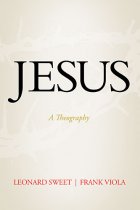
Jesus A TheographyVery rarely do I say what I’m going to say about Jesus: A Theography by Leonard Sweet and Frank Viola: This is a must-read!

Jesus does such an amazing job of showing Christ in all His fullness throughout the entire Bible, that I cannot recommend it highly enough. It’s a weighty read covering a weighty subject. At over 300 pages of text, 20+ pages of quotes from imminent theologians, and nearly 100 pages of end notes, this book gives you so much to contemplate. As much as I enjoy speed reading my books, this was a book that I had to read and digest slowly, as there was so much to process in each paragraph.

Far too many people think Jesus “showed up” in the New Testament. But Leonard Sweet and Frank Viola do a masterful job of weaving together the Old and New Testament texts (or, as the authors call them, the First and Second Testaments), to show Christ in all His fullness. If you are among those who have only seen Jesus in the New/Second Testament, you are about to have your paradigm totally rocked!

Let me restate my opening paragraph again—If you want to know more about Jesus Christ, Jesus: A Theography is a must-read!

I am a Thomas Nelson book reviewer.

Check out some quotes from this book here.

Spirit Rising (book review)

Every time I read or hear Jim Cymbala speak, I know I’m hearing from a man who is hearing from God. This is a humble man who has his spiritual ears tuned-in to the Holy Spirit’s voice, and in Spirit Rising we hear a clear call for us to tune-in to the Spirit’s voice as well.

As I began to read this book, a quote near the beginning jumped off the page and into my heart—

“Many of us want more of God but not to the point of being ridiculed. Our Western minds think, I will serve the Lord, but I will remain in control as I do it. But whether we like it or not, that’s not how the church began. The church began with Spirit-controlled Christians who yielded themselves to God. That’s radical, yes, but that’s the way the Lord did it.

“Some might say, ’Yeah, but we’ve improved upon the New Testament style of Christianity.’ If that’s true, I want to see the spiritual fruit our improvements have produced. People may have mocked those first, ’unsophisticated’ Christians, but thousands got saved in the first four chapters of Acts. The Word of God was treasured. The churches were filled with sacrificial love. A holy excitement pervaded the atmosphere. Have we really improved upon that?”

Through a closer look at the New Testament church, through personal experience, through the voices of notable leaders in the church’s history, and through personal testimonies, Pastor Cymbala makes it clear that today’s Christianity is sadly missing an intimate connection with the Holy Spirit. The subtitle—tapping into the power of the Holy Spirit—is an apt description of what you will find in this book.

If you are hungry for more of God’s presence in your life, in your church, in your community, please dive into Spirit Rising and be prepared to have your spiritual eyes opened!

Church-In-A-Box

Did you ever play with a Jack-in-a-box? You turned the crank, listened to the song, and waited for the funny-looking Jack to pop out of the box. Then you stuffed Jack back in the box and did it again.

And again, and again!

It was predictable.

It happened like clockwork. After awhile, though, the predictability became boring, and the Jack-in-a-box ended up collecting dust on the shelf.

Sometimes I’m concerned that our churches are becoming like a church-in-a-box. Like the predictable Jack-in-a-box, we turn the crank of showing up on Sunday, going through the same routine, waiting for God to show up, and then stuffing it all back into the box, only to repeat it all again the next Sunday.

And the next Sunday, and the next Sunday!

It’s predictable. It happens like clockwork. After awhile, though, the predictability can become boring, and our church-in-a-box ends up collecting dust on the shelf.

Here’s what I’m pondering:

  • Why do we meet on Sunday mornings?

There are as many mentions in the Bible about Christians meeting on other days as there are mentions about the first day of the week.

  • Why do we get so hung up on the “order of service”?

None of the New Testament writers taught about that. Yet if you want to anger some folks, just change up the Sunday routine.

  • Why do we dress a certain way to go to church?

Jesus had only one set of clothes, which means He wore the same thing to the synagogue as He wore the rest of the week. Yet we expect people to “dress correctly” for church.

  • Why do we call what happens on Sunday “worship,” and what happens the rest of the week “work”?

Shouldn’t everything we do bring glory to God? Shouldn’t all of our lives be worship?

  • Why do we complain about a church service not “moving us,” when we don’t feel the Holy Spirit moving the other six days of the week?

I’m not trying to pick a fight. Really.

I’m just wondering if perhaps we’ve gotten used to church-in-a-box. And if we have, perhaps we’ve also put God in a box too. Maybe we’ve become so accustomed to showing up on Sunday, dressing a certain way, following a certain routine, singing certain songs, and then expecting God to pop out and thrill us.

And then we put it all away until the next Sunday.

Wouldn’t God be more glorified if we didn’t put Him in a box? If we worshiped Him every day, not just Sunday? If we felt His Spirit animating us in everything we do, not just in the churchy things we do? If He popped up all throughout the week, in all sorts of places (like work, school, the grocery store, home)?

What do you think? Have we put church (and God) in a box? If so, how should we change?

How To Read The Bible (book review)

People who call themselves Christians should know how to read the Bible, right? Maybe, but many times I think we assume far too much. Fortunately How To Read Your Bible by A.J. Conyers can help.

  • Some people avoid the Old Testament, saying, “It’s too confusing!”
  • Some people simply flip their Bibles open to any passage and simply start reading.
  • Some people only open their Bibles when they’re at church.

All of these methods may work, but they’re not the best way to learn what God has to say to us in His Word. A.J. Conyers explains to his readers the art of reading the Bible, as well as the practice of reading the Bible. He gives enough background information to get you started in the right direction, and he gives you ample resources to continue digging into God’s Word more.

As you might have noticed, I love to read. But hands-down-without-question my favorite book is the Bible. Every time I open it up, I find something new to apply to my life. If you’re having difficulty getting started on a Bible study, this book may be just the thing to help get things rolling.

(I’m also a big fan of YouVersion: the Bible app for your smart phone. You can download it for your iPhone or Droid by clicking here.)

Old And Valuable

During my freshman year of college, I was placed as a roommate with another freshman who was a theology major. Just so we’re all clear about this: theology is the study of God. And just so we’re all crystal clear about this: the study of God is typically based on the Bible.

I can hear some of you now, “Duh! Great insight!” But hang with me for a moment.

Near the start of our first semester together my roommate came into our dorm room very upset, slammed the door shut, and threw down his backpack. When I asked what was the matter he told me he had just come from a meeting with his academic advisor and was furious at his list of required classes. When I inquired what class he wasn’t allowed to take, he said, “No, it’s not what class I can’t take; it’s what classes I have to take!”

“So what classes are you upset that you have to take?” I asked, thinking maybe something like science or phys ed.

“Old Testament,” he responded. I was speechless, but he continued, “I mean, Old Testament! C’mon, that was stuff from a long time ago. We live under the new covenant now, so the old covenant has no purpose for us anymore!”

Although this is somewhat shocking to hear from a theology major, I’m afraid a lot of people feel this way.

Did you know…

  • The Old Testament (OT) is directly quoted by the New Testament (NT) writers nearly 700 times.
  • There are thousands of references to OT people, events, or principles in the NT.
  • Of the 27 books in the NT, only six don’t have direct OT quotations. But four of those six books refer back to OT people or passages.
  • Of the 39 books in the OT, all but nine of them are quoted in the NT.
  • Jesus Himself quoted from the five books of Moses (Genesis, Exodus, Leviticus, Numbers, Deuteronomy) nearly 60 times.

I love the Old Testament! There I read some great stories and meet some very colorful personalities. But I especially love reading the OT to see what was going to happen and then reading the NT to see both what did happen and what’s still going to happen.

Those 39 books of the Old Testament may be old, but they’re so rich, and so valuable, and so enlightening to the New Testament. If you haven’t made the OT a part of your Bible reading time, I encourage you to do so.

The Old Testament is not old, as in worn out, archaic, useless. It’s old, as in priceless, valuable, foundational.

Still Learning

I live by the axiom, “If you’re through learning, you’re through.” So I try to learn something new every day.

I just finished a class called New Testament Survey: a quick overview of the 27 books that compromise the New Testament of the Bible. Here’s a couple of interesting factoids I picked up from my studies:

  • The earliest-written book was James. Interesting, because at one point James thought Jesus (his half-brother) was nuts.
  • Only Matthew uses the term kingdom of heaven; all of the other writers use kingdom of God.
  • Mark uses the word immediately more times than anyone else. Perhaps because his source (Peter) was always doing things so quickly… sort of a ready, FIRE!, aim kinda guy.
  • Luke wrote what is called “the global gospel” for everyone, so he included 45 teachings/events that no one else records.
  • John doesn’t record any of Jesus’ parables.
  • John uses the word believe nearly 100 times— way more than any other writer.
  • Luke talks about the Holy Spirit nearly 60 times in the 28 chapters of Acts.
  • Romans is the longest of Paul’s epistles with 7101 words; Philemon is the shortest with just 355 words.
  • With the exception of the pastoral epistles (1 Timothy, 2 Timothy, Titus) Paul’s letters are arranged in the Bible from longest to shortest.
  • In 1 & 2 Thessalonians (only 136 verses) Paul refers to God, Christ, the Holy Spirit, or a combination thereof more than 150 times.
  • Paul gives Timothy seven word pictures to describe the kind of pastor he should be: son, soldier, athlete, farmer, workman, instrument, and servant.
  • Hebrews is called “the book of better things” so better is used 13 times. This word is used only six times in the remaining 26 books of the New Testament.
  • James wrote 108 verses but issues 50+ direct commands.
  • In John’s three short epistles he uses the word know 33 times, and the word dear ten times.

Keep on learning! There’s a lot of good stuff out there. What have you learned lately?