A Checklist For Influencers

Listen to the podcast of this post by clicking on the player below, and you can also subscribe on AppleSpotify, or Audible.

As the apostle Paul is wrapping up his letter to his friends in the Church at Philippi, he encourages them to be people others want to be around. After all…

The #1 Rule of Influence: You can only influence people who are close to you.

The #2 Rule of Influence: People won’t get close to you unless you are approachable.

So here’s a quick checklist from Paul to Christians who want to be influencers from Philippians 4:4-9:

  • Rejoice in God. Always.
  • Be gentlemen and gentlewomen. Manners matter.
  • Understand God is always with you.
  • Don’t be anxious or fretful.
  • Pray about everything.
  • Be a thank-full person.
  • Be discerning of what goes in your eyes and ears.
  • Continue to learn and practice godly, biblical principles.

A short list, but a lifetime of growth opportunities.

The more you exhibit these qualities, the more approachable you will be. And the more approachable you are, the more you can influence people to learn about the life-changing power of a personal relationship with Jesus.

►► Would you please prayerfully consider supporting this ministry? My Patreon supporters get behind-the-scenes access to exclusive materials. ◀︎◀︎

Going Up, Please

I’m leading a fun discussion at the En Gedi Youth Center with a bunch of excited 6th graders. Our class is called “An Elevation, A Mirror, And A Guy Called Bob” which is based on John Maxwell’s book Winning With People.

In Winning With People, Dr. Maxwell shares 25 principles for improving our interpersonal skills. In my class at the youth center, we’ve already covered the lens principle and the elevator principle.

The elevator principle basically says that we can only take people up or take them down in our interactions with them. There are no “neutral” interactions. I’m encouraging our students to always take people up.

One way we do that is by pausing to T.H.I.N.K before we speak. Before speaking, ask yourself, “Is what I’m about to say…

  • True
  • Helpful
  • Inspiring
  • Necessary
  • Kind?”

This isn’t just good advice for 6th graders. We all would do well to remember to T.H.I.N.K. As Winston Churchill said,

“By swallowing evil words unsaid, no one has ever harmed his stomach.”

Negotiating Conflict

Last week I spent two jam-packed days at the Willow Creek Leadership Summit. As always, I was on information overload with the great content that is presented every year. So I’ve been taking some time to ponder what I learned.

There are a couple of past post on my blog that consistently rank near the top of the list of “most read”:

With that in mind, William Ury’s discussion on how to successfully negotiate conflict really caught my attention.

Ury pointed out that conflict isn’t bad; it’s natural. Therefore, we don’t need to eliminate conflict, but find ways to deal with it in constructive ways.

I’ve tried to learn to look at myself in the mirror before entering into discussions where the potential for conflict is high. This thought was reinforced when Ury said: The greatest obstacle to successful negotiation is: Me. Why? Because I tend to react. “When you’re angry, you’ll make the best speech you’ll ever regret,” he said.

The greatest power we have in negotiation is the power NOT to react. 

Here are some strategies William Ury shared for successful negotiations:

  • Separate people from the problem. Be soft with people and hard with the problem. Soft means listening, empathy, and respect. Change the game: instead of squaring-off against each other face-to-face, be side-by-side facing the problem.
  • Focus on interests not positions. Probe behind the position to find out what the underlying interest is. He gave a great example about two girls who each wanted the one remaining orange. Our natural instinct is to divide the orange so each girl gets one half. But in watching what happens next, we see one girl throw away the peel and eat the fruit; the other throws away the fruit and uses the peel to complete her cake recipe. If we had figured out the interests of each girl, both girls could have had a whole orange! 
  • Develop multiple options. Search for creative options that meet the needs of everyone. Ury shared an example of a successful solution to a problem in the Middle East. Egypt wanted the Sinai peninsula because it was their historic possession; Israel wanted the same piece of land as a security buffer. The solution: let Egypt have sovereign control of the Sinai peninsula, but make it a demilitarized zone. Both sides got what they wanted.
  • Expand the pie before we divide it up. Uses standards that are objectively fair to each side.

The final piece of advice William Ury shared was the concept of BATNA = best alternative to a negotiated agreement. I need to think this through before any negotiations start. This is what I have determined ahead of time that I will walk away with if the negotiation doesn’t go as planned. Ury pointed out that we can negotiate with more confidence if we have a BATNA.

I thought this was pretty good advice. What do you think?

You Can’t Give What You Don’t Have

It seems like a pretty simple concept. If I don’t possess something, as much as I may want to give it away to someone else, I can’t do it.

We know this, don’t we? If my best friend really needs $20, and I really want to give him $20, I cannot help him if I only have $12 in my wallet. I cannot give what I do not have.

So when you take the time to strengthen yourself physically—by getting enough sleep, by exercising, by eating a healthy diet—you are simply preparing yourself to be able to give your physical strength to another.

When you take the time to recharge yourself emotionally—by taking some solitude time, by getting around positive people—you are preparing yourself to be able to give your emotional strength to another.

When you take the time to expand your mind—by reading a book, by taking a class—you are preparing yourself to be able to give your intellectual strength to another.

And when you take the time to renew yourself spiritually—by reading your Bible, by praying, by going to church—you are preparing yourself to be able to give your spiritual strength to another.

“Brethren, let us look well to our own steadfastness in the faith, our own holy walking with God. Some say that such advice is selfish; but I believe that, in truth, it is not selfishness, but a sane and practical love of others which leads us to be mindful of our own spiritual state.” —Charles Spurgeon

Look at the life of Jesus. He never apologized for taking time away to pray, to sleep, to talk with His Father. Then He was never at a loss when someone needed physical, emotional, intellectual, or spiritual strength.

What are you doing to recharge your batteries? It’s never selfish to take the time you need to gather the strength you will need to help others. In fact, being prepared mentally, physically, emotionally and spiritually is one of the most loving things you can do.

Scriptural Surprises

Charles Spurgeon wrote:

“Scripture grows upon the student. It is full of surprises. Under the teaching of the Holy Spirit, to the searching eye it glows with splendor of revelation.”

I love this!

I cannot count how many times I read my Bible and do a double-take. I look again and think to myself, “I don’t think that was there the last time I read that passage!” That’s probably because I wasn’t ready for it earlier.

In the comments below, share something surprising you’ve read in the Bible recently.

Present Tense

Listen to the podcast of this post by clicking on the player below, and you can also subscribe on AppleSpotify, or Audible.

I never want my best days to be in my past.

I don’t want things I’ve learned to become old.

I don’t want nostalgia for God’s moving and provision in my life to be greater than my current joy in His moving and provision.

I don’t want to live in the past tense, but always in the present tense.

For Christians there is a danger in reflecting more on the past than on the present. God says He is the I AM, not the I WAS. He wants to do something new in you and I today—present tense.

I love what Smith Wigglesworth said:

“Beloved, don’t forget that every day must be a day of advancement. If you have not made any advancement since yesterday, in a measure you are a backslider. There is only one way for you between Calvary and the glory, and it is forward. It is every day forward. It is no day back. It is advancement with God. It is cooperation with Him in the Spirit. … If we live on the same plane day after day, the vision is stale; the principles lose their earnestness. But we must be like those who are catching the vision of the Master day by day.”

This is my prayer: Jesus, let me catch the vision of You again today. Let my vision always be present tense.

►► Would you please prayerfully consider supporting this ministry? My Patreon supporters get behind-the-scenes access to exclusive materials. ◀︎◀︎
Still So Much More To Learn

I was thinking about the disciples of Jesus. Can you imagine the things they heard and saw! With their own eyes they saw those jaw-dropping miracles. With their own ears they heard His profound teaching. They watched and heard Him pray. No one ever had the kind of access to Jesus than these men.

And yet, they were still so spiritually dull…

  • They couldn’t grasp what Jesus was teaching, even when He explained it to them privately.
  • Their faith was sorely lacking.
  • They argued among themselves over such petty things.

If these men—with their almost limitless access to Jesus—were still struggling in their faith, what would make me think I have ever “arrived”?

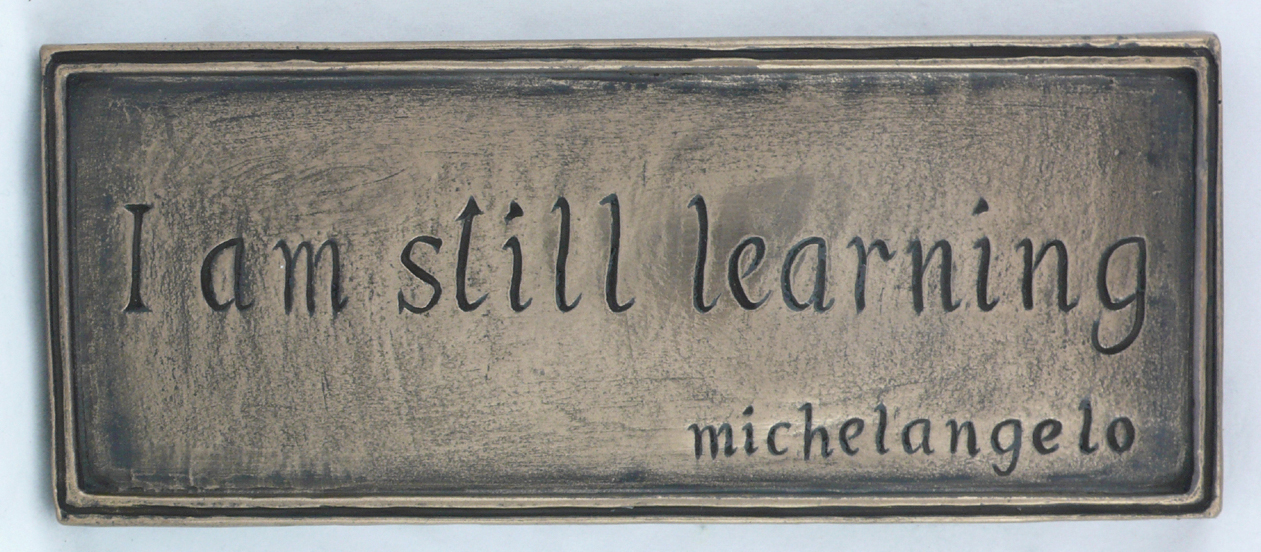
There is still so much more for me to learn about Jesus.

And I do want to learn more! I want to press in—closer and closer, deeper and deeper! I never want to stop learning my Savior’s heart and will!

What about you? Do you want more?

My Blind Spot

Listen to the podcast of this post by clicking on the player below, and you can also subscribe on AppleSpotify, or Audible.

Blind spots can be deadly. I simply don’t see what’s right there until—wham!—it crashes into me.

These blind spots have been called our “unconscious incompetence” zone. I’m not doing well in a certain area, but I just don’t know it yet until—wham!

Up to that point everything seems fine, but wise King Solomon said, “Smugness will destroy fools” (Proverbs 1:32).

It seems there are two ways I could deal with my unconscious incompetencies. (1) I could wait until I get blindsided by one of them; or (2) I could ask the Holy Spirit to reveal them to me. Neither option seems very pleasant, but if I’m going to get hit—wham!—it seems like a better option to let Someone who loves me, and wants the best for me, to do it (see Hebrews 12:5-11).

David thought so too. He prayed—

Search me thoroughly, O God, and know my heart! Try me and know my thoughts! And see if there is any wicked or hurtful way in me, and lead me in the way everlasting. (Psalm 139:23-24)

Or, how about Sir Francis Drake’s prayer:

Disturb us, Lord, when
We are too well pleased with ourselves,
When our dreams have come true
Because we have dreamed too little,
When we arrived safely
Because we sailed too close to the shore.

Disturb us, Lord, when
With the abundance of things we possess
We have lost our thirst
For the waters of life;
Having fallen in love with life,
We have ceased to dream of eternity
And in our efforts to build a new earth,
We have allowed our vision
Of the new Heaven to dim.

Disturb us, Lord, to dare more boldly,
To venture on wider seas
Where storms will show Your mastery;
Where losing sight of land,
We shall find the stars.

We ask You to push back
The horizons of our hopes;
And to push us into the future
In strength, courage, hope, and love.

The wham! moments will come. The question is how do you want them to come?

►► Would you please prayerfully consider supporting this ministry? My Patreon supporters get behind-the-scenes access to exclusive materials. ◀︎◀︎
I Didn’t Choose This

Hello, my name is Craig Owens and I’m a pastor. I wasn’t a PK (pastor’s kid). This isn’t the profession I chose for myself. I envisioned myself doing other things, but God had different plans for me.

He called, and I said “yes.” He called me to be a pastor and so He equipped me for the pastorate. I can relate to what the Apostle Paul wrote—

By God’s grace and mighty power, I have been given the privilege of serving Him by spreading this Good News. (Ephesians 3:7)

Paul, too, didn’t choose be a minister telling people about Jesus Christ. But God had different plans for him.

And so, since God has called me to do this, I must do it to the best of my ability. I don’t have the natural ability for it, I simply have God’s grace and mighty power. And to that grace and power I must add my best effort—

Study and be eager and do your utmost to present yourself to God approved (tested by trial), a workman who has no cause to be ashamed, correctly analyzing and accurately dividing [rightly handling and skillfully teaching] the Word of Truth. (2 Timothy 2:15, AMP)

I like the counsel of Charles Spurgeon:

Again, the theme of a minister should be Christ Jesus in opposition to mere doctrine. Some of my good brothers are always preaching doctrine. Well, they are right in so doing, but I would not care myself to have as the characteristic of my preaching doctrine only. I would rather have it said, ‘He dwelled much upon the person of Christ and seemed best pleased when he began to tell about the atonement and sacrifice. He was not ashamed of the doctrines; he was not afraid of threatening. But he seemed as if he preached the threatening with tears in his eyes, and the doctrine solemnly as God’s own Word. But when he preached of Jesus, his tongue was loosened, and his heart was at liberty.’”

I didn’t choose this, but God chose me. And for that I am extremely humbled and grateful.

How To Read The Bible (book review)

People who call themselves Christians should know how to read the Bible, right? Maybe, but many times I think we assume far too much. Fortunately How To Read Your Bible by A.J. Conyers can help.

  • Some people avoid the Old Testament, saying, “It’s too confusing!”
  • Some people simply flip their Bibles open to any passage and simply start reading.
  • Some people only open their Bibles when they’re at church.

All of these methods may work, but they’re not the best way to learn what God has to say to us in His Word. A.J. Conyers explains to his readers the art of reading the Bible, as well as the practice of reading the Bible. He gives enough background information to get you started in the right direction, and he gives you ample resources to continue digging into God’s Word more.

As you might have noticed, I love to read. But hands-down-without-question my favorite book is the Bible. Every time I open it up, I find something new to apply to my life. If you’re having difficulty getting started on a Bible study, this book may be just the thing to help get things rolling.

(I’m also a big fan of YouVersion: the Bible app for your smart phone. You can download it for your iPhone or Droid by clicking here.)