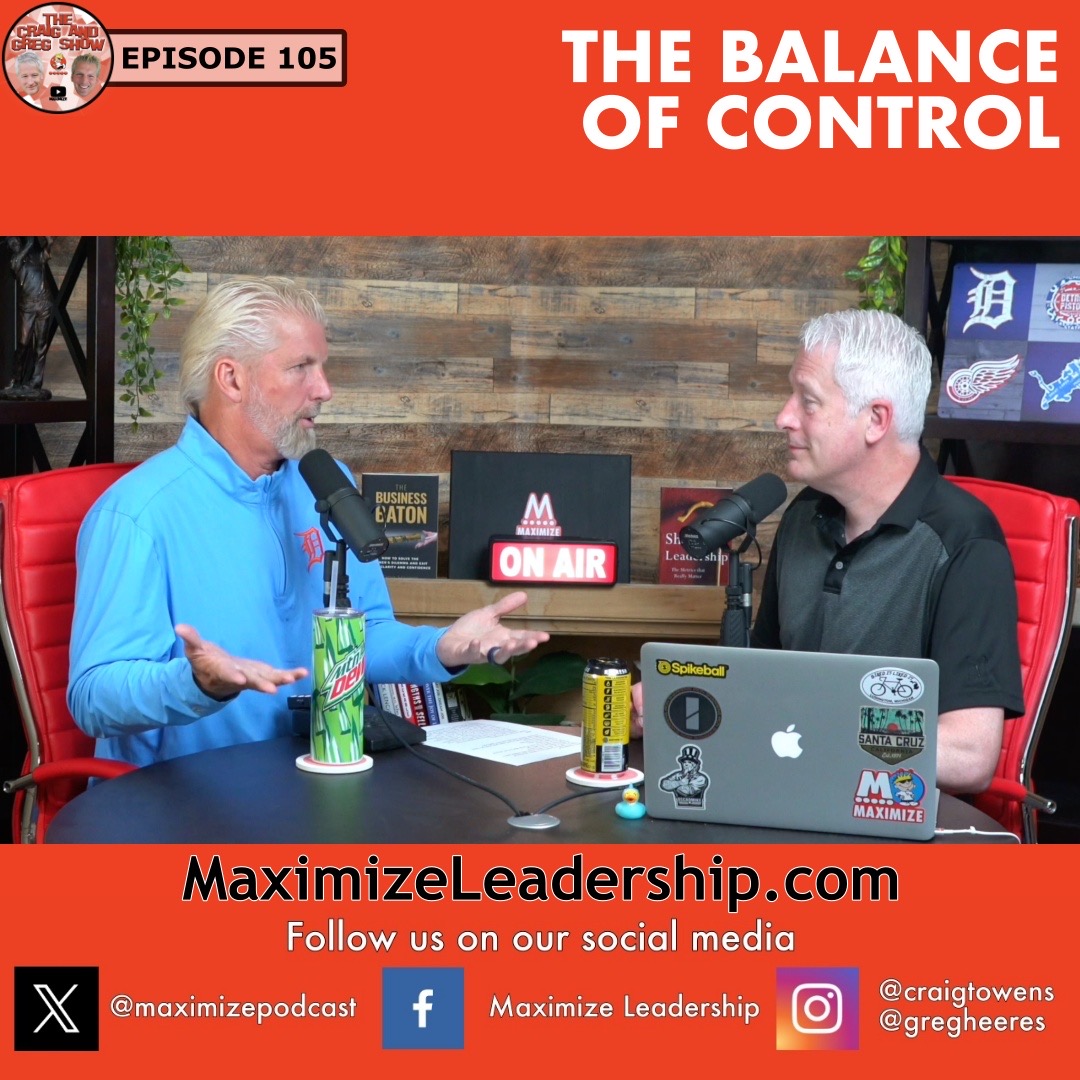
The Craig And Greg Show: The Balance Of Control

Listen to the podcast of this post by clicking on the player below, and you can also subscribe on AppleSpotify, or Audible.

Imagine your organization as a cruise ship you’re the captain of. It is your responsibility to man the helm, keeping the vessel away from danger and navigating to the correct destination. Along the way you decide that the guests’ towels need to be folded a particular way, so you step away from your post for hours to meticulously fold them to your exact specifications. You do a great job but in your absence the ship is listless, veering off course into dangerous waters. 

Of course it’s very likely you won’t find yourself in this exact situation, but the same logic can be applied to our terrestrial pursuits as well. In today’s episode, Greg and I discuss why it’s important for leaders to remain in control, but also vital that we don’t become controlling.

  • [1:00] How could a leader self-assess to make sure they are properly balanced in the way they control their organization? 
  • [3:38] Being organized is not a problem, but controlling the organization becomes the problem.
  • [4:50] I point out the differences between a productive river and a destructive flood.
  • [6:00] Controlling leaders stifle creativity and innovation.
  • [8:25] Tim Irwin’s book Derailed talks about how micro-managing has led to the collapse of many successful organizations.
  • [12:41] Over-controlling leaders are risk-adverse and untrusting of others on their team.
  • [14:13] The value of a coach is getting answers that others on your team aren’t giving you.
  • [17:12] Greg shares a quote about self-discipline as it relates to the proper balance of healthy control.
  • [18:20] Your teammates want your confidence, not your control.
  • [19:44] Leaders, it’s time for you to look in the mirror.

Check out this episode and subscribe on YouTube so you can watch all of the upcoming episodes. You can also listen to our podcast on Spotify and Apple.

What Godly Leaders Do

Listen to the podcast of this post by clicking on the player below, and you can also subscribe on AppleSpotify, or Audible. 

As Paul is coming to the close of his letter to the believers in Rome, he writes these beautiful words, “I myself am convinced, my brothers and sisters, that you yourselves are full of goodness, filled with knowledge and competent to instruct one another” (Romans 15:14). 

(Check out all of the Scriptures in this post by clicking here.)

I love the high esteem Paul has for the Christians in Rome. He’s not looking for what’s wrong with them, but for what’s praiseworthy in them. 

A mark of a godly leader is one who is always looking for the best in the people around him. 

Leaders see the best in people—even if the people don’t see it in themselves yet. (Check out this short video.) 

Leaders point out the specific qualities they see in their people—virtues like goodness, knowledge, and competence. 

Leaders continue to sharpen their people, challenging them to excel even more. “Yet I have written you quite boldly on some points to remind you of them again” (v. 15). 

Leaders enjoy spending time with their people and are refreshed by them. 

   But now that there is no more place for me to work in these regions, and since I have been longing for many years to visit you, I plan to do so when I go to Spain. I hope to see you while passing through and to have you assist me on my journey there, after I have enjoyed your company for a while. … So that I may come to you with joy, by God’s will, and in your company be refreshed (vv. 23-24, 32). 

Leaders pray for their people and ask their people to pray for them. “I urge you, brothers and sisters, by our Lord Jesus Christ and by the love of the Spirit, to join me in my struggle by praying to God for me. Pray that I may be kept safe from the unbelievers in Judea and that the contribution I take to Jerusalem may be favorably received by the Lord’s people there” (vv. 30-31; see Paul’s prayer for them in 16:25-27). 

Leaders publicly compliment their people (16:1-15). 

And leaders protect and empower their people. “I urge you, brothers and sisters, to watch out for those who cause divisions and put obstacles in your way that are contrary to the teaching you have learned. Keep away from them. … The God of peace will soon crush satan under your feet. The grace of our Lord Jesus be with you” (16:17, 20). 

I want to be this kind of leader. In order to do that, I need the help of the Holy Spirit. I must listen to His voice in order to make the changes I need to make so that I may lead in the most Christ-glorifying way possible, and help those around me live even more in their God-given gift zone.

This is part 85 in my series on godly leadership. You can check out all of my posts in this series by clicking here.

►► Would you please prayerfully consider supporting this ministry? My Patreon supporters get behind-the-scenes access to exclusive materials. ◀︎◀︎

Links & Quotes

For personal growth and team growth, consider how you can set both small, bite-size goals that can be done daily and also bigger, stretching goals that energize the competitive drive. Check out more leadership content from The Craig and Greg Show.

I have a lot of new video content on my YouTube channel every week. Please check it out and subscribe so you don’t miss anything.

“This chapter contains the premier teaching of Christianity. It is an undying expression of Jesus’ doctrine of heavenly love. This chapter is more potent for the building of the church than any, or all, of the various manifestations of God’s power. Love is the church’s most effective weapon. Love is the essence of God’s nature. Love is the perfection of human character. Love is the most powerful, ultimate force in the universe. Without love, al various gifts of the Spirit are of no avail. … What a call to self-examination!” —Dr. Henry Halley, commenting on 1 Corinthians 13

“The transition from the good man to the saint is a sort of revolution; by which one for whom all things illustrate and illuminate God becomes one for whom God illustrates and illuminates all things.” —G.K. Chesterton 

T.M. Moore launched a new series of articles about the coming of God’s Kingdom in these last days. In the first article, T.M. wrote, “In his Pentecost sermon Peter announced that, with the resurrection of Jesus Christ and the pouring out of God’s Spirit, the ‘last days’ had begun (Acts 2:14-17), the new economy has been put into effect. Paul says Jesus came in ‘the fullness of the times’ to inaugurate His great work of redemption in these last days (Galatians 4:4). The ‘fullness of the times’ in which the divine economy is unfolding, is now. We are living in the last days, the fullness of the times, when the Lord of heaven and earth is establishing and expanding His divine economy.”

Once again, a new fossil discovery doesn’t fit into evolutionary models, but instead bolsters the facts recorded in the Bible about Creation and the Flood.

“For years, Michael Pratt operated in the shadows of the internet, profiting from coercion, deception, and exploitation under the guise of adult entertainment.” Pratt has now pled guilty to sexual trafficking charges. Fight The New Drug wrote, “The story is more than a courtroom headline. It’s a stark reminder of how the porn industry can weaponize vulnerability, disguise abuse and trafficking, and sell it as fantasy.”

A really penetrating question from John Piper: Why do so many PhDs in theology commit adultery?

The Craig And Greg Show: Unity Not Conformity

Listen to the podcast of this post by clicking on the player below, and you can also subscribe on AppleSpotify, or Audible.

If you’re leading a team, then Greg and I feel pretty confident in assuming that you’ve got them all working, thinking, and behaving exactly like you work, think, and behave, right? Of course not! The differences in personality and thought within your team are what makes it special.

  • [0:18] Leaders like buy-in, but what about those teammates who say, “Hold on a second”?
  • [2:00] Unity doesn’t mean sameness.
  • [3:55] We all have different experiences and gifts so we all bring something different to the table.
  • [4:51] Unity doesn’t guarantee peacefulness in the process of getting to consensus.
  • [7:06] Leaders have to learn to accept the tension among teammates.
  • [9:47] Why do leaders avoid tension?
  • [13:16] I share a quote from Dick Brogden about the “no men” we need on our teams.
  • [14:54] Past success can make leaders deaf to the input from others.
  • [17:09] Greg wonders how to effectively play the devil’s advocate with our teams in order to get the best ideas on the table.
  • [19:03] My funny story about our producer Harrison.
  • [21:08] Greg changed the way he debriefed sales calls with his team, encouraging them to speak out.
  • [23:36] Greg uses an example of Joe Montana to show how leaders can bring confidence to their teams.
  • [25:30] Both opportunities and obstacles present a chance for us to teach our teammates.
  • [27:36] Greg and I want to help you help your team.

Check out this episode and subscribe on YouTube so you can watch all of the upcoming episodes. You can also listen to our podcast on Spotify and Apple.

Links & Quotes

When there is a misunderstanding between the leader and a team member, insecure leaders want the other person to change. Secure leaders, however, take ownership and ask, “What do I need to do differently?” Check out more from The Craig and Greg Show.

I have a lot of new video content on my YouTube channel every week. Please check it out and subscribe so you don’t miss anything.

In elaborating on the words of Jesus in Matthew 5:13 about Christians being the salt of the earth, T.M. Moore wrote, “In Jesus’ day, salt had three primary functions. Most people would have understood two of these, but only those raised in an Old Testament framework would have known about the third.” Read more about what churches should be considering about how they season the community around them.

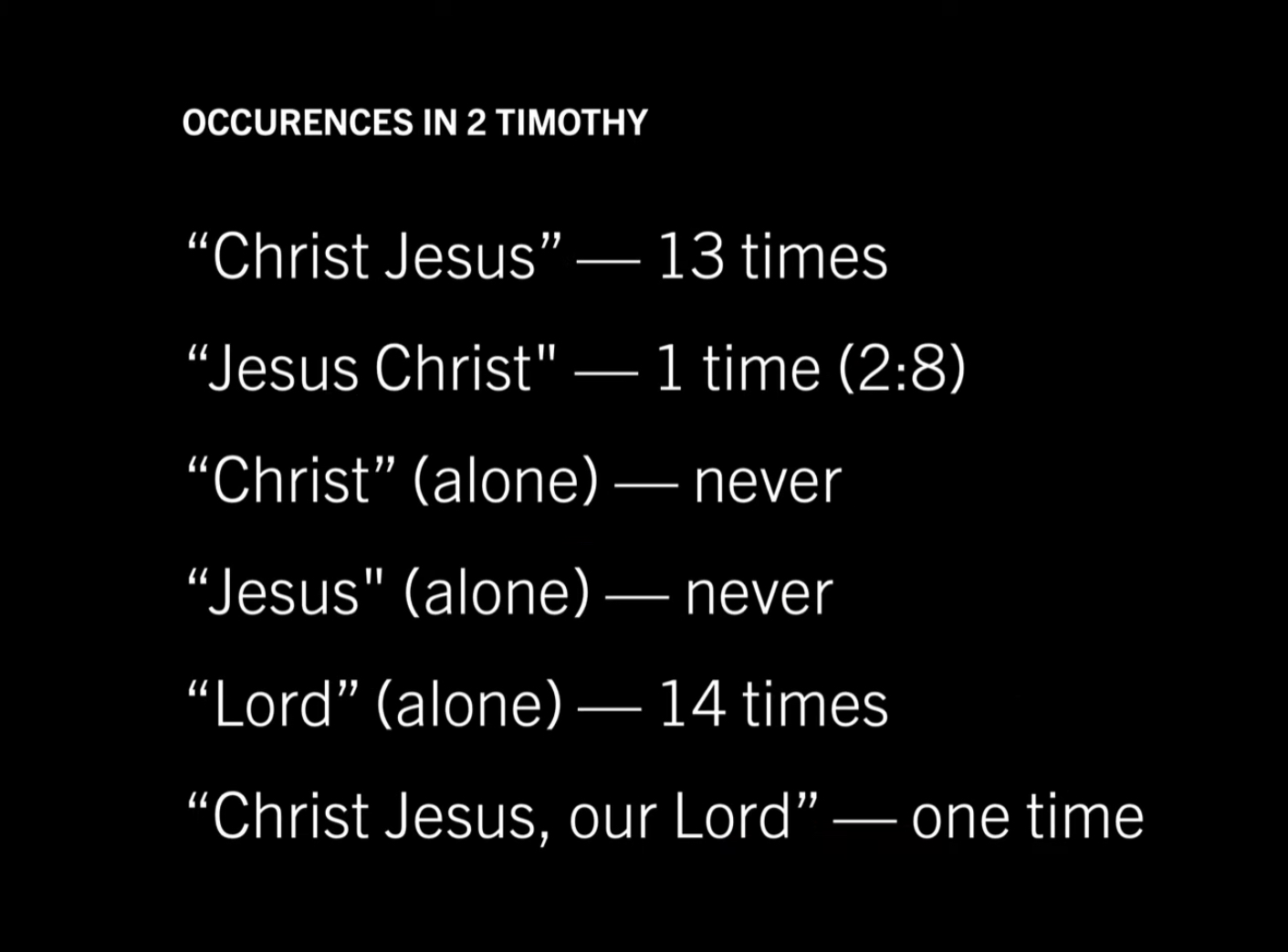
In his “Look at the Book” series, John Piper expounds on the many ways Paul refers to Jesus in his second letter to Timothy. There are several ways, but Paul’s preferred way is “Christ Jesus.” Pastor John unpacks the Hebrew and Greek origins of these words and titles, and why he thinks Paul especially gravitated toward this title.

Aerosols from penguin excrement may help trigger cloud formation, reducing solar heating and helping stabilize local areas of the Antarctic climate, study finds.” Hmmm, it’s almost like God designed His creation to take care of itself—because He did!

And an article in Science says, “According to secular models of Solar System formation, Earth, as an inner Solar System planet, should have little to no water.” And yet more than 70% of Earth is covered with water!

Aelred of Rievaulx wrote, “In friendship there is nothing more outstanding than faithfulness, which seems to be both the nurse and guardian of friendship. In all of life’s turns, in adversity and prosperity, in joy and sadness, in delightful and bitter circumstances, it reveals itself to be comparable to friendship, holding in the same regard both the humble and the exalted, the poor and the rich, the strong and the weak, the well and the infirm.”

Commenting on Aelred’s words, T.M. Moore observed, “Don’t we all want friends like that, who not only will provoke and prod us to grow in the Lord, but will stand by us in good times and bad, when we’re up and when we’re down? But if we would have such friends, we must be good stewards of their trust. This, again, is why spiritual friendships must be grounded in the Lord and focused on Jesus if they are going to bear the fruit of His indwelling Spirit.”

Evolutionary scientists claim to have made some steps forward in their understanding of the origins of life by using “the last universal common ancestor (LUCA).” But creationists like those at ICR observe that, “This mysterious LUCA is an unknown entity that existed from an unknown time ago at an unknown place by an unknown chain of unknown processes.” Clearly, the hypothesis that is the most straightforward and explainable is that God created the life in our universe just as the Bible states.

Along the same lines, Glenn Schrivener asks, “What do you think was there ‘in the beginning’—before peoples, planets, and protons? If you could hit rewind on the history of the universe and go back as far as possible, what would you find?” Then he gives us four possible things we may consider.

Links & Quotes

The apostle Paul demonstrates how a confident leader empowers his teammates to soar—he believed the best in them! Check out the full conversation Greg and I had on The Craig and Greg Show about leaders as gardeners.

I have a lot of new video content on my YouTube channel every week. Please check it out and subscribe so you don’t miss anything.

In the spirit of C.S. Lewis’ Screwtape Letters, in this post Grimgod talks to his nephew Globdrop about the battle over the definition of masculinity. “If total amnesia of man and woman was not our aim, what was? Stripping those definitions of unwanted details. Man reclaimed that he is, not what he is. They reclaimed the temple, yes, but what remains? The gold, carried away. The glory, departed. They raise their flag above ruins. Is this their triumph—that a man is what his body tells him? Is this all? What is a man? A male adult human. What is the difference? Chromosomes. Bone density. Muscle mass. Voice depth. This is the meager strip of land they repossessed, and we smile at it.”

A recent discovery of a mosasaur fossil in Mississippi has evolutionists buzzing about macro evolution. But the facts say otherwise: “The fossil record shows mosasaurs have always been mosasaurs. These and other terrestrial and marine creatures were buried in a series of violent events one could easily attribute to a massive flood. Proteins, pigment, and other biomolecules uncovered in mosasaur bone provide compelling evidence that these reptiles existed recently—as in thousands of years ago.”

A missionary who thought his years of ministry had accomplished nothing and his daughter who had been estranged from her father both discovered just how much God had done through their ministry.

I love this perspective from Detroit Tigers player Brewer Hicklen, “Almost 1100 days… This journey has molded me and I’ve smiled through most of it, but boy have there been some days where I never thought I’d get there. To anyone that feels defeated—don’t ever give up. God has you in that journey for a reason. Failure is a beautiful thing.”

“Four considerations seem to hold especially in the case of friendship: love, affection, security, and delight. Friendship involves love when there is a show of favor that proceeds from benevolence. It involves affection when a certain inner pleasure comes from friendship. It involves security when it leads to a revelation of all one’s secrets and purposes without fear or suspicion. It involves delight when there is a certain meeting of the minds—an agreement that is pleasant and benevolent—concerning all matters….” —Aelred of Rievaulx 

“Psychologist Henry H. Goddard studied tired children and found that they had a burst of energy when he said something encouraging to them. But when he said something negative, they became even more tired.” With that in mind, here’s a 30-second rule to help you better engage others in conversation. 

Pay Attention To The Signals

Listen to the podcast of this post by clicking on the player below, and you can also subscribe on AppleSpotify, or Audible. 

Leaders need to pay very careful attention not to disregard the signals others are sending them.

Check out the full conversation Greg and I had about blind spots.

►► Would you please prayerfully consider supporting this ministry? My Patreon supporters get behind-the-scenes access to exclusive materials. ◀︎◀︎

Know, Go, Show

Listen to the podcast of this post by clicking on the player below, and you can also subscribe on AppleSpotify, or Audible. 

There is a recurring theme throughout the Book of Judges and then later is repeated in the years leading up to Israel’s exile: A godly leader passes off the scene and the people return to their old selfish, godless lifestyle. This sinful life brings God’s punishment, which causes the people to cry out to God for help. God raises up a leader who leads the people in repentance and a return to God. As a result, God’s blessings again flow to His people. Then that leader passes off the scene and the cycle repeats. 

This recurring thought is in the middle of a particularly dark time for Israel: “In those days there was no king in Israel; every man did what was right in his own eyes” (Judges 17:6; see also 18:1). 

The entire 17th and 18th chapters of Judges is a sickening story of the Israelites utterly turning their back on God so they could go do whatever they want. And worst of all, we see godless leaders taking advantage of the situation to line their pockets with worldly riches. 

Just because there is a God-fearing leader on the scene doesn’t guarantee that the people will follow his or her lead and devote themselves to God. But a godless leader almost always results in people debasing themselves by thumbing their nose at God’s laws. 

God raises up leaders and holds them accountable for their actions. He told Ezekiel that there would be consequences for both boldly speaking God’s message or for keeping silent (see Ezekiel 3:16-21). 

God calls His leaders to know His ways, to walk in integrity in that way, and then to call others to walk in that way too. 

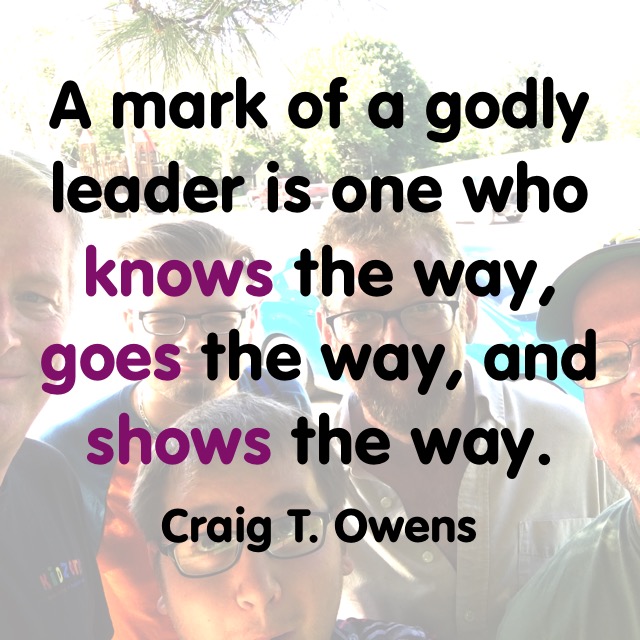
A mark of a godly leader is one who knows the way, goes the way, and shows the way.

This is part 84 in my series on godly leadership. You can check out all of my posts in this series by clicking here.

►► Would you please prayerfully consider supporting this ministry? My Patreon supporters get behind-the-scenes access to exclusive materials. ◀︎◀︎

A Leadership Measurement Trap

Listen to the podcast of this post by clicking on the player below, and you can also subscribe on AppleSpotify, or Audible. 

Leaders have to be very careful of the trap of measuring the growth of their teammates by the wrong metrics. The things that matter most are often the things that are the most difficult to measure, but leaders must find a way.

Check out the full conversation we had on this topic on this episode of The Craig and Greg Show. 

In my book Shepherd Leadership, I have a chapter entitled ‘Don’t Try to Grow Your Own Ministry.’ This book is mainly written for church and non-profit leaders, but there are helpful principles here for every kind of leader. Here’s an except from this chapter—

     Businesses think in terms of quantitative gains—things they can count—but churches and nonprofits should be thinking in terms of qualitative gains—a quality improvement that isn’t as easily counted. I think we all know this, and yet we still persist in wanting to define success in a church or a nonprofit by those quantitative standards such as attendance growth, donations, and the like. When we think qualitative over quantitative, suddenly what seemed “small” is so significant and so valuable that it cannot be calculated! … 

     Don’t try to grow your ministry. First, because it’s not yours, it’s [God’s]; and second, because your measure of success is probably more slanted toward quantitative measurements than qualitative. Jesus wasn’t concerned about bigger numbers: “What do you think?” He asked, “If a man has a hundred sheep, and one of them goes astray, does he not leave the ninety-nine and go to the mountains to seek the one that is straying?” (Matthew 18:12). 

     Philip went to Samaria to tell people about Jesus. He didn’t go there because it fit his plan, but because Jesus said, “You will be My witnesses in Jerusalem, and in all Judea and Samaria, and to the ends of the earth” (Acts 1:8). Philip’s obedience brought God’s success: hundreds turned to Jesus as their Savior, demon-possessed people were delivered, the sick were healed, and the new Christians were baptized in the Holy Spirit. Yet God called Philip to leave these “ninety-nine” and go to the desert to cross paths with just one confused and wondering sheep (Acts 8). After that, Philip virtually disappears from Luke’s historical record. 

     What’s the value of one government official’s life? God says that his value is incalculable. Apparently, God knew that Philip was the perfect shepherd to lead this Ethiopian to the pasture where he would accept Jesus as his Savior. Philip was obedient, a sheep was saved, and God was pleased. But I wonder how many people today might think Philip’s ministry was unsuccessful because he left a bigger ministry in Samaria to go to a smaller ministry in the desert? 

Leaders need to be very cautious about using the right metrics to measure the growth of their teammates and the success of their organization.

►► Would you please prayerfully consider supporting this ministry? My Patreon supporters get behind-the-scenes access to exclusive materials. ◀︎◀︎

Tried And Tested

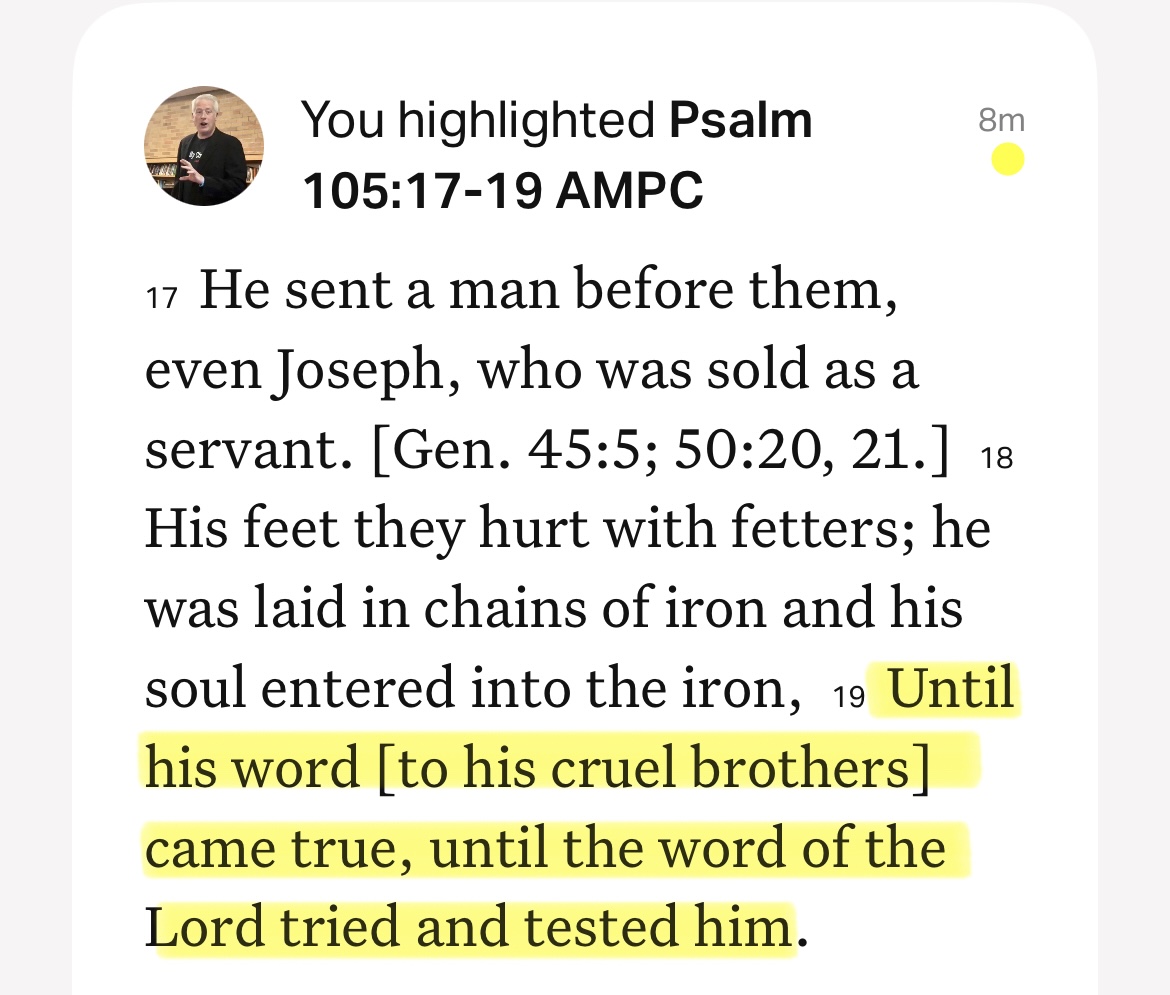
Moreover, [God] called for a famine upon the land of Egypt; He cut off every source of bread [Genesis 41:54]. He sent a man before them, even Joseph, who was sold as a servant [Genesis 45:5; 50:20, 21]. His feet they hurt with fetters; he was laid in chains of iron and his soul entered into the iron, until his word to his cruel brothers came true, until the word of the Lord tried and tested him. The king sent and loosed him, even the ruler of the peoples, and let him go free. He made Joseph Lord of his house and ruler of all his substance [Genesis 41:40]. To bind his princes at his pleasure and teach his elders wisdom. (Psalm 105:16-22 AMPC) 

“The word of the Lord tried and tested him.” When we cling to God’s promises despite the seemingly impossible circumstances we are in, that faithful clinging matures us. It both softens our heart and strengthens our trust in God. 

Before going through the difficulties, Joseph wasn’t ready to operate effectively in such a lofty leadership position. God uses all things to mold us and shape us for His purpose (Romans 8:28). We certainly see a more mature Joseph standing before Pharaoh than we saw interacting with his brothers earlier in his life. 

God called Joseph and he prepared Joseph. All that was lacking was Joseph’s faithful clinging to God and yielding to God’s maturing process. The end result was one of the most impactful leaders that history has ever known! 

I blogged more about Joseph: