Loving Obedience

Love and obeySuppose you had to do a secret project on a remote island. In fact, the island is so remote that it doesn’t even have a name or show up on a map. I am your only point of contact, and the only one with the latitude and longitude coordinates to come get you. You have a satellite phone to use. If I truly cared about you, I would give you the precise sequence of digits to reach me. If I didn’t care about you, I’d let you call any number you wanted to call: perhaps you would eventually reach someone who could help you.

The most loving thing I could do for you is to make sure you knew the one number to call in order to get the help you needed. 

This is exactly how God starts the Ten CommandmentsAnd God spoke all these words: “I am the LORD your God, who brought you out of Egypt, out of the land of slavery. You shall have no other gods before Me.”

How confusing and utterly unloving it would be if God said, “Call any number you want to see if you can find the help you need.” Instead, in His great love for us God says, “I am the only One you will ever need!”

Notice the wording here: “…I am the LORD your God…”

  • I AM—all that you need.
  • the—not one among many, but the One and Only.
  • LORD—God’s covenant name: Jehovah, His name of personal relationship.
  • your—this is a you-Me relationship, not a you-it relationship.
  • God—the All-Powerful, All-Loving One.

This First Commandment is the orientating commandment. When we see all of God’s commandments are rooted in His love (by the way, God uses the phrase the LORD your God five times in the Ten Commandments), everything else in our lives and attitudes is properly aligned.

Jesus demonstrated this for us. He said He loved His Father and therefore obeyed all of His commands (John 14:31). Christ’s obedience was motivated and aligned by love. The Apostle John said this loving obedience is to be the distinguishing characteristic for us too:

This is love for God: to keep His commands. And His commands are not burdensome. (1 John 5:3)

We honor God and obey the First Commandment best when we know He is the One Who loves us enough to say, “I am the only One you need. Don’t look to anyone or anything else, but just come to Me!”

If you have missed any of the messages in our series The Love In The Law, you can find them all by clicking here.

Guardrails

GuardrailWe need a different way of thinking about God’s laws. We can’t think of them as a bunch of Thou-shalt-nots, because—as I blogged last week—that would mean we would have to look at The Lawgiver in an unbiblical way.

So let’s try this…

Suppose you are out for a drive on a crisp fall afternoon in a brand new sports car. You are really excited to see what this car can do! I’ll bet as you drive along the straight stretches of road, you will see very few guardrails along the sides. The guardrails you do see on the straight stretches usually protect us from things like rivers, roads passing underneath us, or perhaps a steep drop-off.

When you come into a tight turn, in addition to seeing a curved-arrow sign and perhaps a sign cautioning you to reduce speed, you are very likely to see guardrails along the turns.

Do those guardrails make you feel ripped off? Do they rob you of driving enjoyment? Have you ever felt like, “I really wish those guardrails were gone, because I’d love to get a couple of my tires off the side of the road”? Of course not!

We all know that those guardrails are there to protect us. In fact, the guardrails actually increase our driving enjoyment, because the dangerous places have been identified, and the metal guardrails will keep us from going somewhere that could be fatal.

This is a good way to think of God’s laws.

Abundant lifeJesus told us that He had come not to remove the guardrails, but to fulfill them through His life, death and resurrection (see Matthew 5:17-20 and Luke 22:20). Jesus didn’t come to rob us of life!

So if the Son sets you free, you will be free indeed. (John 8:36)

I am come that they might have life, and that they might have it more abundantly. (John 10:10).

Far from ripping us off and saying “No!” to us, Jesus came to show us that God’s laws were rooted in God’s love. He came for us to see that God’s laws are His guardrails to keep us away from the places that are dangerous, and perhaps even fatal.

If God didn’t love us, He would let us do whatever we wanted to do. But He does love us, and so He gives us His guardrails to keep us safe. Instead of looking at His laws as something which is robbing you of life, see them as protections that are giving you more abundant life!

If you have missed any of the messages in our series The Love In The Law, you can find them all by clicking here.
Links & Quotes

link quote

Some good reading from today…

“The hunger for love is much more difficult to remove than the hunger for bread.” —Mother Teresa

A challenging word from John Stonestreet: The Pornification Of The Church.

“Here is no need to expound fuller what the Christian Scripture teaches on this point of feelings. It subjects the whole mind to God’s governance and assistance, and all the passions unto it, in such manner that they are all made to serve the increase of justice.” —Augustine

“…For we are not under law in Christ’s church, but under grace, and grace will prompt you to do more than law might suggest….” —Charles Spurgeon

A great story about Pittsburg Pirate star Andrew McCutchen and his parents.

Ryan Anderson has 7 reasons why the current homosexual “marriage” debate is nothing like the debate on interracial marriage.

Apparently we cannot win: the change from CFCs to HFCs in our spray cans is repairing the ozone but raising the earth’s temperature. Oh, wait a minute: this isn’t settled science, but merely someone’s “model” based on “what the data suggests.” Sounds a lot like faith to me!

The Love In The Law

Love In The LawWhen I say “Law” what sort of words come to your mind. Do you think of words like: restrictive? killjoy? barriers? hindrances? no fun?

If you’re a Christian, perhaps the same descriptive words come to mind when you think of biblical commandments. Maybe you think, “Don’t do that” (or for those of you who think in King James English: Thou shalt not).

But if we think of the law/commandments that way, that also means we have to think of the Lawgiver that way. In other words, God becomes a Policeman. He is closely watching to see who will break His laws so that He can dispense the appropriate punishment. After all, if the laws are a bunch of no-nos, then Someone has to be watching for law-breakers and handing out the penalties.

If that’s the case, what do we do with the Bible’s description of God that says “God is love”? If the Lawgiver is Love, how does that change our view of the laws themselves?

It must mean that God’s laws are an expression of His love. It must mean that His love is in the laws He has given us.

It must mean that God’s laws are NOT no-nos, BUT yes-yeses. 

Join us this Sunday at Calvary Assembly of God as we talk about The Love In The Law. We’ll be working our way through the Ten Commandments, especially looking at God’s love that make each commandment a giant YES for our lives. Prayerfully, this series will completely change how we view God’s laws and commands.

If you have missed any of the messages in this series, check them out here:

God’s Longing

God's LongingHere’s what God says about you and me: “I long to redeem them” (Hosea 7:13). The prophet Hosea has a front row seat, watching God pursue and woo His people, and Hosea records for us God’s longing passion.

The placement of God’s declaration—I long to redeem them—is a wonder to me. It’s right in the middle of a catalogue of His people’s sins. God says:

  • Your kings fall because they don’t call on Me (Hosea 7:7).
  • You don’t realize how weak and powerless you’ve become because you won’t pray to Me (7:9-10).
  • You try to rule yourselves without consulting Me (8:4).
  • You disregard My laws as if they were irrelevant (8:12).
  • You no longer pay attention to My prophets who are calling you back to Me (9:7).

And still in the midst of all this comes, “I long to redeem them.” Astounding!

God tells us what we need to do—

Sow for yourselves righteousness, reap the fruit of unfailing love, and break up your unplowed ground; for it is time to seek the Lord, until He comes and showers righteousness on you. (10:12)

The alternative?

BUT you have planted wickedness, you have reaped evil, you have eaten the fruit of deception. Because you have depended on your own strength and on your many warriors…you will be completely destroyed. (10:13-15)

What will you choose: To seek God OR to depend on your own strength?

God LONGS to redeem you, but you have to ask Him to do so.

The Law & The Gospel

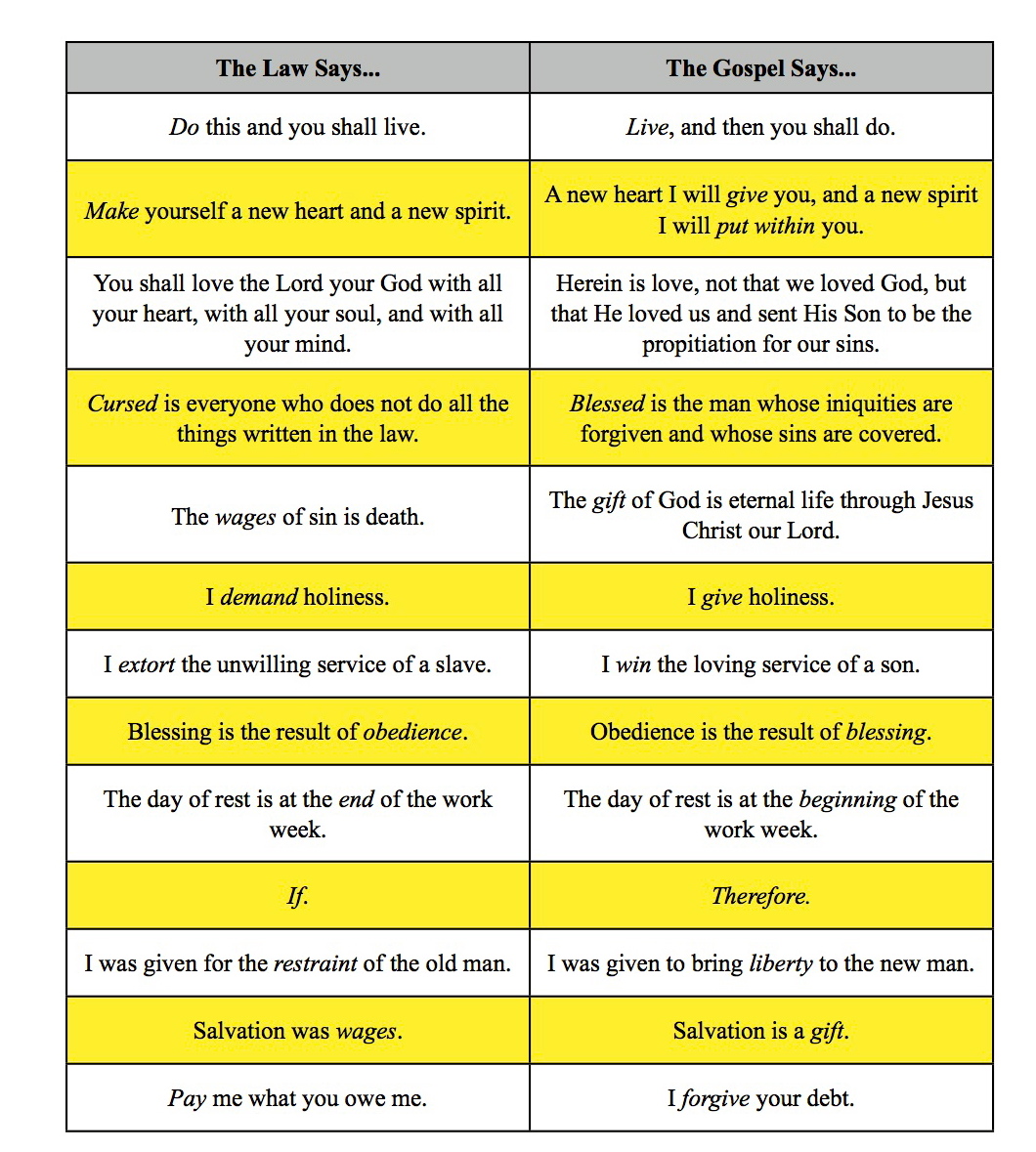
Hannah Whitall Smith, in her book The Christian’s Secret Of A Happy Life, contrasts living under the law and living under the gospel. She says, “It is a fact beyond question that there are two kinds of Christian experience, one of which is an experience of bondage, and the other an experience of liberty. In the first case the soul is controlled by a stern sense of duty, and obeys the law of God, either from fear of punishment or from expectation of wages. In the other case the controlling power is an inward life-principle that works out, by the force of its own motions or instincts, the will of the Divine Life-giver, without fear of punishment or hope of reward. In the first the Christian is a servant, and works for hire; in the second he is a son, and works for love. … The following contrasts may help some to understand the difference between these two kinds of religion, and may also enable them to discover where the secret of their own experience of legal bondage lies:” 

The Law & The GospelTo download a PDF version of this chart click here → The Law & The Gospel ←

To read my book review of The Christian’s Secret, click here.

To read some quotes from this book, click here.


Links & Quotes

link quote

Some great reading I found today.

Dr. James Dobson won a big lawsuit against ObamaCare. Read more here.

“People are always saying it’s the other person’s fault, the other one who needs to change. That is why I believe no amount of counseling will have an impact until God’s people resolve something. We all have to make this our sincere, daily prayer: ‘O God, change me.’ We spend far too much time praying, ‘God, change my circumstances; change my coworkers; change my family situation; change the conditions in my life.’ Yet we seldom pray this most important prayer: ‘Change me, Lord. The real trouble isn’t my spouse, my sibling, my friend. I’m the one who stands in need of prayer.’” —David Wilkerson

[VIDEO] Margaret Sanger of Planned Parenthood on film saying women should stop having babies.

[INFOGRAPHIC] How creative people in history used their time.

Links & Quotes

link quote

These are links to articles and quotes I found interesting today.

Beat the flu: 10 Ways To Boost Your Immune System

[VIDEO] Better Google searches

For 20-somethings: 20 Things People Over 20 Should Stop Doing

“If Christians today want to find the right church, they must begin with prayer! No one is ever going to find God’s true Church by jumping on a bus, train or plane and racing around the world in search of it. We simply can’t get to His Church by any modern conveyance. The only reliable map is our secret closet of prayer!” —David Wilkerson

So President Obama, who has sworn to uphold the law of the land, won′t even uphold his own law?!? New Obamacare Delay

Truth: 10 Bad Reasons To Be A Pastor

“My greatest fear in life is standing before the Lord and hearing Him say, ‘I had so much more for you, but you held on too tightly.’” —Larry Burkett

Yahweh Vs. Polytheism

I have been reading through the Bible chronologically for awhile now using The Archeology Study Bible, and I am really enjoying the new insights into Scripture that I am gaining.

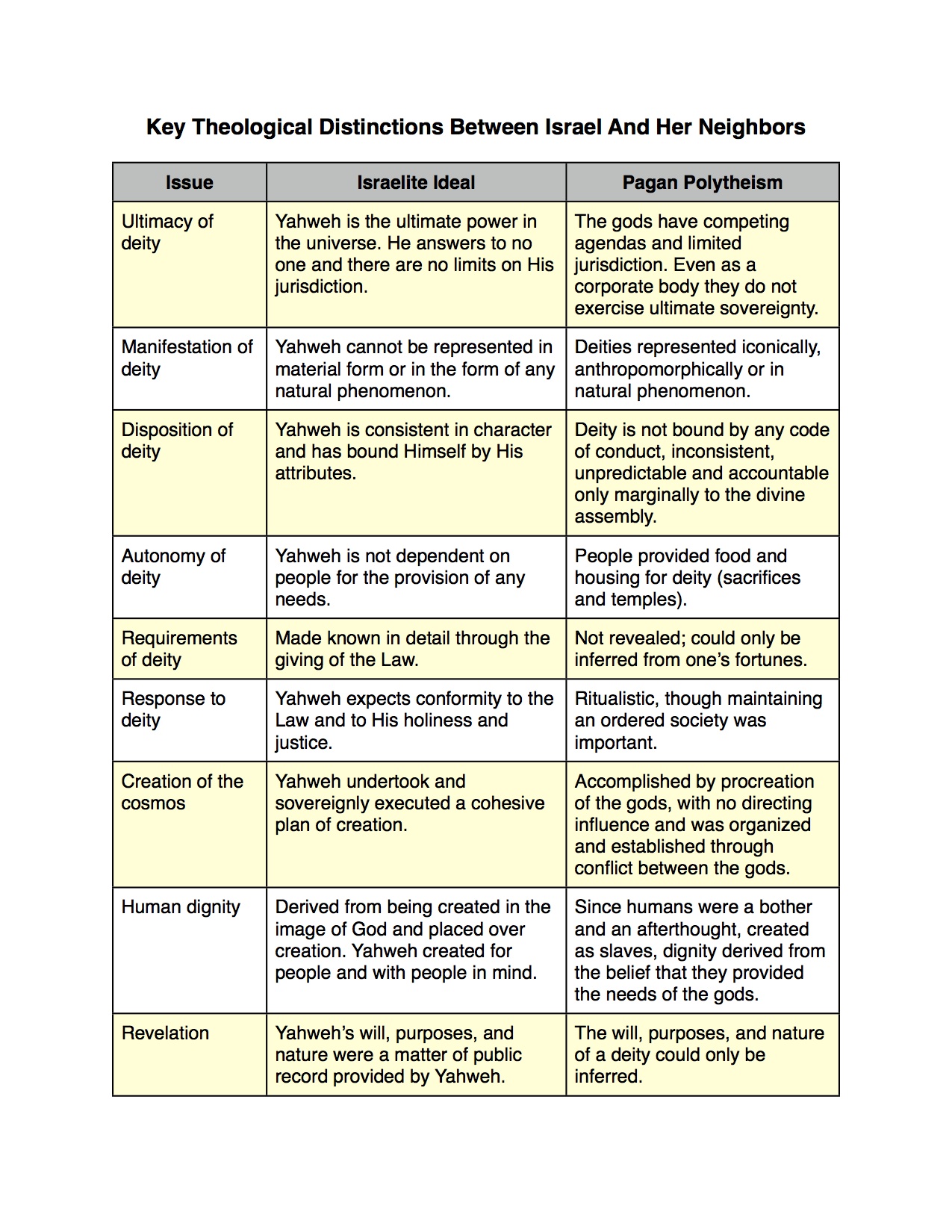
A couple of weeks ago I saw this chart (on page 408) contrasting the monotheistic characteristics of the one true God (Yahweh) with the polytheistic characteristics which the nations surrounding Israel adhered to. It’s quite a fascinating contrast!

Theological difference between Israel and others

(Click the image to see a larger view, or download a PDF version here → Theological difference between Israel and others. Or better yet, purchase a copy of this amazing study Bible for your own use.)

The monotheistic worldview presented in the Bible is the only worldview which makes the most sense of the universe in which we live. Therefore, the Bible is the filter through which I process all of the other books I read.

If … But If … If … But If …

IfNo, I’m not repeating myself; I’m just quoting the pattern in the Bible (specifically Leviticus 26).

God’s laws are inviolate. No conditions will be made, nor any exceptions allowed. The conditions in Leviticus 26 apply as much to the Israelites in 1400 BC as they do to us in the United States of America today.

IF we obey God’s Word, He will bless us with His favor (verses 3-13).

BUT IF we disobey, He will set His face against us (verses 14-17).

IF we continue to harden our hearts and remain unrepentant, God’s punishments will grow increasingly more severe (verses 18-39).

BUT IF we repent wholeheartedly, God will again restore us (verses 40-45).

It’s time for us in America to wake up to this reality! If God held His chosen people, the Israelites, to this, how much more so will He not hold us to it.

We in America have violated God’s principles for too long. We have clearly moved through the first IF and BUT IF stages. I believe we are now in the second IF stage. But the hopeful news is that there is still another BUT IF stage for us to obtain, if only we will repent and ask God’s forgiveness.

It starts with me and with you. Will you join me in asking for repentance and praying for God’s favor to visit us once again?