Leaders Slow Down

Listen to the podcast of this post by clicking on the player below, and you can also subscribe on AppleSpotify, or Audible. 

On the Church Lobby podcast, Karl Vaters asked me for the best piece of advice I have received as a pastor. Here’s what a wise mentor told me that changed my leadership style. 

Leaders can individualize their care for those around them by slowing down. Here’s another conversation I had with Karl on this topic. 

You may also be interested in my full interview on The Church Lobby podcast.

►► Would you please prayerfully consider supporting this ministry? My Patreon supporters get behind-the-scenes access to exclusive materials. ◀︎◀︎

The Benefits Of The Right Kind Of Pastoral Stress

I was very honored to be asked to share these thoughts on KarlVaters.com. I was able to interview Karl about his latest book De-Sizing The Church.

(Photo by Official Presidio of Monterey | Flickr)

Jesus was “made like His brothers in every way” (Hebrews 2:17), which means He was not immune to the ravages of stress, yet He never let that stress overwhelm Him.

No one wants more stress. But attempting to avoid all stress can carry negative results that we seldom take into account.

In this guest article, Craig T. Owens (whom I interviewed in The Church Lobby, Episodes 43 and 82 ) writes about how managing the right type of stress (called eustress) can be a benefit, especially in positions of responsibility, like pastoring.

— Karl Vaters

As a pastor, I’m sure your life is practically stress-free. I mean, what do we have to do with our days except commune with God in our quiet study time, and then descend from the mountain to share the words God has given us? Then we can bask in the approval of our congregations as we watch them seamlessly integrate our sermons into their daily lives.

What’s that you’re saying? It’s not like that for you?

Anyone who has been a pastor for any length of time knows how demanding a job it is to be a shepherd of the flock God has placed under our care. And then frequently our shepherding work becomes even more challenging when we have to attend to the needs of obstinate sheep, or heal from the bites of angry sheep.

At times, we may dream about a more stress-free pasture.

But we actually do ourselves, our flock, and the world around us a huge disservice if we are striving for a stress-free life.

The Power To Persevere

First, I don’t think that is even possible. Adam and Eve in the perfection of the Garden of Eden faced a stressful decision. And Jesus, the Perfect Man, was constantly dealing with the stressors that pushed in on Him.

But more importantly, stress is vital for our healthy growth. Recent studies have shown that moderate levels of stress keep our brain sharp. In fact, the study went on to state that a brain that is striving for zero stress (if that’s even possible) begins to become less adept at problem solving. In our attempts to totally eliminate stress, we are actually squeezing out our ability to adapt, overcome, and soar when we face future problems.

In this case, I am talking about the healthy stress that doctors call eustress. Whenever we face a challenge, our body releases a hormone called cortisol that prepares our mind and body for action. In other words, God designed a way for us to be successful in stressful times.

Eustress is the push against the forces that would ultimately pull down our physical health, our relationships, our mental health, and a host of other things if we simply opt to “go with the flow.”

I read this in a recent article from an organization called Fight The New Drug:

“In a world that often sells ways to avoid stress, it’s crucial to remember that stress can be healthy in moderation. Stress and anxiety can trigger neural and chemical processes in your body designed to help you respond to challenges. Stress researcher Daniela Kaufer explains that ‘some amounts of stress are good to push you to the level of optimal alertness for behavioral and cognitive performance.’ Her research on stress in rats has even demonstrated that intermittent stressful events can create new brain cells in the rats that actually improve their future mental performances.”

I love how modern-day psychology validates what the Bible has already told us! The Bible makes it clear that persevering through the stressors that come against us can make us stronger, healthier, and better equipped for the next challenge. We are also fortified to help others through their times of stress (James 1:2-4; Romans 5:3-5; 2 Corinthians 1:3-5).

(Check out all of the Scriptures in this article by clicking here.)

The Greek word in the Bible translated “persevere” means keeping focused on the goal despite the struggles that it takes to get there. Jesus used this same Greek word at the conclusion of His parable of the sower: “The seed on good soil stands for those with a noble and good heart, who hear the Word, retain it, and by persevering produce a crop,” a crop that Jesus said was a hundred times more than what was sown (see Luke 8:5–15).

The Holy Spirit will push us further than we think we can go to develop the spiritual muscles and endurance we need to shepherd the sheep under our care during their trying times. He knows that persevering produces a huge crop.

Easy Roads Teach Few Lessons

I love riding my bike on the White Pine Trail by my house. My long rides have a really fun stretch where I am flying downhill! But as fun and stress-free as that part is, I’m not really building anything of lasting value. However, when I am coming back uphill and I want to quit because my legs are burning and I can hardly breathe, that becomes a valuable struggle.

I cannot build endurance by any other way than to persevere, to push myself just a little bit more each time. When I want to quit, I pedal just a few more feet. Gradually, the uphill becomes less daunting.

A friend gave me a t-shirt that I like to wear on my rides. When I put the shirt on, the blue-lettered message says, “Do It!” but as I struggle uphill and the sweat begins to pour off my body and drench my shirt, a new message emerges: “Don’t Quit!”

I have learned that easy roads teach very few valuable lessons. But persevering through the stressors not only strengthens me, but it builds an empathy for others that I would have otherwise missed.

The poet Epictetus noted this about the mighty Hercules:

“What would have become of Hercules do you think if there had been no lion, hydra, stag or boar—and no savage criminals to rid the world of? What would he have done in the absence of such challenges?

“Obviously he would have just rolled over in bed and gone back to sleep. So by snoring his life away in luxury and comfort he never would have developed into the mighty Hercules.

“And even if he had, what good would it have done him? What would have been the use of those arms, that physique, and that noble soul, without crises or conditions to stir into him action?”

—Epictetus, The Discourses

So the next time you are thinking about avoiding something that causes stress in your life, why don’t you reframe that thought. Instead, think about how you can become stronger, healthier, and more empathetic toward others because you are committed to successfully navigating that stressful situation.

Don’t ask God to get you out of that stressful situation, but ask Him to help you get something out of that stressful situation.

Eustress, Not Distress

Please notice that I have been talking about the good stress (eustress), but there is also a dangerous stress which doctors call distress. If we are trying to overcome a challenge in our own strength alone, instead of relying on God’s supernatural help, or if we are allowing stress to keep us from our healthy habits, eustress can disintegrate into distress.

The stress hormone cortisol is naturally flushed from the body in two ways: physical exercise and proper sleep. Isn’t it interesting that when we are experiencing higher than usual amounts of stress that two of the areas that seem to disappear from our lives are time for exercise and nights with solid, uninterrupted sleep?

When we allow eustress to become distress, everything suffers. Our physical health is compromised, we have an increasingly difficult time coming up with creative solutions, our patience with difficult people is strained, and we find ourselves fighting irritability.

How Jesus Did It

Earlier I mentioned the stressors that Jesus faced, but notice that we never see Him responding inappropriately, acting in an unhealthy way, or “stressed out” by the needs of the sheep around Him. Keep in mind that Jesus was “made like His brothers in every way” (Hebrews 2:17), which means He was not immune to the ravages of stress, yet He never let that stress overwhelm Him. He never even allowed eustress to cross the line into distress.

How did Jesus keep stress in balance? I see so many healthy habits in His life. For instance, I see not only the regular habit of prayer to start His day (Mark 1:35), but I see Him withdrawing for a time of prayer or even a nap when He completed a stressful time of ministry (Luke 5:16).

Jesus encouraged His disciples in this as well. The disciples were excited to tell Jesus about their latest ministry but the activity around Jesus was so hectic that they couldn’t even find time to get a bite to eat, let alone take a deep breath to recover from their ministry. “Come with Me by yourselves to a quiet place and get some rest,” Jesus told them. And then “they went away by themselves to a solitary place” (Mark 6:30-32).

To keep yourself from becoming distressed, be deliberate about maintaining your healthy habits during your times of eustress. Eat healthy, get proper exercise, get a good night’s sleep, spend extra time in your Bible study and prayer time, and schedule time with healthy friends. All of these things will help you leverage all of the benefits of eustress, making you a stronger, more consistent and empathetic leader.

What Can I Change In Me?

Listen to the podcast of this post by clicking on the player below, and you can also subscribe on AppleSpotify, or Audible. 

When a shepherd leader is bitten by a sheep under their care, it’s quite natural to say, “What’s wrong with them?” Let me highlight that word: natural. 

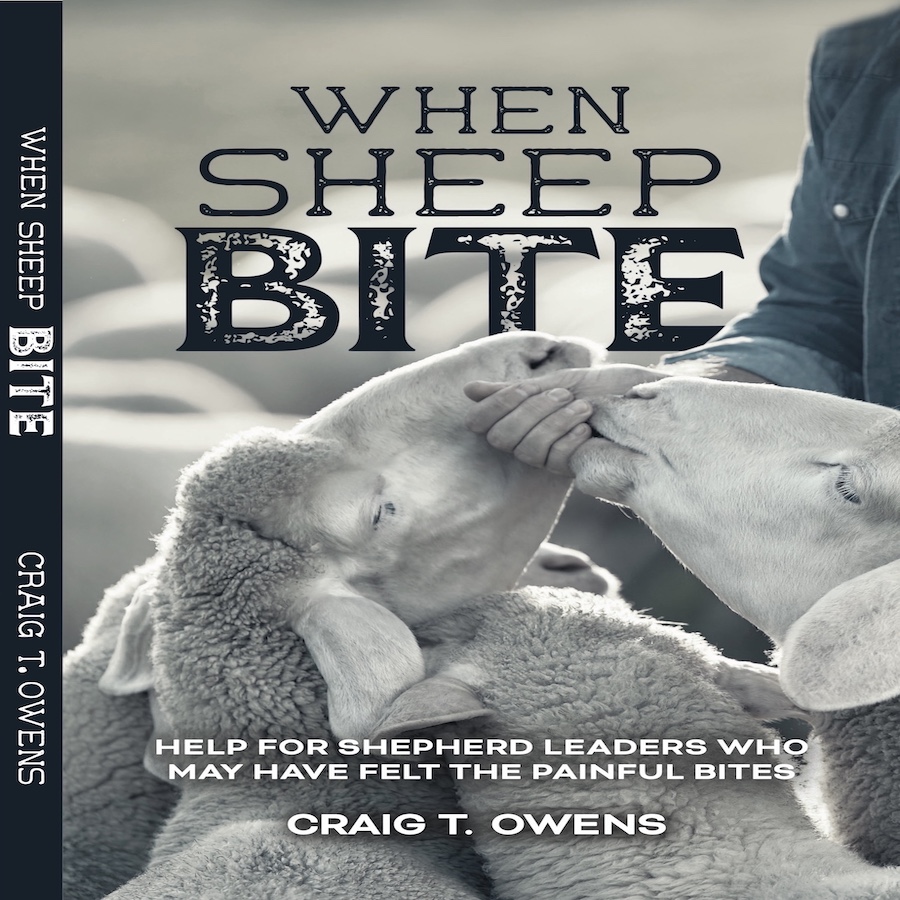
In my book When Sheep Bite, I contrast the natural response with the supernatural response. It takes a lot of work because “natural” comes just so, well, naturally. But to respond supernaturally is going to take some re-training. 

We need to be able to reflect after we’ve interacted with a biting sheep. If we reacted in an inappropriate way, we need to ask forgiveness and attempt to make things right. Then we need to engage in some Holy Spirit-led introspection to switch the natural question of, “What’s wrong with them” to the supernaturally-led question, “What can I change in myself?” 

In a recent interview with Karl Vaters on his Church Lobby Podcast, we talked a bit about this topic. 

One chapter in my book is titled ‘Is God Trying to Get My Attention?’ Here’s an excerpt—

     Pain always takes priority. It always gets our attention and demands to be attended to immediately. We don’t schedule painful things on our daily “To Do” list, but that painful item will become the one and only thing which clamors to be addressed. 

     The same thing is true when the sheep bite and kick their shepherd. It hurts, it demands an immediate response, and it seems to become the only item on our agenda. But I would like to advocate that we don’t respond immediately. Why? Because our primal, gut-level response is almost always very shortsighted, and frequently, upon reflection, we later end up second-guessing what we said or did. 

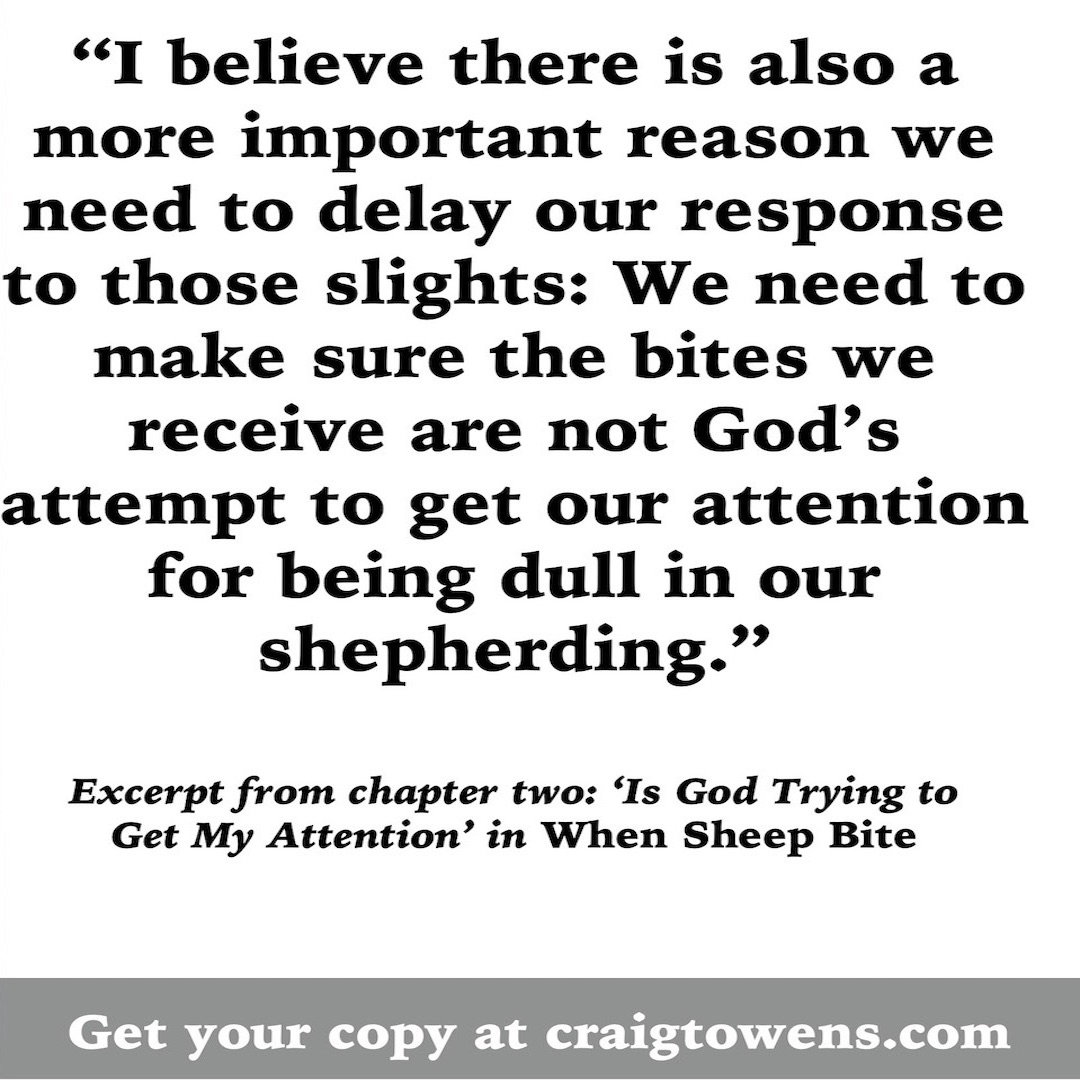
     I believe there is also a more important reason we need to delay our response to those slights: We need to make sure the bites we receive are not God’s attempt to get our attention for being dull in our shepherding. God told Jeremiah, “For the shepherds have become dull-hearted, and have not sought the Lord” (Jeremiah 10:21 NKJV). As a result, God had to send something painful to those religious leaders to make them aware of the dullness that had set in. 

I conclude this chapter with a prayer for shepherds who have been bitten—

     Father, Your sheep continued to wallow in the unhealthy habit of biting the hand that fed them and cared for them. In Your perfect love, You knew just how to discipline them, always with a heart of drawing these wayward sheep back to You. I ask You to please cultivate this loving heart in me. 

     Jesus, even as You were nailed to the Cross by the very sheep You came to save, You didn’t lash out in anger but lovingly prayed, “Father, forgive them for they don’t know what they are doing.” You know how much it hurts when my loving shepherding of these flock under my care is repaid with bites and kicks and abandonment. Jesus, help me to learn to respond in loving forgiveness as You did. 

     Holy Spirit, as David prayed, so I pray, “Search me.” As I do, please show me where my words, actions, or attitudes have rubbed the sheep under my care the wrong way and prompted them to lash out. Help me to repent, forgive, and ask forgiveness. Even if the attack was unprovoked by anything I have done, my heart’s desire is for none to be lost so please help me learn how to bring about restoration. 

     I pray this in the name of my Good Shepherd, Jesus. Amen.

To find out more about When Sheep Bite, or to pick up a copy for yourself, please click here.

►► Would you please prayerfully consider supporting this ministry? My Patreon supporters get behind-the-scenes access to exclusive materials. ◀︎◀︎

Shepherds Individualize Their Care

Listen to the podcast of this post by clicking on the player below, and you can also subscribe on AppleSpotify, or Audible. 

Karl Vaters and I share the same passionate belief that pastors—shepherd leaders—need to be in the pastures where God has placed them, faithfully caring for the sheep under their care. 

Check out this clip from my interview on The Church Lobby—

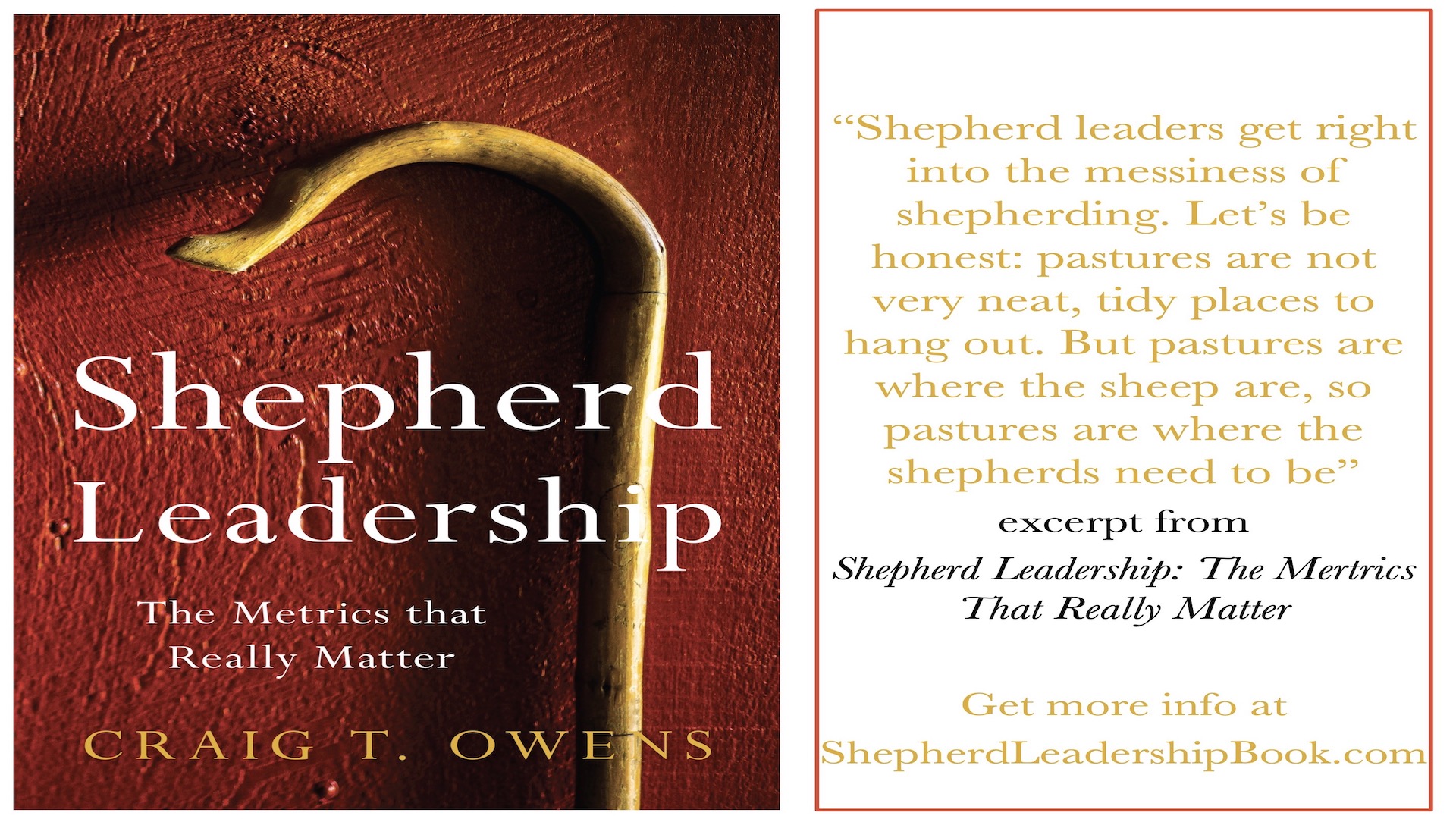
In my book Shepherd Leadership, I wrote this—

     Jesus said not only that He knew His sheep, but that His sheep knew Him, too. Shepherd leaders get right into the messiness of shepherding. Let’s be honest: pastures are not very neat, tidy places to hang out. But pastures are where the sheep are, so that is where the shepherds need to be. If the only time you interact with others is when you want to make an announcement or someone needs to be corrected, your sheep will begin to either resent you or fear your arrival. 

The best way to know the voice of each one of the sheep in your pasture (and the best way for those sheep to know your voice as well) is to be in the pasture as often as you can. This is what Jesus did at the Good Shepherd, and His under-shepherds honor Him when we follow His example. 

You can check out more clips from this Church Lobby interview here. 

Check out my book Shepherd Leadership for yourself or for a pastor that you love. And also check out my latest book When Sheep Bite, which I think of as the prequel to Shepherd Leadership.

►► Would you please prayerfully consider supporting this ministry? My Patreon supporters get behind-the-scenes access to exclusive materials. ◀︎◀︎

Guilt Constricts Leadership

Listen to the podcast of this post by clicking on the player below, and you can also subscribe on AppleSpotify, or Audible. 

Without a doubt, a leader plagued by feelings of guilt is a leader that is operating well-below his or her full potential. 

One of the best ways to avoid these feelings of limiting guilt is for the leader to admit that he or she isn’t an expert in every aspect of their organization. 

In this short clip, Karl Vaters and I are specifically addressing pastoral leaders, but the principles can be applied to leaders of any organization. 

You can check out more clips from this interview by clicking here. 

The two related blog posts I made reference to in this video are:

You may also be interested in a whole series of posts on godly leadership and in my book Shepherd Leadership. 

►► Would you please prayerfully consider supporting this ministry? My Patreon supporters get behind-the-scenes access to exclusive materials. ◀︎◀︎

De-Sizing The Church

Listen to the podcast of this post by clicking on the player below, and you can also subscribe on AppleSpotify, or Audible. 

I’d like to tell you about a book that I think is an absolute must-read for those in church leadership. Check out my interview with Karl Vaters, the author of De-Sizing The Church, on this episode of The Podcast.

Purchase your copy of De-Sizing The Church here.

You can keep up with all that Karl is doing on his blog.

And if you would like to check out when Karl interviewed me about my book Shepherd Leadership, those videos are here.

Here are a bunch of ways to get in touch with me and follow along with other projects on which I am involved.

►► Would you please prayerfully consider supporting this ministry? My Patreon supporters get behind-the-scenes access to exclusive materials. ◀︎◀︎

Avoiding Ministry Burnout

Listen to the podcast of this post by clicking on the player below, and you can also subscribe on AppleSpotify, or Audible. 

It has always been extremely heart-wrenching for me to see pastors and other ministry leaders get so frazzled that they throw in the towel. Many of them not only resign from the churches where they served, but they end up resigning their ministerial credentials too. 

I know this breaks God’s heart as well. 

When I was interviewed on The Church Lobby podcast, Karl Vaters wanted to discuss some preventative steps that pastors could take to avoid this ministry burnout.

In my book Shepherd Leadership, I devote five chapters to the mental, physical, spiritual, and emotional health of those in ministry leadership. I hope you will pick up a copy for yourself or for your pastor. 

To listen to the full interview on The Church Lobby, please click here.

►► Would you please prayerfully consider supporting this ministry? My Patreon supporters get behind-the-scenes access to exclusive materials. ◀︎◀︎

Faithfulness And Excellence

Listen to the podcast of this post by clicking on the player below, and you can also subscribe on AppleSpotify, or Audible. 

I had such a great time with Karl Vaters on his podcast called The Church Lobby. Right at the beginning of the conversation, Karl wanted to talk about the subtitle of my book: The metrics that really matter. 

Check this out…

Some resources for you to check out:

►► Would you please prayerfully consider supporting this ministry? My Patreon supporters get behind-the-scenes access to exclusive materials. ◀︎◀︎