Humbled Dad

If you heard a popping sound earlier today, that was probably my suit coat buttons! I attended the Cedar Springs Rotary Club luncheon today as an honored guest, because my son Brandon was a winner in the essay contest.

The essay contest is for the entire 5th grade in Cedar Springs, where they are asked to write about someone who shows integrity. I’ve known for a couple of weeks that Brandon was one of only five winner selected, but he has carefully guarded his essay. Today at lunch was the first time either Betsy or I heard it.

You can watch Brandon read his essay here…

…or you can read the essay for yourself here:

Dad

     “And that is why God sent Jesus to earth.” That’s my dad practicing his sermon. If you didn’t just catch that, my dad’s occupation is a pastor. Personally I think my dad shows tons of integrity. Here’s some ways my dad shows this as a pastor.

     My first reason I think my dad shows integrity is he speaks God’s word to the people every Sunday and Wednesday at church, so in a way he’s educating people in God’s word.

     My second reason I think my dad shows integrity as a pastor is that he goes out of his way to counsel people at the church and people having a hard time in life. When he goes to hospitals or homes to pray for people, he’s showing his care. Maybe someone needs some tips for staying a healthy Christian, my dad can help.

     My next thing on the list is my dad helping people even in not so good places. Sometimes my dad has to go to the people when they need help. My dad says, “Jesus went to parties and bad places to spread God’s grace and love.” Sometimes my dad has to go to bad restaurants or has to sit in the smoker’s area of a restaurant. But he does it to show God’s love.

     My last reason I think my dad shows integrity as a pastor is he helps the city with activities. He gets the youth group involved and will do what he can.

     My dad also shows integrity as a dad. Here are some things I would say about my dad. My dad is always there for his family. If someone is in need of a ride home, my dad can probably squeeze it in. If someone gets hurt, he’s there for sure. If anyone has a problem, he’ll be there to solve it.

     My second reason my dad shows integrity to the family is by setting a good example for me to follow. But he still lets me grow in my own way. Those are the reasons my dad shows integrity to the family.

     I try to be more like my dad because my dad is a role model to me. He shows me the right from wrong. He helps me grow as a person and will always keep me on the right path. My dad plays with me and shows me humor. He’ll tell me stories about things he did, motivating me to do the same thing. But the thing I look to my dad for the most is to be a better Christian. My dad tells me a small sermon every day. It’s not something you would hear at church, but it just helps me go through my day.

     This is why I believe my dad is a great person and I hope from this story that you can see my dad shows integrity to everybody.

I am one humbled and PROUD dad!

Is Your Integrity Worth $12 Million

My wife alerted me to this almost unbelievable story this morning. Gil Meche, a pitcher for the Kansas City Royals baseball team, is walking away from the final year of his contract with the team.

He’s walking away from $12 million.

Why? Because Gil Meche is a man of integrity. He signed a contract to pitch for the Royals, but due to his injuries, he doesn’t think he can live up to his end of the bargain. I especially liked this part of the article:

“A lot of people might think I’m crazy for not trying to play and make this amount of money,” he said, “[but] I don’t think I’m going to regret it.”

This would have been the final season under the five-year, $55 million contract he signed with the Royals prior to the 2007 season. Health issues, with his back and then with his shoulder, plagued him the last two seasons.

I didn’t want to go try it again for another season and be the guy making $12 million and doing absolutely nothing to help this team,” he said.

There is no settlement, no nothing for Meche as he walks away from the guaranteed money.

“I think it really reaffirms and validates why we signed Gil Meche—the integrity and the class and the respect that he’s displaying,” Royals general manager Dayton Moore said.

What price can you put on integrity?

Or as Jesus asked, “And what do you benefit if you gain the whole world but lose your own soul?”

Thanks, Gil, for showing the world that integrity is worth even more than $12 million.

Thursdays With Oswald—Whose Approval?

This is a weekly series with things I’m reading and pondering from Oswald Chambers. You can read the original seed thought here, or type “Thursdays With Oswald” in the search box to read more entries.

Whose Approval?

     The Gospel of Jesus Christ awakens an intense craving and an equally intense resentment. Base on personal love for the Lord, not on personal love for men. Personal love for men will make you call immorality a weakness, and holiness a mere aspiration; personal love for the Lord will make you call immorality devilish, and holiness the only thing that can stand in the light of God. The only safety for the preacher is to face his soul not with his people, or even with his message, but to face his soul with his Savior all the time.

From Approved Unto God

As a pastor, if I endeavor to please men, I cannot call sin “sin,” nor can I call people to holiness before God. If I love the approval of people more than I love the approval of God, I must naturally water things down.

I must live for the applause of nail-scarred Hands alone.

Thursdays With Oswald—General Maxims

This is a weekly series with things I’m reading and pondering from Oswald Chambers. You can read the original seed thought here, or type “Thursdays With Oswald” in the search box to read more entries.

General Maxims

     (a) If you lack education, first realize it; then cure it.

     (b) Beware of knowing what you don’t practice.

From Approved Unto God

I know the maxim for some is, “Fake it until you make it.” I can’t do that. I won’t do that. The Bible has a word for doing that: Hypocrisy.

How can you say to your brother, “Brother, let me take the speck out of your eye,” when you yourself fail to see the plank in your own eye? You hypocrite, first take the plank out of your eye, and then you will see clearly to remove the speck from your brother’s eye (Luke 6:42).

But just as bad is when I know what I’m supposed to do, and then make excuses not to do that. The Bible has a word for not doing that: Sin.

Remember, it is sin to know what you ought to do and then not do it (James 4:17).

Thursdays With Oswald—Integrated Life

This is a weekly series with things I’m reading and pondering from Oswald Chambers. You can read the original seed thought here, or type “Thursdays With Oswald” in the search box to read more entries.

Integrated Life

     God will never allow us to divide our lives into sacred and secular, into study and activity. We generally think of a student as one who shuts himself up and studies in a reflective way, but that is never revealed in God’s book. A Christian’s thinking ought to be done in activities, not in reflection, because we only come to right discernment in activities. Some incline to study naturally in the reflective sense, others incline more to steady active work; the Bible combines both in one life. We are apt to look on workers for God as a special class, but that is foreign to the New Testament. Our Lord was a carpenter; Paul was a weaver. If you try and live in compartments, God will tumble up the time.

From Approved Unto God

You and I don’t have sacred and secular lives. If you are a follower of God, your whole life is holy: it’s all set apart for God. Don’t slack off in areas that you think are secular; treat everything as holy.

How A Leader Should Bring Correction

Listen to the podcast of this post by clicking on the player below, and you can also subscribe on AppleSpotify, or Audible.

Bringing correction is one of the toughest jobs for those in leadership, but it’s a responsibility that cannot be delegated or ignored. In order for correction to be effective, it must not be too light or too heavy. Unfortunately, many of us have experienced far too many ineffective forms of leadership correction.

I read a great example of how to properly correct in the life of Samuel. In 1 Samuel 12, the people had gotten off track, and Samuel lovingly and effectively brought them back into line. Here’s what his example teaches us on how to correct followers:

1.  Shared history (v. 2). Samuel reminded them of what had happened in their history, and even what they had experienced together. “Newbie” leaders need to be cautious about bringing correction that violates an organization’s established culture.

2. Integrity (v. 3). Samuel’s words and lifestyle lined up. That doesn’t mean he never made a mistake, but it does mean that he was willing to acknowledge and repair his mistakes. Nothing is worse than a leader who says, “Do as I say, not as I do!”

3. Common ground (vv. 6-11). A leader needs to get everyone on the same page. Find something somewhere on which everyone can agree, and then move forward from there.

4. Just say it (vv. 12-13). Don’t beat around the bush; don’t try to bring correction through a parable; don’t soften the blow. Just say it: “This is where I believe you made a mistake.” Far too many leaders talk too much and leave their followers saying, “Huh?” If you are going to bring correction, make sure your followers know exactly what it is you are correcting.

5. Give the remedy (vv. 14-15, 20-21). Samuel pointed out the error, and he just as clearly told them how to get back on track. The remedy should be as clear and simple as possible.

6. Remove the fear (vv. 20, 22). Don’t let the corrected follower be afraid of you! Fear will never re-establish trust. Samuel couldn’t have been more clear on this. He literally said to the Israelites, “Do not be afraid.”

7. Demonstrate servant leadership (v. 23). At the close of the meeting, Samuel said he would do two things: “I will continue to pray for you, and I will continue to teach you.” In telling them this, Samuel was really saying, “Let’s walk through this together.”

If you lead your family, your church, your company, or your team, you are going to have to bring correction at some point. When you need to do this, take some time to review this list and bring correction the way Samuel did: lovingly and effectively.

P.S. You can also check out this post where the apostle Paul gives us another example of how to handle correction properly.

►► Would you please prayerfully consider supporting this ministry? My Patreon supporters get behind-the-scenes access to exclusive materials. ◀︎◀︎

I Am The Judas

I received this email from a trusted ministry partner today and thought it was so impactful that I wanted to pass it along. The author of this story is a missionary in a heavily Muslim country.

Hassan has been a friend and confidant for ten years. He came to know the Lord as a refugee in Eritrea before moving back to the country I’m in looking for work. He started working with us as a teacher at one of our English centers, and over time rose up through the ranks to become its director. Personable, caring, charismatic, and intelligent, Hassan grew the center and it now ministers to over 500 people on a daily basis.

Different people on our team have interacted with Hassan over the years in his home, on ministry trips, and at the small Bible study that he led for other believers from a Muslim background. Many of us can point back to times of sweet fellowship, worship, praise, prayer, and ministry. I have seen Hassan cry real tears in the presence of the Lord.

Three months ago we discovered Hassan stole tens of thousands of dollars from the ministry center. Time revealed that he has taken a second wife, more time revealed he actually has three wives, is possibly a security informant (he knows everything about us), and allegedly paid other Muslims to pretend they were believers to widen the deception.

I am of two hearts on this. On one side I wonder how Hassan could live in both worlds so convincingly. I also realize that I am just as skilled an actor, I have two faces. I can move from praise and legitimate worship to carnality in a moment. I can read my Bible and my eyes mist up at some discovery of Jesus, and then rise up out of my chair to yell at my sons. I can stand in the pulpit and scan the audience for pretty ladies.

I am the “Judas” in the midst. Oh Lord, have mercy on me. O Lord, have mercy on us all.

May we take this word to heart and all take a deep look in our heart—

Search me, O God, and know my heart; test me and know my anxious thoughts. See if there is any offensive way in me, and lead me in the way everlasting. (Psalm 139:23-24)

Therefore let anyone who thinks he stands [who feels sure that he has a steadfast mind and is standing firm], take heed lest he fall [into sin]. (1 Corinthians 10:12)

Sermon Perceptions

I read an interesting article about people’s feelings about sermons. You can read the full article here, but allow me to list some of the main points:

  • Nearly all churchgoers “look forward” to the sermon.
  • Some view sermons as educational, some as entertainment.
  • Catholics wanted the sermon to last 10 minutes. Baptists were fine with a 75-minute sermon.
  • Only 17% say the sermon leads them to change their lifestyle.

Only 17%?!? If that’s the case, why do I (and other pastors) spend so much time preparing a message?

I made a change a while ago. Instead of trying to prepare a sermon, I try to prepare myself.

I’m not a fake-it-until-I-make-it pastor. I don’t tell my congregation how they should live, I tell them how the Holy Spirit is challenging me to live.

I don’t walk to the platform on Sunday morning with my finger pointing out at my congregation, but with my finger pointing squarely at me.

I stumbled upon this anonymous poem a number of years ago. This is my goal in my sermon prep:

I’d rather see a sermon than hear one any day;

I’d rather one should walk with me than merely show the way.

The eye’s a better pupil and more willing than the ear;

Fine counsel is confusing, but example’s always clear.

And the best of all preachers are the men who live their creeds.

For to see the good in action is what everybody needs.

I can soon learn how to do it if you’ll let me see it done;

I can watch your hands in actions, but your tongue too fast may run.

And the lectures you deliver may be very wise and true,

But I’d rather get my lesson by observing what you do.

For I may misunderstand you and the high advice you give,

But there’s no misunderstanding how you act and how you live.

Amen!

So, pastor, it’s not really sermon prep you should be doing, but individual heart prep.

Derailed (book review)

Derailed

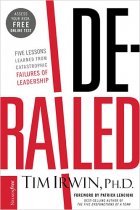
As I read Dr. Tim Irwin’s latest book, Derailed, I thought about a quote from John Maxwell: “A wise man learns from his mistakes. A wiser man learns from others’ mistakes. The wisest man learns from others’ successes.”

The subtitle of this book is “Five lessons learned from catastrophic failures of leadership.” In this, we learn from others’ mistakes. But then Dr. Irwin goes on to show us successes that we can learn from as well. Combining the insight from successful—or should I say “non-derailed” leaders—with his own discernment, Dr. Irwin shows us how to stay on the rails.

When I first noticed that the examples in the book were all high-profile CEOs, I thought, “What could I learn from them? After all, I’m not the CEO of a Fortune 500 company.” But Dr. Irwin does an excellent job of bringing the four qualities of character—authenticity, self-management, humility, and courage—down to a pedestrian level where even we non-CEO-types can benefit from his wisdom.

Although the principles in Derailed can benefit anyone in leadership, or aspiring to a leadership position, this book still might not be for everyone. The six case studies in the book are all derailed CEOs, and unless you have a penchant for the business world, you might not find them very enjoyable reading. However, for those of you who enjoy business history, there is much to gain from a careful reading of Derailed.

I am a Thomas Nelson book reviewer.

Be Real

Superheroes

Masks just for fun

A quick show of hands: how many of you like a phony? Uh-huh, I didn’t think I’d see any hands raised on that one. We may like to see our favorite actor/actress play a convincing role on stage or on screen, but when it comes to real people we interact with on a daily basis, we want the real deal.

Sadly, the people who have the most “realness” to offer often go about it in a phony way. I’ve observed way too many people who claim to be followers of Christ put their masks on:

  • They put on their laughing mask when their coworkers are telling crude jokes. Then switch to their disgusted mask when they tell their church friends how vulgar their coworkers are.
  • They put on their silent mask when someone talks about how they don’t really believe in God. Then they switch to their wise counselor mask when they tell someone else what they should have said.
  • They put on their fake smile mask when someone asks what they think of the boss’s announcement about possible layoffs. Then they put on their pray-for-me mask when they ask someone in church to intercede for them about their future.

Instead

Since God has so generously let us in on what He is doing, we’re not about to throw up our hands and walk off the job just because we run into occasional hard times. We refuse to wear masks and play games. We don’t maneuver and manipulate behind the scenes. And we don’t twist God’s Word to suit ourselves. Rather, we keep everything we do and say out in the open, the whole truth on display, so that those who want to can see and judge for themselves in the presence of God.

Be real. Always. In all circumstances. Masks are for parties. Realness is for people’s souls.