Listen to the podcast of this post by clicking on the player below, and you can also subscribe on Apple, Spotify, or Audible.
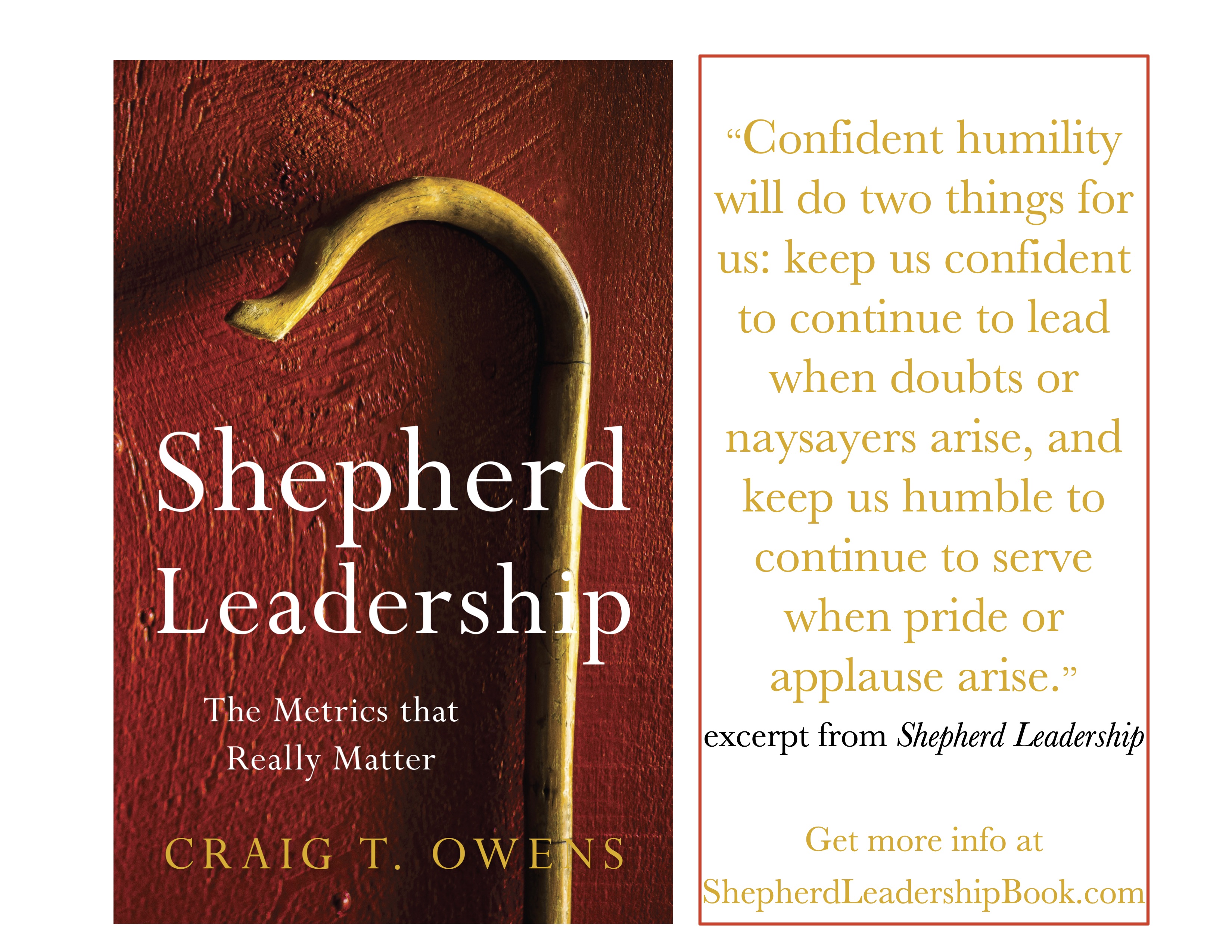
In my book Shepherd Leadership: The Metrics That Really Matter, I take two chapters to talk about a leader’s confidence and a leader’s humility. Effective shepherd leaders are learning to balance their confidence and their humility.
In chapter 4, I tell a true story about an alter-ego superhero I created as a way to remind myself of the importance of adding humility to my confidence. I hope you’ll watch the video featuring the artwork of Adam Comrie and the excellent production work of my son-in-love Ian Murphy. And I also hope that you will pick up a copy of Shepherd Leadership for yourself or for a ministry leader in whom you would like to invest.
Greg wonders why leaders get trapped using metrics of success that don’t really matter [4:10]
I talk about why the subtle shift from “servant leadership” to “shepherd leadership” is important [4:50]
Greg and I discuss the tension between a leader’s confidence and a leader’s humility [6:25]
I explain how my wife helped me see my leadership in a better light [8:00]
my favorite definition of humility comes from C.S. Lewis [9:45]
Greg asks how leaders can develop the right kinds of relationships that will help them continue to grow [10:35]
I share the dangers when leaders try to fly solo [11:40]
Greg talks about the vital need for leaders to refresh themselves [14:00]
who will benefit from reading Shepherd Leadership? [14:50]
I share a humorous story of a way I advised a church to grow their numbers overnight [16:54]
Check out this episode and subscribe on YouTube so you can watch all of the upcoming episodes. You can also listen to our podcast on Spotify and Apple.
This is a weekly series with things I’m reading and pondering from Charles Spurgeon. You can read the original seed thought here, or type “Thursdays With Spurgeon” in the search box to read more entries.
Listen to the podcast of this post by clicking on the player below, and you can also subscribe on iTunes or Spotify.
God Is The Great Worker
I planted, Apollos watered, but God gave the increase. So then neither he who plants is anything, nor he who waters, but God who gives the increase. Now he who plants and he who waters are one, and each one will receive his own reward according to his own labor. For we are God’s fellow workers; you are God’s field, you are God’s building. (1 Corinthians 3:6-9)
God Himself is the Great Worker. He may use what laborers He pleases, but the increase comes only from Him. Brothers, you know it is so in natural things—the most skillful farmer cannot make the wheat germinate, grow, and ripen. … And in the spiritual farm it is even more so, for what can man do in this business? … We can tell out the truth of God, but to apply the truth to the heart and conscience is quite another thing. …
Well said our Lord, ‘Without Me you can do nothing’ (John 15:5). What is the effect of all this upon your minds? Briefly I would draw certain practical lessons out of this important truth of God. (1) The first is, if the whole farm of the church belongs exclusively to the great Master Worker and the laborers are worth nothing without Him, let this promote unity among all whom He employs. …
(2) Next, notice that this fact ennobles everybody who labors in God’s husbandry. …
(3) But lastly, how this should drive us to our knees! Since we are nothing without God, let us cry mightily to Him for help in this, our holy service!
From Farm Laborers
I learned long ago of both the confidence and the humility in reminding myself that God chose me to work in His field. Here’s how I describe that in my book Shepherd Leadership: The Metrics That Really Matter—
There is nothing wrong about aspiring to a leadership position. The apostle Paul wrote to his young protégé Timothy, “This is a trustworthy saying: ‘If someone aspires to be a church leader, he desires an honorable position’” (1 Timothy 3:1 nlt). Yet this desire needs to be tempered by Jeremiah’s words to his scribe Baruch, “Should you then seek great things for yourself? Do not seek them” (Jeremiah 45:5). Taken together, a shepherd leader’s passion for greater leadership should be to gain greater things not for himself but for others.
Shepherd leaders need to remind themselves frequently of this simple statement: God chose me. The confidence comes from remembering “God chose.” If God has chosen me, then He has also equipped me. He foresaw the needs of this organization, and He has prepared me to step into this role for such a time as this. The humility comes from remembering “God chose me.” Who am I that God would think so highly of me? Of all the people on Earth that God could have placed here, why did He pick me? This confident humility will do two things for us: keep us confident to continue to lead when doubts or naysayers arise, and keep us humble to continue to serve people when pride or applause arises. (except from chapter 2 “Secure To Serve”)
The Bible uses two phrases that we don’t typically use today: “the horn of the wicked” and “the horn of the righteous.”
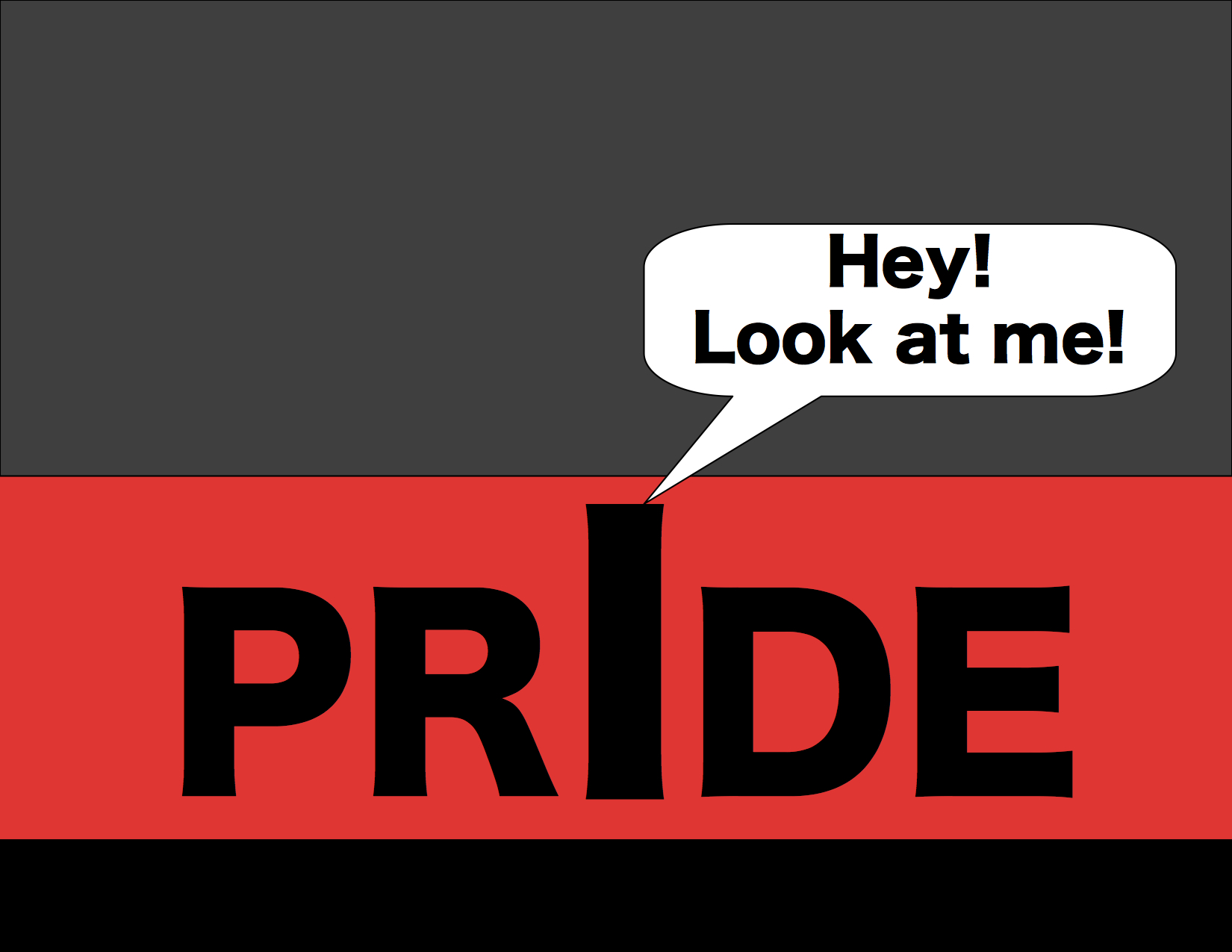
A horn in Hebrew literature is a symbol of strength. The wicked blow their own horn—trumpeting how they are self-made people. Obviously, this God-ignoring arrogance isn’t something God can bless!
What about “the horn of the righteous”? Is there a way to blow our horn so that God is glorified? In a word: Yes!
Check out this short 2-minute video to hear how I describe the right and wrong ways to honor your uniqueness by blowing a righteous, God-honoring horn…
Listen to the podcast of this post by clicking on the player below, and you can also subscribe on Apple or Spotify.
To some who were confident of their own righteousness and looked down on everybody else, Jesus told this parable: “Two men went up to the temple to pray, one a Pharisee and the other a tax collector. The Pharisee stood up and prayed about himself: ‘God, I thank You that I am not like other men—robbers, evildoers, adulterers—or even like this tax collector. I fast twice a week and give a tenth of all I get.’
“But the tax collector stood at a distance. He would not even look up to heaven, but beat his breast and said, ‘God, have mercy on me, a sinner.’
“I tell you that this man, rather than the other, went home justified before God. For everyone who exalts himself will be humbled, and he who humbles himself will be exalted.” (Luke 18:9-14)
I think the NIV footnote on verse 11 is the most accurate rendering of “the Pharisee stood up and prayed about himself.” The footnote says, “He prayed TO himself.” He made himself God, which, if you will recall, is exactly how satan tempted Adam and Eve—you will be like God (Genesis 3:5).
In a portion of William Cowper’s poem Truth, he addresses the pride of the Pharisee, and warns us that this could be our pride too if we aren’t carefully guarding our hearts.
Who judged the Pharisee? What odious cause
Exposed him to the vengeance of the laws?
Had he seduced a virgin, wrong’d a friend,
Or stabb’d a man to serve some private end?
Was blasphemy his sin? Or did he stray
From the strict duties of the sacred day?
Sit long and late at the carousing board?
(Such were the sins with which he charged his Lord.)
No—the man’s morals were exact. What then?
‘Twas his ambition to be seen of men;
His virtues were his pride; and that one vice
Made all his virtues gewgaws [gyoo-gaws] of no price;
He wore them as fine trappings for a show,
A praying, synagogue-frequenting beau.
The self-applauding bird, the peacock, see—
Mark what a sumptuous Pharisee is he!
Meridian sunbeams tempt him to unfold
His radiant glories, azure, green, and gold:
He treads as if, some solemn music near,
His measured step were govern’d by his ear;
And seems to say—“Ye meaner fowl give place;
I am all splendour, dignity, and grace!”
Not so the pheasant on his charms presumes,
Though he, too, has a glory in his plumes.
He, Christian-like, retreats with modest mien
To the close copse or far sequester’d green,
And shines without desiring to be seen.
The plea of works, as arrogant and vain,
Heaven turns from with abhorrence and disdain;
Not more affronted by avow’d neglect,
Than by the mere dissembler’s feign’d respect.
What is all righteousness that men devise?
What—but a sordid bargain for the skies!
But Christ as soon would abdicate His own,
As stoop from heaven to sell the proud a throne.
When the writer of Hebrews says that we can approach the throne of grace boldly, it is clear that it is not because of our righteous deeds, even if they are as exacting and as perfect as a Pharisee. We can only come boldly into God’s presence because we come in the name and the righteousness of Jesus. “I tell you that this man, rather than the other, went home justified before God.”
Adding “in Jesus name” to the end of our prayers isn’t a password that opens the storeroom of Heaven, but it is a reminder that we have nothing in ourselves to commend us to God. We come boldly only in Jesus.
Check out this episode and subscribe on YouTube so you can watch all of the upcoming episodes. You can also listen to our podcast on Spotify and Apple.



 In my book Shepherd Leadership: The Metrics That Really Matter, I take two chapters to talk about a leader’s confidence and a leader’s humility. Effective shepherd leaders are learning to balance their confidence and their humility.






 Craig T. Owens