Gettin’ Messy

In any culture where it exists, leprosy makes its victim an outcast. People might feel bad for the afflicted, but they quickly look away. No one invites the leper to dinner, few even go to visit the leper. Shunned, closeted away, quickly forgotten.

In every culture where it exists today, pain and suffering are treated almost like leprosy. We’ll talk about the problem, pray for the victims, form organizations to address the problem, and even give money to address the issue. But few people do more.

We feel safe at a distance.

We feel sanitized if we don’t have to touch the hurting.

We feel we’ve done our part if we throw a few dollars at it.

But not Jesus. He handled the hurting … literally.

A man with leprosy came and knelt in front of Jesus. He said, “Lord, You have the power to make me well, if only You wanted to.” Jesus put His hand on the man and said, “I want to! Now you are well.” At once the man’s leprosy disappeared.

Jesus put His hand on the man. He didn’t just pray. He didn’t give money. He didn’t organize a rally to address the problem of leprosy. He touched a hurting man.

He got messy.

He conveyed love to a hurting man like nothing else could have.

Robert Shuller wisely noted, “Being a Christian is offering yourself to Him. Your mind for Christ to think through; your heart for Christ to love through; your lips for Christ to speak through; your hands for Christ to touch through.”

What about it? Are you ready to convey the love of Christ by touching—literally—people’s problems? Nothing says “I love you” like the human touch.

This Little Light Of Mine

Did you ever sing that song as a kid?

This little light of mine

I’m gonna let it shine

This little light of mine

I’m gonna let it shine, let it shine

Let it shine, all the time

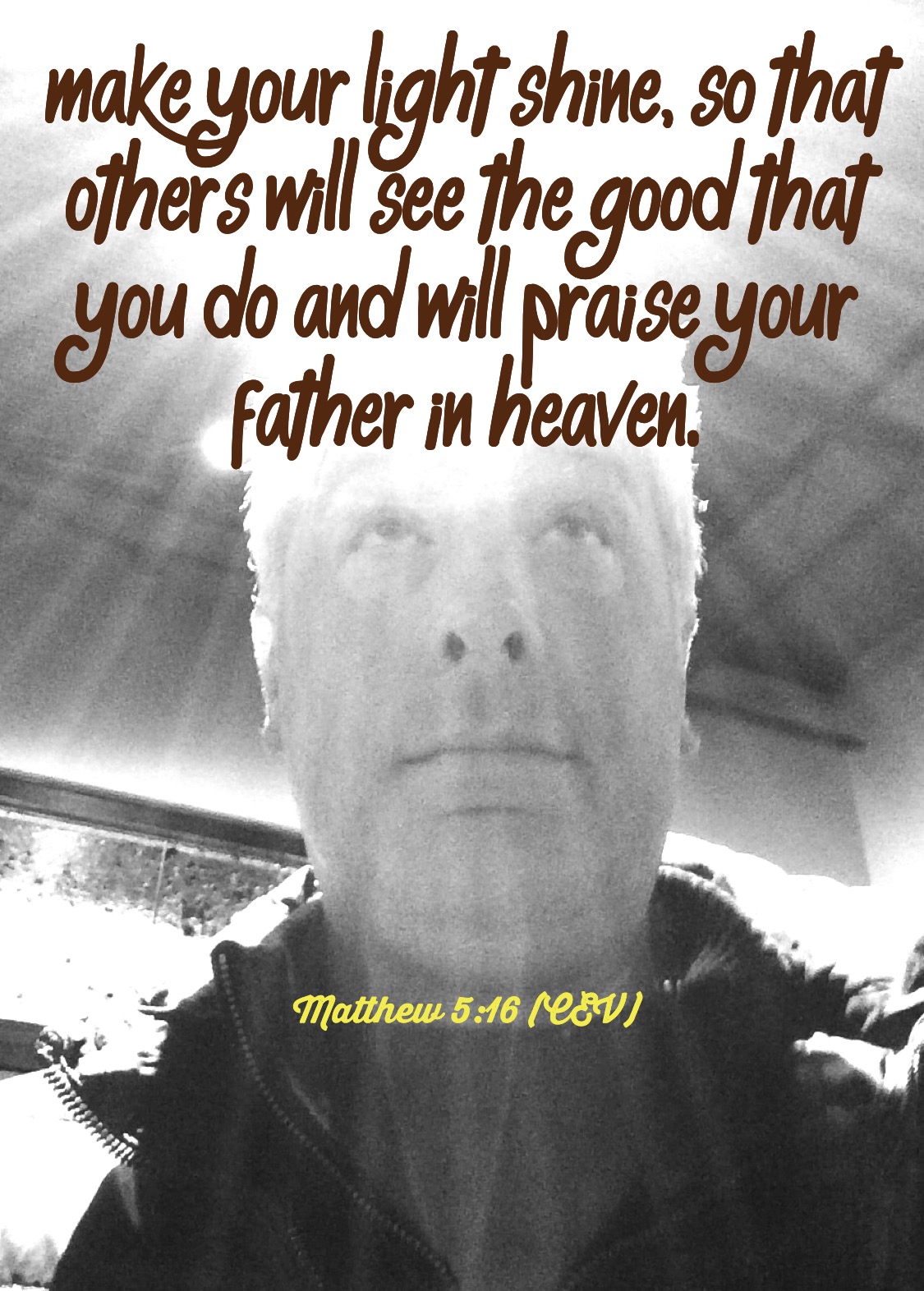
Why did I stop singing that as a “grown-up”? Yesterday I was reading in Matthew 5 where Jesus talked about shining. Many of the translations read, “Let your light shine.” But I really like the Contemporary English Version —

Make your light shine, so that others will see the good that you do and will praise your Father in heaven.

Make it shine!

That’s really the most accurate translation. Let it shine sounds passive. Almost like, “Well, it’s shining already, so I guess I won’t put it out.” But make it shine is definitely in the active tense

… it’s right now

… it’s burning brightly and deliberately and unashamed

I grew up in a Christian home, so maybe I just assumed that my lamp was lit already and I could just let it shine. Maybe you’ve just assumed your light was shining too.

But today I want to be active in making my light shine. I’m going to do good so that others can praise God too.

Won’t you join me in making your light shine brightly today too?

What Are Rules For?

Listen to the podcast of this post by clicking on the player below, and you can also subscribe on Apple, Spotify, or Audible. 

David is on the run from Saul. He leaves town so quickly that he didn’t have time to kiss his wife goodbye. He didn’t even have enough time to grab a weapon, a change of clothes, companions, or food. So he stops by Ahimelech’s house to see if this priest has any food.

Remember this old nursery rhyme?

Old Mother Hubbard
Went to the cupboard,
To give the poor dog a bone:
When she came there,
The cupboard was bare,
And so the poor dog had none.

That’s just about what happened here. Ahimelech said, “The only bread I have is the holy showbread.” This consecrated bread was 12 loaves laid out each Sabbath in God’s presence. When this bread was replaced each week, it became food for the priests. Ahimelech recognized he had a moral obligation to save David’s life which superseded the ceremonial rules.

Jesus used this incident as an example when the Pharisees accused Him of breaking the law concerning the Sabbath day. Jesus and His followers had been walking through a wheat field, plucking some pieces of grain on which they could munch. The rule-keeping Pharisees said this amounted to work, and a violation of Sabbath rules.

I think sometimes we get so caught up in keeping the rules (or following tradition, or preserving decorum) that we forget the meaning behind the rule. Or, more accurately, we forget God’s design behind the rule.

Every rule God gives is to keep us in a place where we can experience His presence. Rules are not life, but they are boundaries that keep us on the path to life.

Ahimelech kept David alive with showbread. Jesus and His disciples sustained themselves with wheat kernels. Jesus healed the sick on the Sabbath to bring life and wholeness.

Following rules just to follow rules misses the point. What is the point? Following God’s rules to find God’s heart is THE point.

So let me ask you: Do you get the point?

You may also want to check out series on God’s rules called The Love In The Law, or the post called Rules Are Overbearing—Love Never Is.

►► Would you please prayerfully consider supporting this ministry? My Patreon supporters get behind-the-scenes access to exclusive materials. ◀︎◀︎

Going Through The Motions

I was talking to a friend who is a missionary in Africa who had just experienced an interesting church service. Many times Africans will hear a worship song from a visiting group of Americans, and they will try to implement that worship song into their church services. Sometimes this can be quite beautiful.

And sometimes it’s quite comical.

These precious African saints were trying their best to imitate the English words they had heard sung in the song Friend Of God. However, their chorus sounded something like this:

I am afraid of God

I am afraid of God

I am afraid of God

He calls me Fred

Comical? Sure. But it’s also very instructional.

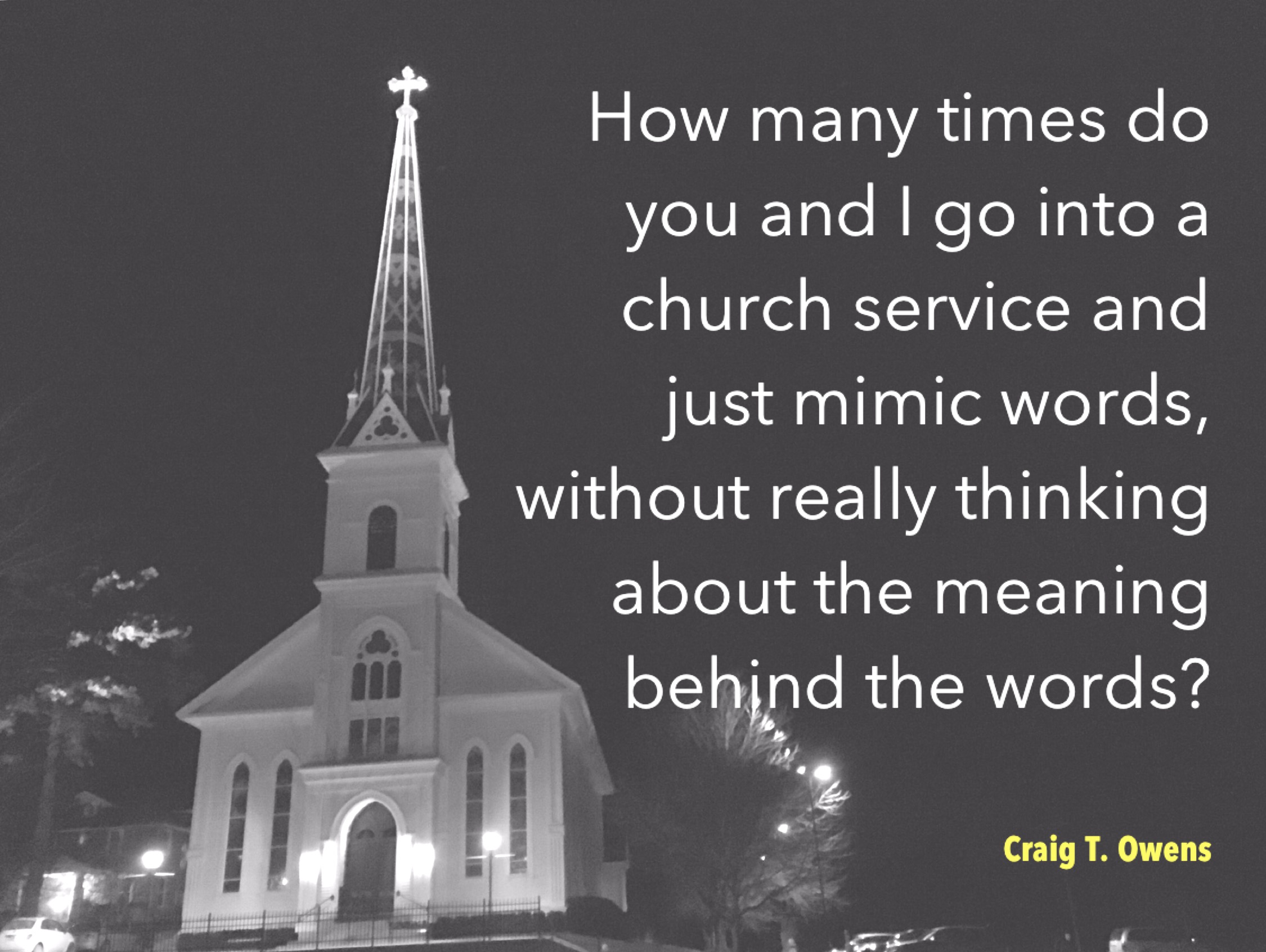
How many times do you and I go into a church service and just mimic words, without really thinking about the meaning behind the words?

We go through the motions—we imitate the sounds we have heard before—and think we are really worshiping.

Here’s what Jesus said:

And when you pray, do not heap up empty phrases… [and] think that you will be heard for your many words.

Are you going through the motions?

  • Do you pray the same prayer at every meal?
  • Do you sing the same songs the same way every time?
  • Do you worship God the same way every time you come into His presence?
  • Do you pray the same prayer every night before bed?

Do you really mean what you are saying? Or are you just going through the motions?

Worrywart

“Worry indicates we’re not willing to let God handle certain things—at least not in His way, and certainly not in His time.” —Craig Groeschel, in The Christian Atheist

Worry is a control issue…

…that is, I want to be in control.

Worry is a sovereignty issue…

…that is, I think I know best how things should work out.

Worry is a trust issue…

…that is, I trust God only when things are happening on my timeframe.

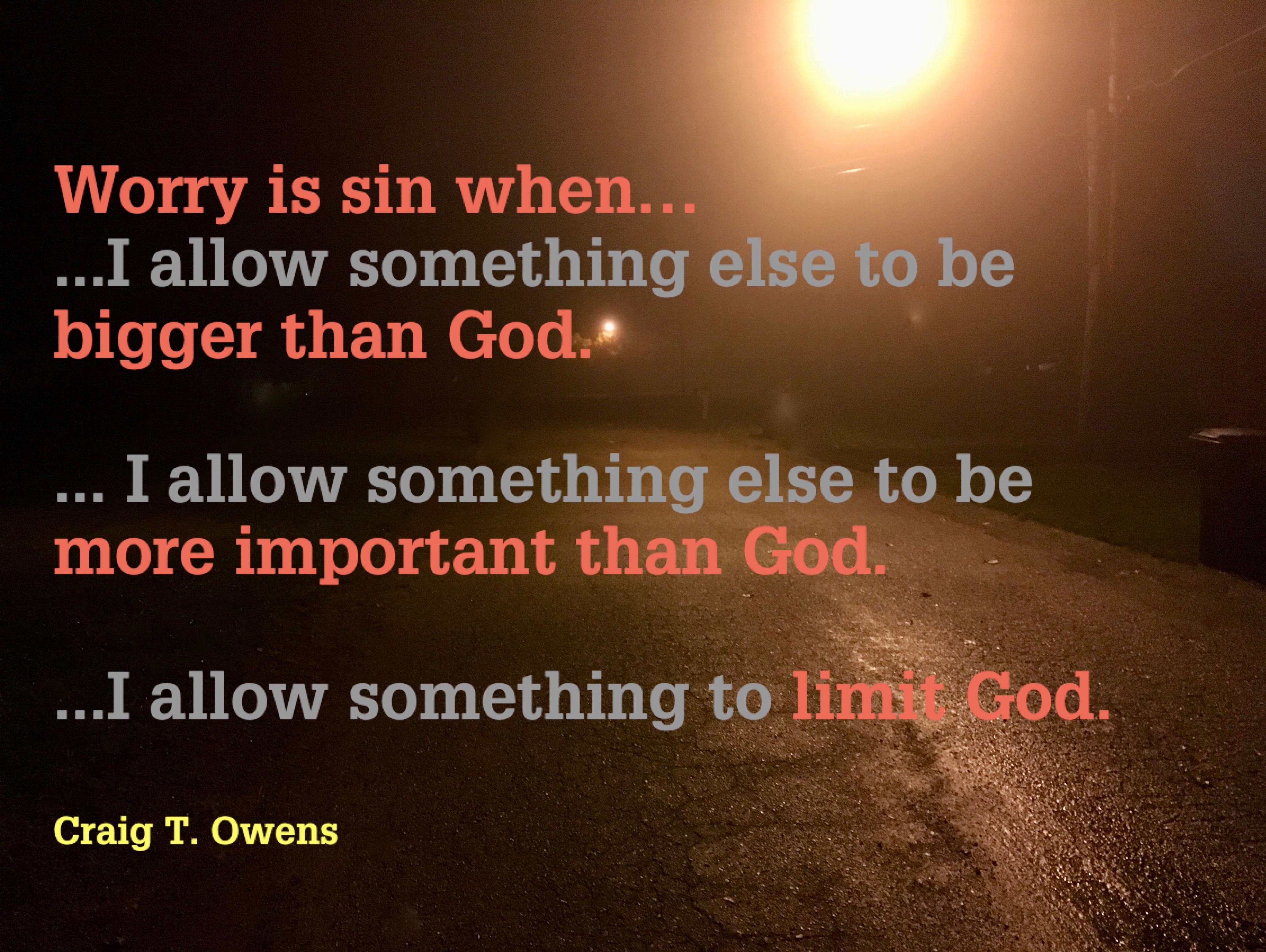
Bottom line: Worry is sin when…

  • …I allow something else to be bigger than God.
  • …I allow something else to be more important than God.
  • …I allow something to limit God.
  • …I look more to myself for solutions than I look to God.

Any worry should be a call to prayer: Don’t worry about anything; instead, pray about everything. Tell God what you need, and thank Him for all He has done. Then you will experience God’s peace, which exceeds anything we can understand. His peace will guard your hearts and minds as you live in Christ Jesus. (Philippians 4:6-7)

Any extended worry should be a call to repentance: Jesus commands us four times, “Do not worry” (Matthew 6:25-34).

Worry can be disguised in a lot of different forms, but it’s still worry. And it’s still sin. I’m working on this.  

Fasting

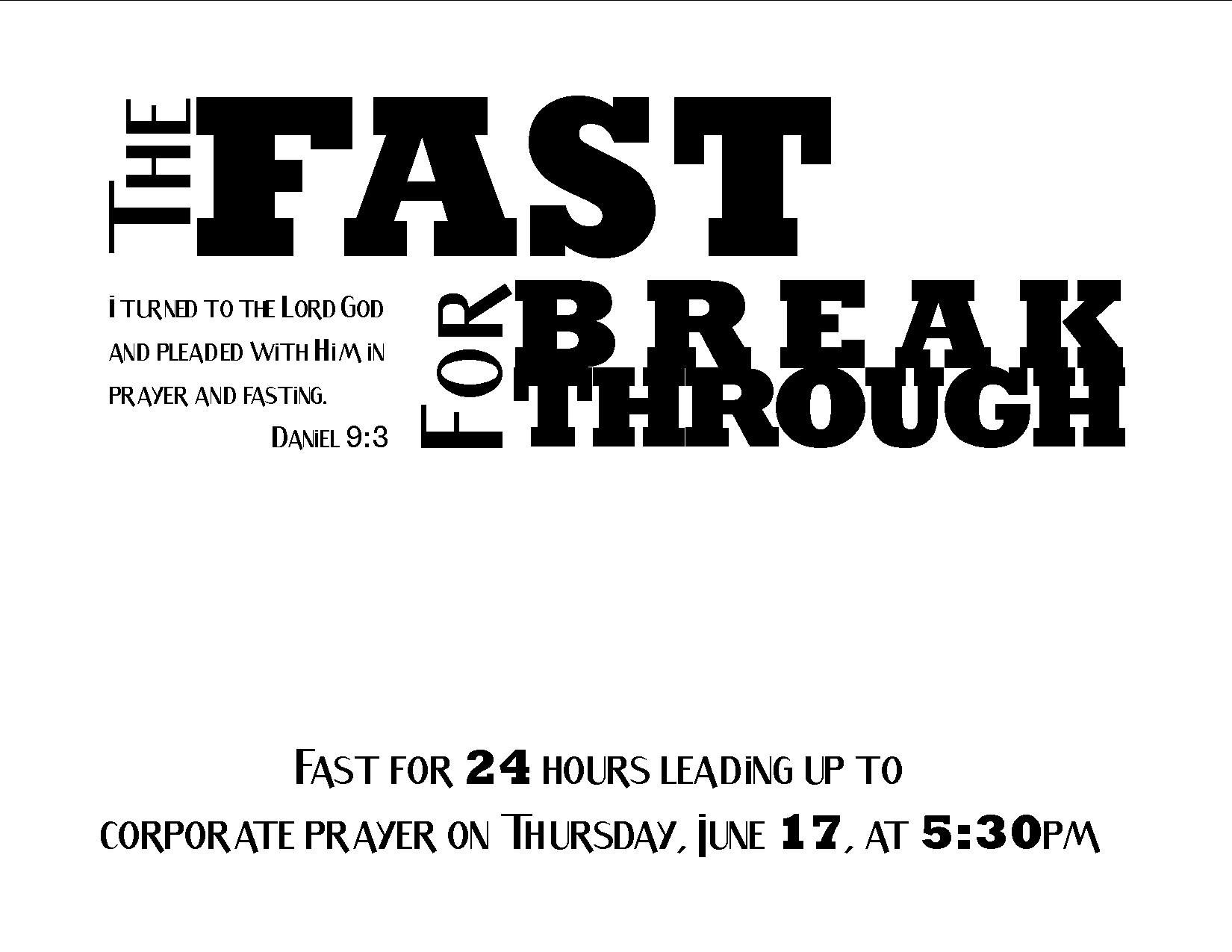
We’re fasting today.

I believe in this: Prayer + Fasting = Breakthroughs.

Even though this looks like a mathematical formula, it doesn’t work like a formula. Jesus challenged religious people who fasted just because. Jesus was really echoing the words God spoke in Isaiah about religious people simply going through pious acts, but their hearts were still far away from God. They thought God operated on a formula: “If we fast, then God has to….” It doesn’t work that way.

We met together for a time of worship and Bible study last night, and we’ll conclude our fast with corporate prayer this evening. We are focusing on our heart attitude. Not fasting just because or even the pastor asked us to. But fasting because we are hungry for God to move … for Him to break chains … for Him to set people free … for breakthroughs!

I can’t wait to see what God is going to do in us and then through us as we spend this time seeking His heart. Prayer + Fasting = Breakthroughs.

Obey─Remember─Teach

I see this pattern of instruction repeated throughout the Bible, but especially as the Israelites are getting ready to enter the Promised Land:

  • Obey God’s commands
  • Remember what He has done for you
  • Teach His commands to your children

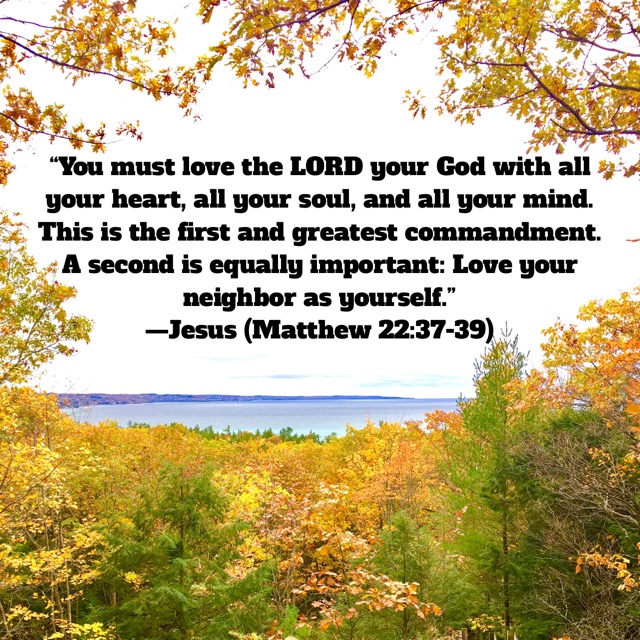
When Jesus was asked which commandment was the greatest, He quoted a passage from Deuteronomy, “Love the Lord your God with all your heart and with all your soul and with all your strength.” And He added, “And love your neighbor as yourself.” These, Jesus said, were the fulfillment of all the law.

  • Love God
  • Love yourself
  • Love your neighbor

This Great Commandment corresponds with this pattern of obey-remember-teach.

  • I obey God because I love Him.
  • When I remember what He has done for me, I can fully appreciate my own value in His eyes.
  • I teach others because I love them and want them to experience the same blessings from God that I have experienced.

This is what I need to be constantly evaluating:

  • Am I obeying God out of fear of what may happen, or out of love for Him?
  • Am I finding ways to continually be reminded of His blessings? Do I realize how valuable I am to Him?
  • Am I expressing true love to others by passing on what I am learning?

Obey [love God] … Remember [love myself] … Teach [love others].

What a great way to live!

BOGOF

Sometimes to get a point across, the only thing you can do is create a new word. Does anyone remember Rich Hall’s list of sniglets on Saturday Night Live? A list of 20 sniglets is here.

This morning we talked about the Parable of the Talents, where the servants were expected to do something with the talents God had given them. Then Jesus talks about the end of time judgment where we are divided into those who did something for God by addressing human needs, and those who ignored the human needs around them.

How do we remember this? How do we apply it to everyday life?

Then it hit me: we all eat; in fact, most of us eat every day. In order to eat, many of us go to the grocery store. And to help stretch the food budget, we often use coupons. When we get one of those buy-one-get-one-free coupons (a BOGOF), what do we do with the free one? Do we consume it ourselves, or could we give it away? Wouldn’t giving away the free one honor God by helping feed the hungry?

So we created a word—BOGOF—and turned it into a refrigerator magnet. We’re going to do our best to build into our daily lives the habit of loving others by addressing their practical needs.

Why don’t you try it yourself? Maybe you can create your own word too! If you do, please be sure to share it in the comments below.

A Word That’s Hard To Say

Listen to the podcast of this post by clicking on the player below, and you can also subscribe on Apple, Spotify, or Audible.

We all like “Yes.” That’s a nice word. But here’s the problem: By saying “Yes” to too many things we’re really saying “No” to many of the things we previously said “Yes” to.

Confused?

Let me try it this way. We all have only 24 hours in a day. No more; no less. We can all do a finite number of things during that 24-hour period. Some may be able to do slightly more, but even the most efficient people have a limit.

When we keep saying “Yes” over and over and over again, eventually our mouths are saying “Yes” but we cannot deliver. We’re out of time, out of resources, out of open places on our To Do list, out of patience, out of energy, out of money.

Perhaps the best way to make your “Yes” mean “Yes” is to say “No.” To truly evaluate what is important, how much time you have, or how much money you have. And then say “No” to the things that you cannot truly commit to.

It’s hard to say “No.” But saying “No” more often will make your “Yes” so much more doable. Otherwise, your verbal “Yes” becomes an “I’ll try,” which eventually is a “Not really,” which in reality is a “No” anyway. So just say “No” upfront.

     And don’t say anything you don’t mean. This counsel is embedded deep in our traditions. You only make things worse when you lay down a smoke screen of pious talk, saying, “I’ll pray for you,” and never doing it, or saying, “God be with you,” and not meaning it. You don’t make your words true by embellishing them with religious lace. In making your speech sound more religious, it becomes less true. Just say “yes” and “no.” When you manipulate words to get your own way, you go wrong. —Jesus (Matthew 5:33-37 in The Message paraphrase)

You can make your “Yes” so much more powerful by only saying “Yes” to those things that are truly important. That means you will need to get comfortable with saying a loving, but firm “No” more often than you probably have in the past.

How many different ways can you say it?

  • No
  • Nyet
  • Nein
  • 否
  • Nee
  • Jo
  • He
  • Non
  • Δεν
  • לא
  • Nei
  • いいえ
  • Không
  • קיין

You may also want to check out a related post called Undecided Or Uncommitted?

►► Would you please prayerfully consider supporting this ministry? My Patreon supporters get behind-the-scenes access to exclusive materials. ◀︎◀︎

One Of The Most Unusual Stories

There is one of the most unusual stories inserted in Genesis 38. I say “inserted” because it almost seems out of place. In chapter 37, Joseph’s brothers have just sold him into slavery and convinced their Dad that a wild animal killed him. In chapter 39, we pick up Joseph’s story again as he arrives in Egypt.

Genesis 38 has a story that doesn’t fit in Joseph’s story. It’s sort of a giant parenthesis. Not only that, it’s a story of mistake after error after mess up after bad judgment after more mistakes.

Judah, an older brother of Joseph, came up with the idea of selling him instead of killing him. Perhaps being around his co-conspirators was too difficult for him, so Judah left town.

  • Mistake #1: not dealing with his guilt and sin, but running away from it.

Judah married a Canaanite woman.

  • Mistake #2: inter-marrying with a non-God-fearing culture.

Judah gave his son Er in marriage to Tamar.

  • Mistake #3: allowing his son to inter-marry with the Canaanites too.

Er sinned. The Bible doesn’t say what it was, but it was so offensive that God put him to death.

  • Mistake #4: sin against God.

Onan (Judah’s second son) sinned. He had a familial responsibility to his brother and sister-in-law’s family line, but he snubbed them both.

  • Mistake #5: more sin against God.
  • Mistake #6: disregard for family.

Judah promised Shelah (his third son) to Tamar. But he procrastinated in following through on that because he thought Tamar was a black widow.

  • Mistake #7: deception.

Tamar disguised herself as a prostitute and waited along the road for Judah.

  • Mistake #8: more deception.

Judah slept with his daughter-in-law Tamar (yuck!), thinking she was a prostitute.

  • Mistake #9: fornication.
  • Mistake #10: incest.

Tamar became pregnant, and Judah wanted to have her publically punished for her infidelity.

  • Mistake #11: hypocrisy.

That’s a whole lot of sin and error and lapses in judgment and mistakes for just one family. What a mess this family had become! So, why in the world is this story inserted here? Because Tamar had twins: Perez and Zerah. In listing the royal, kingly genealogy of Jesus, Matthew writes…

A record of the genealogy of Jesus Christ the son of David, the son of Abraham:
Abraham was the father of Isaac, Isaac the father of Jacob, Jacob the father of Judah and his brothers, Judah the father of Perez and Zerah, whose mother was Tamar.

Perez is listed in the genealogy of Jesus. God took all of those mistakes and made something great come from it!

It doesn’t matter how many mistakes you’ve made. It doesn’t matter how many times you think you’ve blown it. It doesn’t matter how many lapses in judgment you’ve had. God still has a plan for you. He wants to do something great through you. Will you let Him?