Insert Your Name Here

I don’t think anyone would mind having his or her name inserted in any of the following compliments:

  • ___________ is a righteous person.
  • ___________ is blameless before God.
  • God looks favorably on ___________.
  • ___________ walks with God.

Pretty nice pedigree, huh?

This is the description of Noah in the Bible. I especially love the phrase “walks with God.” It’s only used of two people in the Bible: Noah and Enoch. But it’s even more encouraging to me when I read it about Noah’s life.

Noah is the first in Adam’s family line to be born after Adam died. That’s significant because all of his ancestors (including Enoch) would have been able to get a first-hand account from Adam himself about what it was like to be in the Garden of Eden. All of Noah’s ancestors could have heard right from Adam’s mouth what it was like to visit with God personally each evening, to talk to Him face-to-face. And they could have heard firsthand how devastatingly painful it was to lose that intimate fellowship because of sin.

Since Noah was the first person in this family tree to hear about this secondhand, he’s the first person to walk with God by faith. Which is the exact same way we walk with God today:

Faith is being sure of what we hope for and certain of what we do not see (Hebrews 11:1).

You too can insert your name in this blank: “___________ walks with God.”

How do you do this? Pray this:

“God, I want to walk with You. I know it’s impossible to please You except by faith. I want to get closer to You. So I believe that You exist and that You care enough to respond to me when I seek You and love You with all of my heart, soul, mind, and strength.”

Let’s enourage one another to walk in this way every single day.

Unintended Consequences

Sometimes even with the best of intentions, our actions can create a series of events that we never anticipated. What’s worse, like a row of neatly arranged dominos, once the first one has been knocked over, it’s hard to stop the tumble of the other dominos.

Case in point: Abram (or Abraham, as he would come to be known later).

He followed God’s call to leave his homeland of Ur and travel to Canaan—the Promised Land. He came to Canaan as a fairly wealthy man, having built quite a portfolio in his home country. After he arrived, he built a couple of altars to God and things appeared to be going well.

Until the famine. [you can read the story for yourself here]

Then without asking God, Abram left Canaan and traveled to Egypt. This was the first domino to be knocked down. The rest that fell were the unintended consequences of this single decision.

Abram lied to the Egyptians about his wife, telling them that she was his sister. As a result, she was taken into Pharaoh’s harem. Did Pharaoh sleep with her? The Bible doesn’t say for sure. Was Sarai mad at Abram? The Bible doesn’t answer this one either, but I think we all know the answer to this question!

Abram got richer. Because Pharaoh was so happy with Sarai, Pharaoh gave him sheep and cattle, donkeys and camels, and servants.

But this newly acquired wealth caused yet another domino to fall.

Abram and his nephew Lot began to have arguments about their large herds of animals. To settle their dispute, they split up.

Another domino fell.

Lot, without Abram’s mentorship, moved near Sodom. He got caught up in its sinful lifestyle and lost everything he owned. All he had left were two daughters, who were wicked, manipulative young ladies.

And yet another domino.

Abram and Sarai couldn’t have children. So Sarai suggested that Abram sleep with Hagar, their Egyptian maid. Would Sarai have suggested this if Abram hadn’t abandoned her to Pharaoh? If they hadn’t gone to Egypt, Hagar wouldn’t even have been there!

And the final domino.

Hagar did get pregnant. But her son Ishmael became the father of the Arabic people. A race of people that is openly hostile to the Jewish people to this day.

So many unintended consequences. So many dominos knocked down because of just one decision.

I’m grateful that God made something good out of this, but what incredible pain and hardship exist to this day because of one decision 4000 years ago.

My takeaway: I need to lean on, trust in, and be confident in the Lord with all my heart and mind and do not rely on my own insight or understanding.

“And Then He Died…”

Listen to the podcast of this post by clicking on the player below, and you can also subscribe on AppleSpotify, or Audible.

That’s the end of his life. All those years living and that’s all his obituary says: “and then he died.”

Genesis 5 is the lineage of Adam. A mind-numbing list of names and years scroll by:

  • Adam lived 930 years, and then he died.
  • His son Seth lived 912 years, and then he died.
  • His son Enosh lived 905 years, and then he died.
  • His son Kenan lived 910 years, and then he died.
  • His son Mahalalel lived 895 years, and then he died.
  • His son Jared lived 962 years, and then he died.
  • And on and on and on….

For each man we hear the name of one of his sons and how long he lived, but nothing more. Like a modern-day tombstone:

Birth DateDeath Date

The dash between the dates covers childhood, schooling, marriage, inventions, parenthood, and so many other things. But years later, more and more of the details are forgotten and only the dash remains to represent the sum total of the deceased’s life.

And then comes Enoch.

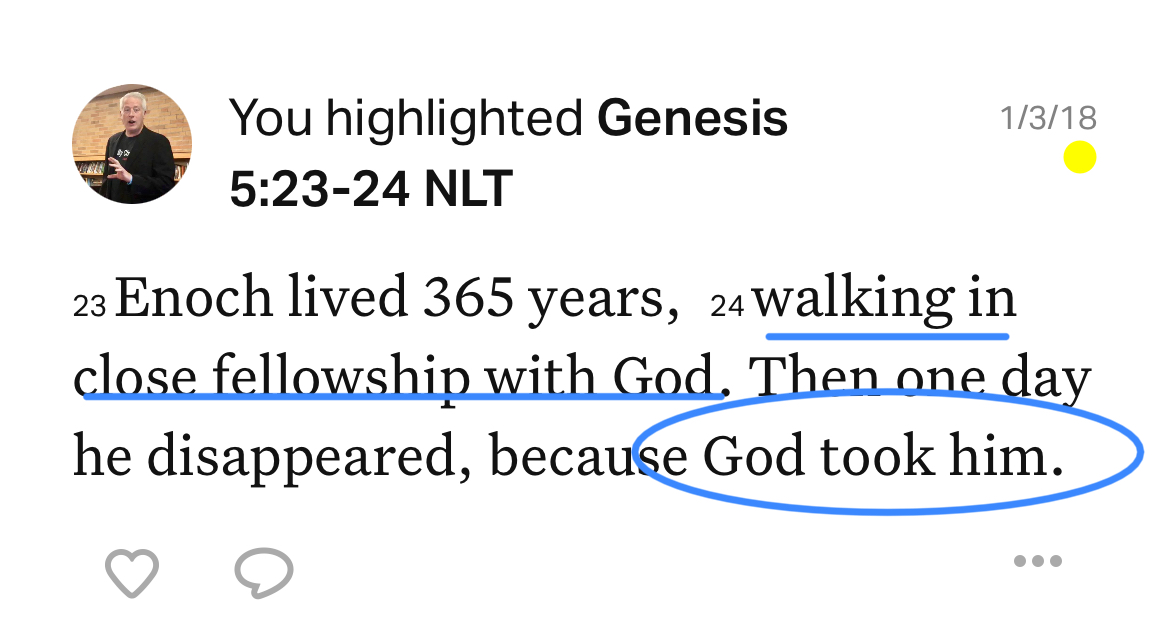
All of the same details are there. Well, except for the “and then he died” epitaph. But actually, there’s so much more. Instead of a death, there’s a phrase that appears only for him: “Enoch walked with God.” The phrase literally means “to be continually conversant.”

Because Enoch lived this way, he didn’t really die. Instead, “He was no more.” He wasn’t here any longer because he is still walking with God. What an incredible blessing to his future generations! He was a blessing while he was alive, and he continues to be a blessing after he is no more.

Enoch’s tombstone reads differently from everyone else. The birth date is there, the dash is there, but instead of “and then he died” we read “he was no more.”

It’s the way I would want my tombstone to read:

Craig T. Owens

1966He walked with God─He was no more (because he is still walking with God)

In The Seven Habits Of Highly Effective People, Stephen Covey suggests living my life today consistent with what I would like said at my own funeral. It starts with a decision: “Today I will be continually conversant with God.” Then at my funeral, they can say of me, like the Bible says of Enoch: “He didn’t die. He’s just not here any longer. He is walking with God in heaven, just like he walked with Him here on earth.”

What do you want said about your dash?

Do you want your life to simply end with “and then he died”? Do you want something more?

Make your dash a continual conversation, a daily walk with God, and all of your future generations won’t see just a dash, they’ll remember “He is no more. He walked with God, and he is still walking with God!

Start walking today!

►► Would you please prayerfully consider supporting this ministry? My Patreon supporters get behind-the-scenes access to exclusive materials. ◀︎◀︎

Not Mine But God’s

Have you ever wondered how Cain and Abel could end up so night-and-day different from each other? Think about it:

  • Same parents
  • Same home
  • No peer pressure
  • No real outside influences

Yet Cain became a farmer and the first murderer, and Abel became a shepherd and the first murder victim.

Yes, I know personality and temperament come into it. But so does the involvement of their parents. It’s interesting that Eve (not Adam) names their boys. There seems to be a little bit of “father absenteeism” that is involved here, but more telling is the commentary that Eve makes in naming her boys.

With Cain, she said, “I have gotten a man from the Lord.” Digging a little deeper in the Hebrew language, Cain means “a possession.” So Eve said, “This is mine. I did it.”

When Abel is born, there is no commentary. However, his name means “breath.” Something only God can give.

See the difference:

Cain = mine!

Abel = God’s!

As a result, Cain grew up wanting to do things to please himself, and Abel only wanted to please God.

As a parent, I always have to remember that my children are God’s. He loaned them to me to raise them up to serve and love Him. They are not mine, they are His.

Children are a gift from the Lord; they are a reward from Him. (Psalm 127:3)

Keep that in mind, Moms and Dads, when you’re interacting with God’s gifts and rewards.

Naked Before God

Imagine: You and your wife are the only people on the face of the earth. No bills, no employer, no economic downturn, no kids, no school, no traffic. Just you and God. That was Adam and Eve in the Garden of Eden. The Bible gives this commentary, “Now the man and his wife were both naked, but they felt no shame.”

Nothing to hide from God. Nothing to hide from each other. A perfect relationship with God. A perfect relationship with each other.

Then the temptation, and the bite of the forbidden fruit. Sin enters. Now, something changes when God comes to talk with His favorite couple: “Then the man and his wife heard the sound of God as He was walking in the garden in the cool of the day, and they hid from God among the trees.”

“Why are you hiding from Me?” God asks.

“Uh,” Adam stammers, “because we’re naked.”

Sin made mankind uncomfortable in God’s presence. Sin made them want to hide from God. They knew He was there, but they tried to pretend He wasn’t. This is why I think many of us don’t come into God’s presence in prayer: we’re uncomfortable because of our sin.

We should not run away from God, instead, we should run to Him. “If we confess our sins to Him, He is faithful and just to forgive us our sins and to cleanse us from all wickedness” (1 John 1:9).

What happens when we’re forgiven? We’re re-clothed. God Himself clothes us. He made clothes for Adam and Eve, and He clothes us, too, in the righteous robes of Jesus. “And all who have been united with Christ in baptism have put on Christ, like putting on new clothes” (Galatians 3:27).

And when we’re clothed in Christ, we no longer have to hide from God, nor feel uncomfortable in His presence. Instead, we can “come boldly to the throne of our gracious God. There we will receive His mercy, and we will find grace to help us when we need it most” (see Ephesians 3:12 and Hebrews 4:16).

Perhaps the reason we don’t spend enough time in prayer is that we feel self-conscious, sinful, uncomfortable… naked.

You don’t have to be naked. You can be clothed in Christ. You can enter into God’s presence without shame and find the mercy and grace and help that you need.

The Least-Attended Church Service…

…and quite possibly my least-popular blog post.

Just to give you a chance to bail out right now: (1) This blog post is about prayer, and (2) I’m going to offend you.

In every church I’ve ever attended or been associated with, the least-attended gathering is the prayer meeting. Guaranteed. When the pastor says, “We’re going to gather just to prayer,” people stay away. Want to hear something else painful? Jim Cymbala nailed it in Fresh Wind, Fresh Fire:

“You can tell how popular a church is by who comes on Sunday morning. You can tell how popular the pastor or evangelist is by who comes on Sunday night. You can tell how popular Jesus is by who comes to the prayer meeting.”

Jesus knew this, too. When He had a prayer meeting with His followers, they couldn’t even stay awake!

Here are four reasons why I think this is true:

1.  Prayer has no entertainment value. Don’t get me wrong, I’m not saying we go to church to be entertained, but there is a certain element of that in a typical church service: we listen to good music, laugh at a humorous video, engage with an effective sermon. We’re largely passive, just absorbing what’s going on.

2.  Prayer is hard work. We’re doing spiritual battle, and everything in our flesh is going to fight against this. Prayer requires physical, mental, emotional, and spiritual energy. It’s draining work.

3.  We want immediate visible results. In our microwave, cellular phone, on-the-go world, we want everything faster and faster. Something is happening when we pray, but we may not see the results of our prayers immediately.

4.  Prayer is naked communication. We’re talking to the All-Knowing Creator of the Universe. There is a certain level of discomfort when we come into God’s presence. Adam and Eve hid when they knew their sins would be seen by God, and we have a tendency to avoid God’s presence for the same reason.

Perhaps this is why Jesus said if just two of us come together in prayer He would be right there with us. I think Jesus knew that prayer meetings wouldn’t attract the large crowds of a concert or even a Sunday morning church service. So if just two people got together who wanted to do the hard work of praying, He would be right there.

If your church, like ours, is kicking off this new year with a time of prayer, don’t become discouraged by the lack of attendance. Keep on praying—Jesus is right there with you.

Is It Selfish To Pray For Success At Work?

Listen to the podcast of this post by clicking on the player below, and you can also subscribe on AppleSpotify, or Audible. 

“Dear Lord, I pray that You will help me be successful on my job today. Help me to make that sale [close that deal, get the promotion, earn the raise]. Bless me today. Amen.” All over the world today people at work are praying something similar to this. Does God notice? Is this a prayer God wants to answer?

I’ve been thinking about this a lot lately. I’ve been wondering if asking God to bless my efforts is praying a selfish prayer.

That well-known prayer by Jabez sounds very similar, doesn’t it? “Oh, that You would bless me and enlarge my territory!” This prayer must have pleased God because the verse ends with, “And God granted his request” (1 Chronicles 4:9-10).

In the life of Joseph, the phrase about his on-the-job success is repeated again and again. First in Potiphar’s house, and then in prison, and then in the royal court we see the phrase “Joseph prospered” (for those of you keeping track at home, that means Joseph was a success at the office). We don’t see Joseph praying for this success, but we see him walking in it nonetheless.

But here’s the key component: it’s all about your heart attitude. In other words, it’s all about how you intend to become successful and what you plan to do with your success.

Jabez wanted to be successful so he wouldn’t be a burden to anyone else. He asked God to give him success in a way that benefitted others. So, too, with Joseph: at every mention of Joseph’s success there is a corresponding phrase like, “The Lord was with him” or “The Lord gave him success in everything he did.”

When Jabez and Joseph were successful on the job, everyone around them knew it was because they did things God’s way. And everyone around them got to share in the blessings of their successes.

Do you want success on the job? Go ahead and pray for God to “enlarge your territory” or help you to “prosper.” Then do things God’s way, and be sure to give Him the credit for your success. I believe that God wants to give you more and more on-the-job success so that He is glorified, and so that others around you recognize God’s provision.

Keep praying for success. I’m praying that for myself and for you too.

►► Would you please prayerfully consider supporting this ministry? My Patreon supporters get behind-the-scenes access to exclusive materials. ◀︎◀︎

Generation Now

Interbellum, Greatest, Silent, Baby Boomers, Busters, MTV, Gen X, Gen Y, Post-Millennial, Gen Z. It seems we’re obsessed with naming and defining our past and present generations. The “experts” tell us what each generation is motivated by, what they’re thinking, what they dream of, and what they are afraid of. I have stacks of books on my shelf about how to relate to people in each of these generational groups, and I constantly get emails that tell me the newest way to get each generation’s attention.

However, when I look in the Bible I only see two generations: this generation and the next generation. God is not concerned with description, but with action. I love what God said to Noah, “Go into the ark, you and your whole family, because I have found you righteous in THIS generation.

What you and I do in THIS generation reverberates into the NEXT generation.

The most important generation is Generation Now.

Yesterday I discovered something a whole lot easier than reading all of these books and sifting through all of the data to learn about GenNow. I discovered this by accident. I discovered it by fun. And I discovered it was exactly the same way Jesus connected with and related to His GenNow.

All I had to do was hang out at my office.

Throughout the day people saw my car in the parking lot, so they just stopped in. It was a blast! Just as Jesus spent times at parties, wedding banquets, in the market place, and with His friends, I got to know GenNow by simply being with them. We talked, we played music (great jam session!), I got beat in ping pong, we ate pizza, we worshipped God, we threw marshmallows at each other.

Through all of this, I learned what GenNow is dreaming about, laughing about, and worrying about. I also affirmed what I already knew: GenNow is a very special group!

Do you have a family member or friend that you want to connect with more deeply? Follow the example of Jesus: just spend time with them. I did, and it was great. In fact, I can’t wait to do it again and again and again!

When Nothing Is Something

I’m not a typical Type-A person, but I do find it very hard to take time off. As soon as I find I’m doing Nothing I’ve immediately got to start doing Something… Anything.

When I’m doing Nothing I feel guilty.

“Who do you think you are? What makes you so special that you can do Nothing! Everything is not finished, so get up and do Something. Do Anything. Just don’t do Nothing!”

By the seventh day God had finished the work He had been doing; so on the seventh day He rested from all His work. And God blessed the seventh day and made it holy, because on it He rested from all the work of creating that He had done (Genesis 2:2-3).

God did Everything in six days. There wasn’t Anything left to do.

So God did Nothing.

And yet that Nothing was Something special.

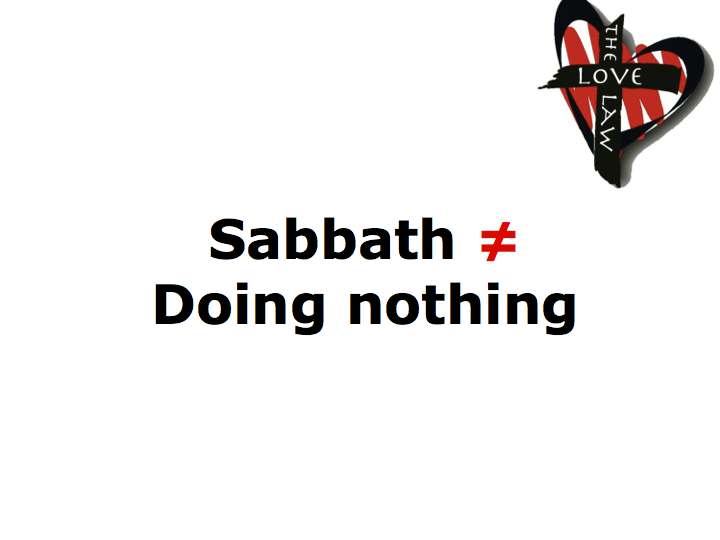
The Hebrew word for rest is shabath which means, “sit down and sit still.” Why? Was God tired? No, the resting is not Nothing; it is Something.

God paused from His work because He wanted to reflect on what He had accomplished. That’s the point.

Doing Nothing is really doing Something. When we take a shabath we’re taking a day to reflect on God’s blessing, His provision, His faithfulness.

I did Nothing today.

My Nothing was really Something special! I began the day by thanking God for all of the blessings in my life. And the more I gave thanks, the more reasons I realized I had to give thanks! After all that thanks-giving, I found that I had one of my most creative and encouraging days.

It’s amazing how Nothing can be a very special Something.

If you’re not already, find a day to do Nothing. I think you too will discover that Nothing is Something.

***A postscript for my pastor friends. Just a reminder: If you have church services on Sunday, then Sunday is not your shabath—it’s a day you’re doing a whole lot of Something. Find another day to do Nothing. God will bless the rest of your week when you do.***

I have some other posts about sabbathing that are worth your time here, here, and here.

No Cowardly Lions, Please

cowardly-lion2

When Jacob was blessing his sons (Genesis 49) he called Judah a lion’s cub. From that time on the men of Judah were known as skilled and fearsome warriors. Years later The Lion of Judah, Jesus, would come from this noble tribe.

But during the time when the judges ruled Israel, Judah and all of Israel “did evil in the eyes of the Lord” (Judges 13:1), and “all the people did whatever seemed right in their own eyes” (Judges 17:6).

As a result, the mighty lions of Judah became the cowardly lions.

Samson is a well-known judge. He is known for his single-handed exploits against Israel’s enemies. As a result of his victories against them, the Philistines moved into Judah’s territory arrayed for battle.

In response, the mighty lions of Judah muster a force of 3000 warriors. This should look good to the warriors of Judah, since the Philistines came to the battlefield with just 1000 warriors—after all, 3-to-1 seems like good odds.

But instead, the cowardly lions of Judah decided to take all 3000 warriors to confront just one man: Samson. They went to him in the cave where he was staying, not to ask him to join them in battle against the Philistines, but to ask him to surrender to the Philistines.

Samson agreed.

But when the Philistines approached Samson “the Spirit of the Lord came powerfully upon Samson” (Judges 15:14). He picked up a donkey’s jawbone and killed all 1000 Philistines. And when they saw God’s power at work in Samson, the mighty lions of Judah jumped into the fray all around Samson!

Uh, actually, no, they didn’t.

The cowardly lions of Judah were nowhere to be found. When Samson had finished with the Philistines, there was not even one lion of Judah around to give him a drink!

They all ran away.

It’s amazing to see what the Spirit of God does for someone. God’s presence in Samson gave him victory when the odds were 1000-to-1 against him. The lack of God’s presence in the lions of Judah made them cowardly lions even when they had a 3-to-1 advantage and had Samson on their side.

“When you go out to fight your enemies and you face horses and chariots and an army greater than your own, do not be afraid. … For the Lord your God is going with you! He will fight for you against your enemies, and He will give you victory!” (Deuteronomy 20:1, 4)

Don’t try to go to battle on your own. Even if you think you’re a mighty lion, you will end up like the Cowardly Lion if God doesn’t go with you.