Sin

I know in politically correct circles it’s not very chic to talk about sin. After all, we’re not supposed to impose our personal values on someone else, right?

Well, I do believe in right and wrong, and the wrong is called sin. So if you are offended by me calling something sin, it would be best for you to stop reading now.

Are you still with me? Then read this: satan…incited David to sin… (1 Chronicles 21:1).

Incited means this wasn’t a straight-up fight. Sin seldom makes a bold, in-your-face attack. Sin isn’t really an ambush. It’s sort of a whispering campaign.

  • Sin is an appeal to ego
  • Sin is a half-truth
  • Sin is an attempt to be subtle
  • Sin is so innocent looking

The Bible says satan lurks like a lion in the underbrush (1 Peter 5:8).

He waits for the perfect opportunity to strike (Luke 4:13).

satan is sneaky (Genesis 3:1).

He lies (John 8:44).

He distorts the truth (Luke 4:9-11).

That’s why I cannot give sin an inch. I have to take every thought captive (2 Corinthians 10:5), and pull everything into the light of The Truth (John 3:20-21).

[Check out all of these verses by clicking here]

It’s not usually the blatant sin that brings down great men and women, but the subtle. So stay on your guard. Always!

Thursdays With Oswald—Why Should I Do What I Ought To Do?

This is a weekly series with things I’m reading and pondering from Oswald Chambers. You can read the original seed thought here, or type “Thursdays With Oswald” in the search box to read more entries.

Why Should I Do What I Ought To Do?

      We imagine that if we obey authority we limit ourselves, whereas obedience to authority is not a limitation but a source of power; by obeying we are more. Naturally we are built to command, not to obey; man was originally constituted by God to have dominion—“And God said, Let Us make man in Our image, after Our likeness: and let them have dominion…” (Genesis 1:26 ); consequently there is the natural desire to want to explain things, because everything we can explain we can command. Spiritually, we are built not to command, but to obey. Always beware of the tendency to want to have things explained; you may take it as an invariable law that when you demand an explanation in connection with a moral problem it means you are evading obedience.

From Biblical Ethics

“God, if You will just tell me why I have to do this, then I’ll do it” doesn’t work. I simply must trust and obey.

God’s Math

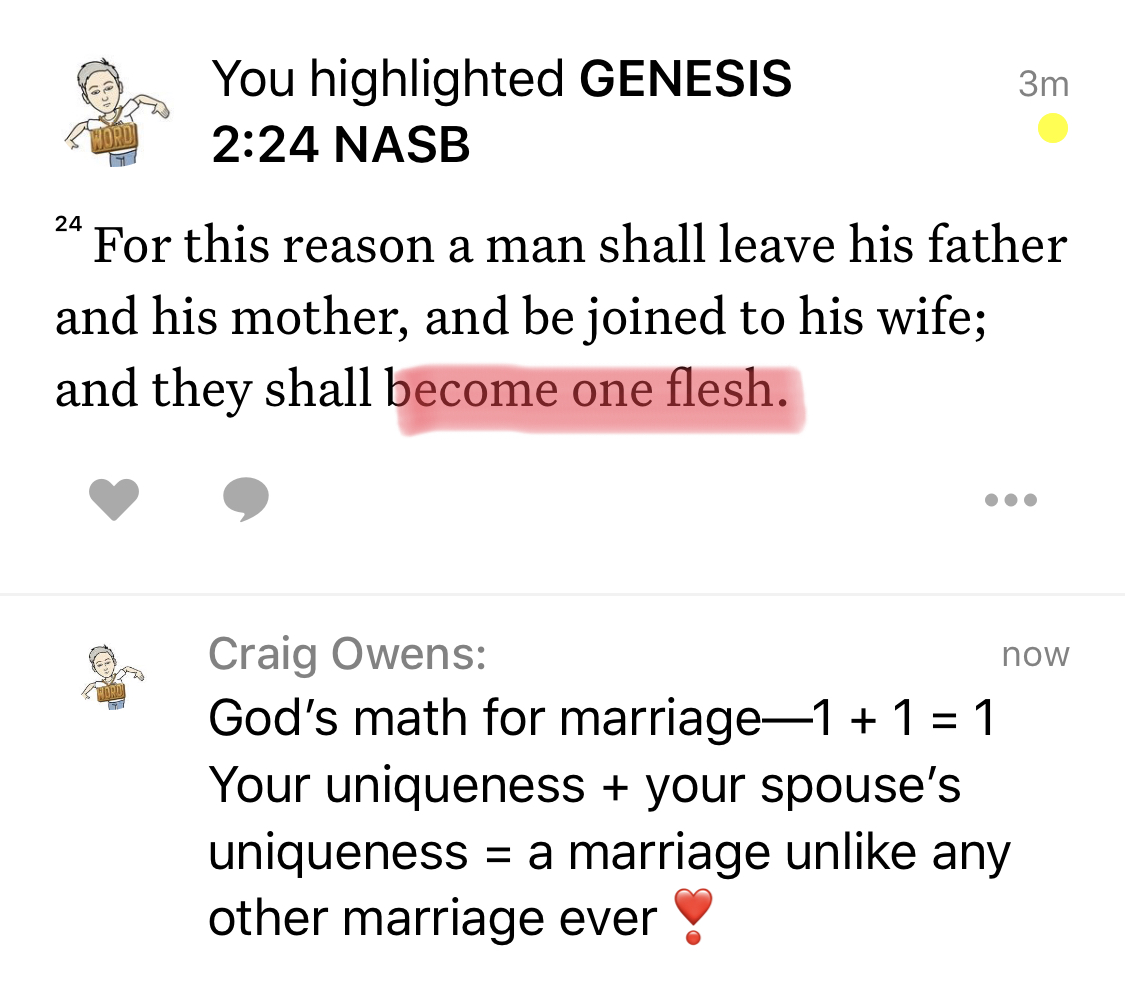
I’m preparing for a wedding this weekend, and I love God’s math that shows up in the marriage relationship. Very simply it looks like this:

1 + 1 = 1

One man + One woman = One marriage.

God said, “Let the husband and wife be joined together. And the two will become one flesh.”

A husband can have his oneness—his uniqueness—enhanced by his wife. So too can a wife have her oneness—her uniqueness—beautified by her husband.

This is why God is for healthy marriages: It gives us a better picture of the oneness that we can have with Jesus Christ. He brings out the oneness—the uniqueness—in all of His followers.

I love it!

Guard These Bones

Here’s an odd one. The Israelites had been slaves in Egypt for a long, long time. God does these miraculous things, culminating in the death of every firstborn child in Egypt who’s not in a house covered by lamb’s blood. Pharaoh has finally had enough, “Quick!” he shouts, “Get out of here now! Leave this country!”

So the Israelites pack up as quickly as they can to leave before Pharaoh changes his mind. And then this odd statement appears, “Moses took the bones of Joseph with him.”

Seriously? Bones? We’re kinda in a rush here!

Well, they’re not just any bones. It’s not like they’re just loose bones lying around. They’re in a mummy case.

Yeah, and…?

They were the bones of Joseph. The one who foresaw the coming famine. The one whom Pharaoh put as second-in-command to make preparations for the famine. The one who saved the Israelites from starvation. That Joseph. Just before he died he made his family take an oath that when they left Egypt, they would take his bones with them (Genesis 50:25-26).

They took the oath. And for the next 430 years someone had to watch over the bones. Through about twelve generations, from father to son, from son to grandson, from grandson to great-grandson, the oath was passed: “Guard these bones. When we leave, the bones go with us.”

So when they left Egypt, Moses took the bones with him. But then the Israelites sinned and had to wander in the wilderness for another 40 years. Another whole generation died, and still the oath was passed: “Guard these bones.”

The Israelites finally re-entered their home land, but had to defeat their enemies that had taken possession of their land while they were in Egypt. For about 30 years the Israelites fought. And still the oath was passed: “Guard these bones.”

Finally as a postscript to Joshua’s account we see Joseph’s bones being buried in Shechem, nearly 500 years after Joseph died!

For 500 years they kept the oath; they guarded the bones.

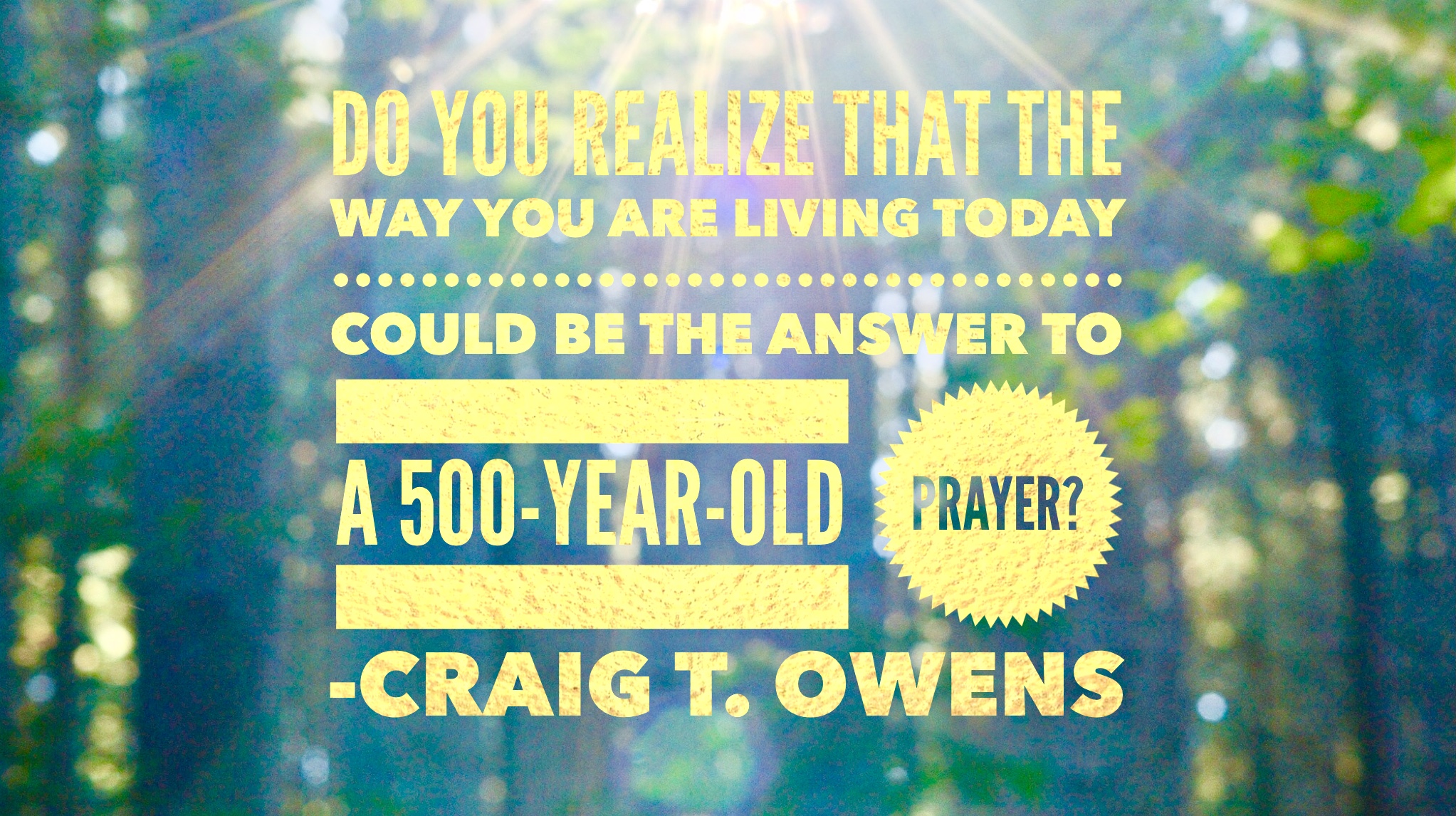
Do you realize that the way you are living today could be the answer to a 500-year-old prayer? Just like the Israelites who kept their eyes on God, you and I must live today with a purpose and with a mission. When we live godly lives, we are guarding the bones of prayers that were prayed, the bones of petitions that were made, the bones of oaths that were requested and honored.

What are you doing today to guard the bones of your ancestor’s prayers?

Knowing What To Look For

On Sunday afternoon Betsy left our house to meet with our KidZone team. She had only been gone for a few minutes when she called me. “I just had to pull over to the side of the road,” she said. “It sounds like something is dragging underneath my van.”

I quickly threw my coat on and drove to meet her. Sure enough, as I pulled up behind her van I could see something hanging down. I laid down next to the van to look underneath and discovered that the band which holds up the gas tank was missing a bolt. I’m not a mechanic, but even I know that’s not a good thing!

I called a friend at church who’s got a lot of hands-on experience with cars. He said, “I’ll be right there.” He arrived quickly with a metal coat hanger, which he used to take the place of the missing bolt.

We turned around to head back to my house. Jeff was in front of me and had only driven about 150 feet when he jammed on his brakes, pulled to the side of the road, and leaped out of his car. I then watched as he ran across the road, bent down, and picked up the missing bolt!

When we got back to my house I said, “You must have the eye of an eagle to spot a rusty bolt on wet pavement.”

“No,” he said, “I just knew what to look for.”

In Genesis 45, Joseph reveals himself to his brothers. Twice he tells them, “Don’t be afraid. God sent me here.”

“Wait a minute,” you might protest, “God sent him to Egypt?! I thought his brothers sold him as a slave. God put Joseph in the position as prime minister of Egypt?! I thought his special dream-interpreting skills did that.”

Joseph went from a prince in Jacob’s family, to a slave in Egypt, to comptroller of Potiphar’s affairs, to a falsely-accused rapist, to a prisoner, to a prison trustee, to a forgotten man, to Pharaoh’s dream interpreter, to Egypt’s prime minister.

Joseph knew what to look for along the way. He knew God had given him a direction for his life, so he was constantly looking for it.

Prayer does this for me, too. I may know verses like

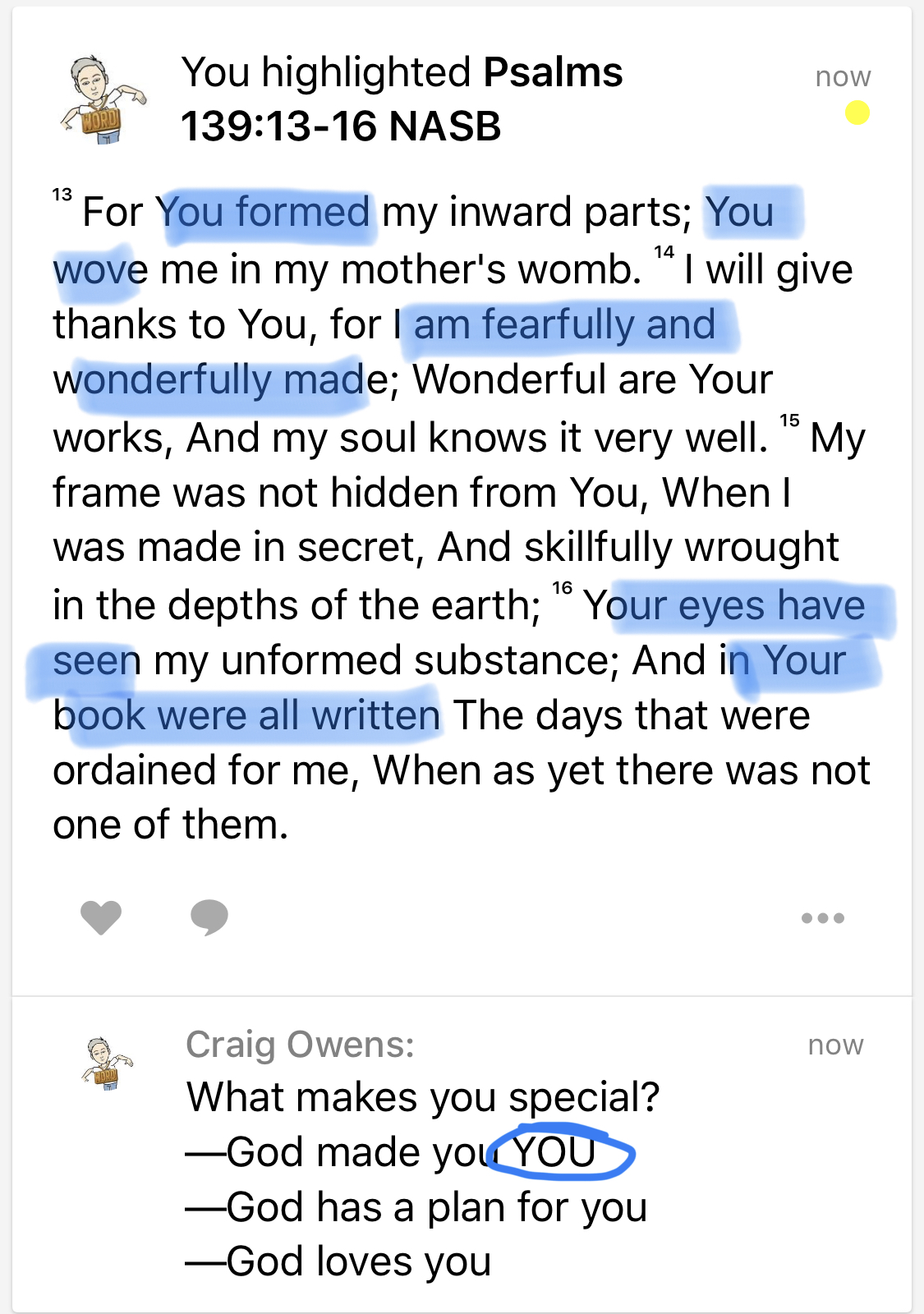
  • I am fearfully and wonderfully made.
  • Before I was born, God knew me.
  • All things are working together for good for me because I love God and called me for a purpose.
  • I should rejoice in my trials because God is developing something in me.

but it’s only when I’m praying these verses that the Holy Spirit trains my eyes to know what to look for.

God was placing Joseph and preparing Joseph to be just where he needed to be, at just the right time, and with just the right skills.

God is doing something with me: He’s preparing me and placing me in His perfect timing to fulfill His perfect plan. When it seems my life has become derailed, I need to know what to look for. Prayer does this: Prayer trains my heart and my mind and my eyes to know what to look for.

I can also assuredly tell you that God is doing something with YOU: He’s preparing YOU and placing YOU in His perfect timing to fulfill His perfect plan. Prayer will help you know what to look for too.

Flight Is Your Best Fight

Listen to the podcast of this post by clicking on the player below, and you can also subscribe on AppleSpotify, or Audible. 

He was ripped and he was handsome. She was lonely and she was hungry. He followed God and she gave lip-service to the numerous gods of Egypt. He was Joseph and she was Potiphar’s wife. He was in charge of all of Potiphar’s household and she was attracted to that power.

A pretty heady place for Joseph to be. Think about it, guys, how would you feel? You’re good looking, successful, and the object of some babe’s desire. What are you going to do with all of that?

Do you know what Joseph did? He ignored her to the point of almost being rude:

And though she spoke to Joseph day after day, he refused to go to bed with her or even be with her.

Or even be with her is a rude phrase. It means she was doing everything she could think of to bring him to her, and he was thwarting her at every turn:

  • She walked into a room; he walked out.
  • She planned her path to run into him; he went out of his way to change his route.
  • She smiled; he kept a straight-faced.
  • She flirted; he ignored.
  • She was persistent; he was consistent.

There are many temptations the Bible tells us to fight. But there are two that we’re advised to flee: idolatry and sexual immorality.

Joseph chose fleeing over fighting.

Solomon said, “When you know what that sort of woman is up to, don’t even walk down her street.”

Talk to Wisdom as to a sister. Treat Insight as your companion. They’ll be with you to fend off the Temptress—that smooth-talking, honey-tongued Seductress.

Jesus said, “Don’t even entertain any thoughts about that kind of woman.”

From this type of temptation, your best fight is flight.

Guys, be like Joseph: stay away, take a different path, don’t smile at the flirty jokes, don’t hang out at her desk, don’t treat her politely. RUN AWAY.

Flight is your best fight against sexual temptation.

►► Would you please prayerfully consider supporting this ministry? My Patreon supporters get behind-the-scenes access to exclusive materials. ◀︎◀︎

Life’s Hardest Work

I’ve been reading through the life of Joseph in the Bible. If anyone had a lot to forgive, it was Joseph:

  • Sold out by his own brothers
  • Falsely accused and imprisoned
  • Forgotten in prison
  • Waiting years and years for God’s promise

Yet, he forgave so fully and so freely. Forgiveness isn’t easy. In fact, it may be one of the hardest things to do.

Here are a few quotes I’m mulling about forgiveness:

“We all agree that forgiveness is a beautiful idea until we have to practice it.” —C.S. Lewis

“For we find that the work of forgiveness has to be done over and over again. We forgive, we mortify our resentment; a week later some chain of thought carries us back to the original offense and we discover the old resentment blazing away as if nothing had been done about it at all. We need to forgive our brother seventy times seven not only for 490 offenses but for one offense.” —C.S. Lewis

“The glory of Christianity is to conquer by forgiveness.” —William Blake

“The weak can never forgive. Forgiveness is an attribute of the strong.” —Mahatma Gandhi

“Forgiveness is love’s toughest work.” —Lewis Smedes

It is hard work, but the results are so worth it. Don’t let your life be controlled by someone who wronged you in the past. Forgive them and free yourself.

One Of The Most Unusual Stories

There is one of the most unusual stories inserted in Genesis 38. I say “inserted” because it almost seems out of place. In chapter 37, Joseph’s brothers have just sold him into slavery and convinced their Dad that a wild animal killed him. In chapter 39, we pick up Joseph’s story again as he arrives in Egypt.

Genesis 38 has a story that doesn’t fit in Joseph’s story. It’s sort of a giant parenthesis. Not only that, it’s a story of mistake after error after mess up after bad judgment after more mistakes.

Judah, an older brother of Joseph, came up with the idea of selling him instead of killing him. Perhaps being around his co-conspirators was too difficult for him, so Judah left town.

  • Mistake #1: not dealing with his guilt and sin, but running away from it.

Judah married a Canaanite woman.

  • Mistake #2: inter-marrying with a non-God-fearing culture.

Judah gave his son Er in marriage to Tamar.

  • Mistake #3: allowing his son to inter-marry with the Canaanites too.

Er sinned. The Bible doesn’t say what it was, but it was so offensive that God put him to death.

  • Mistake #4: sin against God.

Onan (Judah’s second son) sinned. He had a familial responsibility to his brother and sister-in-law’s family line, but he snubbed them both.

  • Mistake #5: more sin against God.
  • Mistake #6: disregard for family.

Judah promised Shelah (his third son) to Tamar. But he procrastinated in following through on that because he thought Tamar was a black widow.

  • Mistake #7: deception.

Tamar disguised herself as a prostitute and waited along the road for Judah.

  • Mistake #8: more deception.

Judah slept with his daughter-in-law Tamar (yuck!), thinking she was a prostitute.

  • Mistake #9: fornication.
  • Mistake #10: incest.

Tamar became pregnant, and Judah wanted to have her publically punished for her infidelity.

  • Mistake #11: hypocrisy.

That’s a whole lot of sin and error and lapses in judgment and mistakes for just one family. What a mess this family had become! So, why in the world is this story inserted here? Because Tamar had twins: Perez and Zerah. In listing the royal, kingly genealogy of Jesus, Matthew writes

A record of the genealogy of Jesus Christ the son of David, the son of Abraham:
Abraham was the father of Isaac, Isaac the father of Jacob, Jacob the father of Judah and his brothers, Judah the father of Perez and Zerah, whose mother was Tamar.

Perez is listed in the genealogy of Jesus. God took all of those mistakes and made something great come from it!

It doesn’t matter how many mistakes you’ve made. It doesn’t matter how many times you think you’ve blown it. It doesn’t matter how many lapses in judgment you’ve had. God still has a plan for you. He wants to do something great through you. Will you let Him?

Digging & Drinking

On Sunday we had our annual business meeting at Calvary Assembly of God. The actual business part was minimal. The more exciting things included hearing how God had blessed us last year, and looking forward to the greater things we can do for Him this year.

I shared a story from Genesis 26 about Isaac. This story just keeps rolling around in my mind.

Initially, God blessed Isaac just because he was Abraham’s son. God said, “Abraham obeyed me. He did everything I asked him to do, so I blessed him.” Then God challenged Isaac: “I am willing to bless you with even more if you, too, will follow Me.”

It’s interesting to note what Isaac did first. He reopened all of the old wells his father had dug, and he gave them the same name Abraham had given them…

…he honored the heritage of his father.

Honoring those who have gone before us is so important. But it’s not enough.

If Isaac was going to experience more of God’s blessings, he couldn’t be satisfied with just drinking from the old wells. Don’t get me wrong: it was good of him to reopen those wells…

…but if that’s all he did, he would have just maintained the status quo.

Isaac had to dig new wells. It didn’t start so well. The first two wells he tried to dig on his own led to quarrels with his neighbors…

…the enemy doesn’t fight against those who maintain the status quo.

…the enemy only quarrels with us when we try to dig new wells.

Isaac kept at it, and his third attempt was successful. Here’s the payoff:

…we can honor our heritage by reopening the old wells and drinking from them.

AND we can continue to dig new wells so that we can minister to more people.

It’s not EITHER-OR. It’s BOTH-AND.

I’m trying to maintain that balance…

…re-digging the old and drinking the new.

…looking back and looking forward.

…honoring our heritage and leaving a new legacy.

…digging and drinking.

Do Your Own Growing

An Irish Proverb says, “It doesn’t matter how tall your father was, you still have to do your own growing.” In other words, my genes may give me a certain predisposition, but I still have to grow on my own.

The same could be said spiritually: “It doesn’t matter how close to God your parents were, you have to approach Him yourself.”

Abraham was so close to God that he was called “friend of God.” His son Isaac had some great spiritual genes, but he still had to do his own growing.

Isaac had the perfect opportunity shortly after Abraham’s death. He and his wife Rebekah wanted to start a family, but they weren’t able to do so. Then comes this great phrase:

…Isaac prayed to the Lord on behalf of his wife…

He got it! And God heard his prayer: Rebekah became pregnant with twins.

Rebekah’s parents were also close to God. But now pregnant and far, far away from home, she was having difficulty with her pregnancy. That’s when Rebekah had her chance to do her own spiritual growing,

…Rebekah went to inquire of the Lord…

She got it too!

Not only was this good for them as individuals, but undoubtedly it strengthened their marriage as well. I have found that couples who pray stay.

  • They stay close to God
  • They stay close to each other
  • They stay more committed to their families
  • They stay in a growth pattern

Are you doing your own growing today?

If you’re still riding someone else’s coattails, it’s time to start doing your own growing.

If you’re still blaming a parent for holding you back, it’s time to start doing your own growing.

You can do it—start talking to God yourself today!