The Holy Spirit knows the best place to use us, the best time to use us, and the best way to use us. We must trust Him! I have lots of new content every week, which you can check out on my YouTube channel.
“In our rush to be thanked or appreciated, or even in our shortsighted compassion, we can undermine the good God is patiently working. In that sense our good is actually evil, for it resists the wisdom, love, and transformative lessons of God.” —Dick Brogden, in Proverbs: Amplified and Applied
I love this quote in J.R.R. Tolkien’s Fellowship of the Ring when Merry Brandybuck tells Frodo about the stick-to-it-iveness of his friends: “You can trust us to stick to you through thick and thin to the bitter end. And you can trust us to keep any secret of yours closer than you keep it yourself. But you cannot trust us to let you face trouble alone. … We are your friends, Frodo.”
I love this devotional from John Piper about God-given foes and God-given faith. “The logic of fearlessness in the face of adversity is this double truth: Both your adversity and your faith in the face of adversity are gifts of God.”
Listen to the podcast of this post by clicking on the player below, and you can also subscribe on Apple, Spotify, or Audible.
One of the things I remember the most about my Mom is her fierce belief that God had a plan for my life. There were times I struggled in my belief, but she was tenacious in her faith on my behalf. I’m here today doing what I do—which I love doing!—because of my Mom’s faith-filled, persistent prayers. So if I could give two words of encouragement to godly mothers who are praying for their kids it would be this: Don’t quit!
In 2 Kings we meet a godly woman who very much wanted to be a mother. While she waited and prayed for an answer to this prayer, she kept ministering to others. One of the men who benefitted from her gracious hospitality was the prophet Elisha. Whenever the prophet would pass through Shunem, he would stay that this woman’s house, where she and her husband had prepared a room especially for him.
It appears this Shunammite woman is married to a man much older than her. They are without a male heir, so if her husband dies she will lose everything—no property, no voice, no source of income. Clearly this has to be a concern for her, but she doesn’t mention this to Elisha when he asks how he can bless her for their care for him. Perhaps she had resigned herself to the thought that her barrenness was a hopeless situation, but Elisha told her that in a year’s time she would become pregnant with a son. She must have been disappointed before because she says, “Don’t mislead your servant,” as if saying, “Don’t get my hopes up again!”
However, God does give this couple a son, and that little boy is dearly loved! At a very young age, this boy dies suddenly. This could have been a time that anger or depression could have been expected. But not with this woman!
Remember when we looked at Psalm 42 last week? The psalmist was grateful for the experience he had in God’s presence, but now that there is a setback of some kind he is struggling with the “Where is your God?” taunt from his enemies.
When God answers our prayer, the devil loves to whisper, “Lucky break. You didn’t really deserve this.” So if anything goes wrong he can lie again, “See, I told you so!”
This is where we must not merely listen to those thoughts but talk back to them. Perhaps the Shunammite said something like, “You’re right, I didn’t deserve this or earn this gift of my son. This is a gift from God’s grace. God promised this son to me and I believe God will preserve what He gives.”
Moms, you must cling to God tenaciously in faith-filled prayer!
This godly mother shows us what tenacious faith looks like. She took her son into Elisha’s room, placing him on the prophet’s bed, and she quickly sends word to her husband that she is going to find Elisha. When her husband asks what is wrong, her faith-filled answer is, “It’s all right.”
As she gets close to Elisha’s home, he sees her in the distance and sends his servant Gehazi to ask, “Is everything okay?” To which she gives the same faith-filled reply, “Everything is all right.”
When she finally gets to Elisha, she grabs onto him and says words that must have gotten Elisha’s attention immediately: “As surely as the Lord lives and as you live, I will not leave you.” These are the exact same words Elisha said to Elijah three times on the day Elijah was taken to heaven. Just as Elisha clung to the promise of God’s blessing, so did this mother (see 2 Kings 2:2, 4, 6).
God did answer her prayer and raised her son back to life. But this wasn’t the end of the blessing.
Remember that a widow without a son has no standing in the community. To be saved from a famine in Israel, this woman and her family lived for seven years in Philistia. While they were there, her husband died and squatters took over her property.
But in God’s perfect foresight and timing, this woman and her miracle son walked into the king’s throne room just as Gehazi was telling the king about the miraculous resurrection Elisha prayed for. The king is so moved by this story that he doesn’t just restore her land, but he orders the squatters to pay back to her all of the income they earned from her land during the time she was away!
Not just restoration, but blessings beyond imagining (see 2 Kings 8:1-6).
We don’t know who wrote Psalm 116, but it very well could have been this boy who was raised to life. The opening verses talk about God’s deliverance from death, but then the psalm says, “I serve you just as my mother did” (v. 16).
This woman’s tenacious faith resulted in immediate provision for her, a legacy of faith in her son, and a testimony that is still encouraging us 3000 years later!
So let me repeat this to godly mothers who are praying for their families: Don’t quit! There are eternal testimonies and rewards coming that you cannot even perceive!
Listen to the podcast of this post by clicking on the player below, and you can also subscribe on Apple, Spotify, or Audible.
I have always appreciated the story of the desperate father who brought his son to Jesus. We get the idea from this story that this Dad had tried everything he could think of to help his boy, but nothing had worked.
This father heard about Jesus and he believed that Jesus could help them. We read that he brought his son to Jesus, but when he arrived, he found Jesus still on the mountain where He was transfigured, along with Peter, James, and John. The nine remaining disciples apparently tried to address this problem, but they were unsuccessful.
As Jesus and the three disciples came down the mountain, they found an argument in full boil. The teachers of the law were arguing with the disciples of Jesus. Apparently, each group had its own idea of how to help this demon-possessed boy.
Now, because of the failure of the disciples to bring relief, this father is experiencing creeping doubts about the original faith he had in Jesus. He says, “If You can do anything, take pity on us and help us.”
Jesus replied, “‘If you can’? Everything is possible for him who believes.”
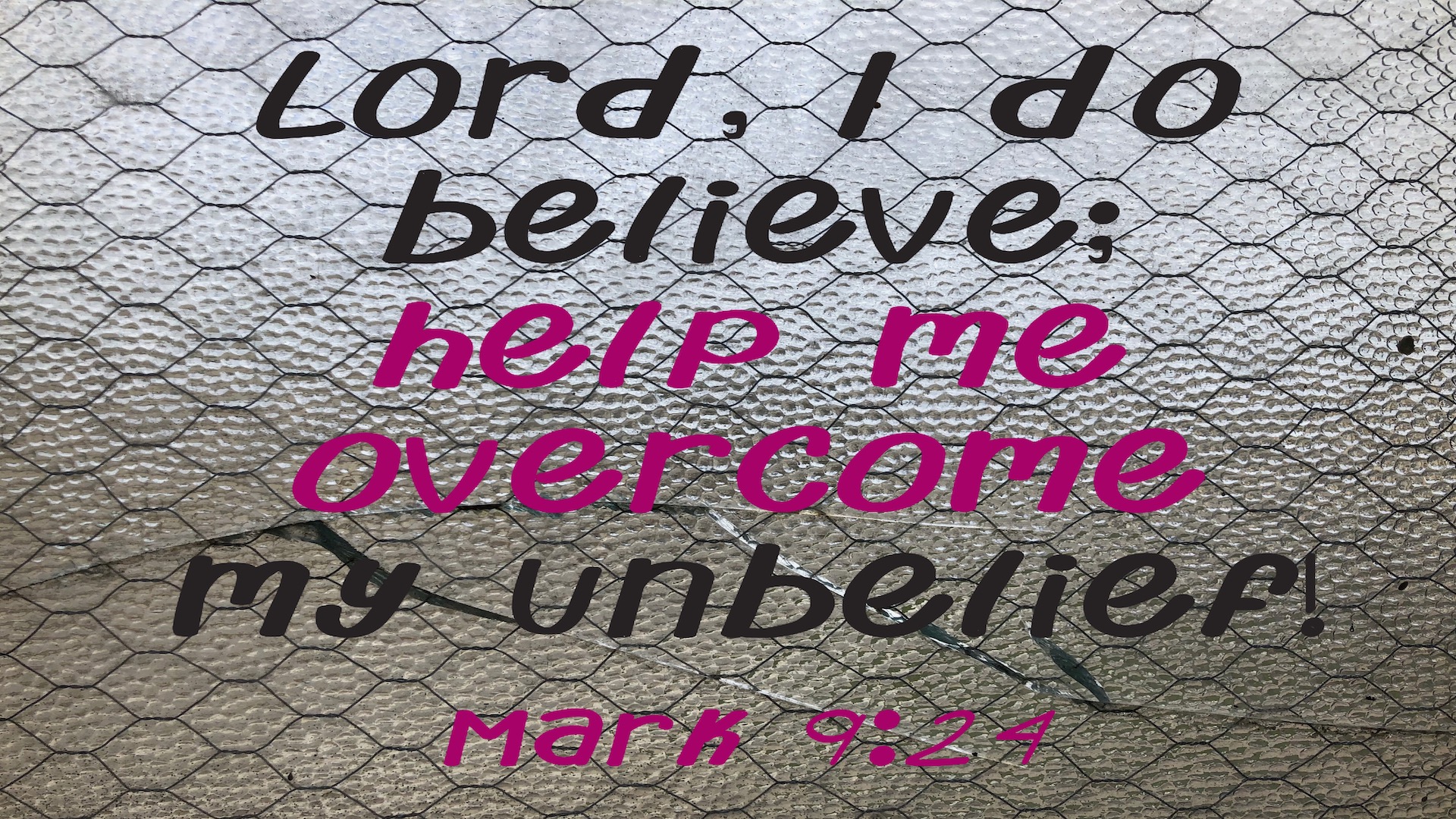
Then this man speaks the honest, but faith-filled words that I believe resonate with so many of us: “I do believe; help me overcome my unbelief!” (Read the full story in Mark 9:14-27.)
He was so wise to continue to come to Jesus even when he was plagued with doubt. His prayer was an honest, bold prayer. In essence, he was saying, “Jesus, I had initial faith in You. But the setback I experienced has caused me to doubt. I want to believe again that You can help me, but only You can rejuvenate my faith.”
Jesus loves to pray for our faith to be rejuvenated!
Knowing what Peter was about to encounter, Jesus told him, “I have prayed for you, Simon, that your faith may not fail” (Luke 22:32). Peter did indeed deny Jesus. But even after that denial, Jesus fully restored him. It would have required incredible faith on Peter’s part to allow Jesus to do that (John 21:15-17). Peter’s humble acceptance of Christ’s restoration demonstrated Peter’s rejuvenated faith to trust in his Savior again.
A good prayer for us may be:
Jesus, even when I doubt, You are faithful. You pray for my faith to be strengthened so that I can come to You again and again. Jesus, I do believe You! Please rejuvenate my faith to drive out these nagging doubts.
Only Jesus is called “the Author and Perfecter of our faith” (Hebrews 12:2), so only He can rejuvenate our faith. Let’s learn a lesson from this father and continue to come to Jesus—even with our nagging doubts—to have our faith rejuvenated. It’s this faith that moves the hand of God to do miracles on our behalf.
Listen to the podcast of this post by clicking on the player below, and you can also subscribe on Apple, Spotify, or Audible.
The word amazement shows up numerous times throughout the Gospels. As you might expect, it’s almost always associated with something Jesus said or did. He would heal someone, calm a storm, silence His detractors, or teach persuasively, and the people stood amazed!
But there are two instances where Jesus Himself is amazed.
The first time is when a Roman centurion sends a message to Jesus by way of a servant. This centurion asks Jesus to speak a word of healing over another one of his servants. He says that just a word from Jesus will be sufficient, and he doesn’t need Jesus to personally come to his house.
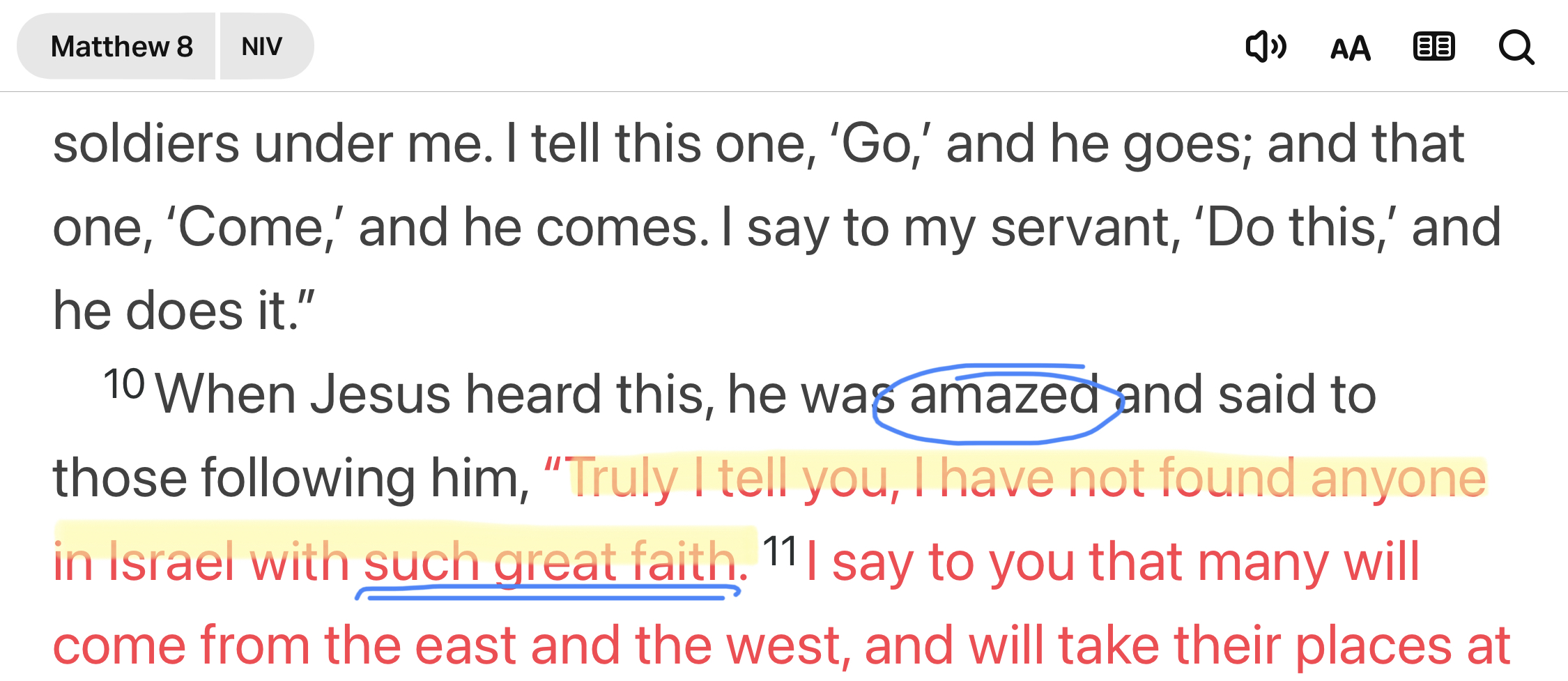
When Jesus heard this, He was amazed. “Turning to those who were following Him, He said, ‘I tell you the truth, I haven’t seen faith like this in all Israel!’” (Matthew 8:10; Luke 7:9).
Because of this centurion’s faith, his servant was immediately healed!
The second time Jesus was amazed was when He was visiting His hometown. There He discovered people with whom He had grown up that refused to believe that He was who He claimed to be. As a result, Jesus “was amazed at their unbelief” (Mark 6:6).
So either Jesus is amazed at our faith in Him, or He is amazed at our unbelief in Him. When I have faith in Jesus—when I believe He is who He says He is, and that He is willing to do what He says He will do—He is amazed at my faith and can do miracles on my behalf. But when I doubt, when I allow my unbelief to seize my heart, I exclude myself from the miracles He wants to do.
Jesus will be amazed at you. Will He be amazed at your faith in Him? Or will He be amazed at your unbelief in His power that is waiting to be released on your behalf? I pray that Jesus will always be amazed at our faith in Him.
Listen to the podcast of this post by clicking on the player below, and you can also subscribe on Apple, Spotify, or Audible.
Last week we saw the dark times in which Micah lived as he prophesied the advent of the Messiah. Israel was both surrounded by enemies as well as lots of practices within their borders that were heartbreaking to God. Many times, our lives can feel the same way: enemies of God all around us and our own turmoil and doubts inside our hearts and minds.
In this dark, hopeless time, the Messiah came as our Great Shepherd. Take a look at what this Shepherd brings us:
He will stand and shepherd His flock in the strength of the Lord, in the majesty of the name of the Lord His God. And they will live securely, for then His greatness will reach to the ends of the Earth. And He will be their peace. (Micah 5:4-5)
We see this idea of Jesus our Great Shepherd bringing peace to our hearts in the New Testament as well:
May the God of peace, who through the blood of the eternal covenant brought back from the dead our Lord Jesus, that Great Shepherd of the sheep, equip you with everything good for doing His will, and may He work in us what is pleasing to Him, through Jesus Christ, to Whom be glory for ever and ever. Amen. (Hebrews 13:20-21)
This peace is also implied in Psalm 23:1 when David wrote, “The Lord is my Shepherd, I shall not be in want.” That phrase “I shall not be in want” really captures the definition of peace.
The Hebrew word for peace is shalom. An easy-to-remember definition of shalom is “nothing lost, nothing missing.” Our Great Shepherd makes sure nothing is lost or missing that would cause us anxiety or doubt, so we can have total peace—we can have shalom!
Jesus said the devil’s agenda was for everything to be lost or missing—“the thief comes only to steal and kill and destroy”—but our Great Shepherd’s agenda is for there to be nothing lost or missing—“I have come that they may have life, and have it to the full” (John 10:10).
Isaiah, who was prophesying at the same time as Micah, sounded a similar note:
Therefore the Lord Himself will give you a sign: The virgin will conceive and give birth to a Son, and will call Him Immanuel. … And He will be called Wonderful Counselor, Mighty God, Everlasting Father, Prince of Peace. (Isaiah 7:14, 9:6)
When this Great Shepherd was born in Bethlehem, the shepherds in the field were the first to hear the good news. Notice what the angels announced: “Glory to God in the highest heaven, and on earth peace to those on whom His favor rests” (Luke 2:14).
Who has God’s favor? Those with faith in Him: “Without faith it is impossible to please God” (Hebrews 11:6). So those with faith in God have God’s favor.
Faith in what? In all that Jesus purchased for us by His blood shed on the Cross: “Therefore, since we have been justified through faith, we have peace with God through our Lord Jesus Christ” (Romans 5:1).
Faith comes from believing that God has made the promise of peace, that God has fulfilled the promise of peace through Jesus, and that God is bringing us to His eternal peace. So now our lives of peace in a world of turmoil can serve as a testimony to others.
Jesus called His followers to be peacemakers (Matthew 5:9) but we cannot do this while we are experiencing anxiety or doubts. To be peacemakers we must be full of peace because of our relationship with the Prince of Peace, who has ensured that nothing is lost and nothing is missing!
If you feel anxious, remember that Bethlehem is your proof that the Prince of Peace has come to remove doubts, anxiety, fear, and inner turmoil. Let every pang of anxiety be immediately a call to run to the Prince of Peace. He has paid an incalculable price to purchase your peace, so don’t leave this gift unopened and unused. A dark, anxious world is looking for peace. Know the author of shalom so that you can introduce others to this Prince of Peace.
Listen to the podcast of this post by clicking on the player below, and you can also subscribe on Apple, Spotify, or Audible.
The word “amazed” shows up numerous times throughout the Gospels, almost always associated with something Jesus said or did. He would heal someone, calm a storm, silence His detractors, or teach persuasively. And the people marveled!
But there are two instances where Jesus Himself is amazed, where the Bible says He marveled at what someone said.
The first is when a centurion asked Jesus for help, but said he didn’t need Jesus to be personally present. He told Jesus that just a word from Him would be more than enough to heal a sick servant. Jesus was amazed at this man’s faith, and as a result, the servant was healed (Matthew 8:10; Luke 7:9)!
The second time that Jesus was amazed was when He was visiting His hometown and the people with whom He grew up didn’t believe He was who He claimed to be. As a result, Jesus was amazed and the Bible says He was unable to do many miracles there (Mark 6:6). How sad!
It’s still true today. Either Jesus will be amazed at our faith or He will be amazed at our unbelief. When we have faith in Him—when we stand amazed and in awe and in expectation of His power—He is amazed and can perform miracles. But when we push Jesus away and say, “We can take care of this ourselves,” Jesus is also amazed. But this type of amazement results in Jesus being unable to unleash His miraculous power on our behalf.
Let’s learn this amazing lesson, and always stand amazed at who Jesus is and what Jesus can do. When we are amazed, and our faith grows stronger, Jesus will be amazed at our faith and will move on our behalf in amazing ways!
Listen to the podcast of this post by clicking on the player below, and you can also subscribe on Apple, Spotify, or Audible.
I am always interested when I see contrasts in the Bible. Things like:
Live this way, not that way
These people are blessed, these people have trouble
If you do this, you won’t have this
So an interesting contrast caught my eye in the story where Jesus calms the storm (Matthew 8:23–27). Jesus is sleeping peacefully in the middle of a storm that is described as “furious [where] the waves swept over the boat.” The disciples were anything but peaceful—they thought they were going to drown—so they yelled for Jesus to wake up.
Before Jesus calmed the storm, He says, “You of little faith, why are you so afraid?”
That’s the phrase that caught my attention. Notice the contrast between “little faith” and “so afraid.” In other words, small faith means big fear!
Strong’s Greek dictionary defines “little faith” as “dread (by implication) faithless.” So it appears there is an inverse proportion between faith and fear.
The word that Jesus used for “afraid” is only used here and in the same story in Mark 4:40, and in Revelation 21:8 which lists people who will be excluded from entrance into heaven.
The phrase “so afraid” (or “O ye of little faith” in the King James Version) is just one word in Greek: olgiopistos. The root word pistos is faith, but I find the prefix oligos very descriptive. It means:
small in quantity
short in time
slight in intensity
In other words, it is faith that is immature, or hasn’t been used much, or hasn’t been applied to a particular circumstance. This word olgiopistos is used five times in the New Testament, and only used by Jesus.
In addition to this story, it is used in Matthew 6:30 and Luke 12:28 when Jesus tells us not to worry about the things that God will provide for us—things like food, clothing, and shelter. Jesus uses this word for Peter when he began to sink in the water after walking a few steps toward Jesus. And Jesus uses it in Matthew 16:8 when He warns His disciples about the “yeast” of the Pharisees and Sadducees that can creep into their hearts and spoil their faith. (Check out all of these verses here.)
In mathematical circles, this relationship between faith and fear is one that would be called inversely proportional. When our faith is high, our fear is low; when our fear is high, our faith is low. I also think it is very eye-opening that the mathematical symbol for inverse proportionality (∝) is the same symbol called ichthus that the early church used to represent Jesus.
Faith and fear cannot coexist in the same heart. Sometimes our faith is small in quantity because we haven’t fed our faith with God’s promises. Sometimes our faith is short in time because we want things done on our time schedule. And sometimes our faith is slight in intensity because we are unsure if God can “come through” in this particular situation.
Whatever the case, when we feel any fear, we need to ask for faith. We need to return to God’s Word and be assured that His promises are applicable regardless of the situation we are in. As our faith grows, our fear has to diminish!
According to 1 Corinthians 12-14, the Holy Spirit operates in nine different gifts to both evangelize the sinner and edify the saints. The apostle Paul says that these gifts are available to all Christians who will allow the Holy Spirit to operate through them.
This is a weekly series with things I’m reading and pondering from Charles Spurgeon. You can read the original seed thought here, or type “Thursdays With Spurgeon” in the search box to read more entries.
Listen to the podcast of this post by clicking on the player below, and you can also subscribe on Apple, Spotify, or Audible.
Three Keys To Effective Prayer
Why is this extraordinary power of prayer given to those who abide in Christ? May what I have to say encourage you to make the glorious attempt to win this pearl of great price! Why is it, that by abiding in Christ and having His words abide in us, we get to this liberty and prevalence in prayer? …
I answer, first, because of the fullness of Christ. … I see clearly enough why the branch gets all it wants while it abides in the stem, since all it wants is already in the stem and is placed there for the sake of the branch. What does the branch want more than the stem can give it? If it did want more, it could not get it. For it has no other means of living but by sucking its life out of the stem. O my precious Lord, if I want anything that is not in You, I desire always to be without it. I desire to be denied a wish that wanders outside of You. But if the supply of my desire is already in You for me, why should I go elsewhere? You are my all, where else should I look? …
The next reason for this is the richness of the Word of God. … The best praying man is the man who is most believingly familiar with the promises of God. After all, prayer is nothing but taking God’s promises to Him and saying to Him, ‘Do as You have said.’ … If the Word of God abides in you, you are the man who can pray because you meet the great God with His own words….
A man will succeed in prayer when his faith is strong. And this is the case with those who abide in Jesus. It is faith that prevails in prayer. The real eloquence of prayer is a believing desire. ‘All things are possible to him who believes’ (Mark 9:23). A man abiding in Christ, with Christ’s words abiding in him, is eminently a believer and consequently eminently successful in prayer.
From The Secret Of Power In Prayer
God Himself has told us, “Call to Me and I will answer you and tell you great and unsearchable things you do not know” (Jeremiah 33:3). Not “I might answer you,” but “I will answer you.”
God also tells us how to receive what we ask in prayer:
Abide in Jesus. Desire nothing else but to know His heart more intimately.
Know God’s Word. The Bible isn’t just a Book to be read through, but it’s a Book to be prayed through.
Stretch your faith. A desperate father said to Jesus, “If You can, please help us.” Jesus admonished that father—and all of us too—to believe that Jesus is able to accomplish what we ask of Him. And then comes this great exclamation from that same desperate father: “I do believe; help me overcome my unbelief!” The God that wants us to have faith in Him for answered prayers is the same God Who imparts that faith to us. How? By abiding in Jesus and taking God at His Word.
Don’t give up, my friend. Keep praying. There is no other way to learn to pray more effectively than to keep on abiding in Jesus, keep on claiming the biblical promises, and keep on stretching your faith to present your prayer request to Him again.
Listen to the podcast of this post by clicking on the player below, and you can also subscribe on Apple, Spotify, or Audible.
Then the king of Assyria sent his field commander with a large army… (Isaiah 36:2).
The enemies of God’s people always use the same tactics.
(1) Sending an intimidating force that seems overwhelming and invincible.
King Sennacherib didn’t send a small detachment of soldiers, but he sent “a large army” to try to intimidate the people of Judah.
(2) Asking doubt-inducing questions.
The field commander asked questions like…
On what are you basing this confidence of yours?
On whom are you depending?
Do you think Jehovah can save you from this?
(3) Fomenting distrust in God’s wisdom and ability.
Once the seeds of doubt had been sown, the field commander attempted to water those seeds by making accusations like…
Do not let Hezekiah deceive you: God can’t help you with this one!
The gods of other nations didn’t help them, so what makes you think your God will help you?
(4) Offering a compromise.
Then came the offer to give in…
Come now, make a bargain with my master and I’ll give you more riches than you can imagine!
Make peace with me while you have the chance, and I promise you will have a trouble-free life!
All of these tactics attempted to play on the fears of people who felt surrounded and overwhelmed.
But I love to remember that the acrostic of the word F.E.A.R. is False Evidence Appearing Real. The field commander in King Hezekiah’s time, and satan today, use the tactics of fear to try to get us to compromise.
King Hezekiah gave us a great example to follow. When he received the field commander’s letter with all of the threats listed, he “spread it out before the Lord” (Isaiah 37:14)! Isaiah reminded the people not to be afraid of the threats of the enemy, because those threats were actually blasphemy against God. And then God tells Hezekiah quite simply, “I will take care of this!”
And God did indeed take care of it.
Without the armies of Judah ever having to lift a sword or a spear or shield, God broke the power of the enemy and sent them away in shame!
When the enemy seems to be surrounding you today, he will use these same tactics. He will try to overwhelm you, get you to doubt what God has said, try to induce you to distrust God, and then offer you a compromise. All the devil has on his side is false evidence that he attempts to make look real.
So do what King Hezekiah did: Spread out those threats before God. Go to His Word and read again what He has already promised you. Then stand firm in faith. God will take care of your adversary!