I pray that your partnership with us in the faith may be effective in deepening your understanding…. (Philemon 6 NIV)
Faith works! As Dr. Henry Halley noted, “Working faith is a sharing faith.”
Faithful working deepens our understanding of all the good things Jesus has given us. Those good things should then fuel us to share the good things—and the Source of all good things—with others.
I pray that the faith you share with us may deepen your understanding of every blessing that belongs to you in Christ. (Philemon 6 NET)
A faith that merely believes without acting would be an ineffective faith. A faith that works becomes a lifestyle testimony that points others to Jesus.
And I keep praying that this faith we hold in common keeps showing up in the good things we do, and that people recognize Christ in all of it. (Philemon 6 MSG)
It is a double blessing to do good things for others:
It was by faith that Abel brought a more acceptable offering to God than Cain did. Abel’s offering gave evidence that he was a righteous man, and God showed His approval of his gifts. Although Abel is long dead, he still speaks to us by his example of faith.(Hebrews 11:4 NLT)
I want to live my life so in step with God that people can say of me as the writer of Hebrews said of Abel: “Although Craig is long dead, he still speaks to us by his example of faith.”
Don’t you want that for your life too?
I believe God wants that to be said of your life. Are you ready?
You can start today by putting your name in the blank: Although ________ is long dead, they still speak to us by their example of faith.
Keep me from lying to myself; give me the privilege of knowing your instructions. (Psalm 119:29 NLT)
We all have a tendency to judge others by what they said or did, but we usually judge ourselves by what we intended to say or do. This is the essence of self-deception: lying to ourselves.
In verse 18, the psalmist asks for his eyes to be open to the truth in God’s Word; in verse 29 the prayer is for him to see if he is truly applying that truth. We could personalize this prayer: “Give me the privilege of knowing that I am really applying Your instructions to my life.”
Give me understanding and I will obey Your instructions; I will put them into practice with all my heart (v. 34). May the Holy Spirit prompt me to do this today. Amen!
Listen to the podcast of this post by clicking on the player below, and you can also subscribe on Apple, Spotify, or Audible.
God called Gideon to lead Israel to victory over the oppressive Midianites. He told Gideon, “Go in the strength you have and save Israel” (Judges 6:14). When Gideon hesitated because he didn’t think he had much strength nor influence to raise an army, God assured him of two things: “I am sending you” and “I will be with you” (vv. 14, 16).
Gideon’s initial recruitment netted him 32,000 soldiers from four tribes: “And he sent messengers throughout all Manasseh, and the Manassites were called to follow him; and he sent messengers to Asher, to Zebulun, and to Naphtali, and they came up to meet them” (v. 35).
God said this large army would be tempted to take the credit for themselves for defeating the Midianites, so God pared down the army to 10,000 men and then to 300 men (7:3, 6).
When God said He would deliver Midian into Gideon’s hands (v. 7), He meant it! HE would do the delivering, with Gideon’s 300 men merely being the instruments He would use. These men would defeat the invaders simply with trumpets and torches.
When these 300 men surrounded the Midianite forces during the night, I want you to notice the bracketed phrase in the AMPC:
And the three companies blew the trumpets and shattered the pitchers, holding the torches in their left hands, and in their right hands the trumpets to blow [leaving no chance to use swords], and they cried, “The sword for the Lord and Gideon!” (v. 20 AMPC)
The Israelites had to leave their swords hanging on their belts to fully obey God!
It was only this posture of full obedience that brought the victory. “They stood every man in his place round about the camp, and all the Midianite army ran—they cried out and fled. When Gideon’s men blew the 300 trumpets, the Lord set every Midianite’s sword against his comrade and against all the army” (vv. 21-22).
Those who weren’t in the 300 were still needed to finalize the pursuit, as they were called up to complete the victory (v. 23).
Perhaps only the 300 had enough faith to not drop their torch and their trumpet and grab their sword.
If it seems like God has stripped you of what you considered your source of security—like the swords that hung unused on the belts of Gideon’s 300—perhaps that is because He is getting ready to do something that only He can do! Whether you feel well armed or simply left holding something as simple as a trumpet and a torch, trust God’s strength. He can deliver you far better than you can deliver yourself.
Listen to the podcast of this post by clicking on the player below, and you can also subscribe on Apple, Spotify, or Audible.
Last week I asked, “How long do we keep praying?” Answer: Until God answers or until He lifts our burden. In the meantime, the Bible encourages us to…
Keep asking with full confidence that God hears you
Keep expecting an answer
Keep worshiping God for Who He is
Keep trusting that your Heavenly Father wants to give you the very best!
With that in mind, let me ask you another question: What does this look like? How do we wait expectantly for God to answer? I’ve got three thoughts from the Scripture.
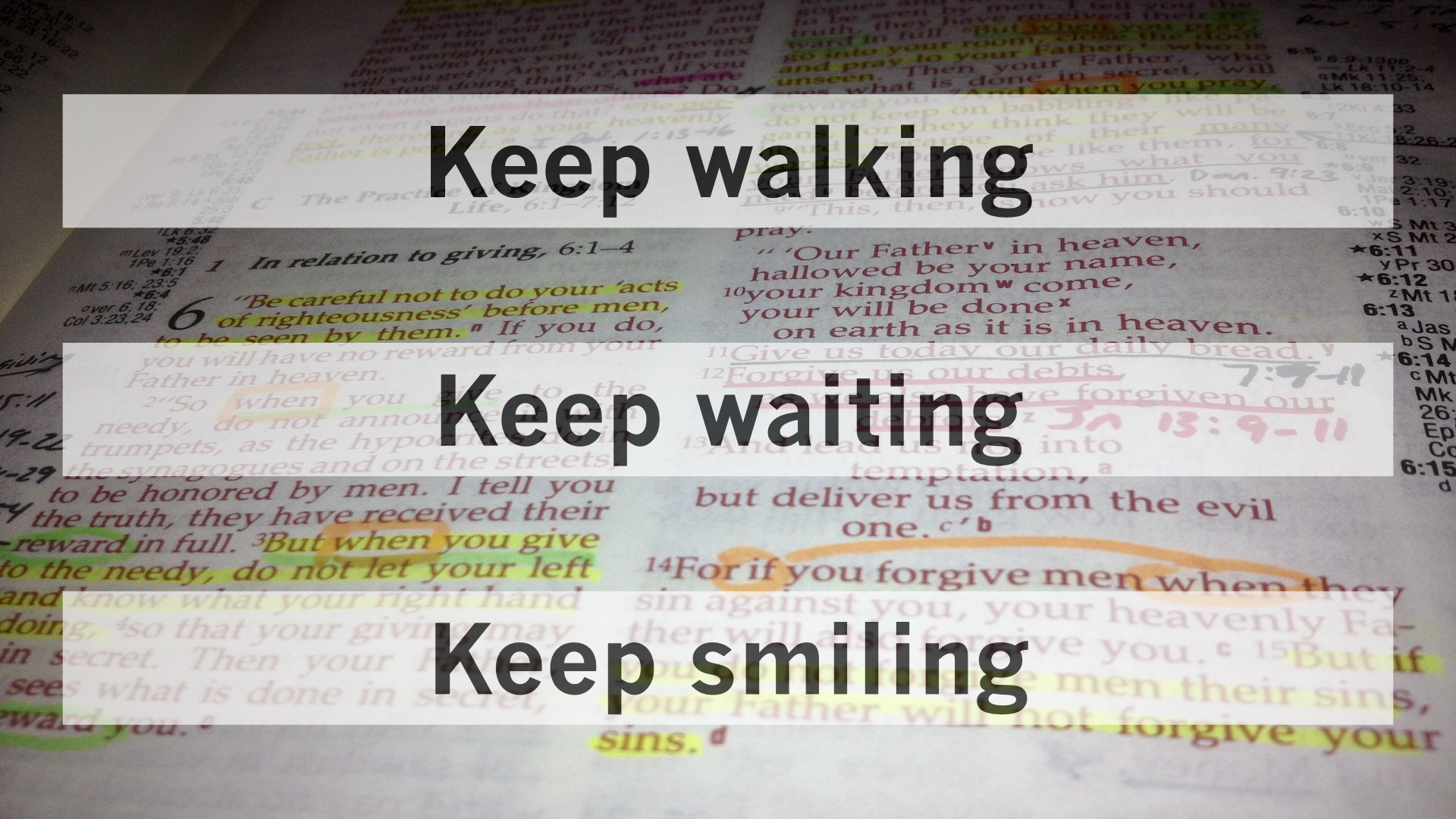
(1) Keep walking
Eliezer had a 300-mile journey which would have taken him about 10 days. Abraham prayed for him before he left and Eliezer prayed when he arrived (Genesis 24:7, 12, 15). His expectation that God would answer him kept him walking. The answer came after 10 days—before he even finished praying!
Nehemiah prayed for God’s favor with King Artaxerxes (Nehemiah 1:11) but then he had to keep walking to work every single day for at least 4 months (2:4). All the while he was praying, expecting, and planning, so when the king asked him what he wanted, Nehemiah was ready to answer.
A royal official met Jesus in Cana and asked Him to heal his son who was was sick in Capernaum. Jesus said, “Go! Your son will live,” and that father began walking his 20-mile journey home. Along the way, his servants met him to deliver the good news of the boy’s full recovery. When the father asked, he found out it was at the very moment Jesus had said, “Go” (John 4:46-53).
Faith takes Jesus at His word and starts walking toward the approaching miracle!
(2) Keep waiting
There are two Hebrew words in the Old Testament that frequently are translated “wait”:
qava = expecting in hope
yahal = guarding that hope
Check out how one psalmist linked hoping and waiting—
Out of the depths I cry to You, LORD; Lord, hear my voice. Let Your ears be attentive to my cry for mercy. … I wait for the LORD, my whole being waits, and in His Word I put my hope. I wait for the Lord more than watchmen wait for the morning, more than watchmen wait for the morning. (Psalm 130:1-2, 5-6)
And David wrote how he had learned to quiet himself in God’s loving presence: But I have calmed and quieted myself, I am like a weaned child with its mother; like a weaned child I am content (Psalm 131:2).
Then listen to the wait-hope-quiet link in Jeremiah’s prayer—
I say to myself, “The LORD is my portion; therefore I will wait for Him.” The LORD is good to those whose hope is in Him, to the one who seeks Him; it is good to wait quietly for the salvation of the LORD. (Lamentation 3:24-26)
In the New Testament, the idea is patience for an expected result is like a farmer who had prepared his field, planted good seed, watered it with his prayers, and is now assured of an abundant harvest (James 5:7-8; Galatians 6:9).
(3) Keep smiling
We put on a smile, not a show!
Contrast what Jesus said about the wrong way to pray and fast…
And when you pray, do not be like the hypocrites, for they love to pray standing in the synagogues and on the street corners to be seen by others. … And when you pray, do not keep on babbling like pagans … When you fast, do not look somber as the hypocrites do, for they disfigure their faces to show others they are fasting… (Matthew 6:5, 7, 16)
…with the God-honoring, God-trusting way—
But when you pray, go into your room, close the door and pray to your Father, who is unseen … But when you fast, put oil on your head and wash your face. (Matthew 6:6, 17)
It’s not a fake smile, but a smile that comes from the joy in our rock-solid expectation in God’s reply to our prayer (Psalm 28:6-7; 38:15)
Pray—then keep walking, keep waiting, and keep smiling in anticipation of what your Heavenly Father is doing on your behalf.
If you want to check out the other messages in this prayer series, please click here.
Psalm 133 tells us that in order for us to sharpen others—and for us to be sharpened by them—we have to be around other them. Christian saints put a high priority on spending time with others.
I have lots of new content every week, which you can check out on my YouTube channel.
From Desiring God’s Here We Stand series comes this great snippet from the history of the Reformation: “[John] Calvin intended to go to Strasbourg for a life of peaceful literary production. But while Calvin was staying the night in Geneva, William Farel, the fiery leader of the Reformation in that city, found out he was there and sought him out. It was a meeting that changed the course of history, not just for Geneva, but for the world. Calvin remembers, ‘Farel, who burned with an extraordinary zeal to advance the gospel, immediately learned that my heart was set upon devoting myself to private studies . . . and finding that he gained nothing by entreaties, he proceeded to utter an imprecation that God would curse my retirement, and the tranquillity of the studies which I sought, if I should withdraw and refuse to give assistance, when the necessity was so urgent. By this imprecation I was so stricken with terror, that I desisted from the journey which I had undertaken.’”
Have you ever heard people claim that celebrity deaths seem to come in threes? It does seem that many times the major cataclysmic events happen in bunches. Dr. Roy Spencer has an interesting post (with corresponding data) in which he outlines the role of randomness in these events.
“In Hebrews 12:2 the writer uses a participle—‘fixing your eyes’—to describe what should be the characteristic orientation of our every waking moment. True and full faith wants to say with David, ‘I have set the Lord always before me’ (Psalm 16:8). … If we are living full faith, having the eye of our heart fixed on the world of unseen things, the reality of that world and all its beauty, goodness, and truth will begin to be evident in our daily lives, filling our lives with the overflowing Presence of Jesus Christ (John 7:37-39).” —T.M. Moore
“There are three kinds of people in the world; those who have sought God and found Him and now serve Him, those who are seeking Him, but have not yet found Him, and those who neither seek Him nor find Him. The first are reasonable and happy, the second reasonable and unhappy, and the third unreasonable and unhappy.” —Blaise Pascal
Evolutionists are now using language that sounds like words Creationists use: “Flowers like hibiscus use an invisible blueprint established very early in petal formation that dictates the size of their bullseyes—a crucial pre-pattern that can significantly impact their ability to attract pollinating bees.” Check out this article from the Institute for Creation Research.
Another very helpful apologetic video from J. Warner Wallace. This video explains how the origin of DNA is best explained not by scientific theories but by the existence of God.
Just as the smallest enzyme is invaluable to the human body, the gift God has given you is invaluable to the Body of Christ. Check out the full sermon called Let’s grow together.
Listen to the podcast of this post by clicking on the player below, and you can also subscribe on Apple, Spotify, or Audible.
John Stonestreet used an interesting term (pre-political) that got me thinking about how many government programs would be unnecessary if the Church was doing what Jesus called the Church to do.
Here’s the full quote from John Stonestreet: “Christian political engagement should hit its fever pitch notduring elections. The only way to relieve the political pressures of our day is to build up the pre-political aspects of our life together, especially the family and the Church. When we care well for our children, our neighbors, and our communities, the state doesn’t have to.”
Is it okay to pray a prayer written by someone else? Sure! But let’s use those prayers merely as guides to help us form our own personalized prayers to our loving Heavenly Father. I shared a whole series on prayer that you may want to check out.
I have lots of new content every week, which you can check out on my YouTube channel.
T.M. Moore wrote, “The Holy Spirit comes to dwell in believers with an agenda. His agenda is not ours, and unless we can put our agendas aside, we will never line up with His to realize more of the presence, promise, and power of the Kingdom of God. The Spirit has not come to make us ecstatically happy. He has not come to fulfill our every wish. He comes to bring forth in us distinctly Kingdom values and virtues: love, joy, peace, patience, kindness, goodness, faithfulness, gentleness, and self-control. He comes to distribute among us spiritual gifts, God-given abilities to serve one another in caring and sharing ways. He comes to empower us as witnesses for Jesus, both in how we live and what we say. And He comes to build our churches up into Christlikeness by our unified and focused work.”
I am really enjoying these mini-biographies of key leaders in the Reformation presented by Desiring God. One that I found especially fascinating is about Menno Simons—“If you are familiar with the contemporary Mennonites, you may be surprised to learn that the group’s founder started as a Catholic priest who had never read the Bible.” Yet, near the end of his life, Menno wrote, “Although I resisted in former times Thy precious Word and Thy holy will with all my powers…nevertheless, Thy fatherly grace did not forsake me, a miserable sinner, but in love, received me…and taught me by the Holy Spirit until of my own choice I declared war upon the world, the flesh, and the devil…and willingly submitted to the heavy cross of my Lord Jesus Christ that I might inherit the promised kingdom.”
“What strikes me is that there’s a very fine line between success and failure. Just one ingredient can make the difference.” —Andrew Lloyd Webber
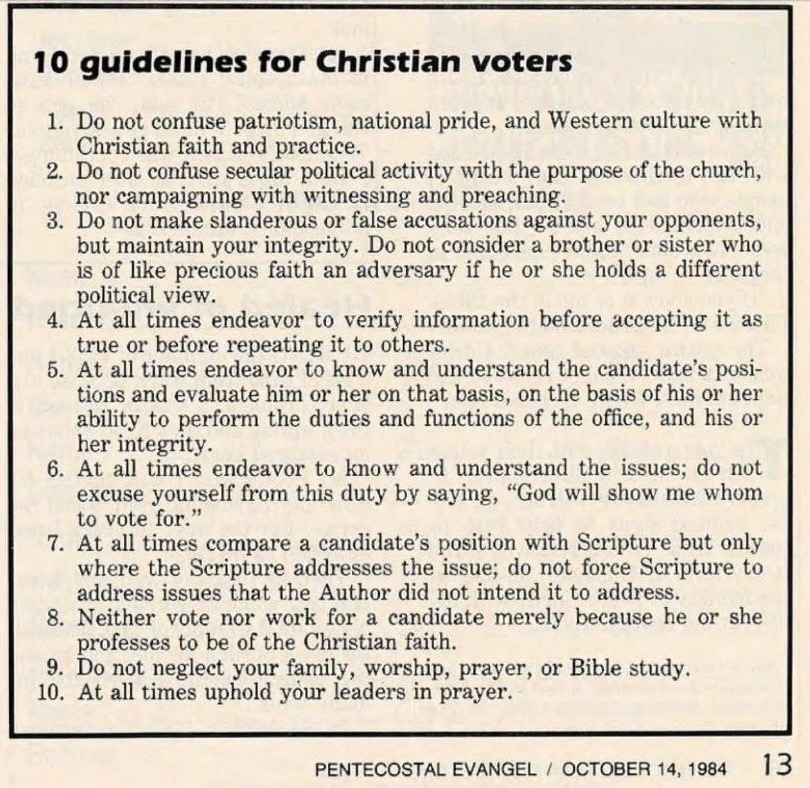
This past Sunday I spoke to my congregation about how Christians should behave biblically during an election season. Someone forwarded to me a related graphic from the Pentecostal Evangel magazine (a publication of the Assemblies of God) from 1984. I love these reminders for Christians!
Researchers unveiled the largest brain map ever completed. It was of a fruit fly, whose brain “includes nearly 140,000 neurons and captures more than 54.5 million synapses”! It took four years to complete this map. “All told, the researchers identified 8,453 types of neuron—much more than anyone had expected. Of these, 4,581 were newly discovered.” This level of complexity and order in a fruit fly is astounding to me. Can you imagine what it would take to map the much larger and more complex human brain?! Truly, David was right when he said that we are wonderfully made by our Creator!
“Freely, willingly and joyfully do good to everyone, serve everyone, suffer all kinds of things, love and praise the God who has shown such grace. Thus, it is just as impossible to separate faith and works as it is to separate heat and light from fire!” —Martin Luther
“Faith the mother of all good works justifieth us, before we can bring forth any good work: as the husband marryeth his wife before he can have any lawful children by her.” —William Tyndale
A.W. Tozer said, “There’s an awesomeness about God which is missing in our day altogether; there’s little sense of admiring awe in the Church of Christ these days.” May we repent of little prayers and boldly pray to an awesome God who wants to do awesome things that will bring Him glory!
I have lots of new content every week, which you can check out on my YouTube channel.
This is a very informative Q&A session with cold case detective and Christian apologist J. Warner Wallace. But I especially like his answer to the first question: Do Christians have to investigate every other religion to be convinced that the Bible is true?
“Faith untried may be true faith, but it is sure to be little faith, and it is likely to remain dwarfish so long as it is without trials. Faith never prospers so well as when all things are against her: tempests are her trainers, and lightnings are her illuminators. … No flowers wear so lovely a blue as those which grow at the foot of the frozen glacier; no stars gleam so brightly as those which glisten in the polar sky; no water tastes so sweet as that which springs amid the desert sand; and no faith is so precious as that which lives and triumphs in adversity. … Faith increases in solidity, assurance, and intensity, the more it is exercised with tribulation. Faith is precious, and its trial is precious too.” —Charles Spurgeon
“Mature Christians can be recognized by a variety of indicators. They feast on the Word of God (Hebrews 5:14), persevere in love and good works (Hebrews 6:9-10), bear the fruit of the Spirit rather than the marks of the flesh (Galatians 6:16-23), use their gifts to help build the church (1 Corinthians 12:7-11; Ephesians 4:12-16), teach the things of Jesus to others (Hebrews 5:12: Acts 1:8), and more. This, the New Testament insists, is the condition toward which every Christian strives.” —T.M. Moore (check out all of the Scriptures T.M. references here)
“Now is the accepted time, not tomorrow, not some more convenient season. It is today that our best work can be done.” —W.E.B. Du Bois
Jesus shows us that only secure people can serve others. Insecure people won’t ever make themselves vulnerable, and so they miss out on God’s blessing. I address this in more depth in my book Shepherd Leadership.








 Craig T. Owens