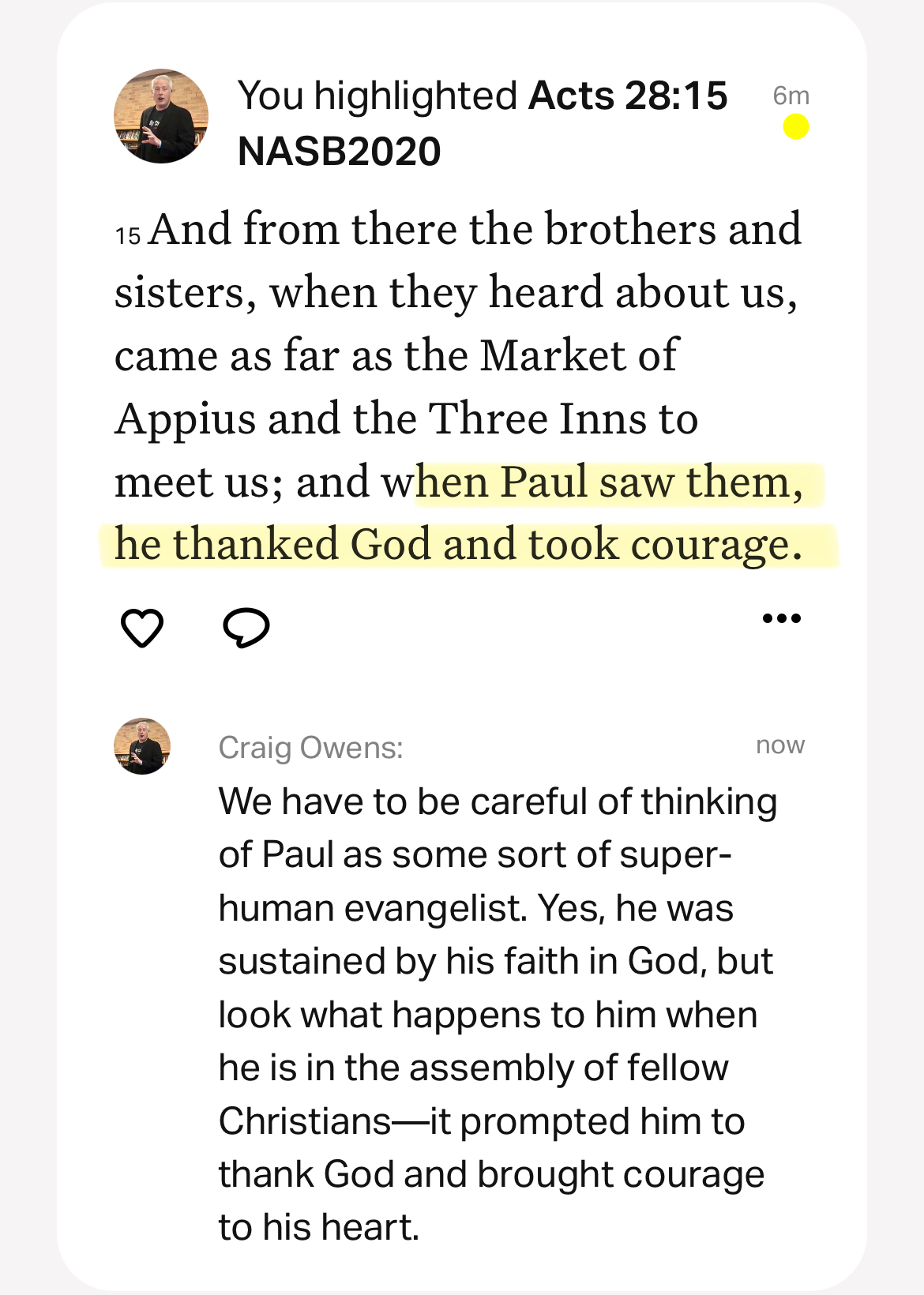
And from there the brothers and sisters, when they heard about us, came as far as the Market of Appius and the Three Inns to meet us; and when Paul saw them, he thanked God and took courage. (Acts 28:15)
We have to be careful of thinking of Paul as some sort of super-evangelist. Yes, he was sustained by his faith in God, but look what happens to him when he is in the assembly of fellow saints—it prompted him to thank God and brought courage to his heart.
Do you have to go to church to be a Christian? Of course not. But you will be encouraged and you will be the source of encouragement to others when you gather together regularly.
As the writer of Hebrews tells us—
Let’s hold firmly to the confession of our hope without wavering, for He who promised is faithful; and let’s consider how to encourage one another in love and good deeds, not abandoning our own meeting together, as is the habit of some people, but encouraging one another; and all the more as you see the day drawing near. (Hebrews 10:23-25)
You may also be interested in these related posts:
Listen to the podcast of this post by clicking on the player below, and you can also subscribe on Apple, Spotify, or Audible.
Let me remind you of something I covered last week:
If we start out thankful but then forget about our blessings, we become fearful and selfish, which makes us susceptible to the sin of grumbling against God.
But if we start our thankful and then continually remember all that God has done for us, we remain joyful and secure, which fortifies us against giving in to the sin of grumbling against God.
As I have shared with you during this series, medical science has discovered so many connections between gratitude and wellbeing—mentally, physically, emotionally, and relationally. Here’s another important finding from medical science: Chronic stress impairs memory formation.
Remember this insight from George Santayana: “Those who do not learn from history are doomed to repeat it”?
But what if we cannot learn the lessons from history because we cannot remember and recall those lessons? That’s one of the ways chronic stress ravages our ability to be grateful. Stress literally clogs up the amygdala in our brain so that these lessons cannot be filed away for future use.
Where does this chronic stress come from? Stress can be a good thing—think of the stress we put on our lungs, heart, and muscles when we exercise. That good stress (eustress) prepares us to respond well in difficult situations.
But chronic stress is unhealthy. It begins to make us withdraw into ourselves. We become self-protective. We start to see potential problems even behind blessings.
Self-protective becomes self-focused, which is the exact opposite of the God-focus we looked at last week in Psalm 103:2. This also makes us want to isolate from people (see Psalm 42:1-4, especially the “used to” in v. 4).
Consider the example of David’s life. David is in a stressful state where I am sure it is becoming increasingly difficult for him to find praiseworthy things. He is becoming more and more self-protective and therefore self-focused.
Saul tries to kill him—1 Samuel 20:28-33
The Philistines have him trapped—21:10-13; Psalm 56
The people of Keilah reward David’s help with betrayal—23:10-12
David is in a desert place (literally!) and sold-out by the Ziphites—23:14, 19-20
Psalm 54 is written when David learns about the Ziphites’ plan. He begins to pour out his complaint to God in vv. 1-3, but then there is a totally different tone in vv. 4-7. What comes between is the word Selah—a pause to consider.
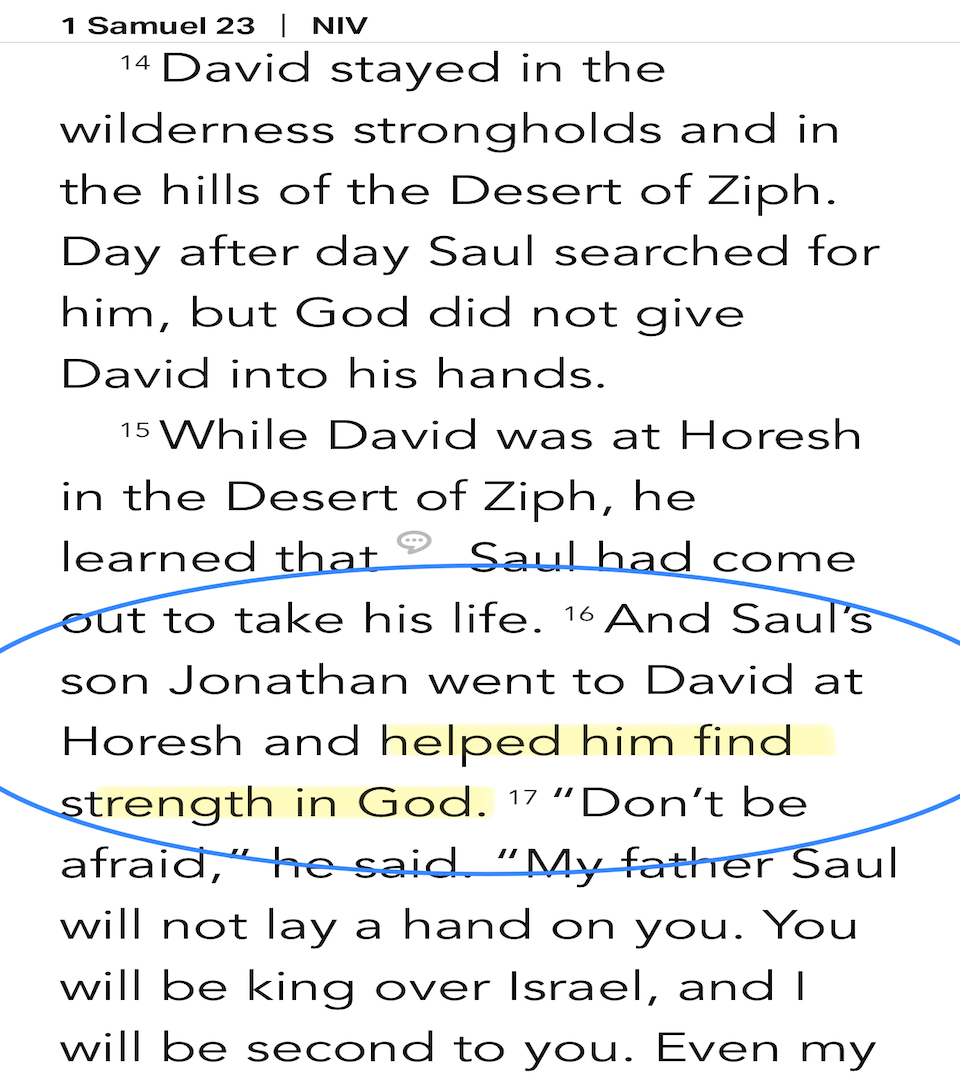
I believe at this time is when Jonathan shows up to encourages David—And Saul’s son Jonathan went to David at Horesh and helped him find strength in God (1 Samuel 23:16).
David learned this lesson well because when he’s in another tight spot, we read that David found strength in the Lord his God, which allowed him to encourage his distraught men to seek God’s help. It was with God’s help that they recovered everything single thing that had been taken from them (1 Samuel 30:1-18)!
Your gratitude fortifies you and helps you encourage other saints. As you encourage other saints, they will then be fortified to help other saints—maybe even you!
I like how Eugene Peterson paraphrases 1 Thessalonians 5:11 in The Message: “So speak encouraging words to one another. Build up hope so you’ll all be together in this, no one left out, no one left behind. I know you’re already doing this; just keep on doing it.”
Your gratitude could make all the difference in someone else’s life, so “just keep on doing it”!
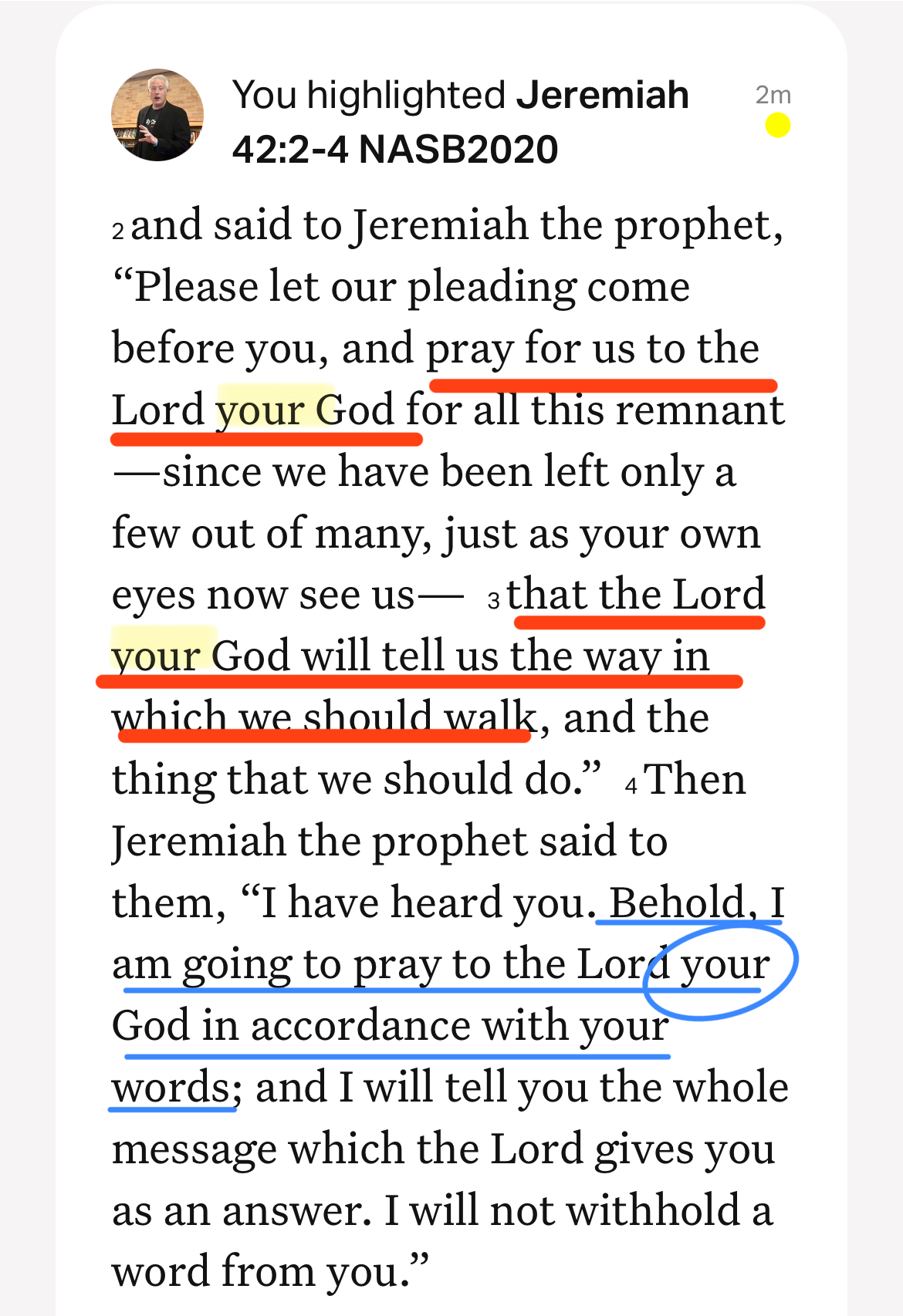
…All the people from the small to the great approached and said to Jeremiah the prophet, “Please let our pleading come before you, and pray for us to the Lord your God for all this remnant—since we have been left only a few out of many, just as your own eyes now see us—that the Lord your God will tell us the way in which we should walk, and the thing that we should do.” Then Jeremiah the prophet said to them, “I have heard you. Behold, I am going to pray to the Lord your God in accordance with your words; and I will tell you the whole message which the Lord gives you as an answer. I will not withhold a word from you.” (Jeremiah 42:1-4)
You can hear the distance that the people felt from God in the words they say to Jeremiah, “the Lord YOUR God.”
But Jeremiah reassures them that God still sees them and loves them when he responds with the exact same words—not “the Lord my God” (as the people thought he would say) but “the Lord YOUR God.”
This word of encouragement from Jeremiah helped this same group of people to see God in the right light: “Whether it is pleasant or unpleasant, we will listen to the voice of the Lord OUR God to whom we are sending you, so that it may go well for us when we listen to the voice of the LordOURGod” (v. 6).
This is a good reminder for all of us that we need to encourage one another whenever we have the opportunity. “Let’s approach [our] God with a sincere heart in full assurance of faith … and let’s consider how to encourage one another in love and good deeds” (Hebrews 10:22, 24).
You may want to check out my post A Unique Look At “Church” for some further thoughts about encouraging our brothers and sisters.
“The God who is our salvation” is on each side of this sacred pause. What can we consider from this?
God is my salvation
God is for me
God is my daily provision
God is my light and my life
God is my escape from death
God is worthy of all my worship
Let’s take time to slow down and truly savor the inspired thoughts when the Holy Spirit moved the biblical author to pause. There are powerful, encouraging, life-changing truths just waiting to burst into our heart and mind!
Listen to the podcast of this post by clicking on the player below, and you can also subscribe on Apple, Spotify, or Audible.
I was reading the results of a survey which said one of the top traits for exemplary leaders was: They keep their word.
But don’t we really mean, “They keep their word most of the time”? After all, we do allow those who have a track record of integrity an “out” for unusual or unexpected circumstances. And we would still say that leader had honesty and integrity.
God always keeps His word. He never needs an “out” because nothing is ever unexpected for Him! He is always the Promise Maker and the Promise Fulfiller (Isaiah 42:9, 46:10, 55:10-11; Jeremiah 1:12).
I like the way Jesus sums up these statement from His Father: For assuredly, I say to you, till heaven and earth pass away, one jot or one tittle will by no means pass from the law till all is fulfilled (Matthew 5:18 NKJV).
Ajot is the smallest Hebrew letter (yodh). In Greek the word is iota. This tells us that God is concerned about the smallest of details.
A tittle is the precise difference between Hebrew letters like cheth and he, between daleth and resh, and between beth and kaph.
All of these are fulfilled—brought to their perfect completion (Luke 1:37, 22:37)!
When we see any of God’s promises made and kept, we need to ask ourselves three questions:
What did it mean then?
What does it mean now?
What does it mean for me today?
For example, look at the promise that was made about people living in a very dark place seeing the Light of God. The prophecy is first made in Isaiah 8:19-9:7 that the people of Zebulun and Naphtali would get to see and experience the light of the Messiah.
Matthew 4:11-17 tells us that after Jesus endured the temptation of the devil for 40 days, He went to Capernaum—the region of Zebulun and Naphtali. But before He arrived there, He was first rejected by the folks in His hometown of Nazareth (see Luke 4:14-31).
Our God who knows the end from the beginning never makes a mistake; nothing is ever random or inconsequential. We should develop the habit of praying, “Now that this is happened, what would You have me do?” As Jesus was rejected by the people who should have been so excited to see His ministry flourish, He wasn’t dismayed or discouraged, but He directed His steps toward Capernaum.
In my heart, I may plan a course for my life, but I must trust God to direct my steps. My life has a purpose. Just as the Holy Spirit directed the movements of Jesus, He is directing my steps.
Even when God seems to have directed my steps into a dark place, He has sent me there as His light. I am sent on purpose. I walk a path Jesus has already walked, and a path that He is still walking with me—He guides me in paths of righteousness for His name’s sake. Even though I walk through the valley of the shadow of death, I will fear no evil, for You are with me (Psalm 23:3-4).
I don’t walk into the darkness in my own strength or as a way to fulfill my own plans but instead I trust that “the zeal of the Lord Almighty will accomplish this” (Isaiah 9:7)!
Because Jesus is fulfilling every jot and every tittle, I can live confidently in Him!
If you would like to follow along with all of the messages in this series called Jots and Tittles, you can find them all here.
Listen to the podcast of this post by clicking on the player below, and you can also subscribe on Apple, Spotify, or Audible.
As these songs of ascent are reminding us, we’re trying to ascend into God’s presence. But it seems like the forces pulling us back downward are so strong! The lyrics in the most popular songs are getting more and more raunchy, the blockbuster movies routinely celebrate sin, TV shows increasingly push a decidedly unbiblical agenda, government leaders are caught in scandals, and church leaders are “de-transitioning” from their Christian testimony.
It doesn’t seem like there is much to celebrate.
Just like the Jews who found themselves defeated and living in a foreign land, or fighting opposition to rebuild their way of life, or contending with occupying forces that were hostile to their religion, we, too, find ourselves in a very similar place—even in a country that was supposedly built on godly principles.
The worldly-minded and irreligious have always tried to pull down the godly. When they do, it makes it hard to even worship God (Psalm 137:1-4).
I’ve been reminding you that in Hebrew literature we can usually get our perspective from the middle of the story. So before we look at this next song of ascent, let’s look at the middle of the Jewish story—the middle of their time of exile, when things seemed darkest.
Jeremiah wrote a book of Lamentations which was in the middle of the exile. In the middle of his tears and gall and bitterness he wrote this—
I remember my affliction and my wandering, the bitterness and the gall. I well remember them, and my soul is downcast within me. Yet this I call to mind and therefore I have hope: Because of the Lord’s great love we are not consumed, for His compassions never fail. They are new every morning; great is Your faithfulness. I say to myself, “The Lord is my portion; therefore I will wait for Him.” … I called on Your name, Lord, from the depths of the pit. You heard my plea: “Do not close your ears to my cry for relief.” You came near when I called You, and You said, “Do not fear.” (Lamentations 3:19-24, 55-57)
Jeremiah said when he called God, He came near. He’s not saying that God had left him, but instead, Jeremiah is saying that he got his eyes off the ever-present God. As soon as he put his eyes back on God, he could feel His nearness.
Our next song of ascent (Psalm 126) opens with the word “when.” This is a celebration of how God kept His word that the exiles would be released from Babylon and return to Jerusalem. As the Jews praised God for keeping His Word, then the surrounding nations saw and heard the testimony in the songs of joy that were being sung.
God’s people were both singing for joy for God’s deliverance AND they were singing in joyful anticipation of what was still to come.
They make a request in prayer for God to “restore our fortunes” (v. 4). This phrase always means that God is going to bring back everything that was taken away and then some.
We have a promise two times in the next two verses that God will (not might) bring in these restored fortunes. In the midst of darkness or drought, it may seem hopeless to keep sowing seed. God sees your tears, and He will use your tears to water that seed and He will bring a harvest.
The New Testament assures us of the same promise: “Let us not become weary in doing good, for at the proper time we will reap a harvest if we do not give up” (Galatians 6:9).
We show our faith in God’s eternal victory by lifting up our voices in song today. That song is a testimony to the nations around us and an encouragement to other saints who may be struggling with weariness (see Ephesians 5:18-20). We keep on singing these songs of joy in anticipation of the final and eternal song we will sing in Heaven.
God is near. He hears your sighs. He sees your tears. He is watering the seeds you are sowing, and He will bring a harvest. As you sow in tears, sow also with songs of joy!
Listen to the podcast of this post by clicking on the player below, and you can also subscribe on Apple, Spotify, or Audible.
It is important for leaders to use the right words to encourage their teammates. The most memorable, motivating, and beautiful word a leader can use is their teammates’ names.
Listen to the audio-only version of this podcast by clicking on the player below, or scroll down to watch the video.
Words are incredibly powerful! With our tongues, we can elevate others to amazing heights, or tear them down completely. In this episode, Greg and I discuss how, as leaders, it is critical that we are mindful of our everyday words so that we ensure we are taking our team in the right direction.
[0:20] Sometimes leaders can forget how powerful their words can be.
[1:00] Words need to be used strategically and carefully.
[2:05] “Words of affirmation” is one of the love languages, but everyone needs to hear words that affirm and encourage them.
[3:40] Some of the most meaningful words are our apologies and requests for forgiveness. When we do this well, it opens up the door for deeper communication.
[6:00] Leaders should be able to see a visible and immediate difference in their teammates when they are speaking the correct words to them. If not, we need to quickly adjust our words.
[6:50] People don’t care how much their leader knows (or says) until they know how much their leader cares about them.
[8:25] Negative words can sour relationships.
[9:08] Leaders need to pay close attention to what words work best with each teammate.
[10:15] What is the difference between efficient communication and effective communication?
[12:40] We share some insights from two noteworthy books: Leadership Jazz by Max DePree and Ten Powerful Phrases for Positive People by Rich DeVos.
[15:00] One of the most beautiful words anyone will ever hear a leader speak is their teammate’s name.
[19:02] Handwritten notes go the extra mile, but we need to slow down to think about who needs to hear an affirming word from us.
[21:20] Greg shares a memorable quote about the long-term results of our words.
[22:07] A good coach can give you more impactful insights than someone close to you.
Check out this episode and subscribe on YouTube so you can watch all of the upcoming episodes. You can also listen to our podcast on Spotify and Apple.
Listen to the podcast of this post by clicking on the player below, and you can also subscribe on Apple, Spotify, or Audible.
Father’s Day can bring up a lot of different emotions for folks. Growing up, you might not have had a very good experience with your father or perhaps you didn’t have a father involved with you at all. Maybe you look back on your own history as a Dad and have some regrets. Perhaps you’re an empty-nester now or maybe you’ve never had kids of your own.
Regardless of your experience with your father or with your own circumstances, I think there are some things that we all naturally expect from our Dads. These are things that we should honor and things we as Dads should strive to demonstrate in our lives.
Luke introduces us to a man in the Book of Acts named Joseph. We don’t know if he is a biological father or not, but he is presented to us as a spiritual father that we would do well to emulate. In fact, we only know his name is Joseph from our first introduction to him. This man was such an inspiration to so many people that he was given the nickname Barnabas—the name that is used everywhere else in the New Testament.
When we think of our list of attributes of an ideal father, I think we all look to our fathers for these five things.
(1) Be there when we are getting started. Barnabas was there when Saul (later named Paul) first became a Christian and when the first Gentiles became Christians (Acts 9:26-28; 11:19-23).
(2) Provide for us financially. Barnabas is the first person mentioned by name that gave a significant and much-needed financial donation to the Church (Acts 4:34-37).
(3) Help us learn to leave our nest and fly on our own. Barnabas gave Paul his first leadership role in the Church (Acts 11:25-26).
(4) Step back as we learn to soar on our own. Barnabas took the lead in the first commissioned missionary journey, but then we see him stepping aside for Paul to take the lead (Acts 13:1-2, 13).
(5) Continue to “be there” for us even after we’ve left the nest. Barnabas also picked John Mark to accompany him and Paul on that first missionary endeavor, but when Barnabas stepped aside for Paul, Mark headed home instead of continuing on their trip. Later on, Barnabas wanted to give Mark another shot, but Paul was strongly against that. As a result, Paul and Barnabas parted company, with Barnabas taking Mark with him. From this point on, Luke doesn’t tell us anything else about Barnabas, but we know that Mark became the first one to write his Gospel account of the life of Jesus and that he became reconciled to both Paul and Peter, becoming an invaluable help to both of them. Although we don’t read what happened, I think it’s a good bet that all of this came about through the encouragement of Barnabas (Acts 13:13, 15:36-40; 2 Timothy 4:11; 1 Peter 5:13).
The name Joseph means “exalted.” Joseph was born into the tribe of Levi, placing him at the heart of the Jewish faith, yet he risked it all to not only acknowledge Jesus as the Messiah but to be so invested in the Christian Church that they called him Barnabas. Luke tells that his name means Son of Encouragement.
The word “encourage” literally comes from in + courage—to put courage into someone, to inspire others with the courage or confidence they need to do something great.
The word “encouragement” in Acts 4:26 in Greek is paraklesis: the same word used for the Holy Spirit.
Fathers can only put in others what is already in themselves.
Acts 11:24 tells us that Barnabas was “a good man, full of the Holy Spirit and faith.” Because He was full of the Spirit of God, he could put that courage and security in others around him.
Guys, it’s the same for us today. We have to be filled with the security, the joy, and the courage that springs eternally from the Holy Spirit. Only when we are filled with the Spirit can we put something truly impactful into the lives of our kids—both our biological and spiritual children.
We don’t know how old Barnabas was. We don’t know if he had children of his own or not. All we know is that he was a good man that was full of the Holy Spirit, and that gave him the courage to put into others.
What a great example for all of us to follow!
If you’ve missed any of the other messages in our series We Are: Pentecostal, where we’ve been learning about the blessings that come to those who are baptized in the Holy Spirit, you can find all of those messages here.
Listen to the audio-only version of this podcast by clicking on the player below, or scroll down to watch the video.
I am not a very good golfer, so when Greg and I hit the course together Greg is generous enough to give me a mulligan—sometimes a lot of them! In the same way, we as leaders need to be willing to give our team members chances to learn from and improve upon their mistakes. In this episode, we discuss how embracing a “mulligan culture” in your organization helps everyone grow and thrive.
[0:22] I explain what Greg gives me that is a huge blessing
[1:25] Leaders need to be gracious.
[2:56] What is the goal of mulligans?
[4:10] Mulligans can cost our business something. How do we calculate that?
[7:18] Success usually goes up with the mulligan attempt.
[9:54] Expect greater success in the second chances.
[11:04] Mulligans need to be given in a safe environment.
[13:06] Second chances and comeback stories are inspiring!
[14:31] Remember that people are the focal point of our mulligans.
[14:55] Greg shares about an unusual phobia with which many people struggle.
[16:50] An important reminder seasoned leaders need to share with emerging leaders.
[18:22] High-performing leaders make it look easy because of the mulligans other people gave them along the way.
Check out this episode and subscribe on YouTube so you can watch all of the upcoming episodes. You can also listen to our podcast on Spotify and Apple.



 And from there the brothers and sisters, when they heard about us, came as far as the Market of Appius and the Three Inns to meet us; and when Paul saw them, he thanked God and took courage. (Acts 28:15)