Christian saints have the joyful privilege of being able to step up for fellow saints. It’s hard work at times, but if we remember who those saints really are, it’s never heavy work!
“A people that values its privileges above its principles soon loses both.” —Dwight D. Eisenhower
“[Jesus] draws us to Himself daily, to seek His beauty in Scripture, dwell before the beauty of His glorious face, bask in the beauty of His heavenly throne room, and become, increasingly, His beauty in and to the world. No matter how long we’ve known Him or how careful and earnest our study of Him has been, His fresh beauty remains fresher still.” —T.M. Moore
“Christianity is always out of fashion because it is always sane; and all fashions are mild insanities.” —G.K. Chesterton
Replace the “sandwich method” of feedback with this: (1) Tell the person why you are giving them feedback, (2) Give them the feedback, and (3) End with a belief statement.
Leaders need to give others confidence to try something new. We need to help people get moving so that we can coach what they are doing. For more great leadership insights, check out The Craig and Greg Show.
I have lots of new content every week, which you can check out on my YouTube channel.
A couple of thought-worthy quotes for pastors. First from David Mathis: “Pastors, observe that in and of itself, mocking is no clear reflection of the faithfulness or fruitfulness of preaching Christ. Wise preachers do not take mocking as an indicator of failure, nor as an indicator of success. Twice in Athens some mock Paul, which may seem like a failure compared to his homiletic triumphs elsewhere. However, others say, ‘We will hear you again.’ And then, in the end: ‘some men joined him and believed’ [Acts 17:32-34]. … How foolish it would be to distract ourselves with the mockers. Or to call special attention to the mocking as some great badge of our own faithfulness. Rather, we have the example of Paul at Mars Hill, who, so far as we can tell, wholly overlooks, with a holy disregard, these mockers and concerns himself instead with those asking honest questions.”
…and then one from John Piper: “Preaching is a happy business. Because even if the text is a hard word that devastates the hearers, the preacher connects the hard word with the gracious word and the hopeful word, and he catches them as they fall. So, in the end, all preaching is a happy business.
“A people that values its privileges above its principles soon loses both.” —Dwight D. Eisenhower
“For condemnation to work, we must say to God what the devil has said to us and believe it. If I want to stand before God with excuses that make what He said to me void, I’ll have to quote the devil to God. Does that sound like a good thing to do? God’s will for me is not to condemn me, but to liberate me from everything that holds me back from being what He created me to be through an ongoing relationship. To accomplish that, I need to do the opposite of what I used to do when I walked in condemnation. Instead of quoting to God what the devil is saying, I quote to the devil what God has said.” —Jim Wiegand, in Recruiting To Releasing
Another great story from the “Here We Stand” series of biographies of notable people during the Reformation. “An attendant asked [King Henry VIII] whom he wished to have at his bedside. The king asked for Thomas [Cranmer]. By the time Cranmer arrived, King Henry was unable to speak. Foxe tells the story. ‘Then the archbishop, exhorting him to put his trust in Christ, and to call upon His mercy, desired him though he could not speak, yet to give some token with his eyes or with his hand, that he trusted in the Lord. Then the king, holding him with his hand, did wring his hand in his as hard as he could (Foxe’s Book of Martyrs, 748).’ The scene sweetly punctuates the most important friendship in the English Reformation. Whatever King Henry believed when he squeezed Cranmer’s hand that day, God used the bond between them to break England free from Roman Catholicism and to recover the one true gospel.”
The ICR reports, “Genesis claims that people in the pre-Flood world routinely attained 900-year lifespans. The best-known example is Methuselah, who had the longest recorded lifespan of 969 years (Genesis 5:27). Skeptics dismiss these great ages as fanciful legends, but recent fossil data are providing unexpected, albeit indirect, corroboration of the Bible’s testimony.” Check out this full report.
“In my experience, each failure contains the seeds of your next success—if you are willing to learn from it.” —Paul Allen, cofounder of Microsoft
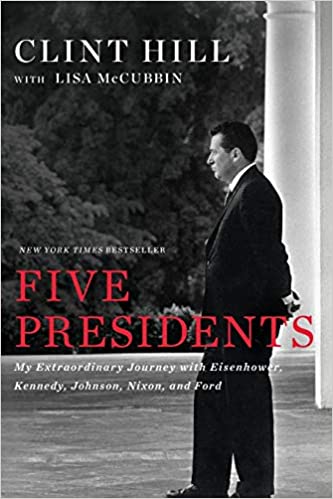
Some of my favorite books to read are in the categories of history and leadership. Five Presidents by Clint Hill is a treasure-trove of both history and leadership, giving us a front-row seat to the leadership styles of five United States presidents.
Mr. Hill was on the presidential protection detail for Presidents Dwight Eisenhower, John Kennedy, Lyndon Johnson, Richard Nixon, and Gerald Ford. During his time, America experienced several “firsts” and Mr. Hill was right there to see them firsthand. During this time in our country’s history, only one of these presidents was elected, reelected, and finished both of his terms as president: Dwight Eisenhower. President Kennedy was assassinated, President Johnson finished JFK’s term but withdrew from running for reelection, President Nixon resigned during his second term, and President Ford became the only president to serve as both president and vice president without being elected to either office and then was defeated in his reelection bid.
Five Presidents is not only an eye-opening, behind-the-scenes look at key historical events during the 1960s and ’70s, but it is also an informative study on the different leadership styles of these five unique men. Eisenhower ran the executive branch like a general, Kennedy was an idealist, Johnson used brute force, Nixon started off well and allowed his own insecurities to derail him, and Ford served as the “ordinary man” trying to clean up the mess left by his predecessor.
Mr. Hill also documents the changes in the operations of the Secret Service. When he began his assignment, there were no bullet-proof presidential vehicles, no protection for presidential candidates (only elected officials), no permanent residence for the vice president, and no Air Force Two. By the time he retired, all of these things—and many more—had been implemented.
Whether you enjoy history, leadership, or presidential biographies, Five Presidents will be a highly enjoyable and informative book for you.
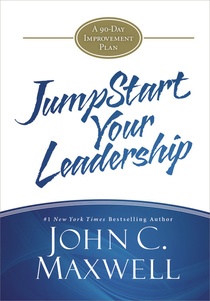
One of the things I appreciate about John Maxwell’s work is how many other authors and deep thinkers he reads. Dr. Maxwell then sifts through all those works and brings the best of the best to his books. Here are some of the other quotes John shared in his book JumpStart Your Leadership.
“Destiny is no matter of chance. It is a matter of choice. It is not a thing to be waited for; it is a thing to be achieved.” —William Jennings Bryan
“No man is a leader until his appointment is ratified in the mines and the hearts of his men.” —Infantryman’s Journal (1954)
“The supreme quality of leadership is unquestionably integrity.” —Dwight Eisenhower
“You don’t lead by pointing and telling people some place to go. You lead by going to that place and making a case.” —Ken Kesey
“Let him that would move the world, first move himself.” —Socrates
“The most essential quality for leadership is not perfection but credibility. People must be able to trust you.” —Rick Warren
“Looking back, my life seems like one big obstacle race, with me being the chief obstacle.” —Jack Paar
“Effective leaders reward dissent, as well as encourage it. They understand that whatever momentary discomfort they experience as a result of being told from time to time that they are wrong is more than offset by the fact that ‘reflective back talk’ increases a leaders ability to make good decisions.” —Warren Bennis
“You can dream, create, design, and build the most wonderful idea in the world, but it requires people to make the dream a reality.” —Walt Disney
“A leader takes people where they want to go. A great leader takes people where they don’t necessarily want to go, but ought to be.” —Rosalynn Carter
“The outstanding leaders of every age are those who set up their own quotas and constantly exceed them.” —Thomas Watson
“Do what you do so well that those who see you do what you do are going to come back to see you do it again and tell others that they should see you do what you do.” —Walt Disney
“The secret is to work less as individuals and more as a team. As a coach, I play not my eleven best, but my best eleven.” —Knute Rockne
You can read quotes from John Maxwell in this book by clicking here.
You can read my review of JumpStart Your Leadership by clicking here.
On May 28, 1954, President Dwight Eisenhower signed into law the Congressional Act (Joint Resolution 243), which added the words “Under God” to the pledge of allegiance. In a speech given soon after, President Eisenhower said, “In this way we are reaffirming the transcendence of religious faith in America’s heritage and future.”
“God is concerned that His people are being shaken in their faith—that they won’t trust Him in their crisis. Beloved, our worst sin is our unwillingness to believe He will do what He promised. That offends Him more than adultery, fornication, drug and alcohol abuse or any other sin of the flesh.” —David Wilkerson
“If today is the day I will be born into heaven—I sure want to make it worth while. If I die today, I want today to be full of the glory of God. I want everything I do today to be worthy of Jesus. If I could die any moment then let every moment count. A healthy view of dying helps us live well. Dying is the only way to live.” —Dick Brogden
One of the more sobering times of my week in Washington, D.C., was the afternoon we spent at the Holocaust Museum. The dehumanizing atrocities perpetrated by one group of people on another group of people is almost unimaginable.
And yet there it was—all the nauseating evidence of man’s evil right before my eyes. It was so overwhelming that I had to hurry past the final exhibits.
Commander of the Allied Forces Dwight Eisenhower wrote to George C. Marshall, the chairman of the U.S. Joint Chief Of Staff—
“…the most interesting—although horrible—sight that I encountered during the trip was a visit to a German internment camp near Gotha. The things I saw beggar description. While I was touring the camp I encountered three men who had been inmates and by one ruse or another had made their escape. I interviewed them through an interpreter. The visual evidence and the verbal testimony of starvation, cruelty and bestiality were so overpowering as to leave me a bit sick. In one room, where they were piled up twenty or thirty naked men, killed by starvation, George Patton would not even enter. He said that he would get sick if he did so. I made the visit deliberately, in order to be in a position to give first-hand evidence of these things if ever, in the future, there develops a tendency to charge these allegations merely to ‘propaganda.’” (emphasis added)
A statement from President Ronald Reagan, from 1988, is etched on the wall of the Holocaust Museum—
“We who did not go their way owe them this: We must make sure that their deaths have posthumous meaning. We must make sure that from now until the end of days all humankind stares this evil in the face … and only then can we be sure that it will never arise again.” (emphasis added)
The rise to power of the Nazis was swift. Their evil was initially unopposed. Few voices spoke out, and even few were heeded. We must never allow this to happen again!
As George Santayana said, “Those who do not learn from history are doomed to repeat it.” As revolting as it is, we must learn from this lesson. You must look this evil in the face. You must allow your children to look this evil in the face. If we don’t, we will be doomed to live through these unthinkable atrocities all over again.
Obvious statement #1:Church ministry is not lone ranger work.
I needed to state that not only as a reminder to myself, but to my other pastor friends too. It seems like we can often lose sight of this fact. We can become so focused on the next sermon, the next appointment, the next Board meeting, the next outreach that we are actually worshiping the ministry instead of worshiping God through our ministry.
Oswald Chambers gave this warning:
“Beware of any work for God that causes or allows you to avoid concentrating on Him. A great number of Christian workers worship their work. The only concern of Christian workers should be their concentration on God. … A worker who lacks this serious controlling emphasis of concentration on God is apt to become overly burdened by his work. … Consequently, he becomes burned out and defeated. There is no freedom and no delight in life at all. His nerves, mind, and heart are so overwhelmed that God’s blessing cannot rest on him.”
When we are more focused on the work than on God, we can easily begin to feel over-worked and under-appreciated. And this usually leads to us either bearing down to work harder or to simply throwing in the towel.
There is a healthy alternative: link arms with The Co-Worker—
“Walk with me and work with Me—watch how I do it. Learn the unforced rhythms of grace. I won’t lay anything heavy or ill-fitting on you. Keep company with Me and you’ll learn to live freely and lightly.” (Matthew 11:29, The Message)
Link with The Co-Worker, and then you will do ministry out of the overflow of your personal worship. Remember, you are a co-worker, not a solo-worker.
Obvious statement #2:Church ministry is not just for the pastor.
Church member, you too are a co-worker with Christ. And with your pastor.
Allow me to paraphrase a quote from President Dwight Eisenhower:
“Never let yourself be persuaded that one [pastor] is necessary to the salvation of America. When [the Church] consists of one leader and [a bunch of] followers, it will no longer be [the Church].”
The Church is a beautiful thing! It functions best when:
Pastor and church member are both linked with Christ
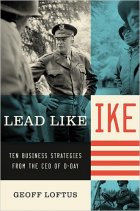
There is so much to like about Lead Like Ike by Geoff Loftus!
If you like military history, you will love the narrative of the strategies and implementation that Dwight D. Eisenhower (or “Ike”) oversaw. It is an amazing retelling of how Ike had to balance so many pressures from not only the Germans but within his own ranks as well, to lead the Allies to victory in Europe during World War II.
If you like business strategies, you will enjoy the way Loftus renames the military build-up in Europe during WWII “D-Day Inc.,” and assigns titles like Board of Directors, CEO, C-level staff, and competitors to the battles in Operation Torch, Operation Overlord, the Battle of the Bulge and others. You will see how Ike functioned as an effective CEO to lead D-Day Inc. in their head-to-head challenges with their German competition.
And if you like biographies about strong leaders, you will see the incredible leadership principles that Ike employed in his personal life and in his military career. You will see a man firmly fixed on his goal, but also a man who felt deeply about the individual soldier, sailor, and airman under his command.
Sprinkled throughout the book (and summed up nicely at the end of each chapter) are strategies for success, implementation plans, and tips for personnel management.
The only thing that disappointed me about this book was that it came to an end! I thoroughly enjoyed it, and I believe you will too. I give it five-out-of-five stars.