Faith To Forgive

Listen to the podcast of this post by clicking on the player below, and you can also subscribe on AppleSpotify, or Audible. 

I shared this in my forthcoming book When Sheep Bite

In January 1647, Oliver Cromwell captured King Charles I during the British Revolution. Within just a few months, Charles escaped and was able to raise another army. A year later, in August 1648, Cromwell’s forces once again defeated the army Charles had raised, and once again Charles was taken prisoner. 

Oliver Cromwell put Charles on trial for his crimes, and after the guilty verdict was pronounced, Charles I was executed. A total of 59 people signed the former king’s death warrant. 

Fast forward eleven years and Oliver Cromwell had died and his son Richard had taken his place as Lord Protector of England. Unlike his father, there was great discontent with Richard’s leadership. As a result, the Loyalists were able to sweep Charles II into power. 

After assuming the throne of England, Charles II wanted the 59 death warrant signers put on trial, but fifteen of them had already died. That little fact didn’t stop King Charles II. He ordered that their bodies be exhumed, placed on trial, convicted of their crimes, and then hung. 

I’m no psychologist, but I think it’s safe to say that Charles II might have had a slight problem with unforgiveness!  

This is from a chapter I entitled “The ties that no longer bind.” The insidious nature of unforgiveness is that it ties us to the one who injured or offended us. 

Jesus taught us to pray, “Forgive us our debts, as we also have forgiven our debtors” (Matthew 6:12). The word He uses for “debts” means something justly or legally due, or an offense or sin that has been committed. So a debtor is one who morally or legally owes another for the wrong committed. 

So for these debts, we are taught to ask for forgiveness of God and to give that same forgiveness to others. Jesus uses the same root word for both “forgive” and “forgiven,” but there are nuances that make the picture quite clear. 

  • When we ask God to forgive our debts, it is the active voice (I have to ask for it) and it is stated in the second person (I have to receive it). When I ask my Heavenly Father for this, my offense has been paid-in-full because the legal and moral requirements aren’t due any longer. I couldn’t pay this debt on my own, but Jesus paid it for me (2 Corinthians 5:21).  
  • When I forgive someone who has wronged me, it is again the active voice (I have to give it), but it is now in the first person (I don’t wait around for the other person to ask for forgiveness). I let it go. I don’t hinder the other person or myself with waiting for the penalty to be paid any longer. 

This is the only part of this model prayer for which Jesus gives a commentary afterwards (in Matthew 6:14-15). With this, Jesus is teaching us that to say, “I’m forgiven” is also to say, “I’m forgiving.” 

Unlike Charles II, when we are forgiven and forgiving, the inevitable result is freedom for both ourselves and our offenders. 

If we practice this relentlessly, we are both freed ourselves and freeing others! 

When we ask God to forgive us, He forgives us immediately and completely (Psalm 103:12; Isaiah 1:18). We are to forgive our debtors just as quickly. 

When we pray, “Forgive as we also have forgiven,” we are both acknowledging His power to forgive us and requesting the faith need to be forgiving people. As C.S. Lewis noted, “To be a Christian means to forgive the inexcusable, because God has forgiven the inexcusable in you.” 

The Bible describes satan’s activity as stealing, killing, and destroying. He’s called the father of lies, so he uses slander to try to steal, kill, and destroy. His slander is: “God can’t forgive that” and “You shouldn’t let them off the hook for what they did to you.” 

These two thoughts are linked, just as “I’m forgiven” and “I’m forgiving” are linked. If I begin to  think that what someone did to me was too big for me to forgive, then I can also believe that there is a sin I have committed that is too big for God to forgive. But when I live both receiving and giving forgiveness, I can tune out this lie from hell. 

If you’ve missed any of the messages in this series called Kingdom Praying, you can find all of them here. 

►► Would you please prayerfully consider supporting this ministry? My Patreon supporters get behind-the-scenes access to exclusive materials. ◀︎◀︎
Saturday In The Proverbs—Knowing True & False Riches (Proverbs 22)

[Each chapter in the Book of Proverbs contains thoughts that fit into a theme; they are not just random thoughts gathered together. In this “Saturday In The Proverbs” series, I will share a theme that I see in each chapter. But the cool thing about God’s Word is that you may see an entirely different theme. That’s great! If you do, I would love for you to share it in the comments below.]

…riches… (Proverbs 22:1, 4, 16).

There are earthly riches and there are heavenly riches. There are temporary gains and there is eternal wealth. This Proverb helps direct us to true riches that last forever. 

Good character and a good reputation are better than money (v. 1)

God alone decides what is truly valuable (v. 2)

Prudence helps you avoid bankruptcy (v. 3)

Humbly fearing God is the path to eternal wealth (v. 4)

A perverse pursuit of wealth is a hard and painful path (v. 5)

Better godly children than gobs of money (vv. 6, 15)

Debt enslaves (v. 7)

Cutting corners to make a buck will come back to bite you (v. 8)

Generosity leads to more blessings (v. 9)

Don’t pay attention to those who scoff at God’s ways (vv. 10, 24, 25)

A grace-filled, pure lifestyle will get you noticed and rewarded (v. 11)

God rewards those who do things His way (vv. 12, 17-21)

A good work ethic brings rewards (vv. 13, 29)

Immoral pursuits end in a deep pit (v. 14)

Don’t treat people differently because of their ‘net worth’ (vv. 16, 22, 23; see also James 2:2-4)

Be careful to whom you make financial  commitments (vv. 26, 27)

Don’t encroach on others’ space (v. 28) 

Links & Quotes

link quote

“A Christian mind asks questions, probes problems, confesses ignorance, feels perplexity, but does these things within the context of a profound and growing confidence of the reality of God and of his Christ.” —John R.W. Stott

“How can we expect to chase satan out of our churches, our homes, our troubled children, if we don’t pray? How can parents expect God to impart spiritual power to them when they argue, fight and gossip in front of their kids? How can they expect to possess authority when they go out drinking, and then fly into a rage when they learn their kids smoke pot?” —David Wilkerson

“An increase of love, a more perfect apprehension of Christ’s love is one of the best and most infallible gauges whereby we may test ourselves whether we have grown in grace or not. If we have grown in grace, it is absolutely certain that we shall have advanced in our knowledge and reciprocation of the love of Christ.” —Charles Spurgeon

“Actions have consequences! In the book of Genesis we read how Joseph placed his loyalty above lust when he was tempted by Potiphar’s wife. His primary concern was the preference of God when he said, ‘How can I do this great wickedness, and sin against God’ (Genesis 39:9)? The lesson we learn from Joseph is surprisingly simple: Do what pleases God. Your co-workers want to include a trip to a gentleman’s club on the evening agenda. What do you do? Do what pleases God. Your date invites you to conclude the evening with drinks at his place. How should you reply? Do what pleases God. You don’t fix a struggling marriage with an affair, a drug problem with more drugs, debt with more debt. You don’t get out of a mess by making another one. You’ll never go wrong doing what is right. Just do what pleases God.” —Max Lucado

Seth Godin has a great point: We usually tell people how to do things, but rarely do we tell them why to do things. Check out Seth’s insight here.

Links & Quotes

link quote

“In this version of the Lord’s Prayer (Luke 11:2-4) Jesus says, ‘When you pray say’ … and then in verse 4 He includes this petition, ‘and forgive us our sins.’ So, if you connect the beginning of the prayer with the middle, what He says is, ‘Whenever you pray say … forgive us our sins.’ I take this to mean that this should be as much a part of all our praying as ‘Hallowed be Thy name.’ Which means that Jesus assumes that we need to seek forgiveness virtually every time we pray. In other words, we are always sinners. … It doesn’t matter how obedient we have been before we pray. We always come to the Lord as sinners—all of us. And God does not turn away the prayers of sinners when they pray like this.” —John Piper

“What if I say that it is not unjust but according to law that when a woman gets into debt her husband should bear it? And with the church of God sinning, it was but right that her Husband, who had espoused her unto Himself, should become the debtor on her behalf. The Lord Jesus stood in the relationship of a married Husband unto His church, and it was not, therefore, a strange thing that He should bear her burdens.” —Charles Spurgeon

“We can have confidence in our ability, through reason, to help our unbelieving friends consider the Good News of Jesus Christ and His Kingdom. We know this because God Himself is reasonable, and we believe He commends the use of reason in making Himself and His will known to men.” —T.M. Moore

“Listen to your conscience. Don’t be afraid not to join the mob—if you feel inside it’s wrong. Don’t confuse being ‘soft’ with seeing the other guy’s point of view. … Avoid self-righteously turning on a friend, but have your friendship mean enough that you would be willing to share with your friend your judgment. Don’t assign away your judgment to achieve power.” —George H.W. Bush, in a letter to his sons during the Watergate scandal

Some interesting lessons in Fast Company’s list of the 50 most well-liked CEOs in the United States.

“satan has tripped up many Christians by convincing them they’ve lost something in the Lord.” But David Wilkerson urges us to forget those things!

If you are praying for one of your loved ones to accept Jesus as their Savior, Tim Dilena has an encouraging word for you in The Amazing Now Becomes More Amazing.

[VIDEO] Conrad Mbewe shows how the so-called prosperity gospel isn’t honest with the entirety of Scripture—

Are You A Thief?

Don't Be A ThiefThere are different kinds of thieves. There’s the one that acknowledges, “I’m a thief. I take things that don’t belong to me. I use cunning and skill, and force if I need to.” Then there’s the one who steals quietly without ever realizing he’s stealing.

In the Ten Commandments when God says, “You shall not steal” (Exodus 20:15), guess what type of thief He’s talking about? It’s not the brazen, bold thief, but the one who may not even realize he’s stealing.

The Hebrew word for steal means move by stealth, take something secretly, or deceive someone. How can we steal?

All of these are subtle, stealthy, secretive ways of robbing someone of time, ideas, value, interest, credit, or even actual possessions!

So here are 4 ways to avoid becoming an thief:

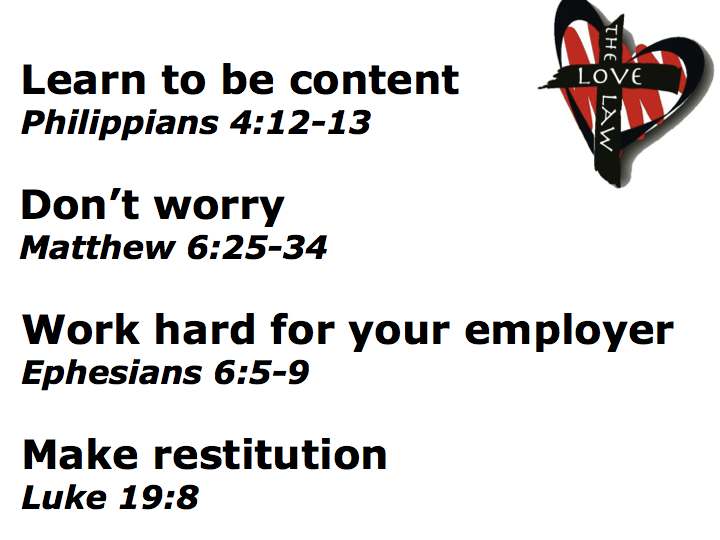
  1. Learn to be content with what you have—Philippians 4:12-13.
  2. Don’t let worry rule your life—Matthew 6:25-34.
  3. Work hard for your employer or employees—Ephesians 6:5-9.
  4. If you have stolen, make full restitution as quickly as possible—Luke 19:8.

Every one of the Ten Commandments are broken in our hearts long before they are worked out in our bodies. So listen to what the Holy Spirit is saying to you to make sure you are not a sneaky thief!

If you have missed any of the messages in our series The Love In The Law, you can find them all by clicking here.

Links & Quotes

link quote

These are links to articles and quotes I found interesting today.

4 Health Dangers Of People-Pleasing

“What is so profoundly disturbing here is that the one person who takes a specific oath to defend the Constitution—to protect the Constitution, to defend the laws of the United States and to enforce the laws—is the one bastardizing them. The rule of law is disintegrating before our eyes.” —Rush Limbaugh. Read this: How Far Can Obama Go?

Amazing story! Miracle Baby Born After Sustains The Life Of His Brain-Dead Wife

“You see, the Lord’s concept of ‘church’ is much different from ours. We think of church as being a ministry to people. It is a place where all the needs of God’s people—spiritual, physical and emotional—are met. Of course, that is all part of what makes up a church. But the true Church, according to Scripture, begins with ministry to Jesus Christ. His concept of the Church is anyplace there is ministry to Him.” —David Wilkerson

Belief in science takes faith: Statistical Errors In The Scientific Method. “Change your statistical philosophy and all of a sudden different things become important. Then ‘laws’ handed down from God are no longer handed down from God. They’re actually handed down to us by ourselves, through the methodology we adopt.” —Dr. Steven Goodman, a physician and statistician at Stanford

The Bible says God has placed eternity in every human heart. Can this be verified? Evidence Of Eternity In Our Hearts?

“With good reason the ancient proverb strongly recommended knowledge of self to man. For if it is considered disgraceful for us not to know all that pertains to the business of human life, even more detestable is our ignorance of ourselves, by which, when making decisions in necessary matters, we miserably deceive and even blind ourselves! But since this precept is so valuable, we ought more diligently to avoid applying it perversely. This, we observe, has happened to certain philosophers, who, while urging man to know himself, propose the goal of recognizing his own worth and excellence. And they would have him contemplate in himself nothing but what swells him with empty assurance and puffs him up with pride. But knowledge of ourselves lies first in considering what we were given at creation and how generously God continues his favor toward us, in order to know how great our natural excellence would be if only it had remained unblemished; yet at the same time to bear in mind that there is in us nothing of our own, but that we hold on sufferance whatever God has bestowed upon us. Hence we are ever dependent on him. Secondly, to call to mind our miserable condition after Adam’s fall; the awareness of which, when all our boasting and self-assurance are laid low, should truly humble us and overwhelm us with shame.” —John Calvin

The dangers of our national debt: America In Debt