Transforming Grace (book review)

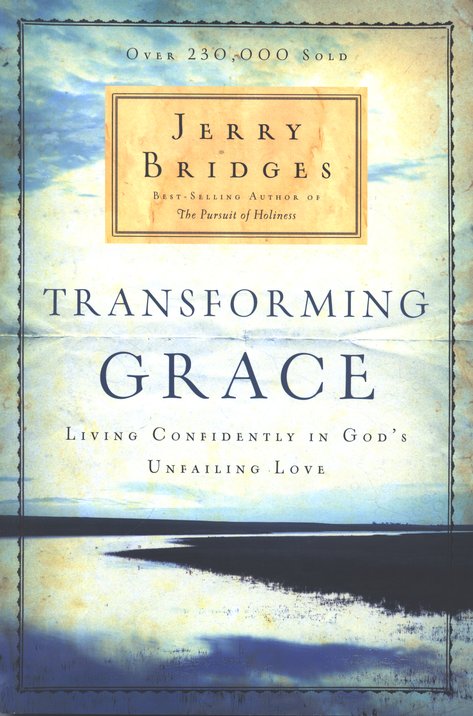
Transforming GraceWhen many people think of God’s grace, the most appropriate adjective they offer is amazing. I totally agree! And when I think of Jerry Bridges’ book Transforming Grace, the word amazing quickly comes to my mind again.

Truly this is one of the best books I have read addressing the topic of God’s grace. Bridges doesn’t range far and wide, but sticks to this one topic: when we truly begin to understand God’s grace, it will absolutely transform our lives.

Early in the book Bridges states the problematic paradigm many of us have about God’s grace—

“My observation of Christendom is that most of us tend to base our personal relationship with God on our performance instead of on His grace. If we’ve performed well—whatever ‘well’ is in our opinion—then we expect God to bless us. If we haven’t done so well, our expectations are reduced accordingly. In this sense, we live by works rather than by grace. We are saved by grace, but we are living by the ‘sweat’ of our own performance.” (emphasis added)

This book is jam-packed with so many paradigm-shifting thoughts, and is well grounded in the Scripture. Bridges transparently shares his own personal struggles with coming to grips with the true nature of God’s grace, and shares the quotes of many notable theologians as well. I loved this book!

If you want to live with a deeper understanding of how God’s grace can transform your life, I couldn’t recommend this book any more highly … this is a must read!

Delightful Fear

Delightful FearThe 112th Psalm begins with an interesting idea that almost sounds like an oxymoron: delightful fear—

Blessed is the man who fears the Lord, who finds great delight in His commands. (v. 1)

  • Fear and delight
  • Worship and obedience
  • Reverence and action
  • Awe and love

These are not contrasting ideas, but two sides of the same coin. They are completions of each other, and they are essential to a healthy relationship with Jehovah. And then, oh!, the blessings that flow from God to me!

  • Mighty children (v. 2)
  • Abundant household (v. 3a)
  • Enduring righteousness (v. 3b)
  • Brightly shining life (v. 4)
  • Reciprocated generosity (v. 5)
  • Security in troubled times (v. 6a)
  • A lasting legacy (v. 6b)
  • No fear of calamity (v. 7)
  • Eternal life (v. 8)
  • Highly honored (v. 9)

After nine verses of these amazing blessings to the one who delightfully fears God, only one verse is left for the one who doesn’t—he is vexed, wasting away, and frustrated.

I don’t know about you, but I want to delightfully fear—worship, obey, revere and love—Jehovah my God!

Links & Quotes

link quote

Some good reading & watching from today…

[VIDEO] John Maxwell has a good reminder about envy.

Watch human nature; we are so built that if we do not get thrilled in the right way, we will get thrilled in the wrong. If we are without the thrill of communion with God, we will try to get thrilled by the devil, or by some concoction of human ingenuity.” —Oswald Chambers

The study ‘provides the best evidence to date that fMRI can be used to identify consciousness in vegetative patients,’ says Russell Poldrack, a cognitive neuroscientist at Stanford University.” An amazing study that proves that vegetative patients are fully aware of their surroundings.

I am a big fan of The Overview Bible Project’s work. This is a great case study on Melchizedek.

Monergism has lots of free ebooks for you… go get ’em!

“The Gospel can be summed up by saying that it is the tremendous, tender, compassionate, gentle, extraordinary, explosive, revolutionary revelation of Christ’s love.” —Catherine de Hueck Doherty

The Love In The Law

Love In The LawWhen I say “Law” what sort of words come to your mind. Do you think of words like: restrictive? killjoy? barriers? hindrances? no fun?

If you’re a Christian, perhaps the same descriptive words come to mind when you think of biblical commandments. Maybe you think, “Don’t do that” (or for those of you who think in King James English: Thou shalt not).

But if we think of the law/commandments that way, that also means we have to think of the Lawgiver that way. In other words, God becomes a Policeman. He is closely watching to see who will break His laws so that He can dispense the appropriate punishment. After all, if the laws are a bunch of no-nos, then Someone has to be watching for law-breakers and handing out the penalties.

If that’s the case, what do we do with the Bible’s description of God that says “God is love”? If the Lawgiver is Love, how does that change our view of the laws themselves?

It must mean that God’s laws are an expression of His love. It must mean that His love is in the laws He has given us.

It must mean that God’s laws are NOT no-nos, BUT yes-yeses. 

Join us this Sunday at Calvary Assembly of God as we talk about The Love In The Law. We’ll be working our way through the Ten Commandments, especially looking at God’s love that make each commandment a giant YES for our lives. Prayerfully, this series will completely change how we view God’s laws and commands.

If you have missed any of the messages in this series, check them out here:

Inconceivable

InconceivableThe “therefores” in Scripture always intrigue me. They are a signal that there is a natural conclusion to the words that just came before the therefore, so it’s important to look at both sides.

The prophet Hosea opens his book with these words: “…the land is guilty of the vilest adultery in departing from the Lord” (Hosea 1:2). The picture is painted of God’s people acting like a wife that has not only abandoned her husband, but turned to prostitution as well. So the list of things that follow God’s therefore are what we might expect—

  • I will block your path
  • I will take away My grain
  • I will take back My wool
  • I will expose your lewdness
  • I will stop your celebrations
  • I will ruin your vineyards
  • I will punish you (Hosea 2:6-13)

Then here is what I find almost inconceivable: the very next word of the very next verse is therefore again, and God says things that, in my mind, are completely unexpected—

  • I will allure you and speak tenderly to you
  • I will restore our marriage
  • I will remove your stains
  • I will obliterate the past
  • I will betroth you to Me forever
  • I will answer your prayers
  • I will restore your crops
  • I will establish you forever
  • I will cancel your divorce
  • I will call you Mine (2:14-23)

This kind of love is mind-blowingly incomprehensible to me. It is so unexpected, so lavish, so overwhelming! This is absolutely the last thing I would have expected God to say, and yet His love is furious and relentless and boundless!

How could I ever slight such a love?!

Taste And See (book review)

Taste & SeeTaste And See is made up of 140 short, powerful thoughts from the pen of John Piper. As the title advises, these are thoughts that you will want to chew on slowly, enjoying the flavorful way Pastor Piper brings Scripture to bear on our daily lives.

Each day’s reading is short (perhaps three pages long at the most), so you would almost think you could speed-read right through it. But the limited number of words for each reading is in no way an indication of the weight of those words. Some devotionals convicted me; some brought me to tears; some made me angry; but all of them made me think differently.

If you are already familiar with John Piper’s books, Taste And See will be a welcome addition to your library. If you haven’t read anything from him yet, this book will be an excellent introduction to this wise and gentle pastor/author.

Taste And See is part of a verse of Scripture which says, “Taste and see that the Lord is good; blessed is the the one who takes refuge in Him” (Psalm 34:8). Indeed, the best part of Pastor Piper’s writings is that you will taste and see more clearly how good and worthy of praise God is!

God’s Longing

God's LongingHere’s what God says about you and me: “I long to redeem them” (Hosea 7:13). The prophet Hosea has a front row seat, watching God pursue and woo His people, and Hosea records for us God’s longing passion.

The placement of God’s declaration—I long to redeem them—is a wonder to me. It’s right in the middle of a catalogue of His people’s sins. God says:

  • Your kings fall because they don’t call on Me (Hosea 7:7).
  • You don’t realize how weak and powerless you’ve become because you won’t pray to Me (7:9-10).
  • You try to rule yourselves without consulting Me (8:4).
  • You disregard My laws as if they were irrelevant (8:12).
  • You no longer pay attention to My prophets who are calling you back to Me (9:7).

And still in the midst of all this comes, “I long to redeem them.” Astounding!

God tells us what we need to do—

Sow for yourselves righteousness, reap the fruit of unfailing love, and break up your unplowed ground; for it is time to seek the Lord, until He comes and showers righteousness on you. (10:12)

The alternative?

BUT you have planted wickedness, you have reaped evil, you have eaten the fruit of deception. Because you have depended on your own strength and on your many warriors…you will be completely destroyed. (10:13-15)

What will you choose: To seek God OR to depend on your own strength?

God LONGS to redeem you, but you have to ask Him to do so.

My Accent

My AccentThe prophet Amos opens his book with these words: The words of Amos…. Amos was the one God chose to deliver His message, and Amos never forgot that, not did he let his audience forget.

It’s not a filler phrase, but it becomes the accent by which everyone knew Amos’ voice. Over 40 times in this short book Amos uses phrases like “says the Lord,” or “declares the Sovereign Lord.” Amos constantly reminded himself and anyone who heard him speak that he was not speaking his own thoughts, but he was speaking God’s Word.

I wonder: What accent do people hear when I speak?

I want to be so full of God’s Word and His Spirit that the “says the Lord” accent is my accent.

When I speak I want people to not hear me but hear the God Who speaks through me.

My words are fallible, but God’s Word is perfect.

Jesus said that my words reflect what’s in my heart. May my accent make it so evidence that my heart is full of the Word of God.

Links & Quotes

link quote

Some good reading & watching from today…

“James has in his mind a picture of people who use prayer to try to get from God something they desire more than God [James 4:2-4]. He calls these people—men and women—‘adulteresses.’ Why? Because in his mind God is like our Husband who is jealous to be our highest delight. If we then try to make prayer a means of getting from Him something we want more then we want Him, we are like a wife who asks her husband for money to visit another lover.” —John Piper

“The greatest outward troubles and calamities that we meet with…must needs appear very little things to the misery which we have deserved.” —Jonathan Edwards

“Our Enemy is a hedonist at heart. All those fasts and vigils and stakes and crosses are only a facade. Or only like foam on the sea shore. Out at sea, out in His sea, there is pleasure, and more pleasure. He makes no secret of it; at His right hand are ‘pleasures for evermore.’ Ugh! Don’t think He has the least inkling of that high and austere mystery to which we rise in the Miserific Vision. He’s vulgar, Wormwood. He has a bourgeois mind. He has filled His world full of pleasures. There are things for humans to do all day long without His minding in the least—sleeping, washing, eating, drinking, making love, playing, praying, working. Everything has to be twisted before it’s any use to us. We fight under cruel disadvantages. Nothing is naturally on our side.” —C.S. Lewis, Screwtape writing to Wormwood in The Screwtape Letters. (In case you didn’t know, The Screwtape Letters are letters from an older demon [Screwtape] to his young apprentice demon [Wormwood]. So the “Enemy” in their correspondence is God.) 

Since I just reviewed Beyond IQ, I have been reading more about the workings of the human brain. This post—How To Rewire Your Brain For Greater Happiness—is interesting. Even though they are quoting scientific findings, everything they have “discovered” was already in the Bible!

Philip Nation has a great list of how God reveals Himself in every book of the Bible.

I love John Piper’s latest project called Look At The Book, which shows Piper teaching the Scripture. Check out this video—

9 Quotes From “Bible Reading”

J.C. RyleJ.C. Ryle’s book Bible Reading has a question repeated all throughout the book: What are you doing with the Bible? do you read it? how do you read it? This is a book that will challenge and encourage both the Bible-reading novice, and the Bible-reading veteran. You can read my full book review by clicking here. Below are some quotes that I highlighted in this powerful little book.

“This is the Book to which the civilized world is indebted for many of its best and most praiseworthy institutions. Few probably are aware how many good things that men have adopted for the public benefit, of which the origin may be clearly traced to the Bible. It has left lasting marks wherever it has been received. From the Bible are drawn many of the best laws by which society is kept in order. From the Bible has been obtained the standard of morality about truth, honesty, and the relations of man and wife, which prevails among Christian nations, and which—however feebly respected in many case—makes so great a difference between Christians and heathen.” 

“The Bible applied to the heart by the Holy Spirit is the grand instrument by which souls are first converted to God. That mighty change is generally begun by some text or doctrine of the Word, brought home to a man’s conscience. In this way the Bible has worked moral miracles by the thousands. It has made drunkards become sober—immoral people become pure—thieves become honest and violent-tempered people become meek. It has wholly altered the course of men’s lives.”

“The Bible can show a believer how to walk in this world so as to please God. It can teach him how to glorify Christ in all the relationships of life, and can make him a good leader, employee, subordinate, husband, father, or son. It can enable him to bear misfortunes and loss without murmuring, and say, ‘It is well.’ It can enable him to look down into the grave, and say, ‘I will fear no evil’ (Psalm 23:4). It can enable him to think about judgment and eternity, and not feel afraid. It can enable him to bear persecution without flinching and to give up liberty and life rather than deny Christ’s truth.” 

“The Lord God knows the weakness and infirmities of our poor fallen understandings. He knows that, even after conversion, our perceptions of right and wrong are extremely vague. He knows how artfully satan can overlay error with an appearance of truth, and can dress up wrong with plausible arguments, till it looks like right. Knowing all this, He has mercifully provided us with an unerring standard of truth and error, right and wrong, and has taken care to make that standard a written Book—the Scripture.”

“A man must make the Bible alone his rule. He must receive nothing and believe nothing which is not according to the Word. He must try all religious teaching by one simple test—Does it square with the Bible? What does the Scripture say?” 

“A false minister may say, ‘You have no right to use your private judgment: leave the Bible to us who are ordained.’ A true minister will say, ‘Search the Scriptures, and if I do not teach you what is scriptural, do not believe me.’ A false minister may cry, ‘Listen to the Church,’ and ‘Listen to me.’ A true minister will say, ‘Listen to the Word of God.’”

“Love of the Word appears preeminently in our Lord and Savior Jesus Christ. He read it publicly. He quoted it continually. He expounded it frequently. He advised the Jews to search it. He used it as His weapon to resist the devil. He repeatedly said, ‘The Scripture must be fulfilled.’ Almost the last thing He did was to ‘open their minds so they could understand the Scriptures’ (Luke 24:45). I am afraid that man cannot be a true servant of Christ, who has not something of his Master’s mind and feeling towards the Bible.” 

“Read the Bible with Christ continually in view. The primary object of all Scripture is to testify about Jesus: Old Testament ceremonies are shadows of Christ; Old Testament judges and deliverers are types of Christ; Old Testament history shows the world’s need of Christ; Old Testament prophecies are full of Christ’s sufferings; Old Testament prophecies are full of Christ’s glory yet to come. … All these shine forth everywhere in the Bible. Remember this clue, if you would read the Bible right.”

“Let us resolve to read the Bible more and more every year we live. Let us try to get it rooted in our memories, and engraved into our hearts. … Let us resolve to be more watchful over our Bible reading every year that we live. Let us be jealously careful about the time we give to it, and the manner that time is spent. Let us be aware of omitting our daily reading without sufficient cause. Let us not be gaping, and yawning and dozing over our book, while we read. … Let us be very careful that we never exalt any minister, or sermon, or book, or tract, or friend above the Word. Cursed be that book, or tract, or human counsel, which creeps in between us and the Bible, and hides the Bible from our eyes! … Let us resolve to talk more to believers about the Bible when we meet them. Sorry to say, the conversation of Christians, when they do meet, is often sadly unprofitable! How many frivolous, and trifling, and uncharitable things are said! Let us bring out the Bible more, and it will help to drive the devil away, and keep our hearts in tune.”