Leaders Are The First To Step Into The Unknown

Listen to the podcast of this post by clicking on the player below, and you can also subscribe on AppleSpotify, or Audible. 

The Jordan River was a powerful border guard. For years it had served the Canaanites well, protecting their eastern border from large-scale attacks from their enemies. Now the Jordan was all that stood between the Israelites on the east side of the river and their promised land on the west side. 

Joshua gave some unusual instructions to the priests that carried the ark of the covenant of the Lord. He told them to carry the ark while they walked into the middle of the flood-level river. He said they should trust that God would stop the flow of the river while they stood there (see Joshua 3:1—4:11). 

I can imagine the two priests carrying the ark at the front stepping into the water, feeling the current rush around their ankles, and holding their breath as they took their next steps deeper into the river. 

Step after step the two priests in front waded into the Jordan. Until finally they walked far enough that the priests carrying the ark from the back stepped into the Jordan. 

And all of a sudden, the water levels begin to go down! Lower and lower until the priests were standing on a damp riverbed that had been completely covered by water just a few minutes earlier. To their left, as they looked downstream, no water was to be seen. To their right, as they looked upstream, they might have glimpsed the wall of water piled up as the invisible Hand of God held it back. 

Only then did the Israelites began crossing the previously uncrossable river. Family after family, tribe after tribe began to march at long last into their promised land. 

   And while all Israel passed over on dry ground, the priests who bore the ark of the covenant of the Lord stood firm on dry ground in the midst of the Jordan, until all the nation finished passing over the Jordan. … For the priests who bore the ark stood in the midst of the Jordan until everything was finished that the Lord commanded Joshua to tell the people…. (Joshua 3:17, 4:10)

It was only after every Israelite had crossed the Jordan, and memorial stones had been gathered from the riverbed and carried to the shore, that the priests carrying the ark of the covenant of the Lord came across themselves. It was immediately after this that the mighty Jordan River began flowing again at full strength. 

There are two important lessons here. First, godly leaders go first. They don’t want to be first, but they want to go first in obeying God so that the way is opened for everyone else to enjoy God’s blessings. 

Second, godly leaders stand their ground until all the people enter into God’s blessing. Remember that God is patient, “not wanting anyone to perish, but everyone to come to repentance” (2 Peter 3:9). 

So leaders, let me encourage you—

Keep going first in obeying God, keep standing firm in His promises, keep showing others the path they need to follow to step into God’s blessings, and keep encouraging people to walk into that blessing. 

Don’t be slow in obeying. Don’t fear going first into the unknown. And don’t become weary or frustrated or nervous and walk away too soon. 

►► Would you please prayerfully consider supporting this ministry? My Patreon supporters get behind-the-scenes access to exclusive materials. ◀︎◀︎
Assured Expectation

Listen to the podcast of this post by clicking on the player below, and you can also subscribe on AppleSpotify, or Audible. 

A recent movie set box office records. Many Hollywood commentators are surmising that it is because the unlikely duo in the movie does something so noble at the end of the movie. Throughout the movie one of the main characters takes to calling himself “Jesus.” At the end of this movie, this character and his friend take the full brunt of the evil on them in the hopes of saving the universe. 

Of course, this storyline isn’t new to Hollywood or even in ancient literature. This epic quest is longed for in the human heart, looking for a hero to selflessly sacrifice himself to save everyone else around them. 

The only problem is that these heroes aren’t sure if their sacrifice is actually going to work. 

This, of course, isn’t the case with Jesus. Angels announce before His incarnation that He will save His people. Jesus Himself says, “I will lay down My life for My friends and I will take it up again.” And in the very last book of the Bible we read that before Time even began, Jesus was already seen as the sacrificial Lamb slain for the deliverance of His people. 

This story doesn’t start in Bethlehem, but when John 1:1 says, “In the beginning,” the language there is really saying, “From before there was a beginning, Jesus our Hero already knew the outcome of His selfless sacrifice.”  

We see hints and foreshadowing of this Most Epic Story all throughout history and throughout Scripture. Like in Psalm 132—the longest of the Songs of Ascent (at 18 verses, the next longest song is only half its length). 

(Check out all of the Scriptures in this post by clicking here.) 

The key verse (v. 10) is in the middle: it connects David and Jesus. The words “Anointed One” is one word in Hebrew: Masiah which is Messiah. In the New Testament,  the word Christ also means Anointed One. 

What do we learn in the first half of this song. It opens with the words, “O LORD, remember David…” (v. 1). 

Because this psalmist mentions the same incident that we discussed in Psalm 131, this is another reason why I think David had the incident of moving the ark of the covenant to Jerusalem in mind when he wrote the previous song (see Psalm 132:2-5; 2 Samuel 6:17). The people continued to rejoices as David made arrangements and provided building materials for his son Solomon to build the temple (vv. 6-9). 

Look at how verse 10 connects David to Jesus the Messiah. In verse 2, David swore an oath to the Lord, but he was physically unable to fulfill his promise. In verse 11 (also see 2 Samuel 7:11-16), “The Lord swore an oath to David.” 

God was able to fulfill His promise, which we see in the life, death, resurrection, and  ascension of Jesus, and then in the promised outpouring of the Holy Spirit. On the Day of Pentecost, Peter declares this in his sermon—connecting the work of Jesus to the prophesy of King David (Acts 2:22-36). 

We can sum up the first half of Psalm 132 with the words “Remember David.” And we can sum up the second half of this song of ascent with the words “Remember Jesus.”  

Remember Jesus [the] Christ, raised from the dead, descended from David (2 Timothy 2:8). 

I like this verse from the Amplified Bible: Constantly keep in mind Jesus Christ (the Messiah) as risen from the dead, as the prophesied King descended from David, according to the good news (the Gospel) that I preach.  

David swears an oath (v. 2) but has no power to fulfill it. God swears an oath (v. 11-12) and fulfills it (Luke 1:33; Revelation 11:15). 

David longs for blessings for the priests and saints (v. 10) but has no power to make it happen. God says, “I will” bless the priests and saints (vv. 13-18; 1 Peter 2:5-9; Revelation 1:6). 

All of our longings for a Hero—for salvation, for purpose, for meaning—are fulfilled in Jesus. All of God’s promises for these things are fulfilled in Jesus. All of our life should be lived in this joyful assurance (Hebrews 10:35-39; Revelation 3:11)! 

Not only should we not stumble in the homestretch, but we should live in such joyful assurance of God’s promises that we soar across the finish line! 

If you cannot remember anything else, remember David and remember Jesus. 

Check out all of the other Songs of Ascent by clicking here. 

►► Would you please prayerfully consider supporting this ministry? My Patreon supporters get behind-the-scenes access to exclusive materials. ◀︎◀︎
Don’t Stumble In The Homestretch

Listen to the podcast of this post by clicking on the player below, and you can also subscribe on AppleSpotify, or Audible. 

We’re up to Psalm 131. After this step, only three more steps to go until we reach the top! We’re almost there. We started in a dark valley surrounded by enemies that wanted to keep us in the valley, but we persevered, we matured, and now the end it almost in sight! 

Notice that David wrote this Song of Ascent, and I think he may have had a particular instance from his history in mind when he did. 

(Check out all of the verses in this post by clicking here.)

At the height of David’s success, the Bible says that, “David knew that the LORD had established him as king over Israel and that his kingdom had been highly exalted for the sake of His people Israel” (1 Chronicles 14:2). So David used his position to do something very noble: return the ark of the covenant of the Lord to Jerusalem. This was a popular decision that “seemed right to all the people” (13:3). 

But it turned out disastrously! 

One of the priests overseeing the transportation of the ark of the covenant was killed, and as a result David became angry at God and fearful of Him. 

After a cooling off time, David humbled himself. He admitted that he hadn’t “inquired of the Lord” before undertaking this task and then he looked to the Scriptures to find out how to move the ark the correct way (15:12-15). 

It’s quite possible David had this incident in mind when he wrote the Song of Ascent for people coming to worship God in the temple where the ark of the covenant of the Lord would be housed. 

The opening words sound the tone of humility—“my heart is not proud” and “my eyes are not haughty.” I think in the context of this opening verse of Psalm 131, pride can be defined as:

  1. trying to handle things on my own 
  2. concerning myself with things outside my control 

That means that humility is trusting that God is in total control. 

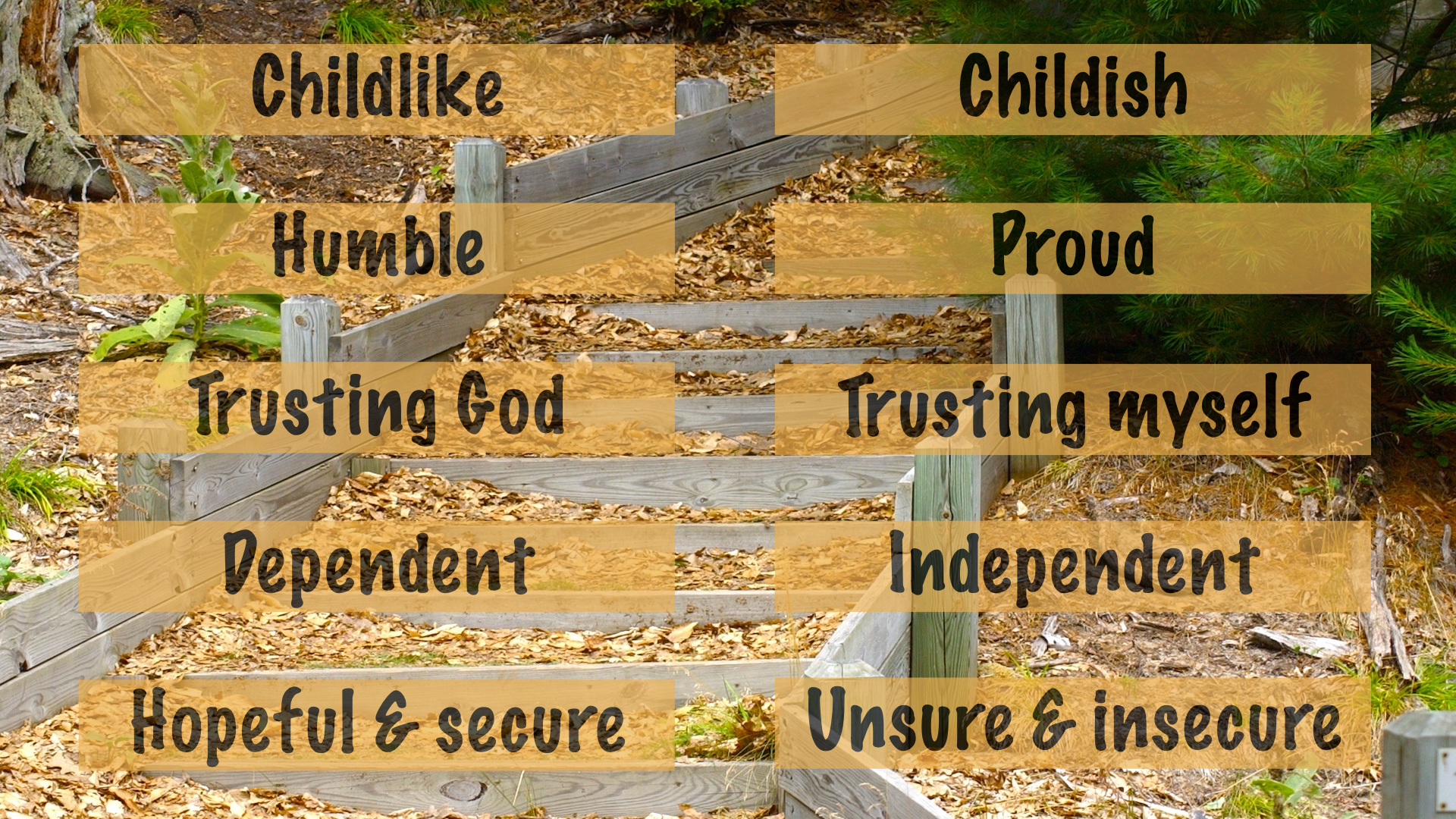
Verse 2 starts with an important word: But. Instead of the fretting of pride, David chooses the trusting of childlike humility. David says that he has “stilled and quieted my soul.” He has chosen childlike humility. 

This is exactly what Jesus told us: “Truly I tell you, unless you change and become like little children, you will never enter the kingdom of heaven.Therefore, whoever takes the lowly position of this child is the greatest in the kingdom of heaven” (Matthew 18:3-4). 

Just look at the differences between childlike and childish! 

The consistent message throughout Scripture—from Creation in Genesis 1 until the realization of our eternal reward in Heaven in Revelation 22—is childlike trust in our Heavenly Father. 

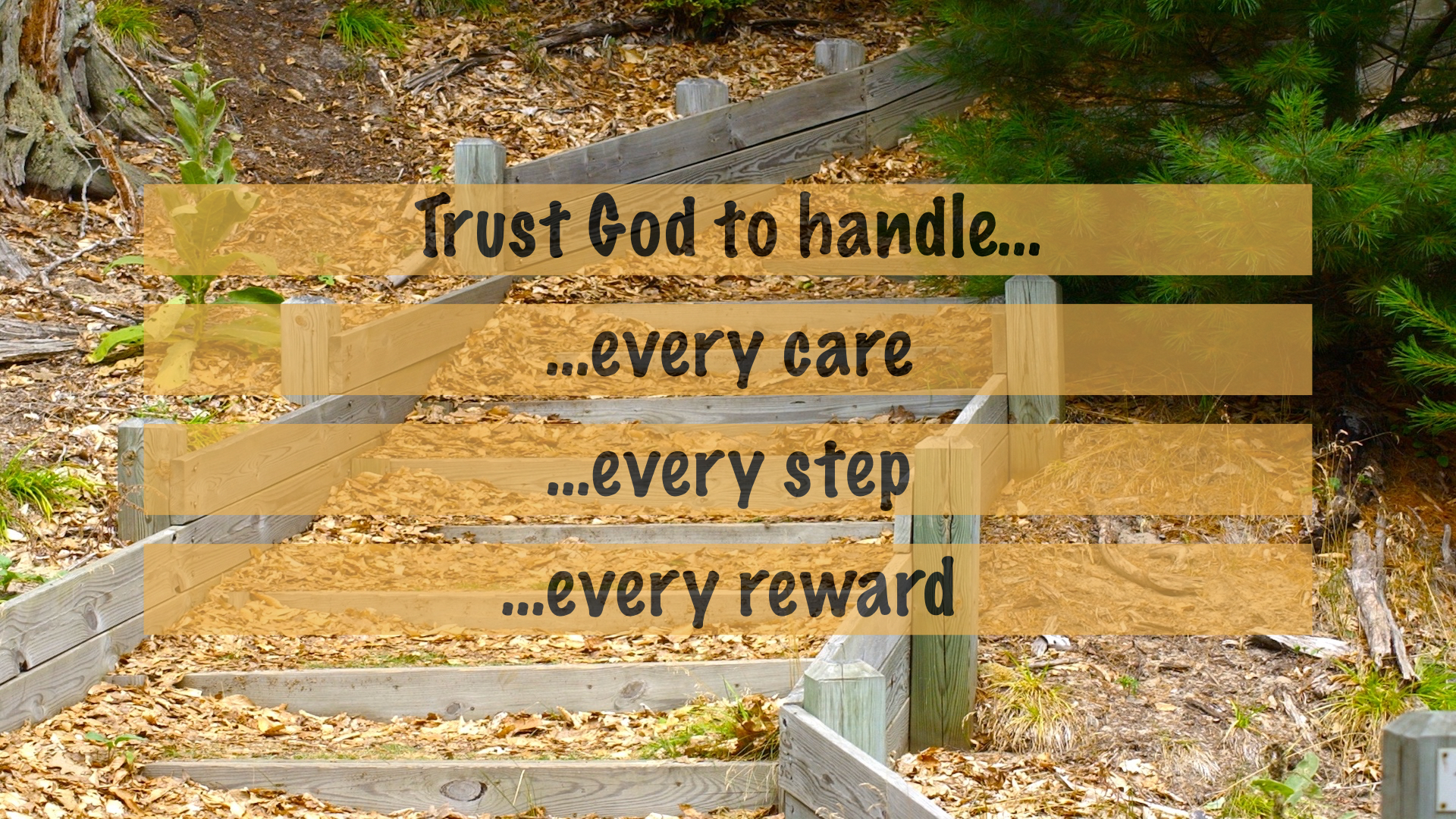
We can trust God to handle…

  • …every care—1 Peter 5:7 
  • …every step—Proverbs 3:5-6 
  • …every reward—Luke 12:32 

Don’t let pride cause you to stumble in the homestretch. The closer we get to the end of the journey, the more childlike we should become. 

If you’ve missed any of the other messages on the Songs of Ascent, you can find them all here. 

►► Would you please prayerfully consider supporting this ministry? My Patreon supporters get behind-the-scenes access to exclusive materials. ◀︎◀︎
The Mercyseat

Listen to the podcast of this post by clicking on the player below, and you can also subscribe on Apple or Spotify.

Hear my cry for mercy … He has heard my cry for mercy (Psalm 28:2, 6).

For David, his cry for mercy was never a one-and-done action. The verb in verse 2 makes this verse read more like, “Hear my cry for mercy as I am continually calling to You for help, as I am continually lifting up my hands toward Your Most Holy Place.” 

Why the Most Holy Place? What was there? Inside the Most Holy Place was the ark of the covenant of the Lord which represented the presence of God. 

What was on top of the ark of the covenant, covering and superseding the Law that was inside the ark? It was the mercyseat (or the “atonement cover” in some translations). The mercyseat is where the high priest sprinkled the blood of the sacrificial lamb every year to make atonement for sins.

Jesus became the once-for-all sacrificial Lamb to make ultimate atonement for all who would believe in Him. When Jesus had finished His work on the Cross, the curtain separating us from the Most Holy Place was torn in two. The ark of the covenant of the Lord with its covering mercyseat—the presence of God—was now accessible to all of us! It was accessible because it was in Jesus, and when I have taken Jesus as my atonement, He is in me and He takes me in to the Father. The mercyseat of my heart has been sprinkled with the blood of the Lamb (see Hebrews 9:1-5, 11-14; 10:19-22). 

Whether David was saying, “Hear my cry,” or “He has heard my cry,” the Hebrew word means to listen with interest and full attention. Whenever you pray, God listens to you with interest and full attention because you are praying right in His presence! Your very breath can be a continual crying, a continual lifting of your voice toward the mercyseat where God meets with you! 

God is not far away from us. He is closer than we usually think. That’s why David says, “My heart leaps for joy, and with my song I praise Him”! 

Keep this in mind the next time you are asking God to hear your cry: He listens to you with full attention because Jesus has taken you right into His presence.

Would you please prayerfully consider supporting this ministry?

When To Seek Consensus

David conferred with each of his officers…. He then said to the whole assembly of Israel, “If it seems good to you and if it is the will of the Lord our God…let us bring the ark of our God back to us….” The whole assembly agreed to do this, because it seemed right to all the people. (1 Chronicles 13:1-4) 

David cast a vision, consulted with his inner circle of leaders, shared the vision with the people, and got unanimous agreement from everyone. 

And yet things went horribly wrong: a man was killed and David became terrified of God.

In the above verses, notice all of the plural pronouns: we and us. David worked hard to build a consensus among the people. 

David was quick to notice that the ark of the covenant of the Lord wasn’t used to consult God during the reign of King Saul (v. 3), but that’s exactly what David didn’t do. He built a consensus among the people without getting a “yes” from God. Even a unanimous decision of the people will fail if God isn’t in it! 

Thankfully, in chapter 15, David corrects this omission. We read phrases like: 

  • “we did not inquire of [God] about how to do it in the prescribed way” 
  • we should do this “in accordance with the word of the Lord” 

I also notice that David no longer sought consensus but merely announced to the people what was happening. In this successful attempt to move the ark, David’s only consultation was with God. After that, he made arrangements with the Levites, gathered his inner circle of leaders, and then asked the people to join in the celebration. 

God had already spoken about how the ark of the covenant was to be moved: it was written in His word. Therefore, as noble as it might sound, there was no reason for David to seek a consensus from the people.

Even if it is not an area or activity explicitly addressed in the Bible, God’s will is to be sought before others are consulted. If God says “yes,” the leader must proceed even if the people say “no.” And the leader must not listen to the people’s “yes” if God has said “no.” 

Consensus is fine in its place, but only in its proper place. 

A mark of a godly leader is one who knows when to seek consensus among the people.

This is part 53 in my series on godly leadership. You can check out all of my posts in this series by clicking here.

How Confident Are Your Prayers?

David hasn’t done anything wrong. He’s never tried to lead a rebellion against King Saul. In fact, he’s never even talked poorly about Saul. And yet Saul is out to kill David!

David tries to get as far away as he can, choosing to live in the desert so that he might get some relief from Saul. Still Saul comes after him with a force of 3000 men! Every time David moves, Saul’s men are hot on his trail. David described his situation like this

My mortal enemies surround me. Their hearts are cold and calloused toward me, and they speak terrible things about me. They track me down and surround me. They are like hungry lions, crouching, waiting to pounce on me!

If you were in David’s sandals, how confident would you be that God could get you out of the situation? Remarkably, David’s confidence was as high as it could be!

David not only was confident that God would hear him, but that He would listen to him. More than that, David knew God would pay attention to him. And then David boldly said, “I call on You, O God, for you WILL answer me.”

How could David pray such a confident prayer? The answer is in this principle…

There is a direct correlation between intimacy and confidence.

David made two very intimate claims about his relationship with God:

  1. You will keep me as the apple of Your eye
  2. You hide me in the shadow of Your wings

The apple of the eye is the pupil. Our eyes are amazingly designed to not only take in information but to protect themselves. If something is getting too close to our eye, the eyelids blink in protection faster than we can consciously tell them to. So David was claiming that God would protect him by reflex!

The shadow of Your wings was a reference to the top of the Ark of the Covenant; a place called the mercy seat. Here is where the priest sprinkled the blood of a sacrificial lamb to atone for the people’s sin and to appeal to God’s mercy. The mercy seat was over-shadowed by two angels’ wings.

David was saying that God kept him in this intimate place—covered by God’s mercy and protection!

Jesus also told us about intimate confidence when He said, “If you remain in Me, and My words remain in you, ask whatever you wish, and it will be given you” (John 15:7).

  • Intimacy: remain IN Jesus, and let His words remain IN you
  • Confidence: ask whatever you wish, and it will be given you

Are your prayers this confident? If not, don’t work on raising your confidence, but work on increasing your intimacy. Check your intimacy level with questions like:

  • Am I abiding in Jesus?
  • Are His words abiding in me?
  • Do I have any unconfessed sin?
  • Is my prayer a “Your kingdom come, Your will be done” prayer?

Focus on intimacy, and then watch your confidence soar! 

If you are interested in learning more about the prayers of David, I have also discussed his prayer for help, his prayer of crying out loud, and his prayer of praise.

Gems

GemsDo you ever get lost in the “begats” of the Bible? You know those long, tedious lists of who was born to whom? In 1 Chronicles there’s an equally long list of names that goes on for five chapters(!) of who’s in charge of what. But be careful not to skip over these lists. The Holy Spirit included them in the inspired Word of God for a reason, and sometimes you find some real gems buried in these lists.

Here are a few that I recently unearthed…

For David had said… (1 Chronicles 23:25)—David’s heart was so closely knit with God’s heart that the words he spoke were God’s words coming through David’s mouth, as he gave instructions about how worship in the tabernacle should be conducted.

David, together with the commanders of the army, set apart some of the sons of Asaph… (25:1, 3, 7)—Asaph, Hemen and Jeduthun prophesied through their singing in the tabernacle. They didn’t compose music and sing to entertain, but to call people to God. Notice, too, that all of the worship leaders in the tabernacle were “trained and skilled in music for the Lord.” Those God calls, He equips.

For God had blessed Obed-Edom… (26:5-8)—The Ark of the Covenant—the symbol of God’s presence—had been housed in Obed-Edom’s home. God’s presence produces blessing! Listen to how Obed-Edom’s descendants are described:

  • Leaders
  • Capable men
  • Able men
  • Capable men with the strength to do the work

Elihu… (27:18)—Even David’s older brother chose to serve him.

Hushai the Arkite was the king’s friend… (27:33)—In the listing of all the court officials, here is a man with no other title than David’s friend.

God’s Word is alive! Ask the Holy Spirit, Who inspired the men who penned these words, to give you fresh revelation as you read the Bible. Then prepare to be amazed at the gems He will reveal to you!

A Caution About Success

CautionAfter King David had been firmly established as the king of Israel, he wanted to show the world how devoted he was to God, and undertook to bring the ark of the covenant to Jerusalem.

This move came after “David knew that the Lord had established him as king” and “that his kingdom had been highly exalted for the sake of God’s people” (2 Samuel 5:12; 1 Chronicles 14:2). David also asked the people about bringing the ark to Jerusalem and “it seemed right to all the people” (1 Chronicles 13:4).

Hooray! It sure sounds like David is using his new position as king to do something wonderful for his people. But…

Even with David’s knowledge that God had established him, David proceeded in a way that was displeasing to God, by attempting to move the ark in a way that God never sanctioned (2 Samuel 6:3; 1 Chronicles 13:7).

When things are going well and there seems to be a lot of positive momentum, we cannot abandon the things that brought God’s success in the first place! 

David had a habit of inquiring of God (2 Samuel 5:19, 23; 1 Chronicles 14:10, 14) which had led to his God-given success (1 Chronicles 14:17). But in the excitement of moving the ark, and the applause of the people David said, “We did not inquire of Him” (15:13) nor did they undertake the task “in accordance with the Word of the Lord” (15:15).

CAUTION!!! We can never be too careful about inquiring of God nor consulting His Word. A danger of success is that we abandon those things which God blesses and simply ride the positive momentum of the moment. No matter how popular or obvious a thing may seem, don’t forget to pray about it and consult God’s Word about it!

Who Are You Talking To?

I love team leadership. I really enjoy getting a group of creative thinkers around me to do some serious brainstorming. I find it so beneficial to seek out the counsel of some wise people who have been around for a while.

But, let’s see, who have I left off this list?

Oh, yeah, I remember now—I didn’t consult God!

Be honest: have you ever done that? Have you ever consulted with a lot of wise—even God-fearing—people, but forgotten to consult with God Himself? If you have (and I certainly have), we’re in good company.

When King David got ready to move the ark of the covenant to Jerusalem, the Bible says,

David conferred with each of his officers….

How’d that work out for him? Not so good.

  • Uzzah died
  • David got mad at God
  • David got scared of God
  • The ark’s arrival in Jerusalem was delayed another three months

Then David had his “Oh yeah!” moment. When he got ready to try again, David said,

We did not inquire of God about how to do it in the prescribed manner….

So here’s my simple reminder to myself (and to you too): It’s fine to consult with others, but consult with God first.