Likeminded

Listen to the podcast of this post by clicking on the player below, and you can also subscribe on AppleSpotify, or Audible. 

How many friends do you have? I don’t mean your “friend count” on Facebook, because you and I both know that some of your “friends” aren’t really those people with whom you would share confidential information.

No, I mean real friends.

There were few people as well-known in his day as the apostle Paul. His missionary journeys took him all over the place. The stories he could tell about his adventures would keep an audience glued to their seats. He knew church leaders and governmental officials. He planted churches and trained pastors. If ever there was someone that would have had a full list of friends on Facebook, it would have been Paul.

Yet here’s what he writes to the church at Philippi:

I have no one else like Timothy, who takes a genuine interest in your welfare. For everyone looks out for his own interests, not those of Jesus Christ. (Philippians 2:20-21)

Among other things, Paul says Timothy is:

  • A servant (Philippians 1:1)
  • Trustworthy (2:19)
  • Faithful (2:20)
  • Christ-focused (2:21)
  • A hard worker (2:22)

Yet when Paul says. “I have no one like him,” he uses a Greek word only used once in all of Scripture. The King James Version translates this word likeminded. This word means equal in quality and quantity of soul.

In other words, of all of the people that would be considered a “friend” of Paul, only one—Timothy—did Paul call likeminded: someone who was Paul’s equal in soul.

If that type of friendship was rare for Paul, how much more so for you and me?

God may only bring one likeminded friend into your life (as He did with Paul). If you have that one likeminded friend, cherish that relationship and give God thanks for it! How blessed we are when we have a friend we can call likeminded!

►► Would you please prayerfully consider supporting this ministry? My Patreon supporters get behind-the-scenes access to exclusive materials. ◀︎◀︎

Myopia

Myopia is also known as nearsightedness. It occurs when light entering the eye is focused incorrectly, making distant objects appear blurred. Nearsightedness is a type of refractive error of the eye. If you are nearsighted, you have trouble seeing things that are far away.

Myopia is a problem physically and spiritually.

Consider the Apostle Paul. He was in prison, and yet he wrote:

Because of my chains, most of the brothers in the Lord have been encouraged to speak the Word of God more courageously and fearlessly. (Philippians 1:14)

The definition of nearsightedness says that an incorrect refracting of the light makes far object blurry, so we tend to focus only on what’s near to us.

How many of us would have blamed Paul if from his prison cell he cried out, “Why me, O God? What have I done wrong? Please get me out of here!”

This would have been a very myopic view, where Paul was only concerned about what was close; namely, himself and his needs! But Paul allowed the light of God to be properly refracted in his spiritual sight, and he could see the big picture.

As a result of his imprisonment, many other brothers were now encouraged to speak out more boldly than before. 

If you’re going through some trying times, don’t give in to myopia. Lift up your spiritual eyes to your loving Heavenly Father. He can shine the light of His Holy Spirit in a way that just may help you to see what He is accomplishing. Through this you will be encouraged AND be an encouragements to others.

As Billy Graham noted, “Courage is contagious. When a brave man takes a stand, the spines of others are often stiffened.”

What Is Happening Is God Is Happening

The Apostle Paul is in prison and on trial for his life, and yet he pens these words: 

Now I want you to know, brothers, that what has happened to me has really served to advance the gospel. (Philippians 1:12) 

Huh?! How can being in prison be a good thing?

First of all, the word know here means experiential knowledge; the kind of insight you only get from personal, intimate, hands-on experience. No one can teach you this, you just have to know it through experience. In essence, Paul is saying, “It might look like a setback from where you’re seated, but I know personally that this is a good thing!” 

Then notice the phrase has happened (I also like this in the King James Version: has fallen out). This isn’t the best translation of this phrase from Greek to English. It’s what is called the middle voice, so that means it’s in the present and imperfect tense. My translation:

It’s happening right now AND it’s not done yet!

  • IF I mean it when I pray, “Your Kingdom come, Your will be done on earth as it is in Heaven…”
  • IF I truly understand that God is working all things together for His glory…
  • IF I really believe that God is directing my steps…
  • THEN I can know that what IS happening IS a God-thing! 

God is up to something that will glorify His name!

And I’m a part of what IS happening to fulfill God’s plan!

So if things aren’t looking too good (even if you’re in prison or on trial for your life!), take note—GOD IS STILL UP TO SOMETHING AND IT’S A GOOD GOD-THING!

11 Quotes From “The Greatest Thing In The World”

I loved the depth of insight about love from Henry Drummond’s short book The Greatest Thing In The World. This book dives into the definition of love that the Apostle Paul gives us in 1 Corinthians 13. To read my full review, and find the links for a free download of this book, please click here.

These are 11 of my favorite quotes from this book.

“Charity is only a little bit of love, one of the innumerable avenues of love, and there may even be, and there is, a great deal of charity without love. It is a very easy thing to toss a copper to a beggar on the street; it is generally an easier thing than not to do it. Yet love is just as often in the withholding. We purchase relief from the sympathetic feelings roused by the spectacle of misery, at the copper’s cost. It is too cheap—too cheap for us, and often too dear for the beggar. If we really loved him we would either do more for him, or less.”

“We hear much of love to God; Christ spoke much of love to man. We make a great deal of peace with heaven; Christ made much of peace on earth.”

“[Patience] is the normal attitude of love; love passive, love waiting to begin; not in a hurry; calm; ready to do its work when the summons comes”

“Love waives even self-satisfaction.” 

“Politeness has been defined as love in trifles. Courtesy is said to be love in little things.”

“The peculiarity of ill temper is that it is the vice of the virtuous. …No form of vice, not worldliness, not greed of gold, not drunkenness itself, does more to unchristianize society than evil temper. For embittering life, for breaking up communities, for destroying the most sacred relationships, for devastating homes, for withering up men and women, for taking the bloom of childhood, in short, for sheer gratuitous misery-producing power this influence stands alone.”

“Souls are made sweet not by taking the acid fluids out but by putting something in—a great love, a new spirit, the Spirit of Christ. Christ, the Spirit of Christ, interpenetrating ours, sweetens, purifies, transforms all.”

“Willpower does not change men. Time does not change men. Christ does.”

“What we are stretches past what we do, beyond what we possess.”

“Never offer men a thimbleful of gospel. Do not offer them merely joy, or merely peace, or merely rest, or merely safety; tell them how Christ came to give men a more abundant life than they have, a life abundant in love, and therefore abundant in salvation for themselves, and large in enterprise for the alleviation and redemption of the world. Then only can the gospel take hold of the whole of a man, body, soul and spirit, and give to each part of his nature its exercise and reward. … Only a fuller love can compete with the love of the world.” 

“No worse fate can befall a man in this world than to live and grow old alone, unloving and unloved.”

Counterculture

[koun-ter-kuhl-cher] noun the lifestyle of those people who reject or oppose the dominant values and behavior of society.

In Ephesians 4:17 Paul tells his audience “you must no longer live as the Gentiles do.” Okay, but his audience was made up of, um, Gentiles! Paul was not telling them to change their heredity, but to change their mindset.

He was asking them to live counterculture. 

If the Apostle Paul was writing to us in America today, no doubt he would tell us: you must no longer live as the Americans do.

Here is the Christian Counterculture:

  • Speak only what’s true
  • Deal with your anger quickly and productively
  • Have a strong work ethic
  • Only speak wholesome words
  • Please the Holy Spirit in all you do
  • Get rid of unbecoming behaviors
  • Be kind to everyone
  • Be compassionate toward everyone
  • Be forgiving of everyone
  • Imitate Christ
  • Remain sexually pure
  • Don’t be greedy
  • Don’t use obscenities
  • Be perpetually thankful

(You can find all of these in Ephesians 4:24-5:4.)

That’s a lot to work on! But as a Christian I want to exhibit a lifestyle that rejects the dominant values and behavior of American society.

With God’s help, I want to live counterculture.

Praying With Imagination

Check out Paul’s prayer in Ephesians 3:14-21. Seriously, go ahead and read it, I’ll wait for you…

Paul’s desire is for us to follow his lead and pray with greater imagination. He doesn’t want shallow, status quo, static prayers. He wants us to go into something deeper, dynamic, unexperienced!

God has glorious riches without end…

…why would we simply ask for table scraps?

The Holy Spirit has unlimited power to pour through our lives…

…why would we try to box Him in? 

Jesus has a deeper faith to come alive in us…

…why are we only dabbling in it?

God has no limit to His depth…

…why are we content with a surface experience?

The Holy Spirit can give us power to operate in a new dimension…

…why are we happy with our ordinary three dimensions?

Christ dies to bring us into an unimaginable love relationship…

…why would we keep Him at arm’s length?

God has no limit to His height…

…why don’t we raise the bar?

God can do more than we can ask or imagine…

…why is our imagination so limited?

Holy Spirit, expand my holy imagination! 

Lord, help my prayer life to be worthy of Your greatness!

Praying For Your Healthy Friends

When do people typically ask you to pray for them? My guess it’s when things aren’t going so well for them.

How about you? When do you usually ask others to pray for you? When things are going well, or when you’re in a tough spot.

Why is it that we usually only think about prayer for sick friends or for friends in desperate need?

The apostle Paul wrote a letter to the Christians at Ephesus to encourage them. This church, as far as we know, wasn’t asking Paul for advice, and they weren’t facing intense persecution. They were mostly a spiritually healthy group.

So Paul wrote this to his healthy friends—

I have not stopped thanking God for you. I pray for you constantly. (Ephesians 1:16)

Paul went on to share with us his prayer for strong, spiritually healthy people (vv. 17-22). He asked God to make his healthy friends even stronger. He asked God to give them:

  • a super-abundance of the Holy Spirit
  • more wisdom and revelation
  • deeper intimacy with God
  • greater hope
  • greater power
  • and more strength

I’m not suggesting we stop praying for people in need. We definitely need to keep doing that. But perhaps it’s time to make a list of your healthy friends, and ask God to give them even more of Himself!

Pastoral Submission

What do you think of when you hear those words pastoral submission?

We may not be on the same page about this yet. I don’t mean people in a congregation submitting to a pastor. I mean something deeper than that.

Allow me to start with an unusual verse for this topic. Paul wrote,

When Peter came to Antioch, I opposed him to his face… (Galatians 2:11).

First of all, this is the proper way to handle an issue like this. Paul didn’t talk to others, nor run to the leaders in Jerusalem, but he went one-on-one with Peter.

Consider Paul’s relationship to Peter if there was a “corporate flowchart” for the First Century Church—Peter would have been Paul’s superior. Yet, Peter not only received this correction from Paul but continued to speak highly of Paul.

Beginning in the first chapter of Galatians we see Paul’s level of accountability. He answered to God, but he also submitted to other church leaders. Not only that, but this passage (Galatians 2:7-9) tells us that other church leaders submitted to Paul.

When I know God has called me, and I am doing my work for His approval alone, and when I know God has called others, and they too are ministering only for His approval then we can mutually submit to one another.

It’s not a top-down hierarchy in the church, except for Jesus being the Head and all others are below Him. All others (clergy and congregation) in the Body of Christ are on equal standing—no one is more important than any other. Therefore, as we submit to Christ’s Headship, we can also mutually submit to others in the Body.

What keeps us from doing this? Pride! We say, “What will others think of me if I submit?” Pastors think, “If I submitted to someone in my congregation, how could I ever lead this church? People will take advantage of me! No one will ever listen to me again!”

Not true!

When I am fully submitted to Christ, there is no stronger grounds for SERVANT leadership.

I don’t pastor to lead; I pastor to serve. 

I’m not building my church; I’m building Christ’s church. 

I’m not growing my followers; but followers of Jesus. 

Holy God, help me to know who I am in You. You have called me to pastor, so I am Your servant. Help me kill my pride! Help me serve and submit. Help me to build Your Church.

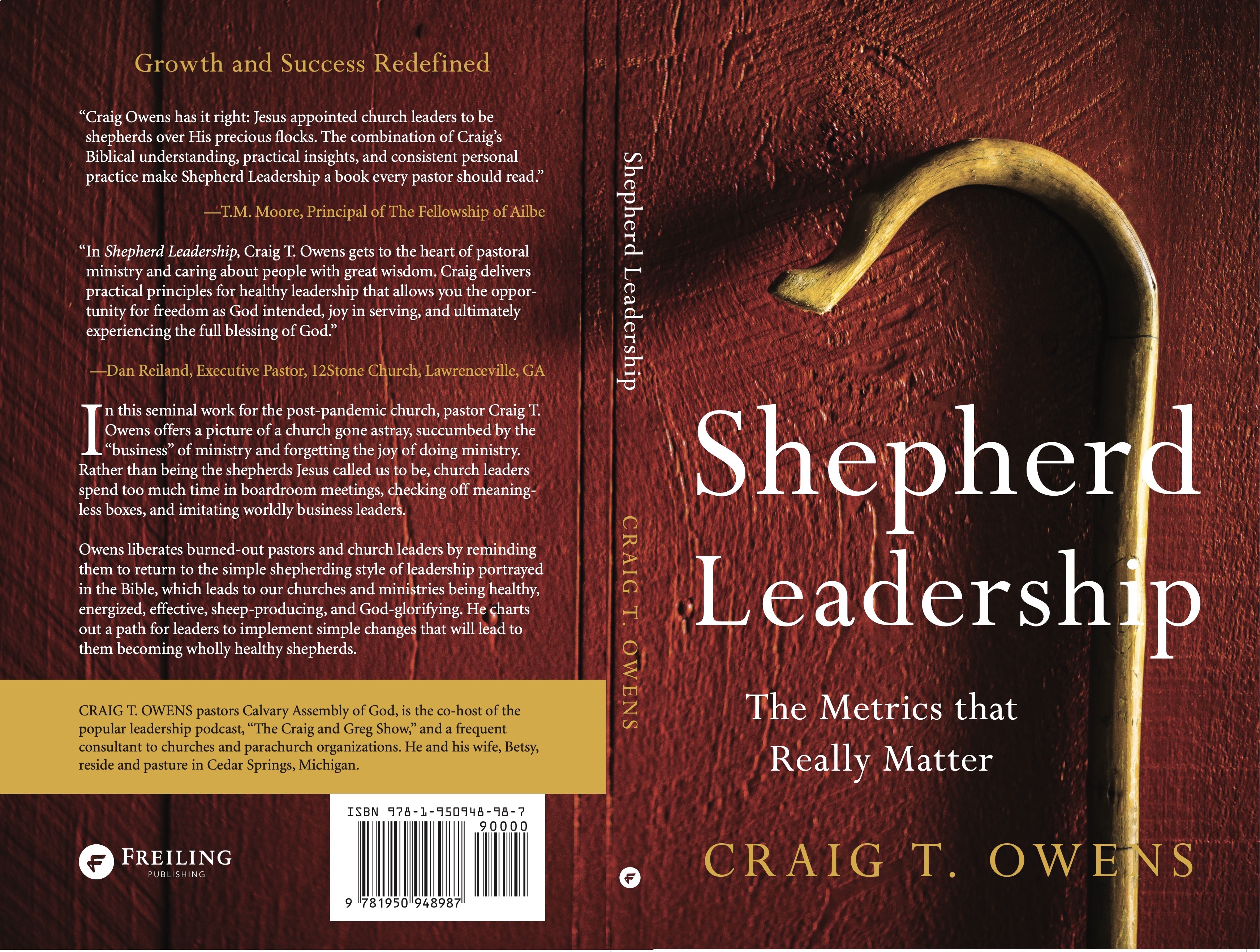
UPDATE: This post was one of the seed thoughts that went into fashioning my book Shepherd Leadership: The Metrics That Really Matter.

The Scriptures Foresaw

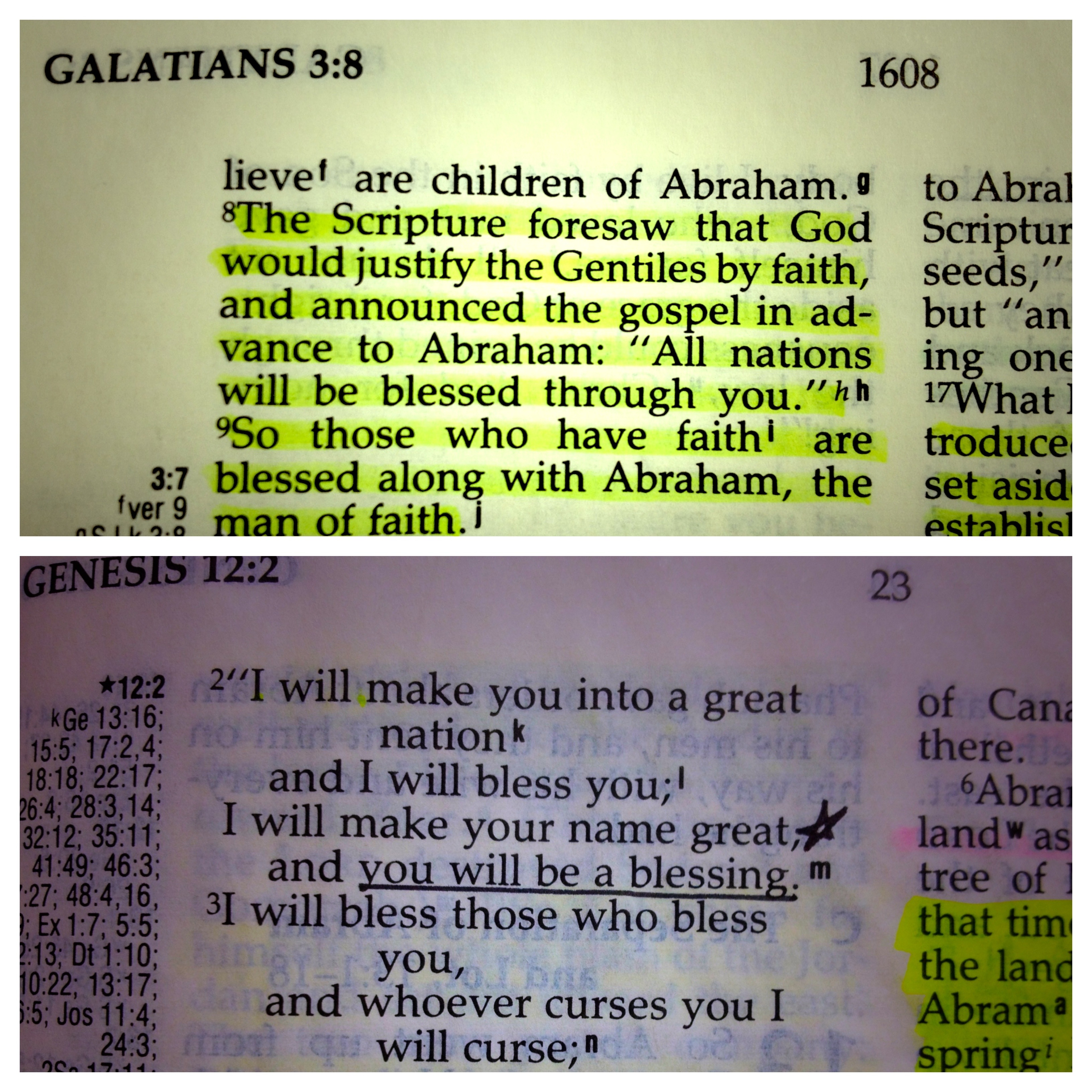
Check out this passage from Galatians 3:8-9—

The Scripture foresaw that God would justify the Gentiles by faith, and announced the gospel in advance to Abraham: “All nations will be blessed through you.” So those who have faith are blessed along with Abraham, the man of faith.

God’s Word is a living Word. They are not merely ink on a page. They are the very words of God.

God’s Word never stops working. God made a promise to Abraham 3000 years before Paul saw it being fulfilled in the Galatian believers. And now, another 2000 years after that, it’s still being fulfilled in ALL who come into a relationship with God through Jesus Christ!

These words are not past tensethose who have faith ARE blessed. They apply to me, today, now, just as much as the day they were spoken by God 5000 years ago! And they apply to you too.

Let this soak in…

Not one promise in the Bible will expire. 

Not one command will become irrelevant. 

Not one precept will ever be out-of-date.

Living. Active. Personal. Real. Present tense. Now!

Do you believe it?

Do you live like you believe it?

Miserable

The Apostle Paul asked the Christians in Galatia an important question:

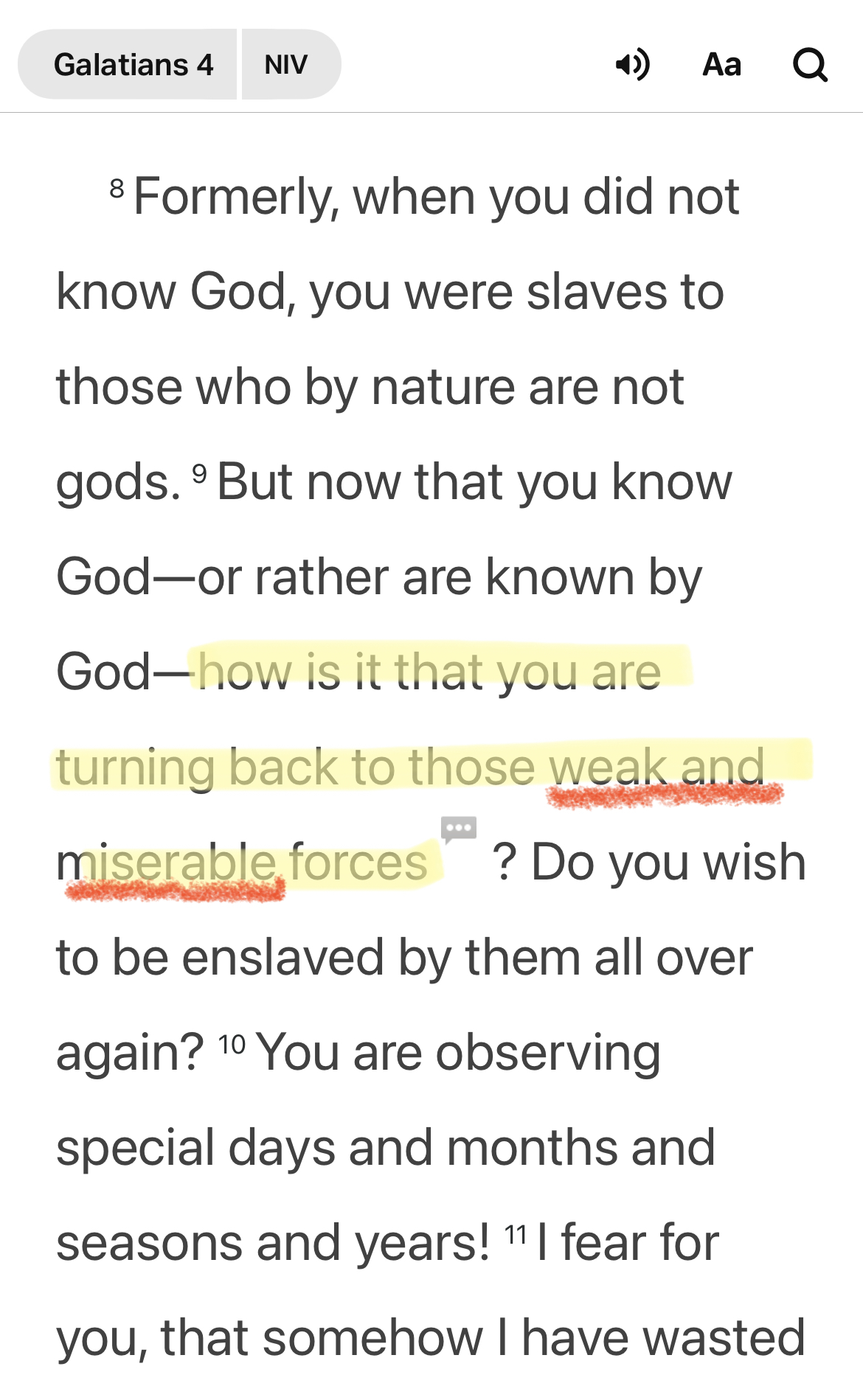
How is it that you are turning back to those weak and miserable principles? (Galatians 4:9)

The two words together in the Greek—weak and miserable—imply things that impoverish us and reduce us to lowly paupers and beggars. That’s not a pretty picture!

Look at the contrast between the princely life and the pauper’s life.

Those who follow Christ:

  • Are called sons of God (Galatians 4:6a)
  • Experience Abba Father’s favor (4:6b)
  • Are heirs to God’s Kingdom (4:7)

Those who don’t follow Christ:

  • Live as slaves (4:7)
  • Are separated from God’s favor (4:1-3)
  • Live as miserable beggars (4:9)

Why would anyone choose the miserable beggar’s life?

Here’s the principle: Everyone serves someone! I will either serve God and be called His son, or I will serve myself (my desires, my passions, my way of doing things) and be called a stranger to God.

Do I want to be in control, or do I want to let God be in control? When I try to control my own life, not only am I not in control, but I actually become a slave to my own passions. Ironic, isn’t it?

The choice is simple, but the choice must be made every day. I must choose to serve God in every moment of every day. It’s the only way to avoid the miserable life, and live the blessed life God has for me.