Questions Christians Hope No One Will Ask (book review)

Apologetics is not the right way to ask forgiveness. Apologetics is the art and science of defending what you believe. One of the most accessible apologists we have is Mark Mittelberg and his very helpful book Questions Christians Hope No One Will Ask.

I have taken a passage from the Bible as my guideline for defending the Christian faith. The Apostle Peter wrote:

But in your hearts set apart Christ as Lord. Always be prepared to give an answer to everyone who asks you to give the reason for the hope that you have. But do this with gentleness and respect, keeping a clear conscience, so that those who speak maliciously against your good behavior in Christ may be ashamed of their slander. (1 Peter 3:15-16)

Focus on Christ … Be prepared to answer … Answer gently and respectfully. In this book, Mark Mittelberg arms Christians with information to help them do just that. He doesn’t shy away from the tough questions like the apparent disharmony between Science and the Bible, or God’s existence, or Christ’s divinity. All of these he addresses using Scripture, philosophy, science, and logic. Mittelberg frequently quotes both Christian and atheist apologists to help make his point. And he does so very winsomely.

Each chapter is designed as sort of a lecture and lab. Mittelberg teaches, and then he walks through some possible conversations and objections an atheist or non-Christian may have about Christian’s beliefs. s

It’s a helpful and enjoyable read.
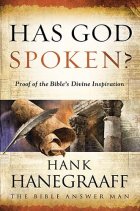
Has God Spoken? (book review)

The Bible has quite a bit to say about apologetics — defending what you believe. Paul tells Christians to study God’s Word so that we won’t be ashamed of it, and Peter tells Christians to always be prepared to answer anyone who questions our faith in Christ. But how do we know the Bible is true? Hank Hanegraaff’s latest book, Has God Spoken?, is an excellent resource to help you answer that question.

You may know Hank as host of the Bible Answer Man, and have come to appreciate his wit and wisdom. In Has God Spoken? you will be well-armed to answer any critics who claim that the Bible is not all that Christians claim it to be.

And I love the format that Hank uses to share all of his wisdom. Just like musicians learned their musical notes through such statements as, “Every Good Boy Deserves Fudge,” Hank uses a variety of acrostics to make his evidence so easy to recall. In addition, this book is fully documented, with nearly 100 pages of endnotes, so you can dig a little deeper into the evidence and proofs that he presents.

The puritan pastor Thomas Watson wrote, “The Bible is a rock of diamonds, a chain of pearls, the sword of the Spirit; a chain by which the Christian sails to eternity; the map by which he daily walks; the sundial by which he sets his life; the balance by which he weighs his actions.” But if someone ever doubts the accuracy, inspiration and inerrancy of the Bible, he will never know the treasures and life resources within its pages. That’s why this book is so valuable, and I highly recommend it to both Bible believers and Bible skeptics.

I am a Thomas Nelson book reviewer.

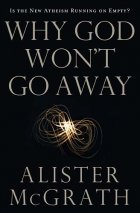
Why God Won’t Go Away (book review)

Allister McGrath is a genius at pointing out the flaws in the arguments that atheists use. So if you would like to know how to pick apart the theories of the leading atheists of our age, Why God Won’t Go Away: Is The New Atheism Running On Empty is just the book for you.

One of the things I appreciate about Dr. McGrath is his humble attitude. He is an extremely learned man, and could probably not only win a debate, but emotionally crush his debating partner in the process. Instead, you can sense the love and humility underlying all of his arguments. But make no mistake: his love in no way diminishes the sheer force of his intellectual prowess.

Why God Won’t Go Away gives the reader some valuable insights into the “four horsemen” of the New Atheism movement: Richard Dawkins, Christopher Hitchens, Sam Harris and Daniel Dennett. Then Dr. McGrath systematically breaks-down their arguments using reason, science, history and fact. Although he points out the intimidation and ridicule that the New Atheists seem to resort to, Alister McGrath never even hints at a Christian using these tactics.

Another thing I appreciate about this book, is that there is enough information here to help the reader learn how to defend themselves against the arguments of an atheist friend, but the topics aren’t so complicated that it requires an advanced college degree to grasp.

I thoroughly enjoyed reading this book, and I think you will too.

I am a Thomas Nelson book reviewer.

Dichotomy & Ricky Gervais

Dichotomy is a big word that means two parts that are opposed to each other. But it also means that they were once joined together—they were once in unity. Much like the first Christians: when people looked at them they saw Jesus; when they heard them speak they heard Jesus; when they watched their lives they saw the life of Jesus.

Christ and Christian were the same unified picture.

Today this is, sadly, far from the truth. People have a lot of wonderful things to say about Jesus, and a lot of nasty things to say about Christians. An unfortunate, and unnecessary, dichotomy exists.

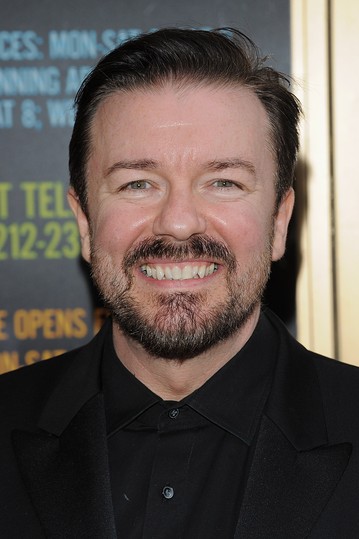
I read an editorial from Ricky Gervais, a self-proclaimed atheist, entitled “Why I’m A Good Christian.” You can read his full editorial in the Wall Street Journal here, but for me this was the key passage:

I am of course not a good Christian in the sense that I believe that Jesus was half man, half God, but I do believe I am a good Christian compared to a lot of Christians.

It’s not that I don’t believe that the teachings of Jesus wouldn’t make this a better world if they were followed. It’s just that they are rarely followed.

Gandhi summed it up really. He said, “I like your Christ, I do not like your Christians. Your Christians are so unlike your Christ.”

I have always felt this way, even when I believed in God, and in a weird way I feel I am still a pretty good “Christian” who doesn’t believe in God.

I think the way back from this dichotomy is two-fold:

(1) Christ-followers need to make an intentional effort to act more Christ-like.

(2) We Christians need to be more thoughtful in our responses to people like Ricky Gervais. I like the pattern Peter recommends

Honor Christ and let Him be the Lord of your life [our motivation for action]. Always be ready to give an answer when someone asks you about your hope [“hope,” not theology, not bad behavior]. Give a kind and respectful answer and keep your conscience clear [there is zero justification for a Christian to give a crass, disrespectful, or sarcastic answer]. This way you will make people ashamed for saying bad things about your good conduct as a follower of Christ [good conduct = we live, talk, and act like Jesus].

C’mon, followers of Christ, let’s close this dichotomy between us and Jesus!

Books I Read In 2010

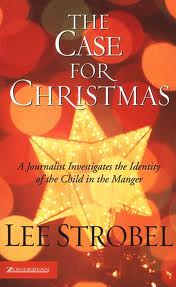
The Case For Christmas (book review)

Virgin birth? The accuracy of the biblical account? God in flesh? These are all intriguing questions that crop up especially around the Christmas season, which is why The Case For Christmas by Lee Strobel is a timely read.

Lee Strobel investigates the fantastic claims that Christians make about the birth of Jesus Christ with all of the cool-headed dispassion of a newspaper journalist. Beginning with his own skepticism about the miracle of the virgin birth of Christ, Mr. Strobel seeks out the sharpest minds who have thoroughly researched the key areas surrounding this subject. In a book that reads a little like a detective story, we get to sit in on some of the fascinating interviews Mr. Strobel conducted for this book.

Whether you are an atheist, a doubter, or a wholehearted believer, there is much to ponder in The Case For Christmas. At only 96-pages long, you can read this book prior to Christmas Day, and gain a better appreciation for the true meaning behind CHRISTmas.

Bad Theology

I’m working on the next lesson in our Spiritual Self-Defense series. It’s a tough topic to address: the deity of Jesus, who was fully God and fully Man.

I know it’s very hard for a finite human mind to grasp an infinite concept like this. However in my studies I have found some really bad theology posted on the web. I realize as soon as I say, “It’s like this…” that I’ve already diminished the majesty of God coming to earth in human form, because Christ’s virgin birth, sinless life, sacrificial death and resurrection is nothing like anything we can comprehend. But still, I need to find a way to capture it and explain it to our students.

C.S. Lewis wrote about the need for good philosophy to address bad philosophy. I’m adapting his quote in this instance to say,

“Good [theology] must exist, if for no other reason, because bad [theology] needs to be answered.”

Prayerfully my good theology can answer the bad theology that I’ve been seeing.

Theology is a compound word: Theos (God) + Logos (wisdom, revelation, thought). I’ve been praying that God will give me greater revelation about Him. And I’m grateful that the Holy Spirit has given me some like analogies to use. But I’m still blown away by how unlike anything we’ve ever known was the coming of Jesus to earth. It is truly the grandest of all miracles.

The Point Of The Gospel

While I was preparing for our Spiritual Self-Defense class, Rick Warren tweeted this timely reminder: “If you spend more time defending the truth than actually sharing it, you will have missed the point of the Gospel.”

What is the point of the Gospel? Isn’t it simply that mankind is lost without God, and that only a relationship with Jesus can bring true life? If that’s the point, we can never argue someone into this divine relationship.

Here are some other thoughts I’m trying to keep in mind for this exciting class:

  • Jesus never shouted down those who disagreed with Him. Isaiah’s prophesy about Jesus said, “He will not shout or cry out, or raise His voice in the streets.” And that’s exactly how Jesus conducted Himself.
  • Jesus said, “God didn’t go to all the trouble of sending His Son merely to point an accusing finger, telling the world how bad it was. He came to help, to put the world right again.” Jesus didn’t come to win an argument, but to win lost people to a relationship with His Father.
  • There are very few exclamation points in Christ’s dialogue in the Gospels, but there are a lot of question marks. He was interested in engaging people in conversation.
  • G. K. Chesterton said, “The principle objection to a quarrel is that it interrupts an argument.” We need to discuss, not argue.

I’m really looking forward to leading this class, but I’m also excited about what I’m learning in the process.

Amazing Book!

I was reviewing some of my notes for our Spiritual Self-Defense class, and I’m always amazed at the unity and accuracy of the Bible. The Bible tells one unified story from beginning to end. For any other book, this is no big deal; in fact, we expect our books to tell the same story all the way through.

But what’s so mind-boggling for me is the fact that the Bible tells its unified story considering:

  • It was written by 45 different authors
  • Writing over a span of 1500 years
  • In three different languages
  • On three different continents

Not only does the Bible tell the same story, but it does so without error or contradiction! What an amazing book!

Contending For The Faith

This Wednesday we’re starting an important series in our Impact youth group called “Spiritual Self-Defense.” Training our students how to defend what they believe. Jude wrote that we need to learn how to earnestly contend for the faith.

I’m also mindful of Peter’s instruction: But in your hearts set Christ apart as holy [and acknowledge Him] as Lord. Always be ready to give a logical defense to anyone who asks you to account for the hope that is in you, but do it courteously and respectfully.

As I’m preparing for this, here are a few things I’m trying to keep in mind. Perhaps you will have some additional things to share with me:

  • Earnestly means wholeheartedly. So I want to convey passion for biblical truths.
  •  Faith means an added dimension beyond scientific proof. Not in place of science, but beyond it. Albert Einstein observed, “Science without religion is lame. Religion without science is blind.”
  • Focusing on the lordship of Christ is the primary focus of Christian apologetics.
  • I need to prepare to answer.
  • My answers need to be logical and well thought out.
  • My answers need to lead people to the hope that is only found in a personal relationship with Jesus.
  • My defense of biblical truths need to be courteous and respectful.

In addition to our training times on Wednesday, we’ll also offer “sparing lessons” in our weekly men’s and women’s Bible studies. If you’re interested to learn more, come and join us at 7PM over the next few Wednesdays.