The Point Of The Gospel

While I was preparing for our Spiritual Self-Defense class, Rick Warren tweeted this timely reminder: “If you spend more time defending the truth than actually sharing it, you will have missed the point of the Gospel.”

What is the point of the Gospel? Isn’t it simply that mankind is lost without God, and that only a relationship with Jesus can bring true life? If that’s the point, we can never argue someone into this divine relationship.

Here are some other thoughts I’m trying to keep in mind for this exciting class:

  • Jesus never shouted down those who disagreed with Him. Isaiah’s prophesy about Jesus said, “He will not shout or cry out, or raise His voice in the streets.” And that’s exactly how Jesus conducted Himself.
  • Jesus said, “God didn’t go to all the trouble of sending His Son merely to point an accusing finger, telling the world how bad it was. He came to help, to put the world right again.” Jesus didn’t come to win an argument, but to win lost people to a relationship with His Father.
  • There are very few exclamation points in Christ’s dialogue in the Gospels, but there are a lot of question marks. He was interested in engaging people in conversation.
  • G. K. Chesterton said, “The principle objection to a quarrel is that it interrupts an argument.” We need to discuss, not argue.

I’m really looking forward to leading this class, but I’m also excited about what I’m learning in the process.


Amazing Book!

I was reviewing some of my notes for our Spiritual Self-Defense class, and I’m always amazed at the unity and accuracy of the Bible. The Bible tells one unified story from beginning to end. For any other book, this is no big deal; in fact, we expect our books to tell the same story all the way through.

But what’s so mind-boggling for me is the fact that the Bible tells its unified story considering:

  • It was written by 45 different authors
  • Writing over a span of 1500 years
  • In three different languages
  • On three different continents

Not only does the Bible tell the same story, but it does so without error or contradiction! What an amazing book!

Contending For The Faith

This Wednesday we’re starting an important series in our Impact youth group called “Spiritual Self-Defense.” Training our students how to defend what they believe. Jude wrote that we need to learn how to earnestly contend for the faith.

I’m also mindful of Peter’s instruction: But in your hearts set Christ apart as holy [and acknowledge Him] as Lord. Always be ready to give a logical defense to anyone who asks you to account for the hope that is in you, but do it courteously and respectfully.

As I’m preparing for this, here are a few things I’m trying to keep in mind. Perhaps you will have some additional things to share with me:

  • Earnestly means wholeheartedly. So I want to convey passion for biblical truths.
  •  Faith means an added dimension beyond scientific proof. Not in place of science, but beyond it. Albert Einstein observed, “Science without religion is lame. Religion without science is blind.”
  • Focusing on the lordship of Christ is the primary focus of Christian apologetics.
  • I need to prepare to answer.
  • My answers need to be logical and well thought out.
  • My answers need to lead people to the hope that is only found in a personal relationship with Jesus.
  • My defense of biblical truths need to be courteous and respectful.

In addition to our training times on Wednesday, we’ll also offer “sparing lessons” in our weekly men’s and women’s Bible studies. If you’re interested to learn more, come and join us at 7PM over the next few Wednesdays.

Winning The Argument Or The Battle

When I entered college, I did so as a science major: pre-med biomedical chemistry, to be exact. I still really enjoy all of the medical sciences: biology, microbiology, organic chemistry, inorganic chemistry, and the like.

As you might be aware many of the scientists today have a bent toward the theory of evolution. That means that a few of my professors and several of the authors I was reading taught and wrote from that paradigm.

This set up the environment for me to want to debate for my Creationist beliefs.

I had one professor who would specifically challenge me during lectures to refute what he had just said about evolution. An author who wrote a lengthy book about evolution carried on a year-long correspondence with me where we each brought out our best arguments. In all instances—although we believed passionately in our positions and could adequately defend them—the discussions never became shouting matches.

The Bible taught me how to do this.

(This week I’m discussing my favorite book—the Bible—from a couple of different aspects. You can read some of those thoughts here, here and here.)

At times I was tempted to “cross the line” to win the argument. And I may have won the argument, but I would have put myself in a position to lose the overall battle. There are two key passages of Scripture that I keep in mind to help me with this.

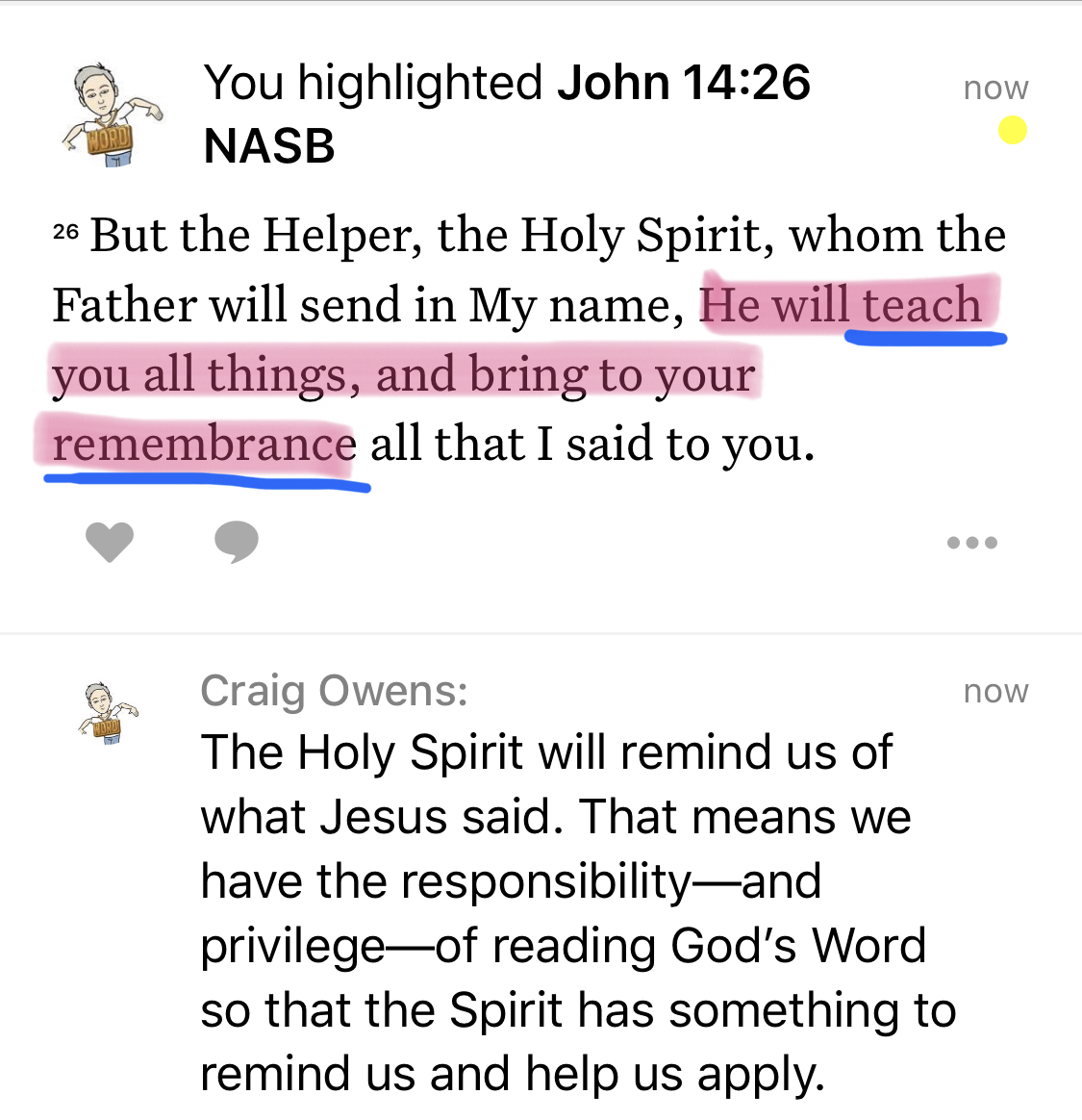
(1) In telling His followers about the Holy Spirit (John 14-16), Jesus said, “But when He, the Spirit of truth, comes, He will guide you into all truth” (John 16:13). And also, “But the Counselor, the Holy Spirit, whom the Father will send in My name, will teach you all things and will remind you of everything I have said to you” (John 14:26).

The Holy Spirit helps me apply biblical truths and principles to my everyday life. He guides me and reminds me of what I have studied.

(2) The second key passage is, “But in your hearts set apart Christ as Lord. Always be prepared to give an answer to everyone who asks you to give the reason for the hope that you have. But do this with gentleness and respect, keeping a clear conscience, so that those who speak maliciously against your good behavior in Christ may be ashamed of their slander” (1 Peter 3:15-16).

Yes, it is important for me to be prepared to give an answer, but this is the middle thought. First, I have to make sure what I’m saying is exalting Christ as Lord. Then I do my best to study and prepare to give an answer, but I must give that answer gently and respectfully.

Allowing the Holy Spirit to help you prepare from the Bible, and allowing Him to guide you into answering questions/critics gently and respectfully honors Christ. And that always wins the battle.