When Your Walking Is Your Praying

Have you ever been in the right place at the right time to experience something wonderful? Maybe you got to meet someone important, or you got the job, or you got the money, or you got to ride in that fancy car. 

Some will call you “lucky” or say you “caught a break,” but both of those statements imply that something unexpected happened to you. 

Is it still “lucky” to be in the right place at the right time if you knew ahead of time that it was coming? For praying Christians, to be in the right place at the right time when we are expecting God to provide is called “an answer to prayer.” 

David prayed, “In the morning, Lord, You hear my voice; in the morning I lay my requests before You and wait expectantly” (Psalm 5:3). The Aramaic word for prayer means “to set a trap.” If we pray, and we live in expectation, then it isn’t luck when we’re in the right place at the right time, but it’s a “trap” that caught the answer to our prayer. 

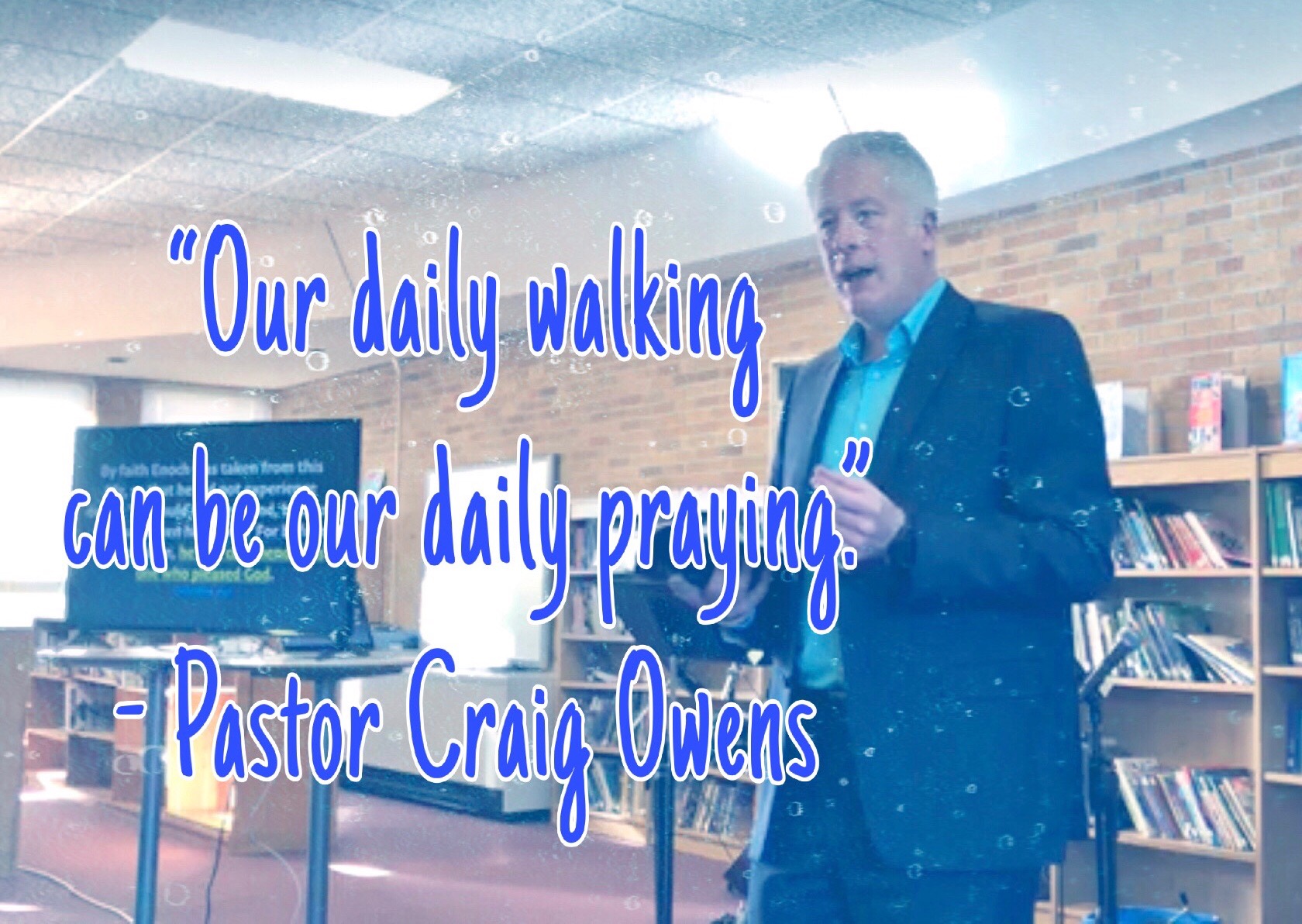
Our daily walking can be our daily praying, as long as we’re walking in faith in the direction God pointed us. 

One man who—literally!—walked this principle out was Elisha.

Before we look at Elisha’s expectant, prayerful walking, let’s look at his prayer request—

When they reached the other side, Elijah said to Elisha, “What can I do for you before I’m taken from you? Ask anything.” Elisha said, “Your life repeated in my life. I want to be a holy man just like you (2 Kings 2:9 MSG).

Elisha was essentially asking to be like Elijah’s firstborn son, to be his spiritual heir. This was the original promise God gave when He told Elijah to anoint Elisha as his successor (1 Kings 19:16). From that point onward, Elisha steadily walked in expectation of God answering this prayer. 

Elisha wouldn’t stay in a place of military victory, or in a significantly spiritual place, or even in a place surrounded by godly leaders. Elisha wouldn’t be held back by a lucrative family business, or the warning words of friends or his spiritual mentor, or even the seemingly uncrossable Jordan River. He kept on walking (see 2 Kings 2:1-15).

He kept on walking.

He kept on walking until “suddenly” God showed up and answered his prayer. 

But was it really “suddenly”? Elisha knew it was coming. He believed what God had promised. He clung to it even when Elijah told him he had asked “a difficult thing.” Elisha kept on walking until he was in the right place at the right time to receive all that God had planned. 

If you have prayed in faith, start walking. Settling anywhere else is robbing yourself of a blessing and robbing God of glory. 

Just keep walking! And let your walking be your praying. Don’t get discouraged. Don’t settle. Don’t stop eagerly expecting that the next step you took could be the “suddenly” you’ve been waiting for. Just keep walking!

Join me this Sunday as we learn a valuable lesson from another bold pray-er from the Bible. 
Yea Or Nay

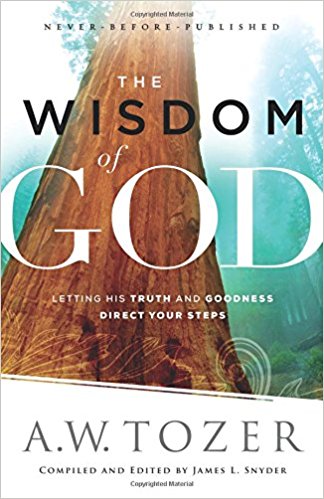
“One of the greatest curses of the modern evangelical movement, in my opinion, is that we are somehow becoming ‘popular.’ Just as soon as you become popular, something goes out of your life, or more accurately, something has gone out of your life before you get popular.

“Historically, the Christian had to be emphatic. He had two words: yea or nay. When God was talking to him, he said yes, and when the devil was talking to him he said no. When God said, ‘Do this,’ he said, ‘Yes, Lord.’ When sinners tempted him to stray, he said an emphatic no.

“The trouble with us now is that we are double-minded. That is why we are weak. Scripture speaks of the double-minded man. He is ‘unstable in all his ways’ (James 1:8). Elijah illustrated this when he said, ‘How long halt ye between two opinions? If the Lord be God, follow Him: but if Baal, then follow him’ (1 Kings 18:21). We need to be on one side or the other. Wholly committed to our high calling in Christ Jesus.” —A.W. Tozer, in The Wisdom Of God

How NOT To Make A Decision

Adonijah thought he was the obvious heir to the throne so he stated what he believed, “I will be king” (1 Kings 1:5). 

On what evidence did Adonijah base his claim? 

  1. All of his friends said he would make a great king
  2. His father (the king) had always given him everything he wanted
  3. He was handsome and popular
  4. A couple members of the king’s court supported him
  5. No one had ever told him “no” 

While all of this sounded good, Adonijah overlooked some vital points. Like…

  1. …more men backed his brother Solomon to be king than backed him
  2. …his father had the decisive and definitive say in who would be king, and he chose Solomon
  3. …God had chosen Solomon to be king

It’s tempting for us to read the popular sentiment of the moment, or to listen to the cheering voices around us, or even to think that our plans are wise and well thought-out. But this is NOT the right way to make a decision.

Instead, we need to humbly consider three things that are external:

  1. The unbiased, wise counsel of others
  2. The buy-in of key stakeholders
  3. God’s clear “yes”

If these three things are in alignment, you cannot go wrong!

How Guys Unintentionally Sabotage Their Relationships

There is a relationship killer that seems to be particularly hard for men. It’s hard because men’s brains are designed in a way that sometimes prohibits them from even seeing this issue.

Bill & Pam Farrel wrote a book called Men Are Like Waffles, Women Are Like Spaghetti. The Farrels identify how men tend to compartmentalize their lives. That is, guys can be so absorbed in one “box” in their life that they are completely oblivious to the other boxes. For instance, when a man is at work he seldom thinks about the other areas of his life (his wife, his kids, the bills that need to be paid, what he’s going to have for lunch).

In addition, men’s brains are also designed to stay in those boxes where things can be quickly fixed. A guy likes fixing things, so the boxes where he can do something and see an immediate result is a box he’s going to keep going back to again and again.

Here’s the trouble… Relationships don’t fit in nice, neat boxes. Neither are relationships something that can be “fixed.” And relationships are never, ever fixed or improved quickly.

So if a guy isn’t aware of these things, he can be unintentionally sabotaging the relationships around him.

King David illustrated this in his unintentional lack of involvement in three of his sons’ lives—

  • Amnon pursued an unhealthy relationship with his step-sister. David got mad but never did anything about it (2 Samuel 13:21).
  • Absalom got revenge for what Amnon did and then fled the country. When David finally allowed him to return to Israel, they never met to resolve what went wrong (2 Samuel 14:28).
  • Adonijah wanted to be king after David, but the Bible says, “His father had never interfered with him by asking, ‘Why do you behave as you do?’” (1 Kings 1:6).

Dave Wills wrote, “We all tend to craft a self-focused view of the world where we emerge as either a hero or a victim in every scene. We’re never the villains in the story. The truth is, though, that we’ve all been the bad guy more often than we’d like to admit. A life of love requires that we look in the mirror and give an honest and humble self-assessment.”

The way to defeat this relationship killer is to become aware of it through humble self-assessment. David learned this truth and shared his prayer with us: “Search me, O God. Show me any areas in my life where I am off-track” (Psalm 139:23-24).

In response to this prayer, the Holy Spirit must have showed David how he had unintentionally starved his relationships with Amnon, Absalom, and Adonijah, because he became highly involved in his son Solomon’s life.

So much so that as Solomon talked to his children about how they should live, he also told them where he had learned how to do this—his father taught him (Proverbs 4:1-4).

Guys, it doesn’t matter how long you’ve been unintentionally in another box. It doesn’t matter how strained the relationship may have become. If you will humbly ask God to search you, reveal to you where you’ve messed up, and ask Him to help you get better … your relationships WILL begin to improve!

Don’t wait another day to pray that “Search me” prayer!

This Is My Doing

This is My doing“My child, I have a message for you today. Let me whisper it in your ear so any storm clouds that may arise will shine with glory, and the rough places you may have to walk will be made smooth. It is only four words, but let them sink into your inner being, and use them as a pillow to rest your weary head: this is My doing [1 Kings 12:24].

Have you ever realized that whatever concerns you concerns Me too? For whoever touches you touches the apple of My eye [Zechariah 2:8]. You are precious and honored in My sight [Isaiah 43:4]. Therefore it is My special delight to teach you. I want you to learn when temptations attack you, and the enemy comes in like a pent-up flood [Isaiah 59:15], that this is My doing and that your weakness needs My strength, and your safety lies in letting Me fight for you.

Are you in difficult circumstances, surrounded by people who do not understand you, never ask your opinion, and always push you aside? This is my doing. I am the God of circumstances. You did not come to this place by accident—you are exactly where I meant for you to be. Have you not asked Me to make you humble? Then see that I have placed you in the perfect school where this lesson is taught. Your circumstances and the people around you are only being used to accomplish My will.

Are you having problems with money, finding it hard to make ends meet? This is My doing, for I am the one who keeps your finances, and I want you to learn to depend upon Me. My supply is limitless and I will meet all your needs [Philippians 4:19]. I want you to prove My promises so that no one may say you did not trust the Lord your God [Deuteronomy 1:32].

Are you experiencing a time of sorrow? This is my doing. I am a Man of sorrows, and familiar with suffering [Isaiah 53:3]. I have allowed your earthly comforters to fail you, so that by turning to Me you may receive eternal encouragement and good hope [2 Thessalonians 2:16].

Have you longed to do some great work for Me but instead have been set aside on a bed of sickness and pain? This is my doing. You were so busy I could not get your attention, and I wanted to teach you some of My deepest truths. They also serve who only stand and wait. In fact, some of My greatest workers are those physically unable to serve, but who have learned to wield the powerful weapon of prayer.” —Your loving Heavenly Father (as recorded by Laura A. Barter Snow)

No Exceptions

Listen to the podcast of this post by clicking on the player below, and you can also subscribe on AppleSpotify, or Audible. 

King David wrote a coronation psalm for his son Solomon as he ascended the throne in Jerusalem. The opening words say, “Endow the king with Your justice, O God, the royal son with Your righteousness. He will judge Your people in righteousness, Your afflicted ones with justice” (Psalm 72:1-2).

David was calling on God’s blessing on his son, but He was also reminding Solomon that he couldn’t rule without God’s help. David’s singular focus was for God to receive all the glory. He closes the coronation psalm like this: “Praise be to the Lord, the God of Israel, Who alone does marvelous deeds. Praise be to His glorious name forever; may the whole earth be filled with His glory. Amen and Amen” (vv. 18-19).

Solomon started out well. “Solomon son of David established himself firmly over his kingdom, for the Lord his God was with him and made him exceedingly great” (2 Chronicles 1:1). Even when God gave Solomon the option to ask for anything, he choose wisdom “to govern this great people of Yours (1 Kings 3:7-9).

David strongly impressed on Solomon that obedience to God was the key to God’s blessing on Solomon and on the nation of Israel. “So be strong, act like a man, and observe what the Lord your God requires: Walk in obedience to Him, and keep His decrees and commands, His laws and regulations, as written in the Law of Moses. Do this so that you may prosper in all you do and wherever you go” (1 Kings 2:2-3).

But there is an ominous word that creeps in very early on in Solomon’s reign. Just one word that foreshadows the downfall that is to come—

Solomon showed his love for the Lord by walking according to the instructions given him by his father David, EXCEPT (1 Kings 3:3).

As you’ve probably heard, Solomon’s many foreign wives began to lead him astray from “observing what the Lord your God requires” and eventually became his downfall. But it began right here with the EXCEPT.

It’s all or nothing.

I cannot pick and choose which words from God I’m going to follow and which I’m going to “except.” If God says I must do it, then I must do it!

The EXCEPT will lead to my downfall just as surely as it did for Solomon.

Heavenly Father, may I be so sensitive to the prompting of Your Holy Spirit if I’ve let any EXCEPTs creep into my life. Reveal them to me so that I may repent, show myself a man, and follow You wholeheartedly.

►► Would you please prayerfully consider supporting this ministry? My Patreon supporters get behind-the-scenes access to exclusive materials. ◀︎◀︎

Endless Noise

Listen to the podcast of this post by clicking on the player below, and you can also subscribe on AppleSpotify, or Audible.

The psalmist said it this way, “Be still, and know that I am God” (Psalm 46:10).

The apostle Paul said, “Study to be quiet” (1 Thessalonians 4:11).

And the prophet Elijah learned that God was not in the big crashing, jarring noises but in “a still small Voice” (1 Kings 19:12).

We are bombarded by noise. Are we missing God in all the noise? When was the last time I was quiet? Quiet enough to hear His still small Voice?

Nearly 80 years ago T.S. Eliot wrote a poem called Choruses From The Rock. Check out this passage—

The endless cycle of idea and action,
Endless invention, endless experiment,
Brings knowledge of motion, but not of stillness;
Knowledge of speech, but not of silence;
Knowledge of words, and ignorance of the Word.
All our knowledge brings us nearer to our ignorance,
All our ignorance brings us nearer to death,
But nearness to death no nearer to God.
Where is the Life we have lost in living?
Where is the wisdom we have lost in knowledge?
Where is the knowledge we have lost in information?
The cycles of Heaven in twenty centuries
Bring us farther from God and nearer to the Dust.

Jesus found time early in the silent morning to get alone with His Father. We would do well to follow this example. Let’s make some quiet time today to hear what God is saying to our hearts.

►► Would you please prayerfully consider supporting this ministry? My Patreon supporters get behind-the-scenes access to exclusive materials. ◀︎◀︎

Courageous Enough To Interfere

King David was brilliant as a king, and a disaster as a father. One of the things that is very telling is what is not written when his kids mess up. The Bible tells us that David felt strong emotions, but he simply didn’t act on them. In fact, one of the most telling verses of inaction comes when his son Adonijah is trying to put himself on David’s throne—

His father had never interfered with him by asking, “Why do you behave as you do?” (1 Kings 1:6)

It takes courage to interfere with our kids when they are misbehaving.

So why don’t some dads interfere? I can think of a few reasons…

  • They didn’t have a good relationship with their own father. In David’s case, his father Jesse didn’t think too highly of David. In fact, David was the overlooked, almost-forgotten son (1 Samuel 16:8-11).
  • They’re too tired. David was so focused on building up Israel’s defenses, and defeating the bad guys, that he had nothing left emotionally and physically to interact with his kids. We need to make it our priority! John wrote: I have no greater joy than knowing my children all walk in the truth (3 John 4). Now that’s a great priority!
  • Their past sins haunt them. David sinned against Bathsheba (like Amnon did against Tamar); David murdered Uriah (like Adonijah did Amnon). So perhaps he felt like he didn’t have the moral authority to interfere with his sons. But if you read some of the wise sayings in Proverbs 6:20-29 and 7:1-5, they sound like a man who has had experience. Let your hindsight (good or bad) be your kids’ foresight.
  • They think it’s too late. It’s never too late! Never! Apparently, David learned this lesson in time and taught his son Solomon (read Proverbs 1:1 and 4:3-4). As long as there is breath in your lungs, you should be your kids’ dad!

Dads, will you be courageous enough to lovingly interfere with your kids if they are getting off track?

Will you be courageous enough to make some changes in your schedule so that you can invest the time and energy and creativity necessary to raise them up?

Will you be courageous enough to confess your past sins, and not let them hold you back from speaking into your kids’ lives?

Will you be courageous enough to start today?

Dad, you kids need you to be involved! Be courageous enough to step into their lives.

How Are You Running?

Listen to the podcast of this post by clicking on the player below, and you can also subscribe on Apple or Spotify.

Ever noticed how often we use the word run in our everyday clichés?

  • I gotta run a few errands
  • I’m running the kids to soccer practice
  • Our funds are running a little low
  • We’re running a bit late
  • I’m running out of energy
  • My patience is running thin
  • Can’t talk now, I have to run

My question is: how are you running?

Elijah ran twice. Once in the power of God, and once in fear.

When he ran in fear, he became completely exhausted to the point where he became depressed and suicidal. When he ran in God’s power, there was no tiredness.

When he ran in fear, he forgot God and focused totally on his own needs. When he ran in God’s power, only God was exalted.

So how are you running today? Are you running in fear of disappointing someone … dropping the ball … losing the job … falling short … losing face?

Or are you running in God’s power … doing the things that draw you closer to Him … running to bring others to Christ … exalting God?

You will be running this week. The bigger question is how are you doing it?

Do It Quickly

Sometimes when you read about an incredible prophet like Elijah, don’t you think, “I wish God would use me like that?” I mean, why not? Was there something different about him? Even James said in the New Testament that Elijah was “just as human as we are.”

So why could use God use him so powerfully? Why not me?

I think the key is in how quickly Elijah responded when God spoke. Check this out:

Then the word of the Lord came to Elijah…. So he did what the Lord had told him.

Then the word of the Lord came to him: “Go at once to Zarephath….” So he went to Zarephath.

The word of the Lord came to Elijah: “Go present yourself to Ahab….” So Elijah went to present himself to Ahab.

See the pattern? God speaks, and in the very next verse, Elijah acts.

No delays.

No excuses.

No planning.

No extra prayer.

No companions.

Just obedience.

The next time you read your Bible and you hear the word of the Lord speak, act on it immediately.

The next time your pastor speaks the word of the Lord to you on Sunday, put it into action on Monday.

As James also said, let’s not just be hearers of the word of the Lord, let’s be immediate doers of the word.

Do it quickly and watch God begin to work through your life powerfully.