Generation Now

Interbellum, Greatest, Silent, Baby Boomers, Busters, MTV, Gen X, Gen Y, Post-Millennial, Gen Z. It seems we’re obsessed with naming and defining our past and present generations. The “experts” tell us what each generation is motivated by, what they’re thinking, what they dream of, and what they are afraid of. I have stacks of books on my shelf about how to relate to people in each of these generational groups, and I constantly get emails that tell me the newest way to get each generation’s attention.

However, when I look in the Bible I only see two generations: this generation and the next generation. God is not concerned with description, but with action. I love what God said to Noah, “Go into the ark, you and your whole family, because I have found you righteous in THIS generation.

What you and I do in THIS generation reverberates into the NEXT generation.

The most important generation is Generation Now.

Yesterday I discovered something a whole lot easier than reading all of these books and sifting through all of the data to learn about GenNow. I discovered this by accident. I discovered it by fun. And I discovered it was exactly the same way Jesus connected with and related to His GenNow.

All I had to do was hang out at my office.

Throughout the day people saw my car in the parking lot, so they just stopped in. It was a blast! Just as Jesus spent times at parties, wedding banquets, in the market place, and with His friends, I got to know GenNow by simply being with them. We talked, we played music (great jam session!), I got beat in ping pong, we ate pizza, we worshipped God, we threw marshmallows at each other.

Through all of this, I learned what GenNow is dreaming about, laughing about, and worrying about. I also affirmed what I already knew: GenNow is a very special group!

Do you have a family member or friend that you want to connect with more deeply? Follow the example of Jesus: just spend time with them. I did, and it was great. In fact, I can’t wait to do it again and again and again!

Uniquely You

Thanks to Mr. Cochrane, my 10th grade English teacher, I have become somewhat of a literalist when it comes to the use of words. For instance, it bothers me when writers confuse your and you’re, or its and it’s, or their, there, and they’re.

Another vocabulary use that bothers me is when someone uses a qualifier with the word unique. It’s incorrect to say, “You’re very unique” or “It’s an unusually unique situation.” Unique, by its very definition, means there is nothing else like it.

Unique is defined as “existing as the only one or as the sole example; having no like or equal; unparalleled; incomparable.”

Do you know another great definition of unique: YOU.

Really, you are unique. You are the only one like you; you are the sole example of you; there is no one like you; you are unparalleled and incomparable. That’s you!

In one of his most intimate prayers, David says to God, “I praise You because I am fearfully and wonderfully made.” The Hebrew word for wonderfully means someone who is one-of-a-kind… unique.

You are uniquely you.

You were created in God’s image—uniquely.

You were created unlike anyone else who has ever lived—uniquely.

You are endowed by your Creator with a set of talents, strengths, and abilities (a gift package) that has never been seen before in the history of mankind, nor will it ever be seen again—uniquely.

You will cross paths with particular people at particular times in your life and their lives that can never be duplicated or recreated—uniquely.

In order to seize unique opportunities, you have to be uniquely you. In order to be uniquely you, you have to become more like Jesus. He embodied every godly attribute perfectly; He lived every moment perfectly; He handled every situation perfectly. “The more I become like Jesus the more uniquely I become myself” (Dr. George O. Wood).

How might you live your life differently today knowing that no one can do what you do the way you do it? The more you become like Jesus, the more uniquely you you will be. Try it!

6,940 Days And Still Counting

When I was a kid we would often sing a hymn at church that had this chorus:

Count your blessings, name them one by one
Count your blessings, see what God hath done
Count your blessings, name them one by one
Count your many blessings, see what God hath done

Today is the 6,940th day I am counting the many blessings of being married to my best friend. Every day I am blessed that Betsy said yes!

King Solomon wrote, “The man who finds a wife finds a treasure, and he receives favor from the LORD.” My life has certainly been full of treasured moments and crowned with God’s favor these past 6,940 days because I found a good wife.

Baby, here’s to the next 6,940 days—it’s going to be even better!

More?

I keep getting these annoying messages on Twitter that say something like, “I got over 500 new followers on Twitter, and you can too!!” Then I get these sorts of emails, “We can increase the traffic to your blog 300% per day!”

What would make them think I want more? Maybe it’s because almost everything in our lives is about more.

  • After high school, go to college to get more education.
  • After college, climb the corporate ladder to get more money or more recognition.
  • After you start working, take more vacations and enjoy more perks.

Lately, I’ve become focused on better. I think better is better than more.

More is about width, better is about depth.

More is an exhausting pursuit, better is a satisfying pursuit.

More is about quantity, better is about quality.

So here’s my challenge, trade more for better

  • Instead of looking for more friends, make your current friendships better.
  • Instead of getting more followers on Twitter, make better followers.
  • Instead of getting more education, get a better education.
  • Instead of trying to read more books, read better books.
  • Instead of spending more time with a lot of people, spend better time with a few people.

In what areas of your life can better be better than more?

Here Comes The ♥♥!

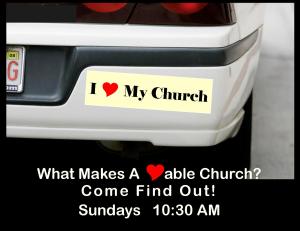
I Heart My Church

Thanks to everyone who gave me some input on what they ♥ about their church. This Sunday I am starting a new series at Calvary Assembly of God called I My Church. We’re going to look at a church that everyone in town was buzzing about. And except for the religious stick-in-the-muds, the buzz was positive.

I believe we can be that church today. If you’re in the neighborhood, I’d love to have you join us over the next four weeks as we learn how to become that church about which everyone in town says I My Church!

An Open Letter To My Daughter

My Dearest Samantha,

Last night as I watched your Mom teaching you how to put on makeup for the very first time, I couldn’t help but think how beautiful you are and what an incredible young woman you are becoming. It’s so wonderful to see that your beauty doesn’t come from anything you’ve done to the outside, but who you are on the inside. All the makeup did was enhance that beauty a little bit.

As you get older I know that fashionable clothes, the latest hairstyles, and the newest cosmetics will play more and more of a role in your life, but always remember where your true beauty comes from. The Bible says it this way, “Your beauty should not come from outward adornment, such as braided hair and the wearing of gold jewelry and fine clothes. Instead, it should be that of your inner self, the unfading beauty of a gentle and quiet spirit, which is of great worth in God’s sight.”

You already have such an inner beauty that God loves … and your Daddy loves! It shines out of your eyes, I can hear it in your voice, I can see it in your actions, I can feel it in your hugs. You are so beautiful!

To keep this unfading beauty shining brightly, remember this: “Charm and grace are deceptive, and beauty is vain [because it is not lasting], but a woman who reverently and worshipfully fears the Lord, she shall be praised!”

I couldn’t be more proud of you than I already am, so I will always be your loudest cheering section and chairman of your fan club! You are my beautiful Rose!

I love you,

   Dad

1

Everyday Greatness (book review)

Everyday Greatness

I have read almost everything that Stephen Covey has written, so when I saw this newest title—Everyday Greatness—with his name on it, I was really looking forward to it. I know the classic rule is “Never judge a book by its cover,” but I admit I broke this rule!

When I saw “Stephen Covey” on the cover I was prepared for his typical thought-provoking insights. Instead what I got in Everyday Greatness was anecdotal support of Covey’s profound teachings from other authors. I was actually pleasantly surprised by this.

The premise of this book is similar to Covey’s other books; namely, you have the power to make the choices that will make your life more effective, more fulfilling, and more beneficial to those around you. Everyday Greatness reinforces this message by letting you hear Covey’s thoughts through the stories of “everyday people.”

The book is divided up into seven categories that everyday people live each day—

  • Searching for meaning
  • Taking charge
  • Starting within
  • Creating the dream
  • Teaming with others
  • Overcoming adversity
  • Blending the pieces

Each of these seven categories is supported by three principles, and each of these principles are illustrated by three short stories and a few pages of noteworthy quotes. So in essence Everyday Greatness presents Covey’s thoughts in 63 short stories and several pages memorable quotes.

Stories are so much more effective at driving a point home than is a lecture, and these stories are the perfect length for anyone. This is a book I’ll keep handy on my shelf so I can return to these stories time and time again. An excellent read!

Do You ♥ Your Church?

i_heart_ny

Several years ago New York City started an advertising campaign to attract tourists to their city: I NY. It worked. More people began to visit the Big Apple than ever before.

But the advertising campaign did something else too. It created a logo sensation that many began to imitate. All over the world we started to see the “I ” logo attached to just about anything: certain dog breeds, small-town USA, international cities, mom & pop and 5-star restaurants, schools, and even sports teams.

One “I ” logo I don’t recall ever seeing is “I My Church.” Why is that?

Do you your church? How about helping me out with some research: In the comments, please tell me what you about your church…

  • what attracted you in the first place?
  • what kept you coming back?
  • what makes you excited to invite others to your church?
  • what makes you proud to say, “That’s my church”?

I’d to hear from you about this!

Good And Angry

When was the last time you got good and angry? Be careful how you answer because I want you to notice that important conjunction AND. So maybe I should ask the question this way: when was the last time you got angry and were still good?

Aristotle correctly pointed out, “Anybody can become angry—that is easy; but to be angry with the right person, and to the right degree, and at the right time, and for the right purpose, and in the right way—that is not within everybody’s power and is not easy.”

Over the past week, I’ve been studying the life and leadership of Nehemiah, an incredible leader who rebuilt the walls of Jerusalem. But when I got to the final chapter of his account, I noticed quite a bit of anger coming from Nehemiah. As a kid, I used to have to really battle against my temper, so this aspect of Nehemiah’s life intrigued me. Can someone be good AND angry?

I think that the deeper I love someone or something, the greater my anger will be towards anyone or anything that violates what I love.

Nehemiah loved God and he was passionate to see God’s holiness magnified. All of his anger is directed at those people or things that violated or detracted from God’s holiness. Look how he got good AND angry

  • Towards Tobiah, who moved his personal belongings into God’s temple, a place reserved exclusively for the worship of God. “I was angry, really angry, and threw everything in the room out into the street, all of Tobiah’s stuff” (v. 8).
  • Towards the people who stopped financially supporting the priests, forcing the priests to leave the temple and work as farmers. “I immediately confronted the leaders and demanded, ‘Why has the Temple of God been neglected?’” (v. 11).
  • Towards those who violated the regulations of the Sabbath Day. “I got angry and said to the leaders of Judah, ‘This evil you are doing is an insult to the Sabbath!’” (v. 17).
  • Towards those tried to get around Nehemiah’s new Sabbath Day regulations. “I spoke sharply to them and said, ‘What are you doing out here, camping around the wall? If you do this again, I will arrest you!’” (v. 21).
  • Towards those who had intermarried with false-god-worshipping people. “I rebuked them and called curses down on them. I beat some of the men and pulled out their hair” (v. 25).
  • Towards Joiada, a priest who married a non-God-fearing woman. “I banished him from my presence” (v. 28).

After each of these incidents, you might expect Nehemiah to regret what he had done and think to himself, “Perhaps I overdid it. Maybe I was too zealous, or maybe I went a little overboard.” But instead, each time Nehemiah was righteously angry he prayed this to God, “Remember me for this, O my God. Remember me with favor because of what I have done” (vv. 14, 22, 29, 31). He was unashamed that he got good AND angry.

The Bible says, “Go ahead and be angry. You do well to be angrybut don’t use your anger as fuel for revenge. And don’t stay angry.”

Can you be good AND angry? Yes! In fact, I think being good helps us be angry with the right person or thing, in the right way, for the right purpose, and for the right length of time. 

Consequences

It was a beautiful sunny evening. All of my work was done, Betsy was home from school, our cooler was packed, and we were off to the park. We were all looking forward to spend this lovely evening grilling some hotdogs, splashing in the water, enjoying the breeze off the lake, and just spending time as a family.

But like an unexpected rear-end collision, all our plans for a fun evening were smashed in a single moment. As we were carrying our cooler and towels and toys toward the picnic tables, a couple of my kids acted up… they broke some of our family no-no’s.

Their actions took less than two seconds. It was just between two of them. But the entire family was affected. We turned around and headed home. No hotdogs on the open grill, no beach time, no after-dinner walk on the trails.

Two made a mistake, but all suffered because actions have consequences.

Isaac Newton said for every action there is an equal and opposite reaction. We often think of this when, for instance, in a game of billiards the cue ball hits another ball. The energy from the cue ball is transferred to the other ball, moving it in the direction it was struck. Sometimes we might be tempted to believe that the only two balls affected were the cue ball and the ball that was struck. But that is not correct. Since those two balls have now been moved to another position on the table, their new positions now affected the entire table—the entire game is now different because of action and reaction.

There are consequences for our actions. And almost always those consequences are felt by someone other than the one who acted. Sometimes the consequences are pleasant and sometimes they are painful or even disastrous.

In Old Testament history, we see good consequences. King David was a righteous man, one who loved God and obeyed God’s commands. About 300 years later King Hezekiah sat on the same throne of Israel. When the Assyrian army was headed toward Jerusalem, Hezekiah prayed and asked for God’s help. God responded, “I promise that the king of Assyria won’t get into Jerusalem, or shoot an arrow into the city, or even surround it and prepare to attack. … I will protect it for Myself and for My servant David.

And we see bad consequences. There was a wicked king of Judah named Manasseh. He is not only one of Judah’s longest-reigning kings, but he is also widely regarded as Judah’s most wicked king. Yet in his lifetime, his kingdom seemed to prosper. And even though his grandson Josiah turned away from evil and turned toward God like no other king ever had done before, just four years after his death Jerusalem fell. King Jehoiachin was defeated and all of Judah was carried off into exile by Nebuchadnezzar as a consequence of Manasseh’s sinful behavior.

Our kids that acted up wrote notes of apology which they read to the family (as we ate our hotdogs at home) and we all forgave them. And we had a nice evening playing around the house. But the evening still had the tinge of regret for what could have been.

Our choices today will have consequences tomorrow. Our actions always affect more than just ourselves—they affect everyone close to us. The people in Hezekiah’s day were grateful for the blessed consequences of David’s right choices. The people in Jehoiachin’s day were grieved for the disastrous consequences of Manasseh’s wrong choices.

What about you? What will your descendants feel about the consequences they are experiencing because of your choices today? It’s up to you, and it’s for them, so live right today.