Thursdays With Oswald—True Liberty

This is a weekly series with things I’m reading and pondering from Oswald Chambers. You can read the original seed thought here, or type “Thursdays With Oswald” in the search box to read more entries.

True Liberty

     True liberty is the ability earned by practice to do the right thing. There is no such thing as a gift of freedom; freedom must be earned. The counterfeit of freedom is independence. When the Spirit of God deals with sin, it is independence that He touches, that is why the preaching of the Gospel awakens resentment as well as craving. Independence must be blasted right out of a Christian, there must be only liberty, which is a very different thing. Spiritually, liberty means the ability to fulfill the law of God, and it establishes the rights of other people.

From Biblical Ethics

Freedom usually means, “I’m free to do what I want to do.”

Liberty is, “I’m free to help you do the right thing.”

Instead of using my freedom to do what I want to do, I choose to use my freedom to help someone else earn their liberty.

Manufactured Success

Listen to the podcast of this post by clicking on the player below, and you can also subscribe on AppleSpotify, or Audible.

Does success come from hard work, or does it have another origin? We can certainly manufacture success by doing some public relations, some spin, some creative promotion. And from the outside, it can look very successful. Someone may even do such a good job manufacturing their success that they begin to believe their own press releases.

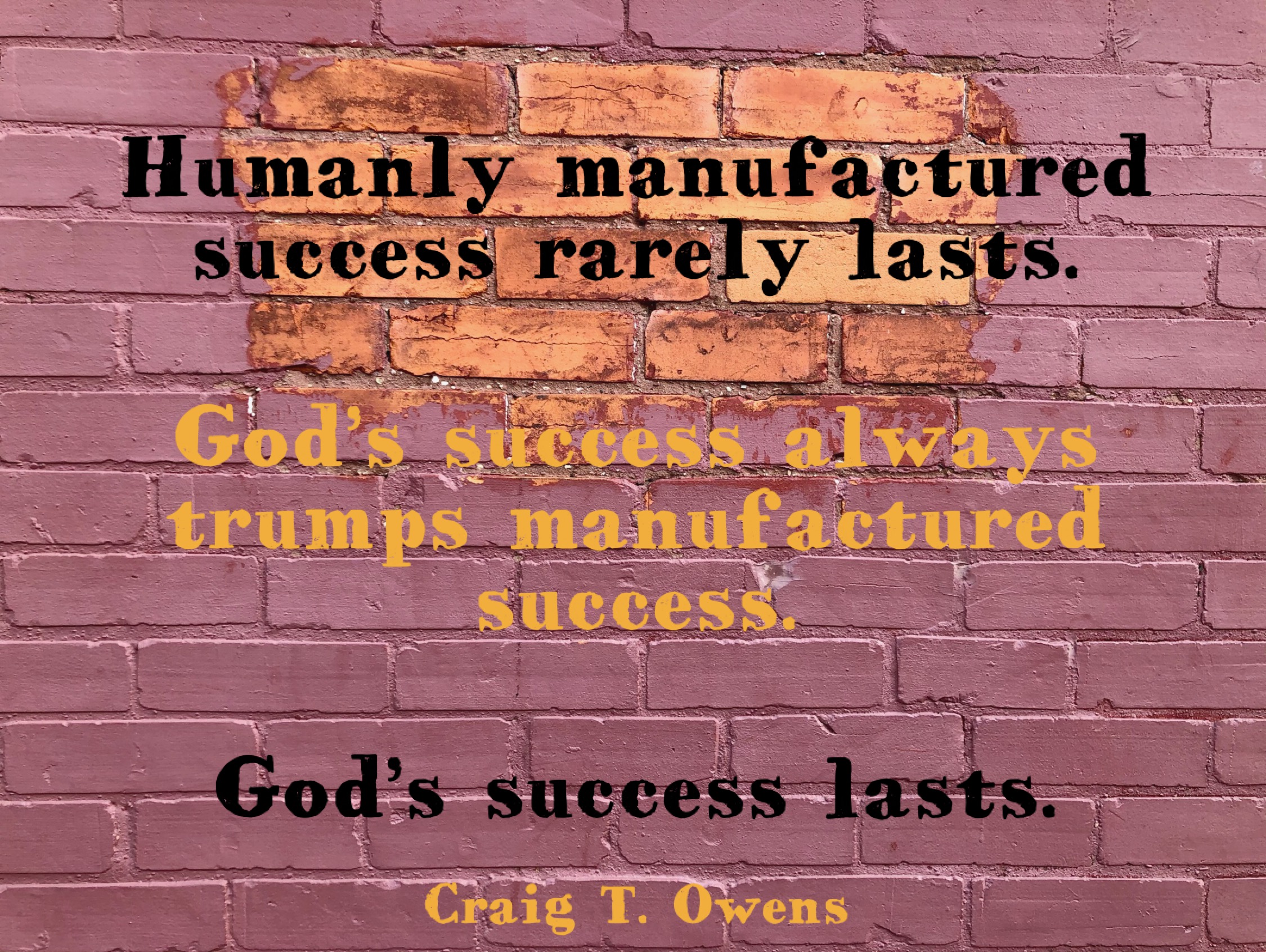
But humanly manufactured success rarely lasts.

Consider the case of a man named Adonijah. He was the heir-apparent in Israel. As the oldest living son of the famed King David, Adonijah was the odds-on favorite to be the next king. And so Adonijah began to manufacture a successful transfer of power for himself. He invited all the right people and ignored those who he knew wouldn’t go along with his plan. He set up everything just the way a prince ascending the throne should have it. His followers joined him for a party and began to raise their glasses in a toast: Long live King Adonijah!

Except God—and King David—had other plans. Just as God directed, David had his son Solomon anointed king. When the few followers that were toasting Adonijah heard this, they all bailed on him and ran away. Even Adonijah recognized that something else can trump manufactured success. Here’s what he said:

“As you know,  the kingdom was mine. All Israel looked to me as their king. But things changed, and the kingdom has gone to my brother; for it has come to him from the LORD.” (1 Kings 2:15)

Success has come to him from the Lord.God’s success always trumps humanly manufactured success.

Manufactured success leads to pride (the kingdom was mine). And pride over-exaggerates our self-worth and obscures reality (all Israel looked to me as their king). God’s success comes to the humble who recognize His lordship and their place in His Kingdom. God’s success lasts.

Although Adonijah eventually recognized this, he didn’t learn from it. In the next scene, he is again trying to manufacture a way to ascend to the throne. And this time he not only loses his position but his life as well.

Here’s what Jesus says: For whoever exalts himself will be humbled [manufactured success], and whoever humbles himself will be exalted [God’s success].

►► Would you please prayerfully consider supporting this ministry? My Patreon supporters get behind-the-scenes access to exclusive materials, like this recent Bible study tip from the Book of Ecclesiastes. ◀︎◀︎

Quitting Church (book review)

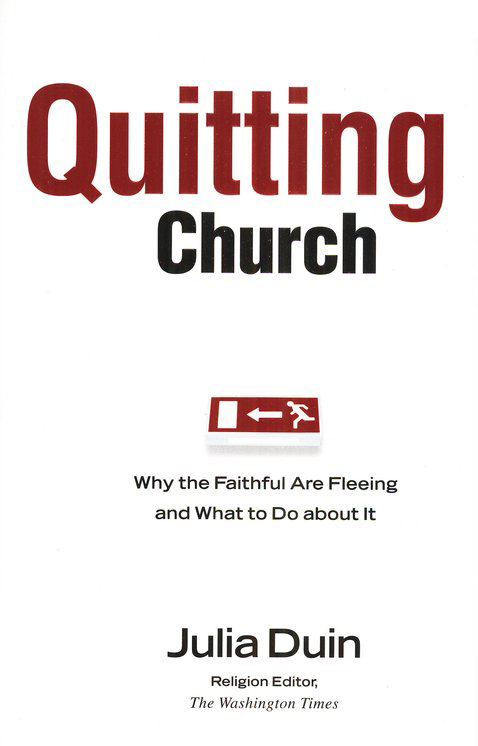
It’s true: people are leaving churches in record numbers. Who is leaving? Why are they leaving? Is there anything churches can do to stem the tide? These are the questions that drove Julia Duin to research and write Quitting Church.

Since I pastor a church, these sorts of questions intrigue me too. Unfortunately, this book left me flat.

The research in this book consists largely of: (a) snippets quoted from other researchers; (b) Julia’s conversations with her friends who have stopped attending church; and (c) Julia’s observations on what “connected” for her at the various churches she has attended. In other words, this book doesn’t present a whole lot of original information. Even the subtitle—why the faithful are fleeing and what to do about it—is misleading, in that I read very little about how to keep the departing from fleeing.

Save your money; take a pass on this book.

The Refinement Of Pain

I was recently invited to join a bunch of guys—mostly staff in the Cedar Springs schools—for some early morning basketball. I love playing basketball, I’m a morning guy, and getting to know new people in Cedar Springs made this an invitation I couldn’t refuse. So I started hoopin’ this week. It was nice to get back on the hardwood floor!

Yesterday morning, I jumped in my car to come home to shower. It’s a mile from the school to my house, but by the time I got home, my back muscles had seized up and I was barely able to stand up to get out of the car. I’ve had this happen to me once before, and it’s a whole lot of no fun!

So all day yesterday my schedule had to be modified, as it hurt to move, it hurt to stand for too long, and it hurt to sit for too long. I couldn’t get in the car. In fact, I couldn’t even bend over far enough to put my own socks on! All my plans for the day were shot.

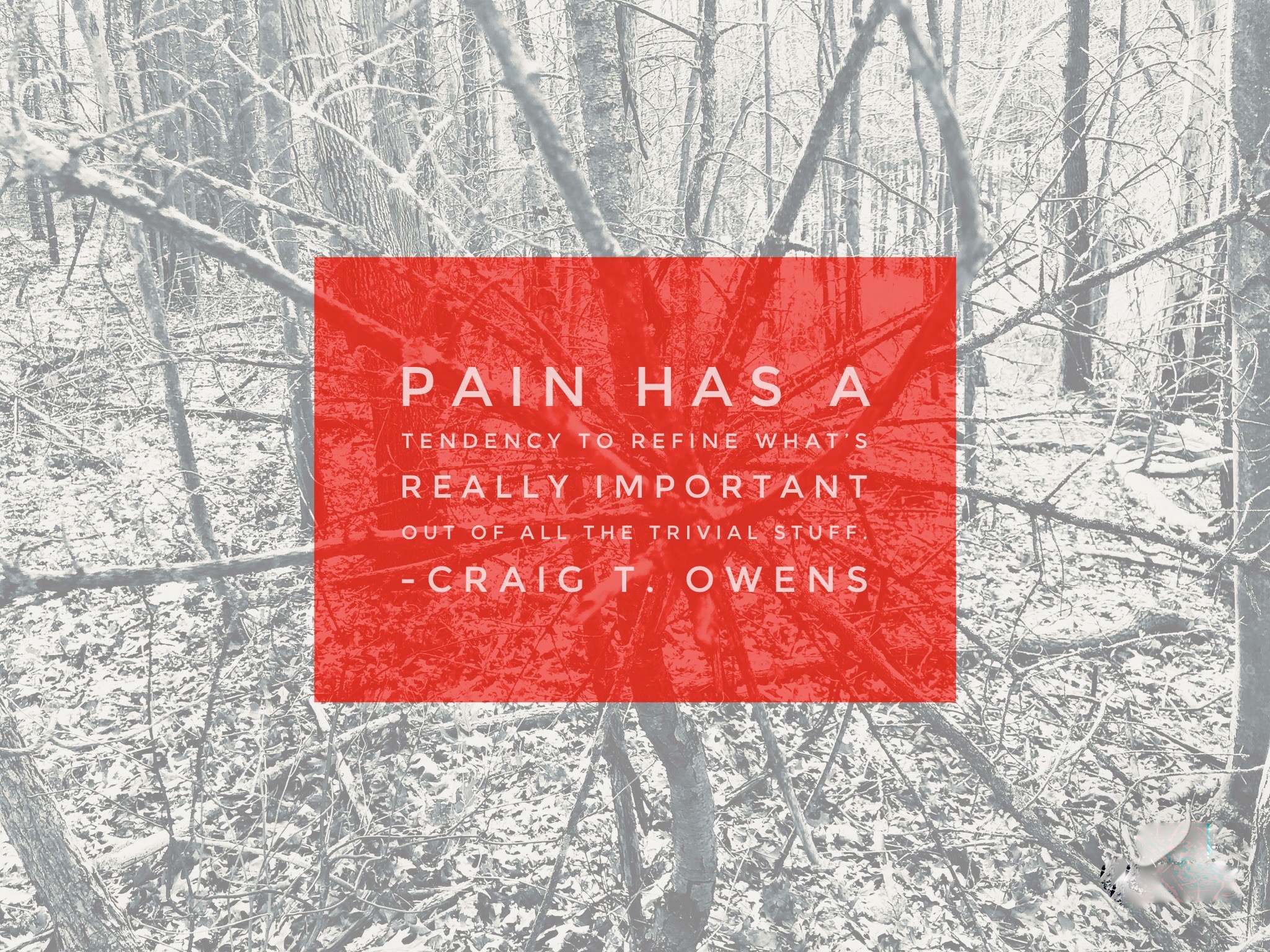
But here’s what I learned: my day wasn’t shot. My plans may not have worked out, but it was still a good day. Pain has a tendency to refine what’s really important out of all the trivial stuff.

  • A day in pain and immobility reminded me of just how blessed I am to normally have good health.
  • It prompted me to pray for others who are confined to a wheelchair or their beds.
  • It gave me greater empathy for those who live in chronic pain.
  • It made me more thankful that I have access to medicines and caregivers, things that some people have access to only rarely.
  • It let me see more clearly the love my family and friends have for me.
  • It gave me more time to pray.

Now here’s the tricky part: to live with these things on my mind even when I’m not in pain.

Here’s what C.S. Lewis wrote in The Problem Of Pain:

I am progressing along the path of life in my ordinary contentedly fallen and godless condition, absorbed in a merry meeting with my friends for the morrow or a bit of work that tickles my vanity today, a holiday or a new book, when suddenly a stab of abdominal [or back] pain that threatens serious disease, or a headline in the newspapers that threatens us all with destruction, send this whole pack of cards tumbling down. At first I am overwhelmed, and all my little happinesses look like broken toys. Then, slowly and reluctantly, bit by bit, I try to bring myself into the frame of mind that I should be in at all times. I remind myself that these toys were never intended to possess my heart, that my true good is in another world and my own real treasure is in Christ. And perhaps, by God’s grace, I succeed, and for a day or two become a creature consciously dependent on God and drawing strength from the right sources. But the moment the threat is withdrawn, my whole nature leaps back to the toys: I am even anxious, God forgive me, to banish from my mind the only thing that supported me under the threat because it is now associated with the misery of those few days. Thus the terrible necessity of tribulation is only too clear. God has had me for but forty-eight hours and then only by dint of taking everything else away from me. Let Him but sheathe that sword for a moment and I behave like a puppy when the hated bath is over—I shake myself as dry as I can and race off to reacquire my comfortable dirtiness, if not in the nearest manure heap, at least in the nearest flower bed. And that is why tribulations cannot cease until God either sees us remade or sees that our remaking is now hopeless.

With God’s help, I’m going to avoid running back to my “toys” today. I’m trying to keep the most important thing in the forefront of my thoughts today.

What lessons have you learned from pain?

Thursdays With Oswald—Fitness Through Regular Exercise

This is a weekly series with things I’m reading and pondering from Oswald Chambers. You can read the original seed thought here, or type “Thursdays With Oswald” in the search box to read more entries.

Fitness Through Regular Exercise

     If we do not fit ourselves by practice when there is no crisis, we shall find that our nature will fail us when the crisis comes. … When your nervous system, which has been ruled by the wrong disposition, is inclined to say “I can’t,” you must say, “You must,” and to your amazement you find you can!

From Biblical Ethics

Practice now before the heat is on.

Then when the heat is on—and nerves are high—you will be able to choose the right thing. Remember what coaches say: You play like your practice.

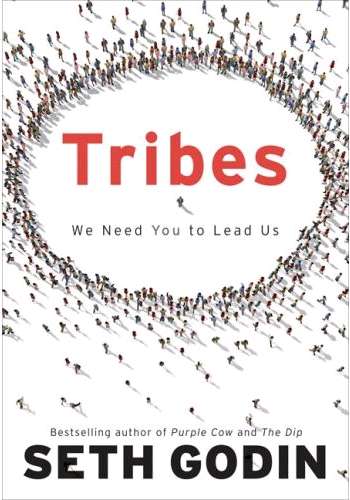
Tribes (book review)

Seth Godin’s work is always thought-provoking. I know that he is mainly writing for a business audience, but I find his comments applicable to the church world (not to mention my personal world) as well.

I “read” Tribes in the audiobook format over a period of several weeks of drive time. I found myself frequently hitting the button which backs up the recording for 30 seconds. After I would replay a section, I would often press “pause” to reflect on the insights Seth had just read to me.

Instead of my usual book review format, I thought I’d just share with you some of the quotes which have been rolling around in my mind:

“Leaders don’t have things happen to them; leaders do things.”

“Faith is critical to all innovation. Without faith, it’s suicidal to be a leader. Religion, on the other hand, represents a strict set of rules that our fellow humans have overlaid on top of our faith. Religion supports the status quo and encourages us to fit in, not to stand out.”

“The best time to change your business [or church] model is when you still have momentum.”

“The tactics of leadership are easy; the art of leadership is hard.”

“Leaders challenge the status quo. Leaders create a culture around their goal, and involve others in that culture. Leaders have an extraordinary amount of curiosity about the world they’re trying to change. Leaders use charisma in a variety of forms to attract and motivate followers. Leaders communicate their vision of the future. Leaders commit to a vision and make decisions based on that commitment. Leaders connect their followers to one another.”

“You can’t manage without knowledge; you can’t lead without imagination.”

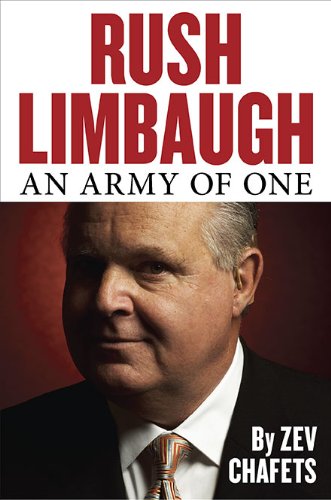
Rush Limbaugh: An Army Of One (book review)

I remember the first time I heard Rush Limbaugh’s baritone voice coming over the airwaves of WXYZ in Detroit. I was just coming back to my office from lunch, and I was compelled to stay in my car in the parking lot to listen to this man with the unusual name, and even more unusual delivery of ideas. Rush Limbaugh: An Army Of One by Zev Chafets is just as compelling as the radio personality he chronicles.

Like him or hate him, you cannot ignore him. Rush Limbaugh has single-handedly changed talk radio. He already holds places in the National Broadcasting Hall of Fame because his radio audience is larger than any other in history. For three hours every afternoon, Rush broadcasts from behind “the golden EIB microphone” to listeners anxious to hear his irreverent and convincing confrontation and refutation of liberal ideology.

Maybe, like me, you’ve wondered what made Rush the broadcaster that he is. Or maybe you wondered what Rush is like during the other 21 hours of the day. Zav Chafets book is a no-holds-barred, full-access, behind-the-scenes look at this conservative icon.

If you are a fan, this book will give you a greater appreciation of the genius of his delivery. If you’re a hater, well, this book won’t do anything to change your mind. Zav is clearly not a “Dittohead,” but he is clearly impressed by this radio giant.

As Zav states in his closing words:

Even after more than twenty years there are still many people who refuse to accept that Limbaugh is more than an entertainer, a pitchman, or a hot-air balloon. These are the same people who mistook [Ronald] Reagan for an amiable dunce. Two decades should have been enough to convince even the most obtuse that Rush Limbaugh is someone you underestimate or ignore at your own peril. He can’t be wished away or shouted down or sniffed into irrelevance. Smart liberals will listen to him, even if they hate what he has to say. The easily outraged, will be. Those with a sense of humor will find themselves laughing despite themselves. Presidents and politicians come and go, but Rush Limbaugh, equipped now with a clean bill of health and accompanied by a lovely new wife (and, who knows, maybe a future Rush Hudson Limbaugh IV), and in undisputed control of the conservative movement, is ready for the next act. He has often said that he doesn’t intend to quit until he has convinced every liberal in the country. He’s not in a hurry, either. His grandfather, the original Rush Hudson Limbaugh, didn’t retire until he was 103 years old.

A very informative, enjoyable read.

Outlive Your Life (book review)

When I hear “Max Lucado has a new book coming out,” I’m like a kid waiting for Christmas! And just like those kids on Christmas morning, when I received Outlive Your Life, I tore into this book, and scarcely put it down until I devoured it.

I love the concept: The impact your life makes can live on far after your physical life has ended here. To make his case, Max uses the example of Jesus’ first disciples whose dedication to spreading the Gospel of Jesus Christ has far outlived their first-century lives. Specifically, Max uses the first twelve chapters of Acts as the disciples begin this work right after Jesus has ascended back into heaven.

Max uses examples from 33 AD to show us a 2010 AD life application. What the original disciples did then, we 21st-century disciples can do now. As always, Max digs such timely truths out of the Scripture that makes it seem so relevant for today. For right now!

At the back of the book is a discussion and action guide which opens with the words, “Max wants you to do more than read about the book of Acts. He wants you to live out the twenty-ninth chapter, writing the story of the church for your generation.” I found both the discussion questions and action ideas personally challenging, and great conversation-starts for a small group or a Bible study.

It’s almost automatic that I give Max Lucado’s books an unreserved five-out-of-five stars, and this book is no exception. You’ll find so much in this book to apply to your life, your church, your ministry. And here’s another bonus: Max Lucado is giving 100% of his royalties to charities such as World Vision who are helping to make a life-changing difference in our world.

I am a Thomas Nelson book reviewer.

Thursdays With Oswald—Why Should I Do What I Ought To Do?

This is a weekly series with things I’m reading and pondering from Oswald Chambers. You can read the original seed thought here, or type “Thursdays With Oswald” in the search box to read more entries.

Why Should I Do What I Ought To Do?

      We imagine that if we obey authority we limit ourselves, whereas obedience to authority is not a limitation but a source of power; by obeying we are more. Naturally we are built to command, not to obey; man was originally constituted by God to have dominion—“And God said, Let Us make man in Our image, after Our likeness: and let them have dominion…” (Genesis 1:26 ); consequently there is the natural desire to want to explain things, because everything we can explain we can command. Spiritually, we are built not to command, but to obey. Always beware of the tendency to want to have things explained; you may take it as an invariable law that when you demand an explanation in connection with a moral problem it means you are evading obedience.

From Biblical Ethics

“God, if You will just tell me why I have to do this, then I’ll do it” doesn’t work. I simply must trust and obey.

Others First

Listen to the podcast of this post by clicking on the player below, and you can also subscribe on AppleSpotify, or Audible.

I have a friend who has a photo album on Facebook called “Me.” The description says, “Sometimes it is just all about me.” And, sure enough, all of the pictures in that album are just her. I know her well enough to know that this is tongue-in-cheek, because she is not a self-absorbed prima donna.

Sadly, some Christian leaders exhibit the It’s-All-About-Me attitude. This really irks me, especially because we see the exact opposite characteristic in Jesus.

Let me key in on just one example from His public ministry. John the baptizer has just been martyred by King Herod. John was Jesus’ cousin. I’m not sure if you’ve ever had a loved one martyred or even murdered, but I’m sure we’ve all lost a loved one at some point. It might be a little easier to take if we saw it coming, but the sudden deaths always jar us the most. We have to have time to grieve our loss.

Jesus had all of the same emotional responses that you and I have, and He wanted some time away to grieve. He got into a boat with His disciples and headed to a remote place on the other side of the lake. Looking for a little time alone to grieve the death of His cousin, Jesus was met by a huge crowd. He would have been perfectly justified in saying, “Not today.” Or even in saying, “I’m going to let My disciples pray with you today.” Instead, Jesus put the needs of others first.

  • Jesus healed all who were sick
  • He taught them
  • Then He provided food for the nearly 10,000 people who were there
  • After the meal, Jesus sent His disciples (who also needed some grieving time) back across the lake without Him
  • Jesus stayed behind and dismissed the entire crowd. I sort of imagine Him hugging people, shaking hands, and continuing to listen to the questions and concerns of everyone

It was only after this that Jesus went up into the hills to spend some time alone in prayer.

Yes, leaders have to take care of themselves and their people. But good leaders take care of others first.

I unpack this idea in even great detail in my book Shepherd Leadership. If you want to be used as a leader, you must allow the Holy Spirit to cultivate this others-first attitude in you.

►► Would you please prayerfully consider supporting this ministry? My Patreon supporters get behind-the-scenes access to exclusive materials. ◀︎◀︎