This is a weekly series with things I’m reading and pondering from Oswald Chambers. You can read the original seed thought here, or type “Thursdays With Oswald” in the search box to read more entries.
Why Should I Do What I Ought To Do?
We imagine that if we obey authority we limit ourselves, whereas obedience to authority is not a limitation but a source of power; by obeying we are more. Naturally we are built to command, not to obey; man was originally constituted by God to have dominion—“And God said, Let Us make man in Our image, after Our likeness: and let them have dominion…” (Genesis 1:26 ); consequently there is the natural desire to want to explain things, because everything we can explain we can command. Spiritually, we are built not to command, but to obey. Always beware of the tendency to want to have things explained; you may take it as an invariable law that when you demand an explanation in connection with a moral problem it means you are evading obedience.
From Biblical Ethics
“God, if You will just tell me why I have to do this, then I’ll do it” doesn’t work. I simply must trust and obey.
Listen to the podcast of this post by clicking on the player below, and you can also subscribe on Apple, Spotify, or Audible.
I have a friend who has a photo album on Facebook called “Me.” The description says, “Sometimes it is just all about me.” And, sure enough, all of the pictures in that album are just her. I know her well enough to know that this is tongue-in-cheek, because she is not a self-absorbed prima donna.
Sadly, some Christian leaders exhibit the It’s-All-About-Me attitude. This really irks me, especially because we see the exact opposite characteristic in Jesus.
Let me key in on just one example from His public ministry. John the baptizer has just been martyred by King Herod. John was Jesus’ cousin. I’m not sure if you’ve ever had a loved one martyred or even murdered, but I’m sure we’ve all lost a loved one at some point. It might be a little easier to take if we saw it coming, but the sudden deaths always jar us the most. We have to have time to grieve our loss.
Jesus had all of the same emotional responses that you and I have, and He wanted some time away to grieve. He got into a boat with His disciples and headed to a remote place on the other side of the lake. Looking for a little time alone to grieve the death of His cousin, Jesus was met by a huge crowd. He would have been perfectly justified in saying, “Not today.” Or even in saying, “I’m going to let My disciples pray with you today.” Instead,Jesus put the needs of others first.
Jesus healed all who were sick
He taught them
Then He provided food for the nearly 10,000 people who were there
After the meal, Jesus sent His disciples (who also needed some grieving time) back across the lake without Him
Jesus stayed behind and dismissed the entire crowd. I sort of imagine Him hugging people, shaking hands, and continuing to listen to the questions and concerns of everyone
It was onlyafter this that Jesus went up into the hills to spend some time alone in prayer.
I unpack this idea in even great detail in my book Shepherd Leadership. If you want to be used as a leader, you must allow the Holy Spirit to cultivate this others-first attitude in you.
This is a new year for many people, especially students heading to college, or families with school-aged children. We’re all coming out of the fun-and-sun times of the summer, and it’s time to get back to a more normal routine.
With this return to routine, many people make New (School) Year’s resolutions. If you’re going to make them, you should do your best to keep them, don’t you think? So here are a few quick bullet points from my message on Sunday.
Check your motivation—be motivated by something which will last into eternity.
Set realistic goals—we often overestimate what we can get done in a day, and underestimate what we can get done in a year.
Don’t quit when you slip—there’s always slip-ups with new things, so be prepared for it, and don’t throw in the towel when it happens.
Start now—the Bible uses the word today twice as often as tomorrow, and uses now 1000 times more than later. Get the point? Don’t wait!
And two more tips that may help:
Guys—studies show you are more likely to follow through on your resolutions if you set specific goals (like: read one chapter a day, or exercise for 30 minutes three times a week).
Ladies—studies also show you are more like to stick with your resolutions if you tell a friend what you have resolved to do differently, and then ask that friend to follow up with you.
I was first introduced to Anne Jackson’s writings through her blog. Something about the raw honesty in the way she wrote was instantly both compelling and confronting. When Mad Church Disease came out, I devoured it in a couple of days. With Permission To Speak Freely, I couldn’t put it down, finishing it the first day I received it.
I say that Anne’s writing is both compelling and confronting. Compelling because her words create in me a desire to want to be the kind of Christian that loves people and embraces them just as they are, just as Jesus showed us. And confronting because I know I am so far away from this.
Permission To Speak Freely addresses a real problem in the church: we don’t let people speak freely. At least, not people with “problems.” People who appear to have their act together, who know how to quote Scripture left and right, who never have a bad day, who always say and do the right things, those are the kind of people that can speak up in our churches. But those who are asking the tough questions, those who are hurting, those who aren’t sure Jesus is for them, those who don’t know how to “behave” in church, those are the kind of people who need to keep quiet. Tough words, I know; but sadly, they are true more times than not.
Anne goes first. She steps out from behind the I’ve-got-it-all-together façade and tells us what sort of struggles she had and has. She gives us “the Gift Of Going Second.” She breaks the ice, she pulls down the churchy barriers so that the rest of us can say, “Yeah, that’s me too.”
Part of this book reads like Anne’s memoirs. But then there’s the poetry, and the artwork, and the handwritten postcards with real people confessing real hurts and real questions. This book grabbed my heart and made me take a hard look at how I expect people to act in church. My kids are PK’s (preacher’s kids) just as Anne was, so I had to take a look at my expectations for them. I confronted my expectations for the families and individuals in our congregation.
I believe that is what this book will do most for you: cause you to confront the way you’ve always believed people should act in church. I looked at myself, and I found myself needing to extend more grace. Thanks, Anne, for being transparent enough to get me to take an honest look at my own life.
Listen to the podcast of this post by clicking on the player below, and you can also subscribe on Apple, Spotify, or Audible.
How would you define loyalty? All of the dictionary definitions have to do with faithfulness. It’s almost implied that there is a blindness (at worst), or a dogged persistence (at best), to remain loyal to a person or to an idea. The thinking goes, “If I’m loyal to someone, like it or not, I become their Yes-man.”
But I think…
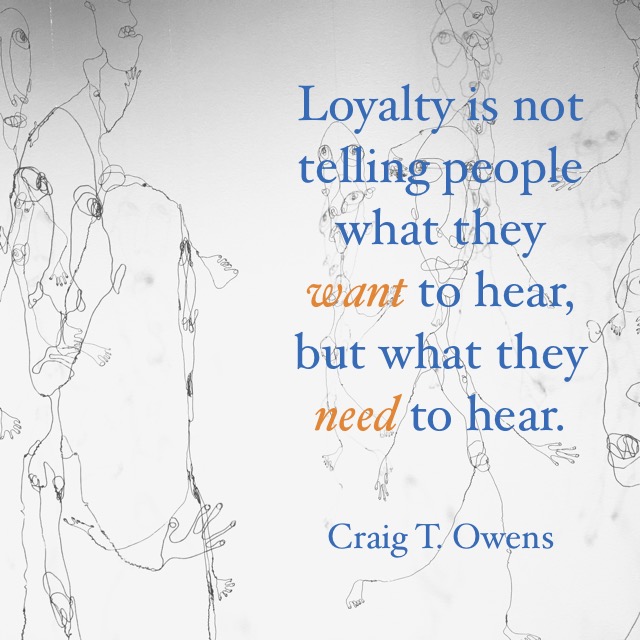
Loyalty is not telling people what they want to hear, but what they need to hear.
For an example, take the prophet Nathan in the Bible. We don’t know how old he is when he steps on the scene, or even where he came from. There isn’t a clue as to his tribal ancestry or even his father’s name.
King David wanted to build a temple for the ark of the covenant of the Lord, and he asked Nathan about this. Nathan immediately said, “Yes!” (kinda reinforces that idea of loyalty = Yes-man, doesn’t it?) But wait! That night, God speaks to Nathan and says, “Tell David he’s not the one to build the temple for Me.” So Nathan returns to David and loyally tells him no.
Later on, David steals another man’s wife and contrives a plan to have that man murdered on the battlefield. David thinks he’s gotten away with it until Nathan, the loyal friend, shows up to confront David with his sin. Nathan didn’t want to see David fail, but he wanted to give him a chance to confess and repent.
Near the end of David’s life, one of David’s sons, Adonijah, wanted to take the throne for himself. Many of the officials in David’s palace jumped on the bandwagon, but loyal Nathan did not. In fact, Nathan even got word to the King about Adonijah’s plans. As a result, David asked Nathan to anoint his son Solomon as king.
During David’s life, Nathan wrote David’s biography. If Nathan was just a mindless Yes-man, he could have easily left out the messy parts of David’s life. But the loyal friend wanted to show future readers that we all mess up, but God forgives and restores us when we repent.
Nathan’s name means the gift God gave or a giver. Both meanings fit this loyal man.
Loyal friends give their friends the gift of life. They don’t let friends go down a destructive path. They don’t join with others when they attack. They remain constant, always-there, friends.
What a blessing to be called a loyal friend! And what an even greater blessing to have “Nathans” in our own lives!
Check out these opening paragraphs from an article on WebMD (if you wish, you can read the full article here):
People over 50 get a self-esteem boost when they read negative news about young adults, a study shows.
Researchers also say young people, when given the choice, would rather read about people their own age and aren’t very interested in stories about their elders, whether the articles are positive or negative.
“Our results reflect that the younger readers did not perceive older people as all that relevant,” study researcher Silvia Knobloch-Westerwick, PhD, of Ohio State University, tells WebMD by email. “They’re more concerned with figuring out who they are and where they stand, and those in the same age group appear to provide the relevant comparisons for that.”
Okay, this disturbs me on several areas. Basically, each age group is dissin’ the other age group.
The senior citizens are projecting a snickering, see-I-told-you, father-knows-best, condescending attitude on youth. Why would anyone who is willing to learn and grow want to be around that kind of person?!
Then our youth have an I’ve-got-it-all-figured-out, I-don’t-need-you, you’re-out-of-touch attitude toward the senior citizens. Why would anyone who is willing to mentor someone ever want to be that kind of person?!
I think both of these generational groups could learn from this wise advice:
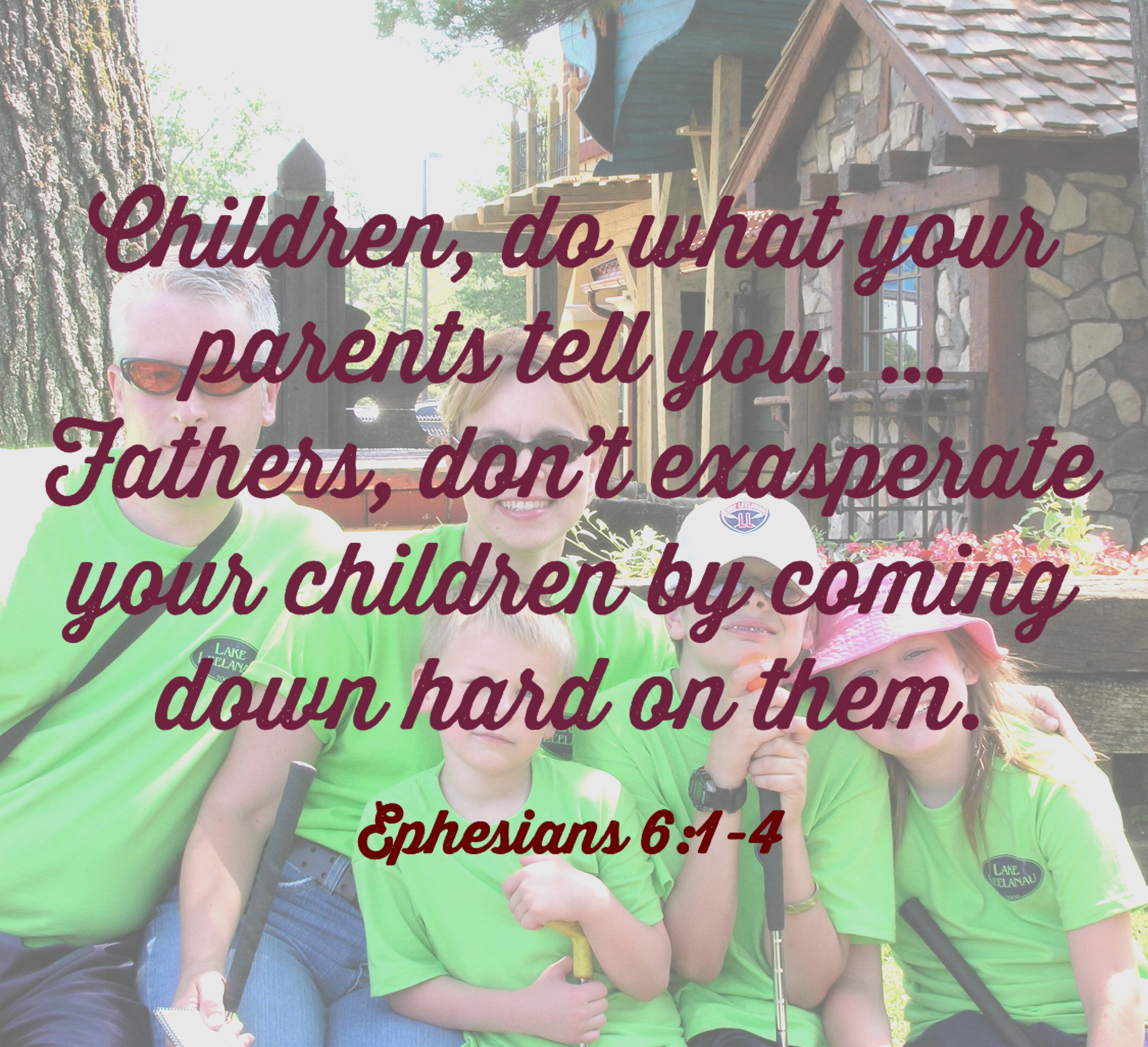
Children, do what your parents tell you. This is only right. “Honor your father and mother” is the first commandment that has a promise attached to it, namely, “so you will live well and have a long life.” Fathers, don’t exasperate your children by coming down hard on them. Take them by the hand and lead them in the way of the Master.
“Action has killed its thousands. Reaction its tens of thousands.” —E. Stanley Jones
Yes, he pulled out in front of you [action], but is tailgating him any better [reaction]?
Sure, she embarrassed you [action], but is slandering her any better [reaction]?
Yep, he lied to you [action], but is harboring a lifelong grudge any better [reaction]?
Okay, she tripped you [action], but is slapping her any better [reaction]?
That pastor betrayed your confidence [action], but is assassinating his character any better [reaction]?
“Vengeance is a passion to get even. It is a hot desire to give back as much pain as someone gave you. … The problem with revenge is that it never gets what it wants; it never evens the score. Fairness never comes. The chain reaction set off by every act of vengeance always takes its unhindered course. It ties both the injured and the injurer to an escalator of pain. Both are stuck on the escalator as long as parity is demanded, and the escalator never stops, never lets anyone off.” —Lewis Smedes
“But I tell you not to try to get even with a person who has done something to you. When someone slaps your right cheek, turn and let that person slap your other cheek.” —Jesus Christ
Two of my favorite authors are C.S. Lewis and Oswald Chambers. Lewis helps me to see biblical truths in a way I’ve not seen them before. Chambers helps me live out those biblical truths differently than I’ve been living them before.
I’m working my way through the complete works of Oswald Chambers (or maybe I should say, his writings are working their way through me!), so I thought I’d share with you, my dear reader, what’s challenging me.
We’ll see how this goes, but on Thursdays, I’ll share with you something I’ve been reading and thinking about from the writings of Oswald Chambers. Sometimes I may just let the teacher speak for himself, and sometimes I may offer a thought or two of my own. As always, you are welcome to weigh in with your thoughts as well. I’m excited to share these lessons with you.
God’s “Oughts”
Strictly speaking, there is no disobedience possible to an imperative law, the only alternative being destruction. In this sense the moral law is not imperative, because it can be disobeyed and immediate destruction does not follow. And yet the moral law never alters, however much men disobey it; it can be violated, but it never alters. Remember, at the back of all human morality stands God.
The Ten Commandments were not given with any consideration for human ability or inability to keep them; they are the revelation of God’s demands made of men and women who had declared that if God would make His law known, they would keep it. …
If the “Oughts” of the Old Testament were difficult to obey, Our Lord’s teaching is unfathomably more difficult. Remember, the commandments were given irrespective of human ability or inability to keep them; then when Jesus Christ came, instead of doing what we all too glibly say He did—put something easier before men, He made it a hundredfold more difficult, because He goes behind the law to the disposition.
The purity God demands is impossible unless we can be re-made from within, and that is what Jesus Christ undertakes to do through the Atonement. … It is not a question of applying Jesus Christ’s principles to our actual life first of all, but of applying them to our relationship to Himself, then as we keep our souls open in relation to Him our conscience will decide how we are to act out of that relationship.
From Biblical Ethics
A growing relationship with Jesus = Greater sensitivity to my conscience and the Holy Spirit = Correct disposition to obey God’s laws.
I’ve always been fascinated by the leadership of Israel’s second king: David. There are so many leadership lessons to be learned from his life. A few things I’ve noted about his leadership that I am always trying to implement in my life as well.
Respect—David treated everyone (even his enemies) with respect.
Shrewdness—David used his wits exceptionally well. He knew how to shower gifts on the right people, show recognition to those who needed their ego stroked, be gracious to those who were uncertain, and even flex his muscles with show-offs who got out of line.
Prayer—David was a man of prayer. He prayed for direction, he asked God for strategies, he prayed for deliverance. He prayed for everything.
Confident humility—I know it sounds like an oxymoron (how can someone be both confident and humble?), but David really got this. Check out this commentary:
And David became more and more powerful, because the Lord God Almighty was with him. … And David knew that the Lord had established him as king over Israel and had exalted his kingdom for the sake of His people Israel.
Man of the people—David didn’t closet himself away; he lived and led in full sight of everyone.
All the people took note and were pleased; indeed, everything the king did pleased them.
I want to lead like David led!
What about you? Are there other areas of David’s leadership that you admire or want to imitate?



 Why Should I Do What I Ought To Do?




 Craig T. Owens