My Great Desire

From Oswald Chambers—

I want to ask a very personal question—How much do you want to be delivered from? You say, “I want to be delivered from wrong-doing”—then you don’t need to come to Jesus Christ. “I want to walk in the right way according to the judgment of men”—then you don’t need Jesus Christ. But some heart cries out—“I want, God knows I want, that Jesus Christ should do in me all He said He would do.”

How many of us “want” like that?

God grant that this “want” may increase until it swamps every other desire of heart and life.

Do you want, more than you want your food, more than you want your sleep, more than you want anything under heaven, or in heaven, that Jesus Christ might so identify you with Himself that you are His first and last and forever?

God grant that the great longing desire of your heart may begin to awaken as it has never done, not only the desire for the forgiveness of sins, but for identification with Jesus Himself until you say, “I live; yet not I, but Christ liveth in me.”

I want Jesus more than anything! I want Him to have all of me!

God, grant that the great desire of my heart may begin to awaken as it have never done before!

The Inner Chamber & The Inner Life (book review)

Andrew Murray is a brilliantly straightforward author. There aren’t hidden meanings, or complex phrases, or deep theology to wade through; instead, he takes you right to the heart of the matter. And the heart of the matter in The Inner Chamber & The Inner Life is our daily personal devotional time with God.

Never before have I read a book like this that taught me how to prepare myself to have my personal quiet time with God each morning. I have made it a habit to pray before I open my Bible, asking the Holy Spirit to illuminate the Word to my heart. But Andrew Murray has given us 36 short chapters on how and why we should spend more time preparing ourselves even before we open the Bible.

I am a morning person, so I love to get up early to spend my quiet time with God before my day gets started. Whether you are a morning person or not, Andrew Murray makes a pretty good case for why the morning hour with God is indispensable. (I know my “night owl” friends may groan at this, but you really should check this out!)

If you would like to see your personal devotional time become a richer time with God, you will do well to read The Inner Chamber & The Inner Life.

(Check out some quotes I shared from this book by clicking here.)

It’s Not Anger Management

Listen to the podcast of this post by clicking on the player below, and you can also subscribe on AppleSpotify, or Audible.

Aristotle had an insightful quote that was almost accurate—

“Anybody can become angry—that is easy; but to be angry with the right person, and to the right degree, and at the right time, and for the right purpose, and in the right way—that is not within everybody’s power and is not easy.”

I agree with most of this, but I would argue that it’s not within anybody’s power to express their anger in the right way.

The Bible says that our challenge is to not sin when we are angry (Ephesians 4:26). But most anger is selfishly provoked. That means, I’m angry because I have been offended, or my “rights” have been violated, or someone injured me.

If my anger has been selfishly provoked, how can I be expected to express my anger in any other fashion but selfishly?!

Instead of me trying to manage my anger, I need to listen to the Holy Spirit’s voice. There is one important question the Spirit asks us (which comes from Jonah 4:9)—

Do you do well to be angry?

  • Is it good for me to be angry with this? or should I let this go?
  • Is my anger righteously provoked? or is it selfishly provoked?
  • Does this grieve the Holy Spirit (Isaiah 63:10)?

God’s Spirit within you is never silent. He will either confirm that your anger is righteously provoked (as it was with Jesus in John 2:13-17), or it’s selfishly provoked (as it was with Jonah). That’s why you must ask yourself that question and allow the Holy Spirit to help you answer it: Do I do well to be angry?

If you answer “yes,” and the Holy Spirit confirms this in your heart, then He will help you to be angry with the right person, and to the right degree, and at the right time, and for the right purpose, and in the right way (as Aristotle said).

And if you answer “no,” the Holy Spirit is the only one who can help put out the flames of your anger in a healthy way.

So don’t try to manage your temper. Listen to the Holy Spirit asking you, “Do you do well to be angry?” And let Him guide you from there.

If you want to check out the other messages in our series called Ticked Off! you may click here.

►► Would you please prayerfully consider supporting this ministry? My Patreon supporters get behind-the-scenes access to exclusive materials. ◀︎◀︎

4 Myths About Your Temper

This morning I shared with my congregation—in part one of our Ticked Off! series—three myths about anger. I want to add a fourth here…

1.  Anger is a sin. 

God is angry numerous times; in fact, the Old Testament alone has hundreds of verses that mention God’s anger. In the New Testament, Ephesians 4:26 says, “…in your anger do not sin….” It doesn’t say, “don’t get angry,” but “when you’re angry, don’t sin.”

2.  Anger is always destructive. 

Some great advances have been brought about by people who got angry. For instance, Martin Luther, the father of the reformation, wrote, “When I am angry I can write, pray, and preach well, for then my whole temperament is quickened, my understanding sharpened, and all mundane vexations and temptations gone.”

3.  Anger doesn’t affect me.

Anger affects you physically. In one medical study researchers found that people who had strokes were more likely to have experienced anger in the two hours prior to having their stroke. It also affects your relationships. After you blow up, people close to you are injured and began to distance themselves from you.

4.  I can manage my anger.

Anger has a tendency to completely seize you, making it next to impossible to manage the furnace of emotions that is raging inside you. You cannot manage your anger! Instead, you need God’s help.

Check out the messages in this series by clicking here.

Spiritual Sword Play

Pastor, consider these words from Charles Spurgeon—

“We pastors depend entirely upon the Spirit of God to produce actual effect from the gospel, and at this effect we must always aim. We do not stand up in our pulpits to display our skill in spiritual sword play, but we come to actual fighting: our object is to drive the sword of the Spirit through men’s hearts.”

In order to effectively drive the sword of the Spirit through men’s hearts we must be well-trained in spiritual warfare. That training takes place in the secret chamber alone with God. Eugene Peterson gives this warning to pastors—

“Three pastoral acts—praying, reading Scripture and giving spiritual direction—are so basic, so critical, that they determine the shape of everything else in ministry. Besides being basic, these three acts are quiet and done mostly out of the spotlight of public ministry. Because they do not call attention to themselves, they are so often neglected. …Because almost never does anyone notice whether we do these things or not, and only occasionally does someone ask if we do them, these real acts of ministry suffer widespread neglect.”

You cannot give to others what you do not possess yourself!

Pastor, get alone with God. Everyday. Sharpen your sword through private prayer and personal devotion. Everyday!

Going Up, Please

I’m leading a fun discussion at the En Gedi Youth Center with a bunch of excited 6th graders. Our class is called “An Elevation, A Mirror, And A Guy Called Bob” which is based on John Maxwell’s book Winning With People.

In Winning With People, Dr. Maxwell shares 25 principles for improving our interpersonal skills. In my class at the youth center, we’ve already covered the lens principle and the elevator principle.

The elevator principle basically says that we can only take people up or take them down in our interactions with them. There are no “neutral” interactions. I’m encouraging our students to always take people up.

One way we do that is by pausing to T.H.I.N.K before we speak. Before speaking, ask yourself, “Is what I’m about to say…

  • True
  • Helpful
  • Inspiring
  • Necessary
  • Kind?”

This isn’t just good advice for 6th graders. We all would do well to remember to T.H.I.N.K. As Winston Churchill said,

“By swallowing evil words unsaid, no one has ever harmed his stomach.”

Thursdays With Oswald—Melt My Prejudices

This is a weekly series with things I’m reading and pondering from Oswald Chambers. You can read the original seed thought here, or type “Thursdays With Oswald” in the search box to read more entries.

Melt My Prejudices

     Until the Holy Spirit comes in we see only along the line of our prejudices. When we let the Holy Spirit come in, He will blow away the lines of our prejudices with His dynamic power, and we can begin to “go” in God’s light. 

     A darkened heart is a terrible thing, because a darkened heart may make a man peaceful. A man says—“My heart is not bad, I am not convicted of sin; all this talk about being born again and filled with the Holy Spirit is so much absurdity.” The natural heart needs the Gospel of Jesus, but it does not want it, it will fight against it, and it takes the convicting Spirit of God to make men and women know they need to experience a radical work of grace in their hearts. …

     The only way to alter the hardened heart is to melt it, and the only power that can melt it is the fire of the Holy Ghost. 

From Biblical Psychology

It’s scary to think that my darkened heart can make me numb to the convicting of the Holy Spirit. All the more reason that I need to pray the prayers of the psalmist:

Search me, O God, and know my heart; test me and know my anxious thoughts. Point out anything in me that offends You, and lead me along the path of everlasting life. (Psalm 139:23-24)

Create in me a pure heart, O God, and renew a steadfast spirit within me. Do not cast me from Your presence or take Your Holy Spirit from me. (Psalm 51:10-11)

O, Holy Spirit, melt my prejudices! Keep my heart tender before You!

Ticked Off!

Have you ever been so angry that you couldn’t see straight?

Has someone ever pushed all your buttons?

Have you ever worked with someone who knew how to get on your very last nerve?

I can’t imagine anyone answering “No” to these questions. Of course, we all get mad. The real issue is what do we do when we get there?

More specifically: what’s a Christian to do when he or she gets thoroughly ticked off?

Starting this Sunday, I’m going to be exploring this topic, and I hope you can join me. We’ll be looking at what the Bible has to say about what we are supposed to do with these strong emotions. If you missed any of these messages, check them out here:

GrowING

Listen to the podcast of this post by clicking on the player below, and you can also subscribe on AppleSpotify, or Audible.

A few checklist items for a growING Christian (from Philippians 4:4-9):

  • Learning to rejoice in the Lord. Always.
  • Maturing in gentleness.
  • Becoming more consciously aware of God’s omnipresence.
  • Decreasing in anxiety.
  • Constantly praying.
  • Increasingly thankful.
  • Learning to remain peaceful.
  • Becoming more discerning of what goes into my mind.
  • Learning and relearning biblical principles.

I observe four things about this list:

  1. None of the verbs in the Greek are past tense. These are all on-goING processes.
  2. If this list is changed from in-process to fully-completed, it sounds like Jesus.
  3. I have to decide daily to be growING.
  4. I cannot grow through this list without help: I need the Holy Spirit.

This is a rather short list, but it’s filled with a lifetime of growING opportunities.

If I decide today that I want to be growING, my Heavenly Father will bring me into more opportunities where the Holy Spirit will help me develop and exhibit the qualities of Jesus Christ.

Are you ready to do some growING today? If so, ask the Holy Spirit to take you into your next growING lesson.

►► Would you please prayerfully consider supporting this ministry? My Patreon supporters get behind-the-scenes access to exclusive materials. ◀︎◀︎

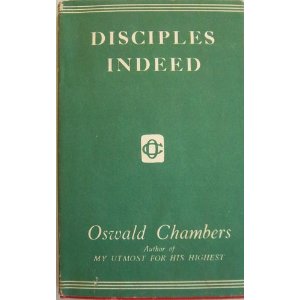
31 Quotes From “Disciples Indeed”

When I read an Oswald Chamber book, I feel like I could highlight every line on every page! So for Disciples Indeed (you can read my full review by clicking here), I did my very best to narrow it down to my 31 favorite quotes.

“Truth is a Person, not a proposition; if I pin my faith to a logical creed I will be disloyal to the Lord Jesus.”

“If we understood what happens when we use the Word of God, we would use it oftener.”

“Everything the devil does, God over-reaches to serve His own purpose.”

“We continually want to present our understanding of how God has worked in our own experience, consequently we confuse people. Present Jesus Christ, lift Him up, and the Holy Spirit will do in them what He has done in you.”

“Spiritual famine and dearth, if it does not start from sin, starts from dwelling entirely on the experience God gave me instead of on God who gave me the experience. …Whenever I put my experience of life, or my intelligence, or anything other than dependence on God, as the ground of understanding the will of God I rob Him of glory.”

“There is nothing so still and gentle as the checks of the Holy Spirit if they are yielded to, emancipation is the result; but let them be trifled with, and there will come a hardening of the life away from God. Don’t quench the Spirit.”

“The only sign that a particular gift is from the Ascended Christ is that it edifies the Church. Much of our Christian work today is built on what the Apostle pleads it should not be built, viz., the excellencies of the natural virtues.”

“My conscience makes me know what I ought to do, but it does not empower me to do it.”

“In the moral realm if you don’t do things quickly you will never do them. Never postpone a moral decision. Second thoughts on moral matters are always deflections.”

“You often find people in the world are more desirable, easier to get on with, than people in the Kingdom. There is frequently a stubbornness, a self-opinionativeness, in Christians not exhibited by people in the world. If there is to be another Revival it will be through the readjustment of those of us on the inside who call ourselves Christians.”

“The greatest test of Christianity is the wear and tear of daily life, it is like the shining silver, the more it is rubbed the brighter it grows.”

“We have to do more than we are built to do naturally; we have to do all the Almighty builds us to do.”

“Beware of the people who tell you life is simple. Life is such a mass of complications that no man is safe apart from God. Coming to Jesus does not simplify life, it simplifies my relationship to God.”

“God’s idea is that individual Christians should become identified with His purpose for the world. When Christianity becomes over-organized and denominational it is incapable of fulfilling our Lord’s commission; it doesn’t ‘feed His sheep,’ it can’t.”

“When you pray, what conception have you in your mind—your need, or Jesus Christ’s omnipotence?”

“Prayer is the vital breath of the Christian; not the thing that makes him alive, but the evidence that he is alive.”

“By intercessory prayer we can hold off satan from other lives and give the Holy Ghost a chance with them.”

“The greatest answer to prayer is that I am brought into a perfect understanding with God, and that alters my view of actual things.”

“See that you do not use the trick of prayer to cover up what you know you ought to do.”

“The work we do in preparation is meant to get our minds into such order that they are at the service of God for His inspiration. Conscious inspiration is mercifully rare or we would make inspiration our god.”

“Spiritual insight is in accordance with the development of heart purity.”

“Spiritual sloth must be the greatest grief to the Holy Ghost.”

“It is quite true so say ‘I can’t live a holy life’; but you can decide to let Jesus make you holy. ‘I can’t do away with my past’; but you can decide to let Jesus do away with it.”

“If I make personal holiness a cause instead of an effect I become shallow, no matter how profound I seem. It means I am far more concerned about being speckless than about being real; far more concerned about keeping my garments white than about being devoted to Jesus Christ.”

“Freedom is the ability not to insist on my rights, but to see that God gets His.”

“Beware of saying, ‘I haven’t time to read the Bible, or to pray’; say rather, ‘I haven’t disciplined myself to do these things.’”

“Weighing the pros and cons for and against a statement of Jesus Christ’s means that for the time being I refuse to obey Him.”

“If my testimony makes anyone wish to emulate me, it is a mistaken testimony, it is not a witness to Jesus. The Holy Spirit will only witness to a testimony when Jesus Christ is exalted higher than the testimony.”

“As you go on with God He will give you thoughts that are bit too big for you.”

“How many people have you made homesick for God?”

“Christian service is not our work; loyalty to Jesus is our work.”