A Byzantine Benediction

Christus Ravenna MosaicA prayer for all of us…

Go now with God.
Be not tempted to stay in the safety of known places.
Move from where you are to where God points.
Go now with God.
Be not tempted to go only in your time, when it suits, when it is sure,
For now is God’s time.
Go now with God.
Choose not to go alone.
Go in faith that there is no wilderness so vast,
No way so confused,
That God is not already there to show you the way. ―Byzantine Benediction

Links & Quotes

link quote

“When the body is about to be led into a sinful action by some fear or craving, we are to take the sword of the Spirit and kill that fear and that craving. In my experience, that means mainly severing the root of sin’s promise by the power of a superior promise. … Having promises at hand that suit the temptation of the hour is one key to successful warfare against sin…. Be constantly adding to your arsenal of promises. But never lose sight of the chosen few that God has blessed in your life. Do both. Be ever-ready with the old. And every morning look for a new one to take with you through the day.” —John Piper

“At the heart of the Hebrew concept of marriage is the notion of covenant—a legally binding agreement with spiritual and emotional ramification (Proverbs 2:17). God serves as a witness to the marriage covenant, blessing its faithfulness but hating its betrayal (Malachi 2:14-16). The Lord’s intimate involvement renders this legal commitment a spiritual union, ‘so they are no longer two, but one’ (Matthew 19:6). The purpose of marriage as articulated in the Bible is to find true companionship (Genesis 2:18; Proverbs 18: 22), produce godly offspring (Malachi 2:15; 1 Corinthians 7:14) and fulfill God’s calling upon an individual’s life (Genesis 1:28). … Marriage binds husband and wife together into an entity greater than either partner as an individual, and it does so in order to assure continuity of the family lineage.” —Archeological Study Bible

“To educate a man in mind and not in morals is to educate a menace to society.” —Theodore Roosevelt

Eric Metaxas, in his commentary A Murderous Mother, tells how the environmentalists have gotten off track, and how Christians are really the only one who can help us.

“In our esteem, the joys of earth are little better than husks for swine compared with Jesus the Heavenly Manna. I would rather have one mouthful of Christ’s love, and a sip of His fellowship, than a whole world full of carnal delights. What is the chaff to the wheat? What is the sparkling paste to the true diamond? What is a dream to the glorious reality?” —Charles Spurgeon

I really like this post—Is There A Spiritual Side To Sex?

Abortion, Inc. documents the $500 million Planned Parenthood gets in your tax dollars to keep killing innocent children.

Links & Quotes

link quote

“That is the religion of ninety-nine English people out of every hundred who know nothing of divine grace—we are to be as good as we can; we are to go to church or to chapel, and do all that we can, and then Jesus Christ died for us, and we shall be saved. Whereas the gospel is, that He did not do anything at all for people who think they can rely on themselves, but gave Himself for lost and ruined ones. He did not come into the world to save self-righteous people; on their own showing, they do not want to be saved.” —Charles Spurgeon

Twitter stands up to ISIS. About time!

bu-030415-1Interesting research results from The Barna Group in What Millennials Want When They Visit Church.

“The engagement of God’s power never takes the place of the engagement of our will! The power of God in sanctification never makes us passive! The power of God engages itself beneath or behind and within our will, not in place of our will. … God will never appear with power in your will in any other form than a good resolve that you make and keep.” —John Piper

“Jesus is Amen as to His righteousness. That sacred robe shall remain most fair and glorious when nature shall decay. He is Amen in every single title which He bears; your Husband, never seeking a divorce; your Head, the neck never being dislocated; your Friend, sticking closer than a brother; your Shepherd, with you in death’s dark vale; your Help and your Deliverer; your Castle and your High Tower; the Horn of your Strength, your confidence, your joy, your all in all, and Amen in all.” —Charles Spurgeon

Read this in my Archeological Study Bible and thought this rang true for our generation still today: “This generation was not guilty of the gross idolatry of its forefathers. Rather, these Israelites had embraced a kind of dead orthodoxy, in which they tried to get by with the minimum that their faith required.”

Thursdays With Oswald—Faith And Common Sense

Oswald ChambersThis is a periodic series with things I’m reading and pondering from Oswald Chambers. You can read the original seed thought here, or type “Thursdays With Oswald” in the search box to read more entries.

Faith And Common Sense 

     Common sense is not faith and faith is not common sense; they stand in the relation of Ishmael and Isaac, of the natural and the spiritual, of individuality and personality, of impulse and inspiration. Faith in antagonism to common sense is fanaticism, and common sense in antagonism to faith is rationalism. The life of faith brings the two into right relationship.

     How am I going to find out what the will of God is? In one way only, by not trying to find out. If you are born again of the Spirit of God, you are the will of God, and your ordinary common sense decisions are God’s will for you unless He gives you an inner check. When He does, call a halt immediately and wait on Him. Be renewed in the spirit of your mind that you may make out His will, not in your mind, but in practical living. God’s will in my common sense life is not for me to accept conditions and say—“Oh well, it is the will of God,” but to apprehend them for Him, and that means conflict, and it is of God that we conflict. Doing the will of God is an active thing in my common sense life.

From Not Knowing Where [italics in original; bold font added by me]

Have you ever considered that we find the will of God by not trying to find the will of God? I love Chambers’ conclusion that as a Christian you are the will of God, now we just need to be renewed in our spirits to hear His voice and direction for us.

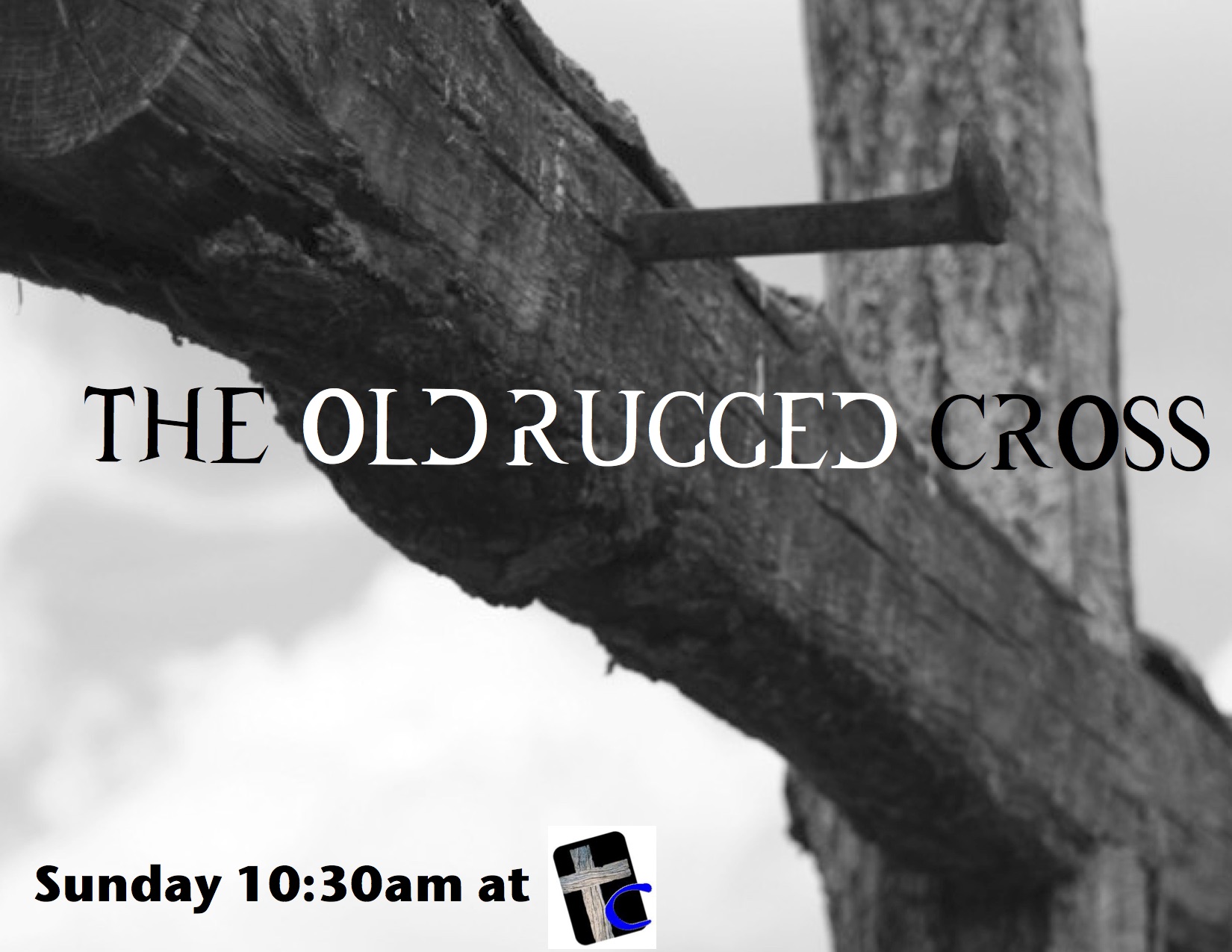
The Old Rugged Cross

The Old Rugged CrossThe Apostle Paul traveled the known world preaching and teaching. Luke preserves some of his sermons for us in the Book of Acts, and Paul’s letters reveal the depth of and breadth of his Spirit-inspired thoughts. But of all the doctrines which this eminent apostle taught, there was one truth that stood out as the foundation for all others—

And when I came to you, brethren, I did not come with superiority of speech or of wisdom, proclaiming to you the testimony of God. For I determined to know nothing among you except Jesus Christ, and Him crucified (1 Corinthians 2:1-2).

The work that Jesus Christ did on an old rugged Cross is absolutely the most central message of all others. Without the Cross, no other doctrine makes sense.

Sadly, we spend far too little time looking at the Cross.

Join me this Sunday as we take a long look at the Cross and the Lamb of God Who was sacrificed on it. Our series is simply called The Old Rugged Cross.

4 Notes On Haggai

(c) Laura Kranz at The Overview Bible Project (see my note below)

(c) Laura Kranz at The Overview Bible Project (see my note below)

The prophet Haggai wrote one of the shortest books in the Old Testament, and his recorded ministry only spans five months(!) in 520 B.C. But in this short book I find four really cool things—

(1) God uses His people at specific times for specific purposes. All of Haggai’s messages from God have a very precise date stamp on them, so we know exactly when  they were delivered. Also, most of his messages say something like, “The word of God came through Haggai to Zerubbabel [or to Joshua, or to the people, or to the priests].” If God used Haggai like this, isn’t it likely that He is using you or I at specific times and for specific purposes?

(2) God invites us to “give careful thought” to His messages. Five times God says, “Give careful thought to your ways” (1:5, 7; 2:15, 18). This phrase literally means to take a strong hold on each thought and examine it intensely. This thought process is always connected to another phrase: “This is what the Lord Almighty says….” In other words, we are to thoughtfully examine our lifestyle with God’s Word being the standard of measurement (cf. 2 Corinthians 10:5).

(3) Obeying God’s Word brings God’s “stirring.” When God says move and we move, His Spirit will energize our spirit, and empower our lives for action. God never calls us to do something without giving us the empowerment to do it.

(4) I need to act courageously. God calls us to “be strong” (three times in 2:4) “and work, for I am with you.” Courageous action after God has stirred us up drives out fear. On the flip side, inactivity because of fear almost always leads to more fear and more inactivity.

Don’t ever let the category “minor prophet” trick you into thinking God doesn’t have a major message to share with you. Just one word from God is more powerful than we can ever imagine!

(The portrait of Haggai in this post was created by Laura Kranz at The Overview Bible Project. She and her husband Jeffrey do some amazing things that will add insight to your Bible study time. Click here to read my review of their book The Illustrated Guide To The Authors Of The Bible. And while you’re on their website, subscribe to some of the cool guides that regularly get emailed out.)

E.M. Bounds On Prayer

E.M. BoundsAn amazing passage from E.M. Bounds’ book The Necessity Of Prayer—

“Here, let it be said, that no two things are more essential to a Spirit-filled life than Bible reading and secret prayer; no two things more helpful to growth in grace; to getting the largest joy out of a Christian life; toward establishing one in the ways of eternal peace. The neglect of these all-important duties, presages leanness of soul, loss of joy, absence of peace, dryness of spirit, decay in all things that pertain to spiritual life. Neglecting these things paves the way for apostasy, and gives the evil one an advantage such as he is not likely to ignore. Reading God’s Word regularly, and praying habitually in the secret place of the Most High puts one where he is absolutely safe from the attacks of the enemy of souls, and guarantees him salvation and final victory, through the overcoming power of the Lamb.” (emphasis added)

Countdown To Zero Day (book review)

Countdown To Zero DayI don’t typically read fiction books. So when I first began reading Countdown To Zero Day by Kim Zetter, I had to stop to double-check that what I was reading wan’t fiction. This book had such a gripping storyline from the opening page that it sounded just like a novel.

But it’s not. It’s a real story with possible deadly consequences for the computerized world.

Countdown To Zero Day is like a detective story or a spy thriller, where different groups are trying to unravel the mystery of a highly-advanced computer virus that appears to only be effecting a specific type of computer. The story alternates back and forth between the cyber-sleuths unraveling the Stuxnet virus, and a group from the IAEA (International Atomic Energy Agency) trying to reveal Iran’s attempts to coverup their advancing nuclear weapons programs.

I really liked the format of the book. Kim wrote the book for computer techies that understand much of the computer jargon and basic operations of computer viruses, but for those who are technically-challenged, the abundance of footnotes will quickly allow the reader to feel more technically savvy.

The book follows this one particular case to address the larger question: Is cyber-warfare the next threat for all of us to address? That’s a good question, and the book allows lots of world experts to weigh-in. Techies and non-techies alike will enjoy this book!

I am a Random House book reviewer.

Links & Quotes

link quote

“There is a burden of care in getting riches; fear in keeping them; temptation in using them; guilt in abusing them; sorrow in losing them; and a burden of account at last to be given concerning them.” —Matthew Henry

“Don’t imagine I doubt for a moment that what God sends us must be sent in love and will all be for the best if we have grace to use it so. My mind doesn’t waver on this point; my feelings sometimes do. That’s why it does me good to hear what I believe repeated in your voice….” ―C.S. Lewis

“Our comfort comes not from the powerlessness of our enemies, but from our Father’s sovereign rule over their power.” —John Piper

Have you seen all the videos of one of Obamacare’s architects, Jonathan Gruber? Here is the story behind the man, Rich Weinstein, who unearthed all of these clips and exposed the outright lies and hypocrisy. And this video compilation is just a sampling of the lies—

Charles Spurgeon On Humility

C.H. Spurgeon“How careful should we be when we do anything for God, and God is pleased to accept of our doings, that we never congratulate ourselves. The minister of Christ should unrobe himself of every rag of praise. ‘You preached well,’ said a friend to John Bunyan one morning. ‘You are too late,’ said honest John, ‘the devil told me that before I left the pulpit.’ The devil often tells God’s servants a great many things which they should be sorry to hear. Why, you can hardly be useful in a Sunday School but he will say to you ‘How well you have done it!’ You can scarcely resist a temptation, or set a good example, but he will be whispering to you ‘What an excellent person you must be!’ It is, perhaps, one of the hardest struggles of the Christian life to learn this sentence—‘Not unto us, O Lord, not unto us, but unto Thy name give glory.’ Now God is so jealous on this point that, while He will forgive His own servants a thousand things, this is an offense for which He is sure to chasten us. Let a believer once say, ‘I am,’ and God will soon make him say ‘I am not.’ Let a Christian begin to boast, ‘I can do all things,’ without adding ‘through Christ which strengtheneth me,’ and before long he will have to groan, ‘I can do nothing,’ and bemoan himself. Many sins of true Christians, I do not doubt, have been the result of their glorifying themselves. Many a man has been permitted by God to stain a noble character and to ruin an admirable reputation, because the character and the reputation had come to be the man’s own, instead of being laid, as all our crowns must be laid, at the feet of Christ.” —Charles Spurgeon