Argument Vs. Experience

There is a curious word that shows up about 70 times in the Bible (almost all of them in the Psalms)—Selah. The best scholars can figure is that this word has some sort of musical meaning: 

  1. Pause / Interlude—to rest in silence. This might even be where the singers stopped while the music continued. 
  1. Accentuation—to lift up or exalt; as in the renewed vigor of the singer or musician after pausing for a deep breath. 
  1. Consideration—the root word for Selah means to weigh on a balance, with the idea of despising the things that are light or trivial, and valuing the things that carry weight or substance. The Amplified Bible uses the phrase “pause and calmly think of that.” 

All three are valid definitions, and all three are used in the Psalms. I think the context of the Psalm makes it clear which one is meant. Sometimes more than one meaning is implied, and sometimes all three meanings are implied. 

Selah first shows up in Psalm 3. This is also one of the few psalms that uses Selah multiple times. We also get a clue to the context in the introduction: A psalm of David. When he fled from his son Absalom [see 2 Samuel 15]. 

David has a lot of enemies ganging up on him? The Message says, “enemies past counting!” And David laments that his enemies are whispering something very negative: “There is no God” or “God is too disinterested or weak to help you” or “You don’t deserve to have God’s help.” 

In the midst of this noise, David pens his first  SELAH—David needs a pause. The enemies past counting have got his thoughts swirling. He needs to pause and calmly think: “I KNOW God can and will help me because He has already helped me in the past. You may have your arguments and reasons, but I have my personal experience with God!” 

Notice the very next word: But (v. 3). You ARE [not were or will be] a shield around me…. To the Lord I CRY aloud [not I used to cry or I will cry], and He ANSWERS [not He answered or He will answer] me… (v. 4).

The second SELAH (v. 4) is the renewed vigor after the pause. The Message says, His answers thunder from the holy mountain. This corresponds with what David wrote when God delivered him previously (see Psalm 18:4-13). Then in the next four verses, David lists all the blessings that come when God answers: 

    • sleep 
    • sustaining power 
    • no fear of the tens of thousands on every side
    • deliverance
    • retribution for enemies 
    • God’s blessing—Real help comes from God. Your blessing clothes Your people! (v. 8 in MSG) 

David concludes this psalm with one final SELAH (v. 8)—to weigh on a balance. On one side: accusations and threats (only words). On the other side: personal experience of past deliverance and confident assurance of God’s present presence and rock-solid hope in God’s future grace. Pause and calmly consider those scales: which side are you on? Do you have only words, or do you have personal experience? 

The one with an experience with God is NEVER at the mercy of the one with only an argument against God. 

Join me next Sunday as we continue our look at the Selahs in the Book of Psalms. You can join me in person or on Facebook Live. 

Saturday In The Proverbs—Fools Talk A Good Game, But… (Proverbs 14)

[Each chapter in the Book of Proverbs contains thoughts that fit into a theme; they are not just random thoughts gathered together. In this “Saturday In The Proverbs” series, I will share a theme that I see in each chapter. But the cool thing about God’s Word is that you may see an entirely different theme. That’s great! If you do, I would love for you to share it in the comments below.]

Where no oxen are, the trough is clean; but much increase come by the strength of an ox (Proverbs 14:4).

You can have something that looks pristine on the outside, but it is all show and no production. Eventually, it will all come crashing down. 

Or you can have the messiness of productivity which will result in lasting success. 

The wise make the productive mess, knowing that they are building something lasting. The fool only tries to make it look good on the outside, but they are undermining themselves (see vv. 1, 11). 

The fool talks a good game, but…

  • their perversity is despised by God
  • their pride injures themselves and others 
  • they lie to keep up appearances 
  • they never learn from their mistakes
  • they are deceitful 
  • they are on the path to death
  • they are self-confident and quick-tempered, which alienates them from others 
  • they will eventually serve the wise
  • they despise others’ needs 
  • they are poor
  • they are fearful of the future
  • they don’t leave a good legacy for their children
  • they rot with envy
  • the oppress poor people
  • then will end up in utter shame

…all for the sake of trying to make others think they have lives that are perfect! 

Keeping up appearances is hard, painful, unrewarding, and will ultimately end in disaster. 

When Problems Arise…

Selah

The word Selah appears nearly 70 times in the Bible, almost exclusively in the Psalms. Although it is primarily a musical term, it applies beautifully to our new summer series. 

Selah can mean…

  • a pause from the noise to reflect;
  • a preparation for an exciting accent; or 
  • a reflective time of consideration

Throughout the Psalms, Selah appears at the end of a verse, at the end of the psalm, or sometimes even mid-sentence. But each one of them is perfectly placed by the Spirit-inspired authors to get us to take a breath and deeply contemplate what we just read or sang. 

Summertime is typically a time for us to pause from our regular routine. Perhaps it’s a vacation, time with friends and family, driving around with the windows down and the music blasting, or just a quiet walk through woods or along a beach. In any case, whether we realize it or not, we’re actually doing Selah in these break-from-the-routine activities. 

Join me beginning this Sunday for our summertime look at each of the Psalms that ask us to Selah. I think you will find that this Sunday summertime pause will be both refreshing and encouraging. You can join me either in person or on Facebook Live. 

If you missed any of the messages in this series, check them out here:

Thursdays With Oswald—Jeremiah 9

Oswald ChambersThis is a weekly series with things I’m reading and pondering from Oswald Chambers. You can read the original seed thought here, or type “Thursdays With Oswald” in the search box to read more entries.

Jeremiah 9

[These are notes from Oswald Chambers’ lecture on Jeremiah 9.] 

    Jeremiah states that wisdom and enlightenment are not to be found among the infatuated people, they have been swept away from right judgment by false prophets who taught that everything develops along a natural rational line. That was the infatuation in Jeremiah’s day, and in our own day the proclaimers of the truth of God are in the minority; men won’t listen to them.

     There are those who say there is no such thing as the supernatural incoming of Jesus Christ, either in history or in the human heart. Our Lord Jesus Christ is not Someone Who has sprung from human nature by evolution: He is Someone Who has come crushing into the human nature by the superb miracle of the Incarnation. The supernatural is the only explanation of our lives if we are right with God, and at any moment God may tumble our lives up as He likes. The question is, are we willing to let Him? We have to maintain our personal relationship to God in Christ Jesus, no matter what happens. The one thing that is of value to God in a human life is a personal relationship of holiness to God, and every part of physical, mental, moral life and of Christian work that is not so related will be desolated and burnt as rubbish.

     The characteristic of life today is that the gospel of, ‘Cheer up, look on the bright side,’ is being preached on all sides. Our Lord says, in effect, that every happiness and peace and well-being that is based on the ignoring of a relationship to God will end in dirges and woes, disasters and terrors.

From Notes On Jeremiah

This statement arrested my attention—At any moment God may tumble our lives up as He likes. The question is, are we willing to let Him?

That is the true question for all followers of Jesus Christ: Am I willing to let Him have His way with my life?

Love Gives

For this is how God loved the world: He gave(John 3:16 NLT)

My beloved friends, let us continue to love each other sincelove comes from God. Everyone who loves is born of God and experiences a relationship with God. The person who refuses to love doesn’t know the first thing about God, because God is love—so you can’t know Him if you don’t love. This is how God showed His love for us: God sent His only Son into the world so we might live through Him. (1 John 4:7-9 MSG)

Saturday In The Proverbs—Nourishing (Proverbs 13)

[Each chapter in the Book of Proverbs contains thoughts that fit into a theme; they are not just random thoughts gathered together. In this “Saturday In The Proverbs” series, I will share a theme that I see in each chapter. But the cool thing about God’s Word is that you may see an entirely different theme. That’s great! If you do, I would love for you to share it in the comments below.]

A man shall eat well by the fruit of his mouth … The righteous eats to the satisfying of his soul… (Proverbs 13:2, 25).

God’s wisdom never leaves us flat. Never leaves us with a bad taste in our mouth. Never leaves us unsatisfied. Never leaves us without all that we need. 

God’s wisdom…

  • instructs (v. 1) 
  • satisfies the soul (vv. 2, 12, 25)
  • preserves life (vv. 3, 14)
  • brings real riches (vv. 4, 7, 11)
  • promotes (v. 5) 
  • guards (vv. 6, 8)
  • leaves a legacy (vv. 9, 22, 24)
  • increases peace (v. 10)
  • rewards (v. 13) 
  • brings favor (vv. 15, 18)
  • grows knowledge (v. 16)
  • preserves health (v. 17) 
  • gets things down (v. 19) 
  • gains even more wisdom (v. 20) 
  • repays good (v. 21)
  • wastes nothing (v. 23) 

Wow! How nourishing God’s Wisdom is! 

Prayer Is A Weapon

…the twenty-four elders fell down before the Lamb. Each one had a harp, and they held gold bowls filled with incense, which are the prayers of God’s people (Revelation 5:8). 

Then another angel with a gold incense burner came and stood at the altar. And a great amount of incense was given to him to mix with the prayers of God’s people as an offering on the gold altar before the throne. The smoke of the incense, mixed with the prayers of God’s holy people, ascended up to God from the altar where the angel had poured them out (Revelation 8:3-4). 

No prayer is ever lost.

Every prayer is a weapon. 

Every prayer is an incense of worship before God’s throne. 

I may not see the result of my prayers immediately, but they are all known in Heaven, and they are being stored up for a day when God will unleash His power. 

I must never think my prayers are trivial, temporary, or impotent. 

EVERY PRAYER is a mighty weapon!

Thursdays With Oswald—Jeremiah 8

Oswald ChambersThis is a weekly series with things I’m reading and pondering from Oswald Chambers. You can read the original seed thought here, or type “Thursdays With Oswald” in the search box to read more entries.

Jeremiah 8

[These are notes from Oswald Chambers’ lecture on Jeremiah 8.] 

     Wherever I banish them, all the survivors of this evil nation will prefer death to life (Jeremiah 8:3). 

     Our Lord Jesus used these burning words, “The worms that eat them do not die, and the fire is not quenched,” [Mark 9:44, 46, 48] in reference to the condition of people who deprive themselves of right judgment by persistently going wrong (see also 2 Thessalonians 2:11). In the prophecies of Jeremiah we have the same great revelation, that eternal issues are involved in temporal living, but in a different connection. If we are going to remain true disciples of Jesus Christ, we will have to remain alien to the day we live in.

     Such terrible suggestions as these verses contain [verses 1-3] serve as a very wholesome awakening, and bring men to the understanding of the need of Redemption. …  

     The subject of the Second Coming is the one the average unholy Christian cannot stand, and the tendency is to listen, as the people did in Jeremiah’s day, to the false prophets (2 Peter 3:3-6). …  

     The modern scholar pretends to be expounding the Word of God, but in reality he is writing with a lying pen, he builds his wisdom out of his own rationalism, and takes out of the law of God only what agrees with it. …  

     Paul says the same to Timothy—“For the time will come when men will not put up with sound doctrine. Instead, to suit their own desires, they will gather around them a great number of teachers you say what their itching ears want to hear” (2 Timothy 4:3). 

     They dress the wound of My people as though it were not serious. “Peace, peace,” they say, when there is no peace (Jeremiah 8:11). That is the perpetual peril at all times, relieving present pain by a temporal fictitious cure, when what is needed for an effectual cure is a surgical operation. …  

     All Christians are not Christian workers, but those who are called to be workers need the courage of the Holy Ghost to face life from God’s standpoint. We have to keep our hearts and minds faced with the awful condition of human life apart from the Cross of Christ. We must get into our souls the iron of God which makes us strong enough to present Jesus Christ to men. …  

     The majority of us know nothing about shame and repentance, consequently we drift from the central point because we more easily get into sympathy with men than with God, and that is slander against God. To save the world cost Jesus Christ His life, and if we teach that the world can be saved in any other way we slander God.

From Notes On Jeremiah

Oh God, help us—all of us, but especially Your workers—to preach sound doctrine that would save lost people from an eternal Hell. 

Work Can Be Worship

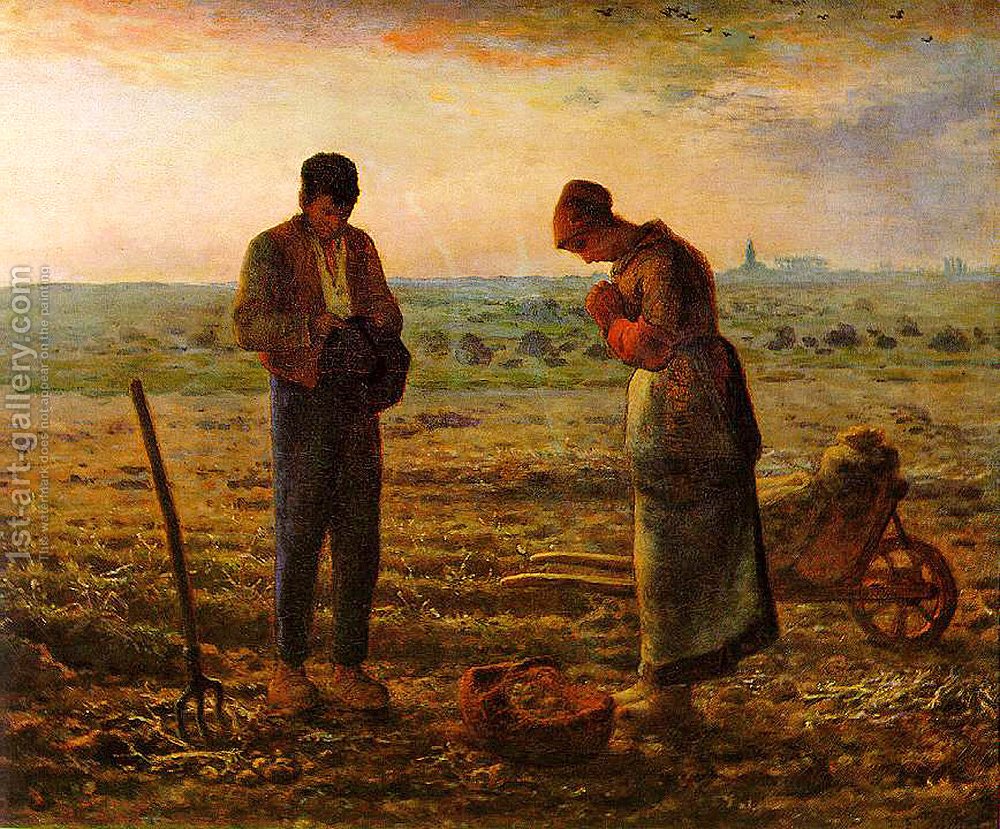
“Have you seen the painting The Angelus by Jean-Francois Millet? It portrays two peasants praying in their field. A church steeple sits on the horizon, and a light falls from heaven. The rays do not fall on the church, however. They don’t fall on the bow heads of the man and woman. The rays of the sun fall on the wheelbarrow and the pitchfork at the couple’s feet. 

“God’s eyes fall on the work of our hands. Our Wednesdays matter to Him as much as our Sundays. He blurs the secular and sacred. One stay-at-home mom keeps this sign over her kitchen sink: Divine tasks performed here daily. An executive hung this plaque in her office: My desk is my altar. Both are correct. With God, our work matters as much as our worship. Indeed, work can be worship.” —Max Lucado, in You!

(To read some other quotes from You!click here, please .)