John Piper’s intertwining of the biographies of John Newton, Charles Simeon, and William Wilberforce in The Roots Of Endurance was masterfully done! Especially because, unlink the previous books in Pastor John’s “The swans are not silent series,” all three of these men knew each other and interacted with each other. Check out my full book review by clicking here.
“Simeon with us—his heart glowing with love of Christ. How full he is of love, and of desire to promote the spiritual benefit of others. Oh! that I might copy him as he Christ.” —William Wilberforce, writing in his journal about Charles Simeon
“It is hoped and believed that the Lord has raised you up for the good of His church and for the good of the nation.” —John Newton, in a letter to William Wilberforce
“Unless God has raised you up for this very thing, you will be worn out by the opposition of man and devils. But if God be for you, who can be against you.” —John Wesley, at 87 years of age, in a letter to William Wilberforce
“Frustration is normal, disappointment is normal, sickness is normal. Conflict, persecution, danger, stress—they are all normal. The mind-set that moves away from these will move away from reality and away from Christ. —John Piper
Listen to the podcast of this post by clicking on the player below, and you can also subscribe on Apple, Spotify, or Audible.
Peter Drucker noted, “It wasn’t until the twentieth-century that we pluralized the word priority. For most of its history, the word has been singular.”
If we have too many priorities, we can frequently find them in conflict with each other. This forces us to make an extremely difficult decision: Which priority has a higher priority?!
Ultimately, whatever business or industry or profession we are in, we are in the people business. All of our efforts fail without good investment in people. So our overriding priority must be on the people God has placed around us.
“The human brain is simply not designed to multitask. You can get by doing multiple things at once, but you can’t do them well. Your brain is physically unable to process more than one set of instructions at a time, so while you are juggling all of those actions at once, your brain is scrambling to keep up. Through a variety of experiments measuring brain activity, scientists have discovered that the constant switching back and forth from one activity to another energizes regions of the brain that specialize in visual processing and physical coordination, while simultaneously disrupting the brain regions related to memory and learning. According to the research, ‘We are using our mental energy to concentrate on concentrating at the expense of whatever it is that we’re supposed to be concentrating on.’ Got that?
“More simply: when we multitask we’re dumber. How much dumber? A recent study for Hewlett Packard exploring the impact of multitasking on performance revealed that the average worker’s functioning IQ drops ten points when multitasking…. (The analogy the researchers used is that a ten-point drop in IQ is equivalent to missing one night of sleep.)” —Marcus Buckingham
The biggest victim of attempting to multitask is your relationships. Those closest to you suffer the most. If someone needs me and I’m too busy to give them me, then very busy has become too busy and it’s time for me to evaluate who—not what—is my highest priority.
Friends, this is something that helped me with the apparent controversies not only in the Bible but in conversations with those who have differing opinions from me. I hope this helps you too!
You can help me help others by becoming one of my Patreon supporters. As my thanks for that support, you will receive exclusive content that only my supporters get access to. Please check out my Patreon page and support this ministry at just $5/month.
Listen to the podcast of this post by clicking on the player below, and you can also subscribe on Apple, Spotify, or Audible.
This is part 4 in our series “Is that in the Bible?”
Statement #4—Name it and claim it. Is that in the Bible? No!
But in fairness, even the proponents of this belief don’t usually say it this way. Instead they quote words from Jesus like: “I will do whatever you ask in My name” (John 14:13) or “Ask whatever you wish, and it will be given you” (John 15:7).
They really want this to be true, I think, because in their minds happy, prosperous Christians make God look good. On the other hand, struggling Christians make God look bad. There is a whole branch of theology called theodicy which literally means: “a defense of God’s goodness and omnipotence in view of the existence of evil.”
This is nothing new. Religious people have always tried to have pat answers. In the oldest book of the Bible, Job’s friends were convinced that suffering results from sin and blessing results from righteousness. And yet according to God, Job was a righteous man (Job 1:1, 8, 20-21).
At the advent of Jesus, the chief priests and scribes want the Messiah to be heroic so they modified a prophecy to make Bethlehem sound more impressive (compare Micah 5:2 with Matthew 2:6).
So it follows that this name-it-claim-it group wants God to look good because His people look good, dress well, drive nice cars, live in big homes, fly private jets, and never get sick.
But Jesus Himself told His followers to, “Sell your possessions and give to the poor” (Luke 12:33). And He said,“Blessed are you when people insult you, persecute you and falsely say all kinds of evil against you because of Me” (Matthew 5:11). And Jesus also said, “In this world you will have trouble” (John 16:33).
This is not to say that God opposes wealth: He gave wealth to His leaders, Job was doubly-wealthy after his trial, and wealthy people funded the ministry of Jesus and the early church. But this isn’t the same as pursuing—or even demanding—wealth, or of making the erroneous connection that poor people are somehow out of favor with God.
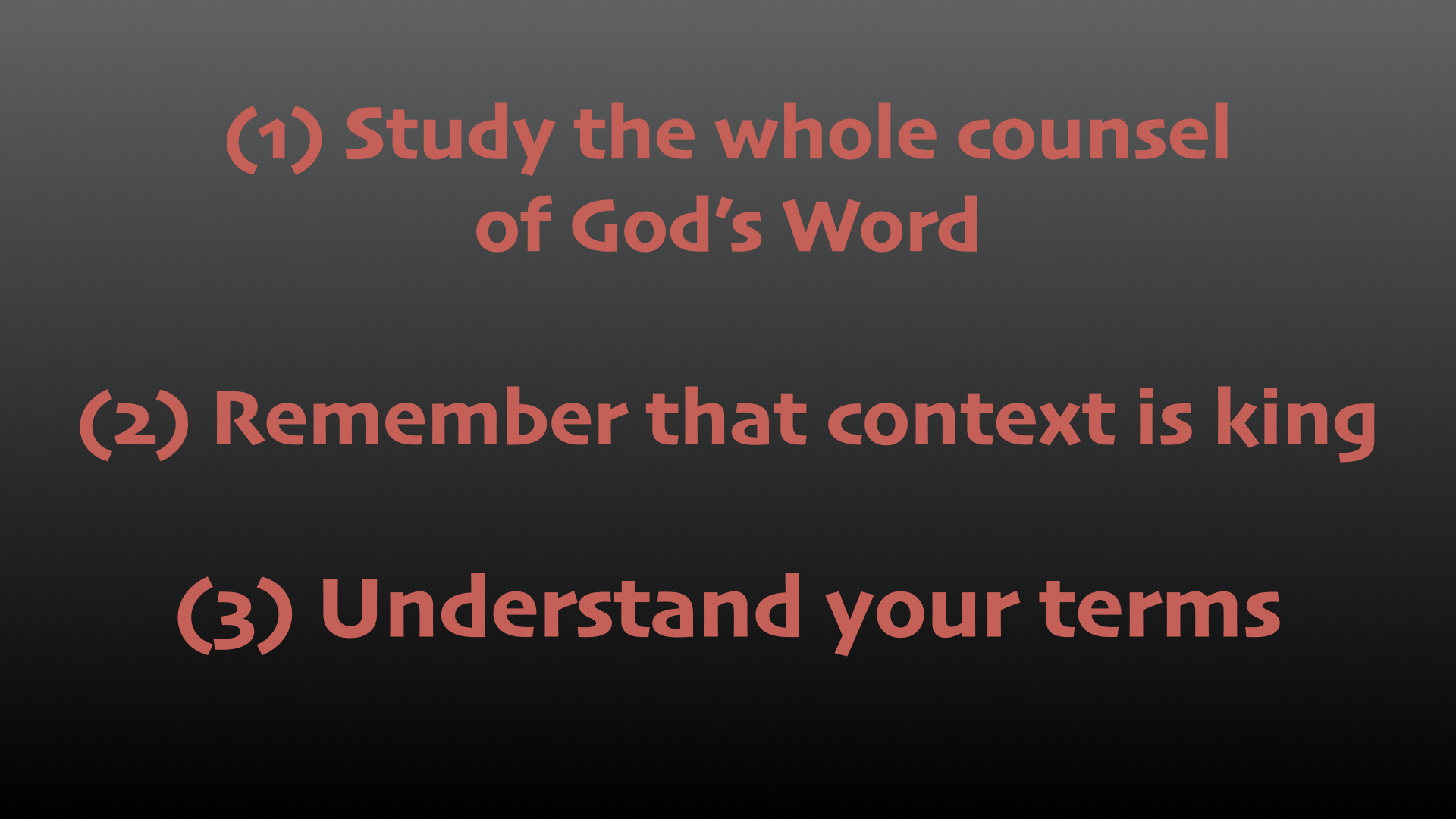
How do we avoid these errors? Here are three thoughts:
The word “eisegesis” means to read something into the Word. But that is like creating your own beliefs and then going to the Bible to find phrases that support what you already believe. On the other hand “exegesis” is to read the Bible and have it speak to us by the Holy Spirit.
Two of the phrases from Jesus that the name-it-and-claim-it folks use (John 14:13 and John 15:7) turn out to mean something entirely different than, “God will give me all of the things I demand from Him” when they are read within the context of the things Jesus was teaching at that time (see John 14:9-14 and 15:1-8).
(3) Understand your terms.
If something is biblical, that is something the Bible says yes to. Unbiblical things the Bible says no to. But non-biblical are those the Bible doesn’t explicitly address. We have to be very careful of trying to make non-biblical things sound biblical or it may lead to some unbiblical attitudes and actions.
This is exactly what the Pharisees did by giving their non-biblical traditions the weight of biblical statements, and then looking down on others in a very unbiblical way.
God is sovereign. We do not tell Him what to do. We do not demand Him to respond to our needs. We trust Him and and we abide in Him. Then in the abiding, asking and understanding and fruitfulness are as natural as a flower sprouting from a branch that is attached to the vine. We don’t name things and claim things for our personal comfort, but we desire solely for God’s glory to be seen—whether in wealth or poverty, health or sickness, peaceful times or tribulation.
Evaluating all biblical sounding statements by those three items—studying the whole counsel of God’s Word, understanding the context, and knowing our terms—will guide us from going astray.
T.M. Moore wrote, “It’s not likely John the Baptist would be welcomed in many pulpits today. Even though Edwards used him as a model of ‘The True Excellency of a Gospel Minister,’ few and far between are the shepherds today who would even think of adopting his example.
“Edwards wrote, ‘He also shone bright in his conversation, and his eminent mortification and renunciation of the enjoyments of the world; his great diligence and laboriousness in his work, his impartiality in it, declaring the mind and will of God to all sorts without distinction; his great humility, rejoicing in the increase of the honour of Christ, though his honour was diminished, as the brightness of the star diminishes as the light of the sun increases; and in his faithfulness and courage, though it cost him his own life.’
“These days many pastors secure their ‘honor’ in subtle but significant ways. They go by ‘Reverend’ or ‘Doctor.’ Have reserved parking places and their name on the church sign. Adopt fashionable garb and speech. Try hard to be friends with all the right people. Such shepherds want to advance their honor; John worked to have his honor diminished, that the honor of Christ might increase.”
Vaughn Shoemaker (1902-1991) was an American editorial cartoonist. He won the 1938 and 1947 Pulitzer Prizes for Editorial Cartooning for his work with the Chicago Daily News. He was the creator of the character, John Q. Public, and a faithful Assemblies of God layman. I am a fourth-generational Pentecostal in the Assembly of God fellowship, so I love studying more about the men and women who have made this such a robust missions-minded fellowship! Read more of this amazing man here.
“This is a radical call for us to look hard at our present lives to see if they are shaped by the hope of the resurrection. Do we make decisions on the basis of gain in this world or gain in the next? Do we take risks for love’s sake that can only be explained as wise if there is a resurrection?” —John Piper
“Jesus will do the things we ask for if they make God’s greatness known. So how do we ask this way? We must ask from right relationships (Mark 11:24-25, 1 Peter 3:7), with right motives (James 4:3, Proverbs 16:2), through right living (James 5:16, Proverbs 15:29), in good faith (James 1:6-7), according to His will (1 John 5:14-15). In short, if you think Jesus would put His name on it, and it will make His Father famous, then ask and believe! But remember, we’re here for Him—He’s not here for us.” —Craig Groeschel, in Twisted
For parents and anyone else who works with students, this is a segment from the Axis ministry’s Culture Translator newsletter:
In his book Man’s Search for Meaning, Viktor Frankl writes that “success, like happiness, cannot be pursued; it must ensue, and it only does so as the unintended side-effect of one’s personal dedication to a cause greater than oneself… Happiness must happen, and the same holds for success: you have to let it happen by not caring about it.”
An idea like that would likely seem counterintuitive to many of the students in Professor Santos’ classes—students who have been raised from young ages to pay careful and constant attention to their academic viability. Students like these grow up with a hope and an expectation that achieving perfection (whether academic, relational, spiritual, or other) will finally yield the happiness, satisfaction, and recognition they’ve been looking for. But after achieving perfection, the next source of anxiety is maintainingperfection. As Christopher Fry once put it, “What, after all is a halo? It’s only one more thing to keep clean.”
Jesus concludes Matthew 5 by saying to his hearers, “Be perfect, therefore, as your heavenly Father is perfect.” It’s a verse most Christians may not want to touch, and one that anxious overachievers might point to as justification for their continual striving. But as C.S. Lewis points out in Mere Christianity, Jesus’ words presuppose our dependence on Him. He writes, “The command Be ye perfect is not idealistic gas. Nor is it a command to do the impossible. He is going to make us into creatures that can obey that command… The process will be long and in parts very painful, but that is what we are in for. Nothing less. He meant what He said.”
In other words, our betterment is in partnership with our Creator, and happiness is merely a by-product of our total surrender. Whoever has ears, let them hear.
This is a weekly series with things I’m reading and pondering from Charles Spurgeon. You can read the original seed thought here, or type “Thursdays With Spurgeon” in the search box to read more entries.
Listen to the podcast of this post by clicking on the player below, and you can also subscribe on Apple, Spotify, or Audible.
The Natural Out-Gushing
If you remain in Me and My words remain in you, ask whatever you wish, and it will be done for you. (John 15:7)
He does not say, ‘If you abide in Me, and My words abide in you, you will do spiritual things,’ but ‘you will ask.’ By prayer you will be enabled to do. But before all attempts to do, you will ask. The choice privilege here given is a mighty prevailing prayerfulness. Power in prayer is very much the gauge of our spiritual condition. …
Prayer comes spontaneously from those who abide in Jesus. … Prayer is the natural out-gushing of a soul in communion with Jesus. Just as the leaf and the fruit will come out of the vine without any conscious effort on the part of the branch but simply because of its living union with the stem, so prayer buds and blossoms and produces fruit out of souls abiding in Jesus. … They do not say to themselves, ‘Now is the time for us to get to our task and pray.’ No, they pray as wise men eat—namely, when the desire for it is upon them. …
Habitual asking comes out of abiding in Christ. You will not need urging to pray when you are abiding with Jesus. …
‘If you abide in Me, and My words abide in you, you will ask’—and you will not wish to cease from asking. He has said, ‘Seek My face,’ and your heart will answer, ‘Your face, Lord, I will seek’ (Psalm 27:8). …
This power in prayer is like the sword of Goliath. Wisely may every David say, ‘There is none like it; give it to me’ (1 Samuel 21:9). This weapon of all-prayer beats the enemy and at the same time enriches its possessor with all the wealth of God.
From The Secret Of Power In Prayer
When I first met the beautiful young lady that would eventually become my wife, we spent hours and hours and hours talking with each other. It was how I got to know her heart, and how she got to know mine. My conversations with Betsy are still some of the most cherished times I have.
But what if after we got married I said to Betsy, “I love you, my darling, and I’m so looking forward to a lifetime with you! I will make it a priority to give you my undivided attention for 90 minutes every Sunday morning. Other than that, I’ll be thinking about you while I go about my busy life.” How intimate is this relationship going remain?
Sadly, this is how many Christians treat their relationship with Jesus. “Thank You for saving me from the penalty of my sin, Jesus! I love You and I’m so looking forward to an eternity with You in Heaven. I will make it a priority to give You my undivided attention every week at church. Other than that, I’ll be thinking about You while I go about my busy life.”
No branch can remain healthy and produce any fruit if it is only occasionally attached to the vine. In order for the branch to be fruitful, it must be continually abiding in the life-giving sap of the vine.
Intimacy with Jesus means abiding with Him at all times. It means engaging in conversation with Him at all times. Brother Lawrence commented, “The time of business does not with me differ from the time of prayer; and in the noise and clatter of my kitchen, I possess God in as great tranquility as if I were upon my knees at the blessed sacrament.”
My friend, let’s all seek to become more aware of the closeness of Jesus. Let us “take delight in the Lord” (Psalm 37:4) and continually engage Him in intimate conversation. As we do, the fruitfulness of our prayer life cannot help but blossom into beautiful things that give God great joy and glory.
Listen to the podcast of this post by clicking on the player below, and you can also subscribe on Apple, Spotify, or Audible.
Ezekiel 9 is a sobering chapter for anyone, but especially for those in leadership. Listen to the opening verses—
Then I heard [God] call out in a loud voice, “Bring the guards of the city here, each with a weapon in his hand.” And I saw six men coming from the direction of the upper gate, which faces north, each with a deadly weapon in his hand. With them was a man clothed in linen who had a writing kit at his side. They came in and stood beside the bronze altar.
Now the glory of the God of Israel went up from above the cherubim, where it had been, and moved to the threshold of the temple. Then the LORD called to the man clothed in linen who had the writing kit at his side and said to him, “Go throughout the city of Jerusalem and put a mark on the foreheads of those who grieve and lament over all the detestable things that are done in it.”
As I listened, He said to the others, “Follow him through the city and kill, without showing pity or compassion. Slaughter old men, young men and maidens, women and children, but do not touch anyone who has the mark. Begin at My sanctuary.” (Ezekiel 9:1-6)
It is no small thing to be called a leader. God calls leaders and expects them to represent Him well in their leadership assignment. That’s why God’s judgment always starts with those who are called by God to be leaders.
It starts with me.
Why? Because as a leader goes, so go the people. The smallest of sins that the leader tolerates in his own life give license to the people to sin even more. So it is right that God’s judgment begins at the top. It is right that God’s judgment on leaders be even more severe (James 3:1).
Ezekiel reports that God’s glory moved from the temple to the east gate, and then from the east gate to the mountain outside the city (9:3; 10:4, 18-19; 11:23). God was still speaking clearly and distinctly (10:5), but the leaders were so blinded by their sin that they neither noticed God’s glory moving away from them and repented of their sin, nor did they call the people to repentance.
The only ones who were spared from God’s judgment where those who were grieving and lamenting all the sins of the city.
If God is going to continue to use me as his leader—if He is going to give me His Word to speak to others—I must be sensitive to His searching of my heart. I must grieve over my own sin first and repent from it. Then I must be a willing servant to speak God’s Word of both judgment and salvation to whomever He sends me.
A mark of a godly leader is one who grieves and quickly repents over his revealed sins.
It starts at the top. It starts with me. Leaders must be held to the highest of standards.
I hope all godly leaders will join me in this prayer: Father God, may I be usable by You. May I be sensitive to the prompting of Your Holy Spirit, and grieve over my sins. May I be quick to repent and receive Your restoration, so that I can continue to lead other people into an intimate relationship with You.
This is part 62 in my series on godly leadership. You can check out all of my posts in this series by clicking here.
Listen to the podcast of this post by clicking on the player below, and you can also subscribe on Apple, Spotify, or Audible.
A meme that makes me chuckle every time I see it is a “quote” attributed to Abraham Lincoln in which he says, “The problem with quotes found on the internet is that they are often not true.”
(Not to spoil the joke for you, but unless Lincoln knew how to time travel to the future, I don’t think he knew about the modern internet! 😂)
I love this meme because it captures something that so many people fall into: a quick acceptance of a statement without verifying its source or thinking through the implications of the statement’s truthfulness.
Some insightful comments sound Shakespearean, but William never wrote them.
Some pieces of wisdom sound Socratic, but Socrates never taught them.
Some religious maxims sound godly, but the Bible never recorded them.
I would like to invite you to join me as we relaunch this series called Is That In The Bible? I think you may be surprised to discover just how many phrases we call biblical aren’t, and how many phrases there are that we never realized are actually in the Bible.
By the way, if you have a phrase that you would like to have us explore in this series, please leave it in a comment below. If you would like to check out the questions we addressed previously, please click here.
In this installment of this series we asked: Is this in the Bible…
Listen to the podcast of this post by clicking on the player below, and you can also subscribe on Apple, Spotify, or Audible.
I always glean so many valuable lessons when I read the autobiographies or biographies of notable people of history. The Roots Of Endurance is the third installment in John Piper’s excellent series “The swans are not silent.”
This book looks at the lives of John Newton, Charles Simeon, and William Wilberforce. Unlike the other books in this series, these men were all contemporaries and all of them had at least a passing relationship with each other. In fact, their lives and accomplishments were an encouragement to each other.
Pastor John makes the case in this book that in order to endure through difficult times successfully, we must have a deep root into the joy of the Lord. This root nourishes our hearts to persevere successfully through long trials. These three men exhibit this endurance beautifully. John Newton had to endure his own struggles with his past, Charles Simeon contended with an obstinate congregation, and William Wilberforce battled pro-slavery forces in Parliament for years before the abolition of the slave trade was enacted.
All three of these men endured successfully because they trusted God so deeply. These roots of trust went deep and helped them to persevere for God’s glory.
As I have mentioned in my other book reviews from the series, anyone who enjoys biographies of godly leaders or the study of church history will thoroughly enjoy The Roots Of Endurance.
If you would like to check out the other books in this series that I have previously reviewed, please click here, here, or here.



 John Piper’s intertwining of the biographies of John Newton, Charles Simeon, and William Wilberforce in The Roots Of Endurance was masterfully done! Especially because, unlink the previous books in Pastor John’s “The swans are not silent series,” all three of these men knew each other and interacted with each other. Check out my full book review by clicking here.






 Craig T. Owens