The Voice In Your Ear

Listen to the podcast of this post by clicking on the player below, and you can also subscribe on AppleSpotify, or Audible. 

I would like you to think about a wise, loving friend. One who has years of godly wisdom, empathy, loads of patience, and loving boldness. When you talk with them, you know that you will always get good counsel—even if you may not like exactly what they have shared with you, deep down you know it is still sound wisdom. This is what the Holy Spirit—as our Counselor—does for us. 

The Holy Spirit is not merely a force, but He is a Person. Jesus Himself give the Spirit the pronouns “He / Him / His.” 

Then take a look at just the beginning of the Book of Acts. The Holy Spirit does things a person does

  • He speaks God’s Word (1:16; 4:25) 
  • He empowers (2:4) 
  • He can be lied to (5:3, 9) 
  • He can witness events (5:32) 
  • He can be resisted (7:51) 
  • He can encourage (9:31) 
  • He gives wisdom (6:10) 
  • He gives direction (8:29, 10:19) 

I especially want to key in on those last two attributes where the Holy Spirit is speaking to us. 

Samuel grew up during the time of the judges, where everyone did whatever they thought best. This is a time that is described like this, “In those days the word of the Lord was rare; there were not many visions” (1 Samuel 3:1). Visions in the Hebrew language is two words: open communication. In other words, people just weren’t listening for God’s voice. 

Samuel had to learn to hear God’s voice as well (see this passage and all of the other biblical references in this post by clicking here). 

God doesn’t reveal His heart to those who are unwilling to obey. His persistent call is for obedience to His Word and reliance on His provision. So the word of the Lord had to be revealed to Samuel (v. 7). When Samuel said he was listening (v. 10), that was a posture of readiness to obey. 

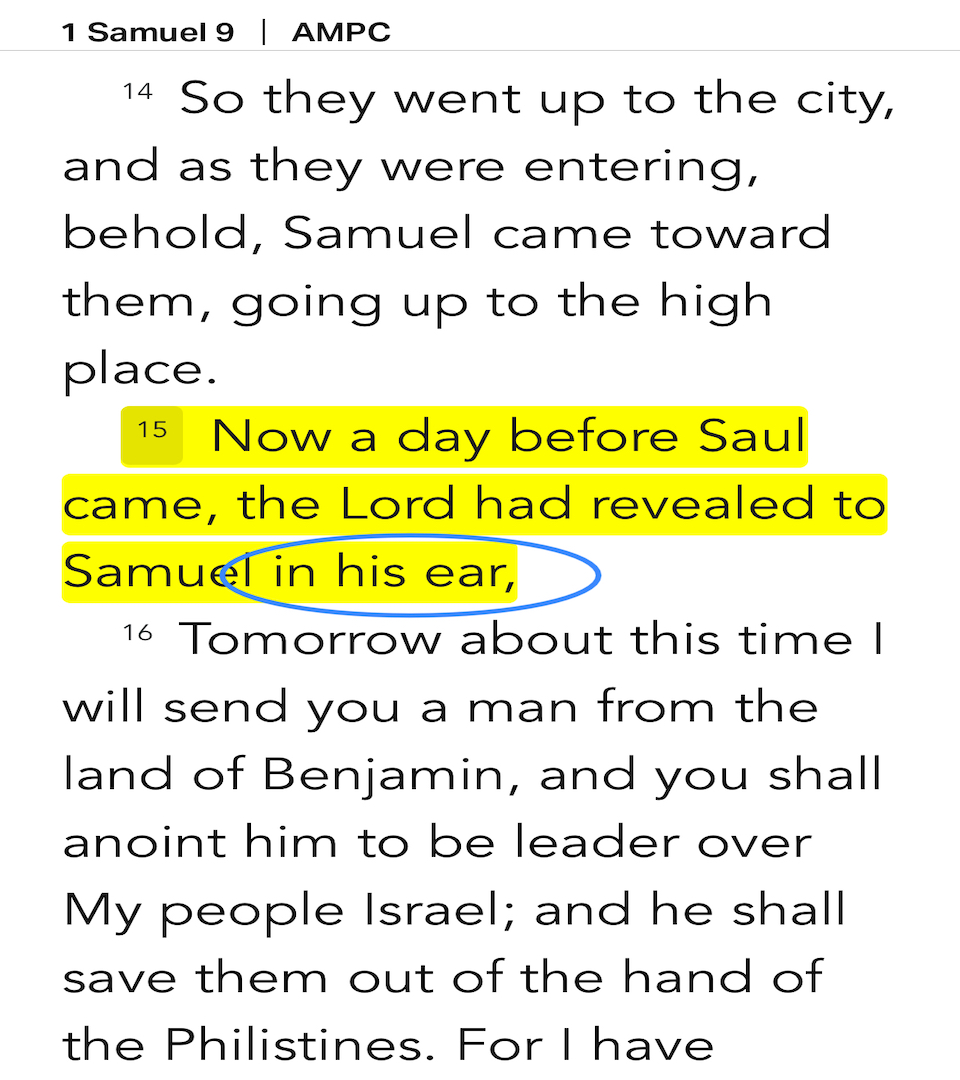
God wants to reveal His heart to His obedient people. I love how God does this later for Samuel, “Now the Lord had told Samuel in his ear the day before Saul came…” (1 Samuel 9:15). 

This is how Jesus described the Holy Spirit in John 7:37-39, as streams that flow continuously out of our being. And Jesus also calls Him Counselor (John 14:16). 

Isaiah described our Counselor like this, “Whether you turn to the right or to the left, your ears will hear a Voice behind you, saying, ‘This is the way; walk in it’” (Isaiah 30:21). 

Let’s call this GPS = God’s Personal Spirit in us! 
Those who are baptized in the Holy Spirit—utterly yielded to His wisdom—will experience:

  1. More insight into God’s Word—Psalm 119:18 
  2. More timely application of God’s Word—2 Timothy 3:16-17 
  3. More boldness in prayer—2 Samuel 7:27 (same word for in his ear as Samuel experienced) 

All Christians have a deposit of the Holy Spirit in their lives at the moment of salvation. The baptism in the Holy Spirit is a completed yielding to the Counselor’s influence. So don’t stop at salvation, but ask Jesus to send you what the Father has promised (Luke 24:49; Acts 2:33). 

Check out all of the messages in our series leading up to Pentecost Sunday by clicking here. 

►► Would you please prayerfully consider supporting this ministry? My Patreon supporters get behind-the-scenes access to exclusive materials. ◀︎◀︎

Links & Quotes

If someone is gossiping to you about others, you can be sure that they are gossiping to others about you—shut it down! Check out this full message about gossips.

I have a lot of new video content on my YouTube channel every week. Please check it out and subscribe so you don’t miss anything.

I hope you celebrated your Mom on Mother’s Day weekend. This is a great perspective from the Axis newsletter: “Some in our culture say motherhood is a prison, or a trap set by the patriarchy. Pop singer Chappell Roan, for example, recently said she didn’t know any people who have kids and are happy. Others say it’s a paradise—with ‘momfluencers’ online making it look like having kids is a nonstop joyride where the lighting is always perfect and nobody ever cries. When ‘prison’ and ‘perfection’ are presented as the only two options, it’s no wonder U.S. birth rates are declining. One way to honor mothers this year is to admit that motherhood is work—albeit spirit-forming, richly rewarding work—and that we can’t expect to see all the fruit of that labor within our lifetime. Hales writes, ‘Christian parenting is about continually pointing to Jesus as the Author and Perfecter of our faith, clinging to the reminder that He who began a good work in us and our children will complete it.’”

In his study Bible, Dr. Henry Halley offered this comment on 1 Corinthians 6:11. “The greatest proof of the new birth is a changed life. Children of God now suddenly love the following:

  1. They love Jesus. Before conversion the sinner might hold Christ in high esteem, but after conversion they love the Savior (1 John 5:1-2). 
  2. They love the Bible. We should love God’s Word as the psalmist did in Psalm 119. There he expresses his great love for God’s Word 17 times. 
  3. They love other Christians. ‘We know that we have passed from death to life, because we love each other. Anyone who does not love remains in death’ (1 John 3:14). 
  4. They love their enemies (Matthew 5:43-45). 
  5. They love the souls of all people. Like Paul, they too can cry out for the conversion of loved ones. ‘Brothers and sisters, my heart’s desire and prayer to God for the Israelites is that they may be saved’ (Romans 10:1). 
  6. They love the pure life. John says that if anyone loves the world, the love of the Father is not in them (1 John 2:15-17). 
  7. They love to talk to God. ‘Speaking to one another with psalms, hymns, and songs from the Spirit. Sing and make music from your heart to the Lord’ (Ephesians 5:19).”

T.M. Moore and I share the same passion for pastors to operate as shepherds. Moore wrote, “Shepherds equip the saints who take up the works of the ministry that build the church. The work of shepherding is hard. It’s not a program that you run from time to time, hoping to enlist new folks in the training. It is the ongoing, body-building means whereby the Lord’s flocks are nourished and become equipped to use their Spirit-given gifts (1 Corinthians 12:7-11) and power (Acts 1:8) to grow their church in unity and maturity in the Lord.” Moore also wrote an endorsement for my book Shepherd Leadership. 

John Piper has a thoughtful and biblical response to a question about Christians losing their rewards in Heaven. In part, he says, “All the good deeds that God approves and rewards are works of faith and the fruit of the Spirit. So, let’s get the idea of merit for these good deeds totally out of our minds.” He goes on to show the Scriptures that secure our promised rewards from God. 

Paleontologists have discovered an amazing dinosaur graveyard off the coast of southern Chile. The fossilized remains here gave ample evidence to the global Flood described in the Bible.

Pay Attention To The Signals

Listen to the podcast of this post by clicking on the player below, and you can also subscribe on AppleSpotify, or Audible. 

Leaders need to pay very careful attention not to disregard the signals others are sending them.

Check out the full conversation Greg and I had about blind spots.

►► Would you please prayerfully consider supporting this ministry? My Patreon supporters get behind-the-scenes access to exclusive materials. ◀︎◀︎
Who God Rewards

Listen to the podcast of this post by clicking on the player below, and you can also subscribe on AppleSpotify, or Audible. 

Think of the most well-known Christian evangelist you can imagine preaching before tens of thousands of people all over the world, broadcasting his sermons online, selling books, and being invited to pray with the world’s leaders. 

Now think of a pastor you may know in a rural community ministering to a small congregation. He has no online presence, no books, and is hardly known outside of his own town. 

The apostle Paul would say to both of them, “You are only servants of God.”

“What, after all, is Apollos? And what is Paul? Only servants, through whom you came to believe—as the Lord has assigned to each his task. … This, then, is how you ought to regard us: as servant of Christ (1 Corinthians 3:5, 4:1). 

Only servants of Christ.

God calls His servants to do their servant’s work with care and quality (1 Corinthians 3:10, 14). And he also says, “The one who plants and the one who waters have one purpose, and they will each be rewarded according to their own labor (v. 8). 

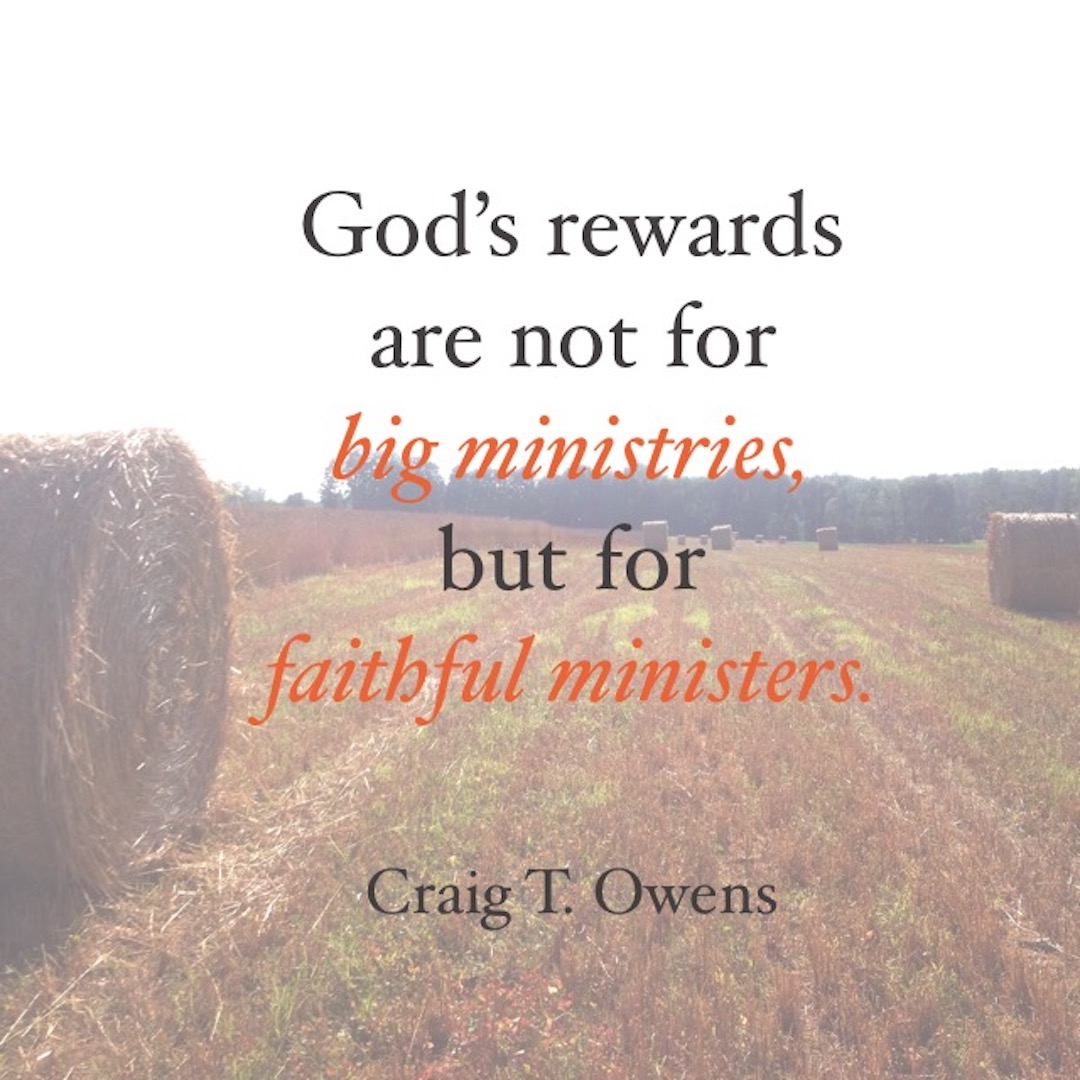
God’s rewards are not for big ministries, but for faithful ministers. 

I talk a lot about faithfulness in my book Shepherd Leadership. In the chapter entitled ‘Stick-to-it-iveness,’ I wrote this—

     Peter instructs us that our example for the flock must be God-honoring. People do what people see. If I would have arrived on that Saturday bent out of shape that things weren’t working out as I had planned, I would have robbed people of the enjoyment that they should have had that day. Remember that when Jesus told us that He had set an example for us (John 13:15), it was an example of putting others’ needs ahead of His own. Did Jesus want to wash those dirty feet? Probably not. But He not only washed them well, but He also had such a good attitude that its impact is still being felt today. 

     Peter was there on that day. He heard Jesus say this about following His example of such others-focused leadership: “Now that you know these things, you will be blessed if you do them.” So Peter reminds his readers that the Chief Shepherd is returning with rewards for the faithful under-shepherds. Occasionally, we will get some rewards here, but keeping our steadfast focus on the rewards and blessings that are still to come will help us stick with our responsibilities, even on those days when no one else seems to notice or even care. 

     Let’s listen to the words of the apostle Paul again: “So, then, no more boasting about human leaders!” (1 Corinthians 3:21).

And let me repeat myself—

God’s rewards are not for big ministries, but for faithful ministers.

►► Would you please prayerfully consider supporting this ministry? My Patreon supporters get behind-the-scenes access to exclusive materials. ◀︎◀︎

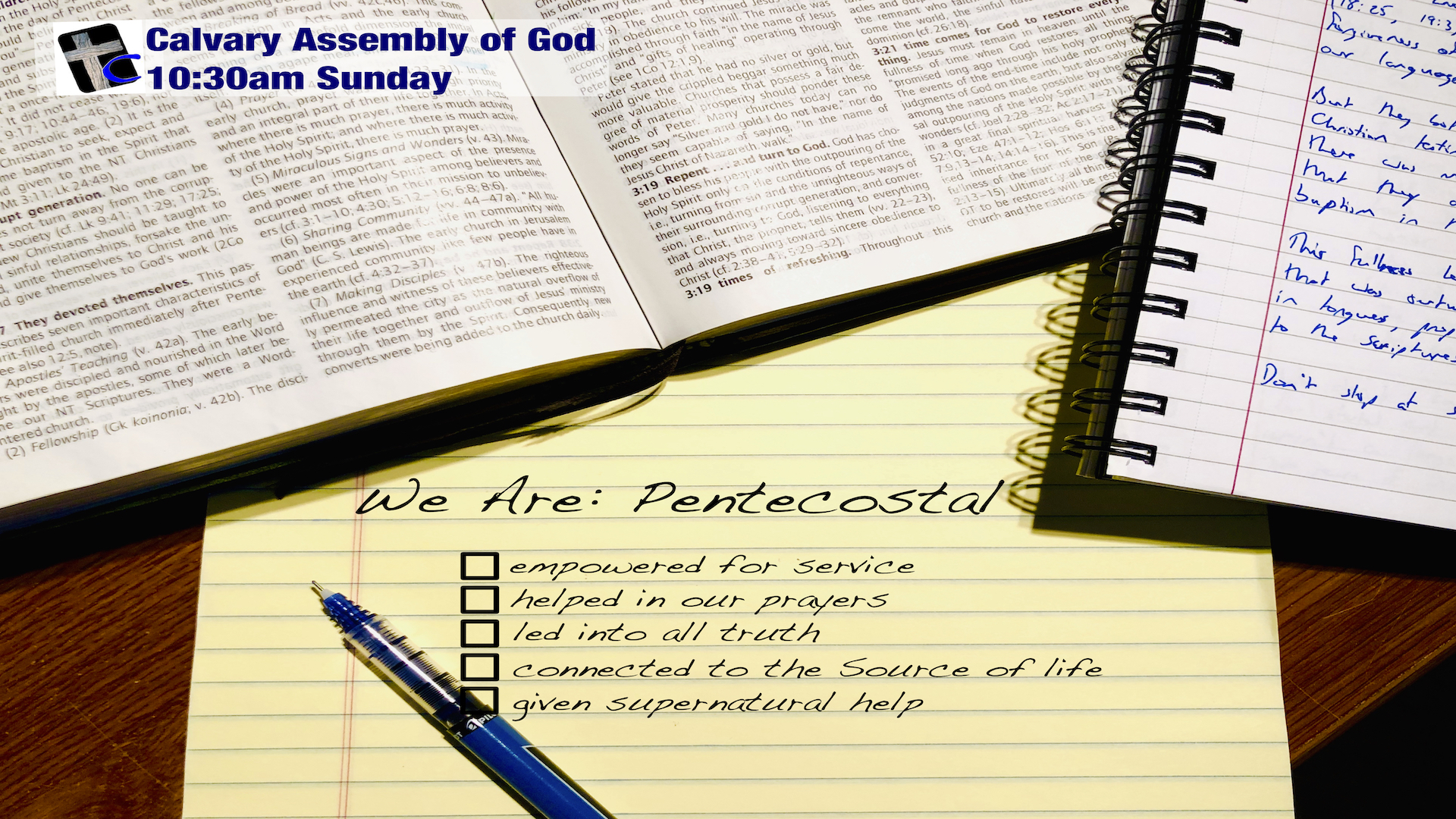
We Are: Pentecostal

Pentecost for over 1500 years was a celebration in Jerusalem that brought in Jews from all over the world. But on the Day of Pentecost which came just ten days after Jesus ascended back into heaven, the meaning of Pentecost was forever changed! 

Followers of Jesus—now empowered by an infilling of the Holy Spirit—began to take the good news of Jesus all over the world. These Spirit-filled Christians preached the Gospel and won converts to Christ even among hostile crowds, performed miracles and wonders, stood up to pagan priests and persecuting governmental leaders, and established a whole new way of living as Christ-followers. 

We, too, can be Pentecostal followers of Jesus Christ today. We can experience an anointing and an empowering in our lives that turns ordinary Christianity into extraordinary Christianity! 

Please join me this Sunday at Calvary Assembly of God as we rejoin this series. You can check out what I taught in this series in 2023 by clicking here.

The topics we have covered this time are:

Know, Go, Show

Listen to the podcast of this post by clicking on the player below, and you can also subscribe on AppleSpotify, or Audible. 

There is a recurring theme throughout the Book of Judges and then later is repeated in the years leading up to Israel’s exile: A godly leader passes off the scene and the people return to their old selfish, godless lifestyle. This sinful life brings God’s punishment, which causes the people to cry out to God for help. God raises up a leader who leads the people in repentance and a return to God. As a result, God’s blessings again flow to His people. Then that leader passes off the scene and the cycle repeats. 

This recurring thought is in the middle of a particularly dark time for Israel: “In those days there was no king in Israel; every man did what was right in his own eyes” (Judges 17:6; see also 18:1). 

The entire 17th and 18th chapters of Judges is a sickening story of the Israelites utterly turning their back on God so they could go do whatever they want. And worst of all, we see godless leaders taking advantage of the situation to line their pockets with worldly riches. 

Just because there is a God-fearing leader on the scene doesn’t guarantee that the people will follow his or her lead and devote themselves to God. But a godless leader almost always results in people debasing themselves by thumbing their nose at God’s laws. 

God raises up leaders and holds them accountable for their actions. He told Ezekiel that there would be consequences for both boldly speaking God’s message or for keeping silent (see Ezekiel 3:16-21). 

God calls His leaders to know His ways, to walk in integrity in that way, and then to call others to walk in that way too. 

A mark of a godly leader is one who knows the way, goes the way, and shows the way.

This is part 84 in my series on godly leadership. You can check out all of my posts in this series by clicking here.

►► Would you please prayerfully consider supporting this ministry? My Patreon supporters get behind-the-scenes access to exclusive materials. ◀︎◀︎
A Leadership Measurement Trap

Listen to the podcast of this post by clicking on the player below, and you can also subscribe on AppleSpotify, or Audible. 

Leaders have to be very careful of the trap of measuring the growth of their teammates by the wrong metrics. The things that matter most are often the things that are the most difficult to measure, but leaders must find a way.

Check out the full conversation we had on this topic on this episode of The Craig and Greg Show. 

In my book Shepherd Leadership, I have a chapter entitled ‘Don’t Try to Grow Your Own Ministry.’ This book is mainly written for church and non-profit leaders, but there are helpful principles here for every kind of leader. Here’s an except from this chapter—

     Businesses think in terms of quantitative gains—things they can count—but churches and nonprofits should be thinking in terms of qualitative gains—a quality improvement that isn’t as easily counted. I think we all know this, and yet we still persist in wanting to define success in a church or a nonprofit by those quantitative standards such as attendance growth, donations, and the like. When we think qualitative over quantitative, suddenly what seemed “small” is so significant and so valuable that it cannot be calculated! … 

     Don’t try to grow your ministry. First, because it’s not yours, it’s [God’s]; and second, because your measure of success is probably more slanted toward quantitative measurements than qualitative. Jesus wasn’t concerned about bigger numbers: “What do you think?” He asked, “If a man has a hundred sheep, and one of them goes astray, does he not leave the ninety-nine and go to the mountains to seek the one that is straying?” (Matthew 18:12). 

     Philip went to Samaria to tell people about Jesus. He didn’t go there because it fit his plan, but because Jesus said, “You will be My witnesses in Jerusalem, and in all Judea and Samaria, and to the ends of the earth” (Acts 1:8). Philip’s obedience brought God’s success: hundreds turned to Jesus as their Savior, demon-possessed people were delivered, the sick were healed, and the new Christians were baptized in the Holy Spirit. Yet God called Philip to leave these “ninety-nine” and go to the desert to cross paths with just one confused and wondering sheep (Acts 8). After that, Philip virtually disappears from Luke’s historical record. 

     What’s the value of one government official’s life? God says that his value is incalculable. Apparently, God knew that Philip was the perfect shepherd to lead this Ethiopian to the pasture where he would accept Jesus as his Savior. Philip was obedient, a sheep was saved, and God was pleased. But I wonder how many people today might think Philip’s ministry was unsuccessful because he left a bigger ministry in Samaria to go to a smaller ministry in the desert? 

Leaders need to be very cautious about using the right metrics to measure the growth of their teammates and the success of their organization.

►► Would you please prayerfully consider supporting this ministry? My Patreon supporters get behind-the-scenes access to exclusive materials. ◀︎◀︎
Links & Quotes

The sooner we start praying, the sooner we can see God move. Let’s make sure that prayer is not our last resort, but our first response!

I have a lot of new video content on my YouTube channel every week. Please check it out and subscribe so you don’t miss anything.

T.M. Moore has a challenging word for those who are called to preach the Gospel. He writes, “Jesus, like Ezekiel set His face like flint to fulfill His appointed mission. And so must we, for whom the Word is both sweet and bitter (cf. Revelation 10:8-11). We must live and proclaim its sweet and bitter message to an impudent and hard-hearted age, beginning in our churches. It is time for judgment to begin from the house of God (1 Peter 4:17). We must speak to our brethren in the Lord, the household of faith, to teach, warn, direct, and to summon them to revival, renewal, and awakening, for a greater knowledge of the Lord and His love, and a fuller realization of His Kingdom presence, promise, and power.”

Then John Piper shares 10 reasons why Christian preaching is a privilege.

“An essential aspect of creativity is not being afraid to fail.” —Edwin H. Land 

I have written before how significant it is that the New Testament uses the phrase “one another” so many times. T.M. Moore writes about this as well, noting, “The more we love Jesus, the more loving our neighbors will come (super)naturally to us as the Spirit of God works in us to will and do of His good pleasure. So, as in everything we do to take up Jesus’ work of building His Church, loving one another begins with loving Jesus.”

After listing a truckload of verses describing Who the Holy Spirit is, Sinclair Ferguson concludes, “Think about all of that! This Spirit—this one and the same Spirit, and no other—‘dwells within thee.’ He is the very Spirit who dwelled in the Lord Jesus. … There are not multiple Holy Spirits—One in Whose grace and power the Lord Jesus lived, One Who indwells you, One Who indwells me, and a multiplicity of other Holy Spirits indwelling an innumerable company of believers. No! There is only One Holy Spirit; and He who thus indwells me as the Spirit of Christ also indwells every believer I shall ever meet.”

Tried And Tested

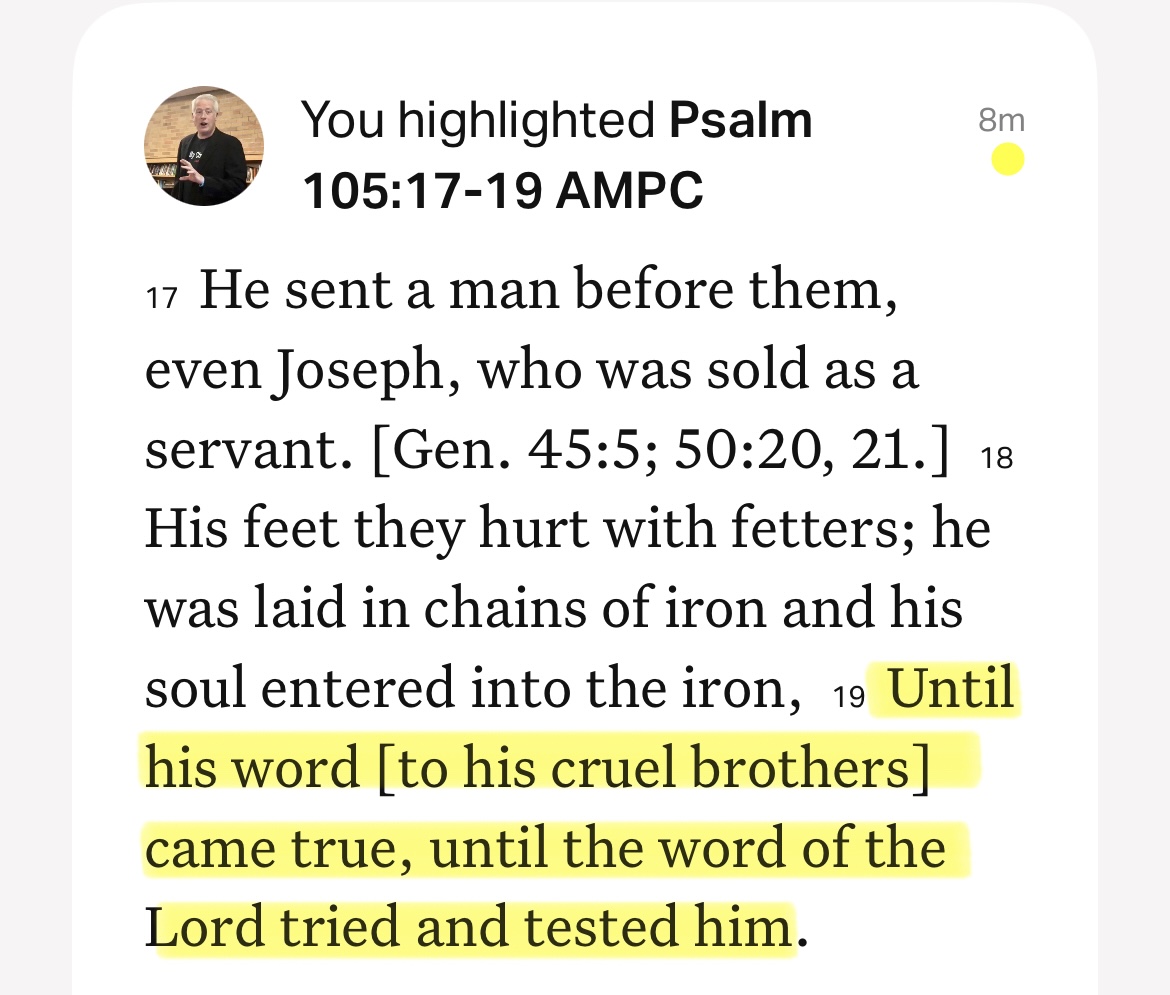
Moreover, [God] called for a famine upon the land of Egypt; He cut off every source of bread [Genesis 41:54]. He sent a man before them, even Joseph, who was sold as a servant [Genesis 45:5; 50:20, 21]. His feet they hurt with fetters; he was laid in chains of iron and his soul entered into the iron, until his word to his cruel brothers came true, until the word of the Lord tried and tested him. The king sent and loosed him, even the ruler of the peoples, and let him go free. He made Joseph Lord of his house and ruler of all his substance [Genesis 41:40]. To bind his princes at his pleasure and teach his elders wisdom. (Psalm 105:16-22 AMPC) 

“The word of the Lord tried and tested him.” When we cling to God’s promises despite the seemingly impossible circumstances we are in, that faithful clinging matures us. It both softens our heart and strengthens our trust in God. 

Before going through the difficulties, Joseph wasn’t ready to operate effectively in such a lofty leadership position. God uses all things to mold us and shape us for His purpose (Romans 8:28). We certainly see a more mature Joseph standing before Pharaoh than we saw interacting with his brothers earlier in his life. 

God called Joseph and he prepared Joseph. All that was lacking was Joseph’s faithful clinging to God and yielding to God’s maturing process. The end result was one of the most impactful leaders that history has ever known! 

I blogged more about Joseph:

The Craig And Greg Show: Cultivate Your Garden

Listen to the podcast of this post by clicking on the player below, and you can also subscribe on AppleSpotify, or Audible.

Here in West Michigan, the city of Holland has a yearly festival that has just begun called Tulip Time where attendees will see millions of the most beautiful flowers growing everywhere. It is a stunning display, but perhaps even more impressive is the hard work and care that goes into the cultivation of these flowers. In today’s episode, Greg and I want to encourage you to bring the mindset of a gardener to your leadership. With hard work, patience, and just the right amount of careful pruning, your team will grow from small seeds in the ground to a dazzling beauty that rivals any horticultural display. 

  • [0:40] I’m not sure I’m qualified to talk about today’s topic… 
  • [1:32] A seed has almost everything it needs to grow, and so do our teammates.
  • [3:13] What do people need most from a gardener-leader?
  • [5:25] Leaders will need to exhibit confidence in a teammate’s competency.
  • [8:04] We need to be careful of not rushing the process.
  • [10:16] I share how the apostle Paul demonstrated belief in his people.
  • [12:04] How do we make sure our teammates know we have genuine belief in them?
  • [14:33] I reference a great passage from Greg’s forthcoming book about how leaders stand up for their team.
  • [19:13] A healthy habit for gardener-leaders.
  • [21:36] Gardening isn’t an assembly line—the growth plan for every person must be individualized.
  • [23:44] Greg shares an insightful quote about obstacles.
  • [25:11] Coaching can help you help your teammates grow.

Check out this episode and subscribe on YouTube so you can watch all of the upcoming episodes. You can also listen to our podcast on Spotify and Apple.