


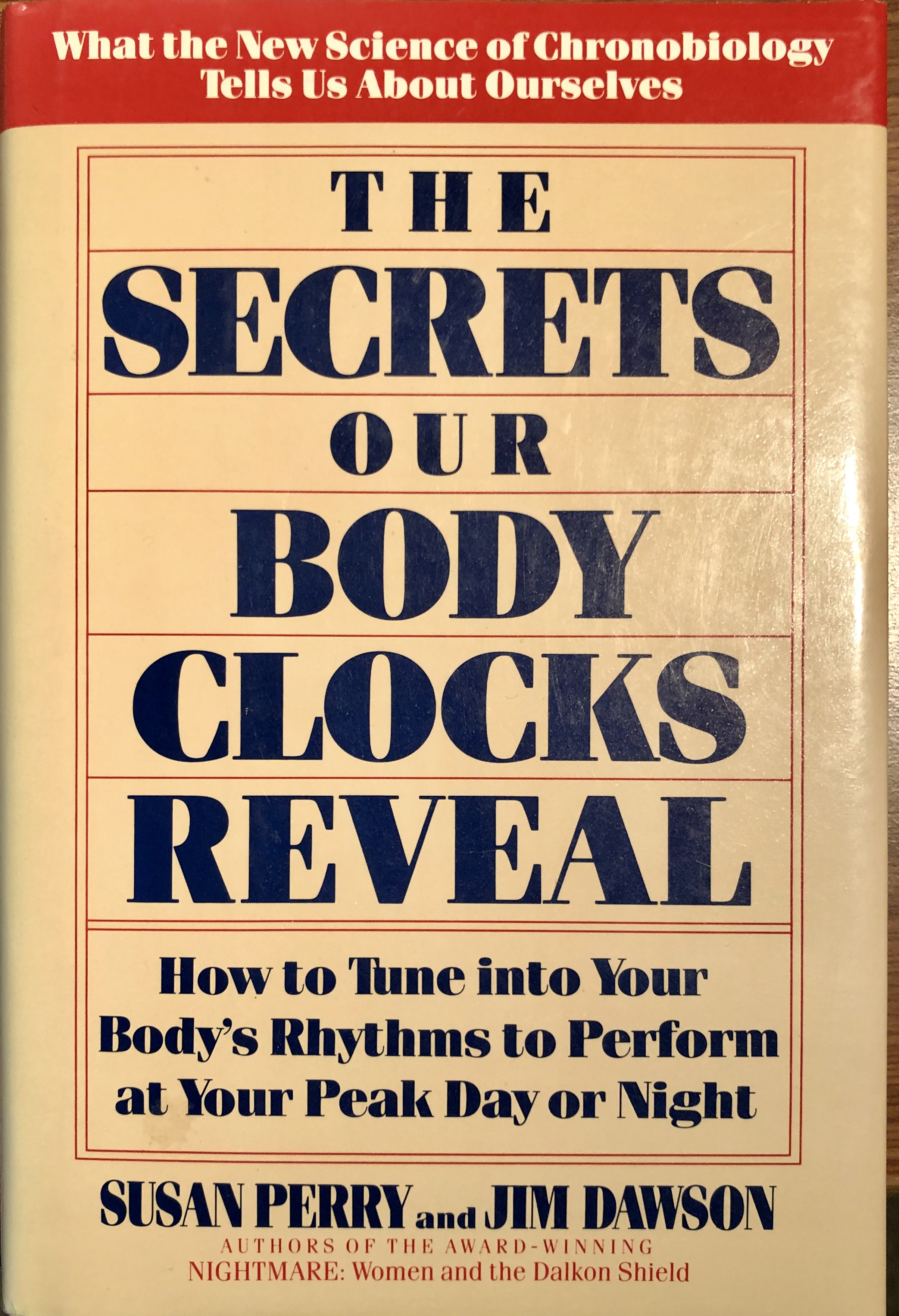
 I really enjoyed reading The Secrets Our Body Clocks Reveal (you can read my full book review by clicking here). From this book, I’ve begun implementing a few of the tips I discovered. Here are a few of the facts and tips that I found interesting.
- “Most of us reach our peak of alertness around noon. … We are least alert during the early morning hours—specifically, between 3:00 a.m. and 6:00 a.m.”
- “Your immediate, or short-term, memory is best during the morning hours. … Your long-term memory is a different matter, however. Afternoon is the best time for learning material that you want to recall days, weeks, or even months later. … How well you remember things depends on when you learn them, not when you recall them.”
- “On average, we tend to do best on cognitive tests—things that require the greatest mental effort—during the morning hours, particularly the late morning hours.”
- “All of your senses—taste, sight, hearing, touch, and smell—are their keenest during the twilight hours of late afternoon and early evening.”
- Tips for keeping your daily rhythms on beat: (1) get out in the sun for at least fifteen minutes each day, and (2) try to follow a regular daily routine.
- “Fortunately, there is another way to avoid the Monday morning blahs. Stay up as late as you like, but make sure you get up at your regular wake up time. In other words, don’t sleep in. And don’t take naps during the day. Then, when night rolls around again, you’ll find yourself able to fall asleep at or before your regular bedtime, and you’ll avoid pushing your cycle ahead.”
- “Scientists have also discovered that short naps (twenty minutes or less) are just as revitalizing as long ones—and less disruptive to regular sleep rhythms. In addition, regular nappers wake up more refreshed than those who take only an occasional nap. When naps are part of the regular daily rhythm, they are less disruptive.”
- “Generally, our moods peek around four hours after we awaken.”
- “A regular exercise program can go along way toward easing the physical effects of stress. … The exercise program must be regular, however; sporadic physical activity, such as an occasional game of tennis or softball, or an activity that is not appropriate to your physical condition, can be a harmful stressor.”
- “Melatonin’s daily rhythm is similar to that of legendary vampires: it appears at the onset of darkness and begins to disappear at the break of dawn. In other words, darkness triggers the chemical’s release; sunlight suppresses it. It should come as no surprise, therefore, that melatonin reaches its seasonal peak in the body during the dark winter months.”
- “Beards tend to grow the most on Sunday and the least on Wednesday.”
- “If you wake up in the morning with a temperature of 99° F, you are very likely coming down with a cold, the flu, or some other kind of illness. But if you have that same reading around dinner time, you may be in perfect health. The reason, of course, is that your temperature rises during the day. A high reading early in the day is a greater indication of illness than the same reading late in the day.”
- “Take a commonplace drug like aspirin, for example. When swallowed at 7:00 a.m., aspirin stays in the body for up to twenty-two hours. When the same dose is taken at 7:00 p.m., it is completely out of the body within seventeen hours.”
- “When you know your rhythms are out of sync, be aware that you are particularly vulnerable to illness. It is the time to be extra careful about keeping your distance from people with the flu or other viruses.”
- “The best thing you can do for a tension headache is to learn how to relax. As soon as the headache begins, lie down, if possible, so you can take the strain off your neck, since this is the location of most of the muscles that tense up and cause a tension headache. Close your eyes and breathe deeply to return oxygen to your strained muscles. Better yet, ask a sympathetic friend or loved one to gently massage your neck and shoulders.”
- “Eat your biggest meal at breakfast, your next biggest at lunch, and your smallest at dinner.”
- “About every ninety minutes, most people experience an urge to put something into their mouths. … Generally, it will pass in about fifteen minutes.”
- “According to recent studies conducted at Northwestern University, both morning and night people perform simple mental tasks better during the morning hours after consuming the caffeine equivalent of one to three cups of coffee. But when the tasks become more complex, only night people do better under the influence of caffeine. For morning people, the higher dose of caffeine, the more mistakes they make.”
- “Carbohydrates help calm and focus your mind.”
- “Protein foods increase your alertness and help you feel more energetic. … Protein can be eaten either alone or with a carbohydrate food to energize the mind. For carbohydrates to have their calming effect, they must be eaten alone.”
Susan Perry and Jim Dawson also shared what they uncovered about the importance of sleep. Click here to read about their research.




 Craig T. Owens