
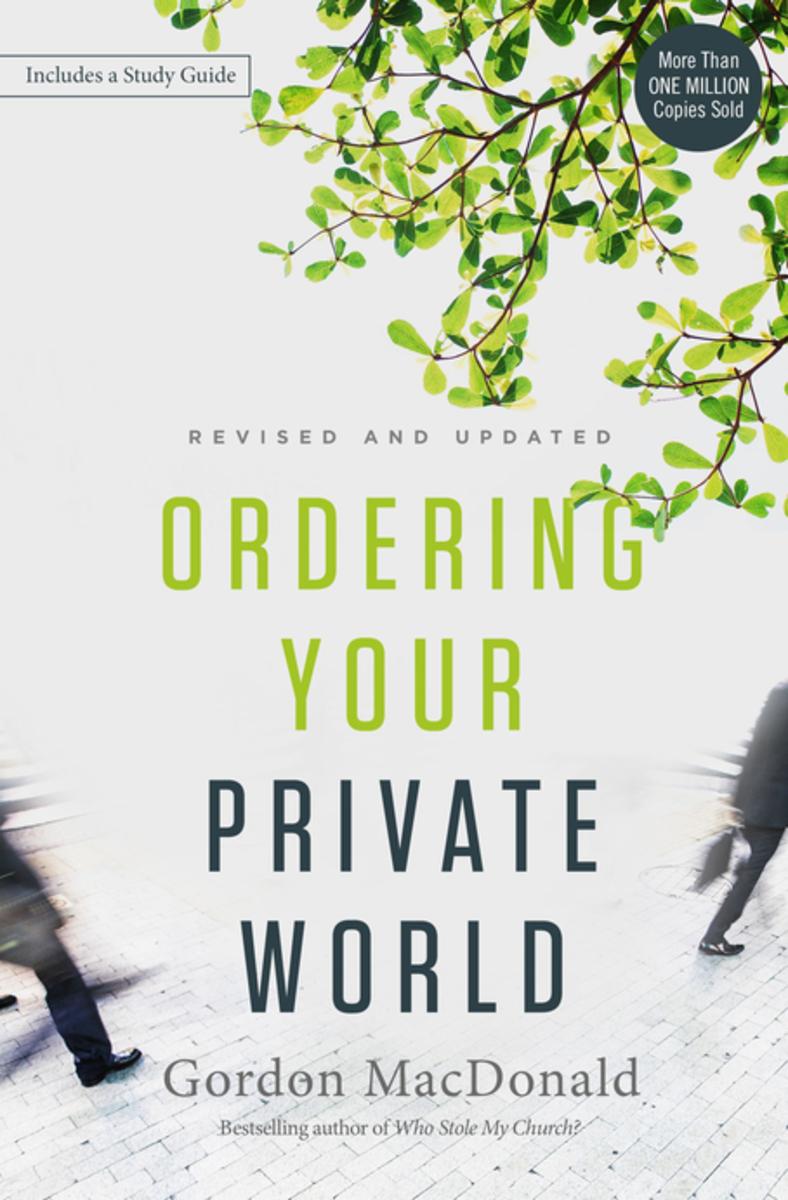
12 More Quotes From “Ordering Your Private World”

Gordon MacDonald did a phenomenal job synthesizing biblical principles as he teaches us how to pay attention to our private, inner world. One of the things I enjoyed was the number of other authors and teachers he quotes throughout Ordering Your Private World. Here are a few of those quotes he shared…

“The battle is lost or won in the secret places of the will before God, never first in the external world. … Nothing has any power over the man who has fought out the battle before God and won there. … I must get the things settled between myself and God in the secret places of my soul where no stranger intermeddles, and then I can go forth with the certainty that the battle is won.” —Oswald Chambers

“I took pleasure where it pleased me, and passed on. I forgot that every little action of the common day makes or unmakes character, and that therefore what one has done in the secret chamber, one has some day to cry aloud from the house-top. I ceased to be lord over myself. I was no longer the captain of my soul, and did not know it. I allowed pleasure to dominate me. I ended in horrible disgrace.” —Oscar Wilde 

“Think of no other greatness but that of the soul, no other riches but those of the heart.” —John Quincy Adams, in a letter to his daughter

“A public man, though he is necessarily available at many times, must learn to hide. If he is always available, he is not worth enough when he is available.” —Elton Trueblood

“Remember a long life of steady, consistent, holy labor will produce twice as much fruit as one shortened and destroyed by spasmodic and extravagant exertions; be careful and sparing of your strength when and where exertion is unnecessary.” —Catherine Booth, in a letter to her husband William Booth, founder of the Salvation Army

“There can be intemperance in work just as in drink. What feels like zeal may be only fidgets or even the flattering of one’s self-importance.” —C.S. Lewis

“The man of action has the present, but the thinker controls the future.” —Oliver Wendell Holmes

“No other pleasure suits every occasion, every age or every place. But the study of letters is the food of youth, the delight of old age, a delight at home and no burden abroad; it stays with us at night, and goes with us on our travels, near and far.” —Cicero

“We need to find God, and He cannot be found in noise and restlessness. God is the friend of silence. See how nature—trees, flowers, grass—grow in silence; see the stars, the moon and sun, how they move in silence…. The more we receive in silent prayer, the more we can give in our active life. We need silence to be able to touch souls. The essential thing is not what we say, but what God says to us and through us. All our words will be useless unless they come from within—words which do not give the light of Christ increase the darkness.” —Mother Teresa

“St. Augustine says, ‘God gives where He finds empty hands.’ A man whose hands are full of parcels can’t receive a gift. Perhaps these parcels are not always sins or earthly cares, but sometimes our own fussy attempts to worship Him in our way. Incidentally, what most often interrupts my own prayers is not great distractions but tiny ones—things one will have to do or avoid in the course of the next hour.” —C.S. Lewis

“Let inward prayer be your last act before you fall asleep and the first act when you awake.” —Thomas Kelly

“I know that there are certain mental and emotional and moral and spiritual attitudes that are anti-health: anger, resentments, fear, worry, desire to dominate, self-preoccupation, guilts, sexual impurity, jealousy, a lack of creative activity, inferiorities, a lack of love. These are the twelve apostles of ill health. So in prayer I’ve learned to surrender these things to Jesus Christ as they appear.” —E. Stanley Jones

You can check out my review of Gordon MacDonald’s Order Your Private World by clicking here. And you can read some quotes from Gordon by clicking here.
A Godly Leader’s Legacy

…the command of David the man of God (Nehemiah 12:24).

In Nehemiah 11-12 long lists of names and functions are listed as Jerusalem is repopulated and the temple functions reestablished.

One important aspect of worship is the temple musicians and singers who offered thanks to God. The organization of these worshipers was instituted by King David nearly 600 years earlier, so the phrase “according to the command of David” doesn’t surprise me.

But the description “the man of God” does surprise me!

Why not just “King David”? Yet 600 years after his reign David is still known as God’s man!

A mark of a godly leader is one the people still think of as “godly” long after he’s gone.

My prayer—Lord, may my legacy continue to bring You glory long after I have left the scene.

This is Part 11 in my series on godly leadership. You can check out all of my posts by clicking here.

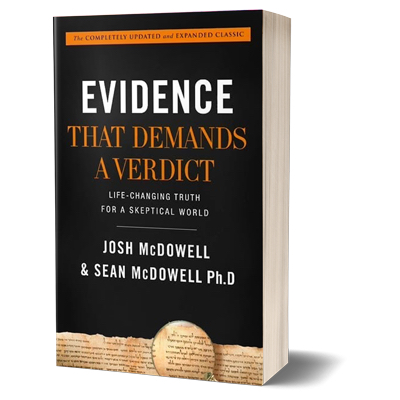
Evidence That Demands A Verdict (book review)

The Apostle Peter wrote a letter to Christians in which he called them “aliens and strangers” because of their belief in a personal Creator and Lord. In this letter, he tells Christians to “always be prepared to give an answer” to those skeptics who want to know about their faith in God. In Evidence That Demands A Verdict, Josh and Sean McDowell have given Christians a key component to help them be prepared to give sound answers.

This book is massive (at just under 900 pages)! But it is an encyclopedia of evidence that will prepare Christians to respond to any argument that an atheist or skeptic may bring up. To be honest with you, the Table of Contents is usually one of the first places I study in books I’m reading, but I usually end up skimming through it pretty quickly. But in Evidence, I was pleasantly surprised at the layout. Not only will you find a listing of the chapters, but a brief description of the contents. At the opposite end of the book, the Subject Index is also quite extensive. I know these are not things usually bragged on in a book review, but for a book this size—and for the numerous times you undoubtedly will be returning to prepare to answer a skeptic—these two reference points are extremely handy!

The first edition of Evidence (written by just Josh) came out nearly 20 years ago. If anything, the evidence for the beliefs that Christians hold has been further validated through research, archeological discoveries, and the like. So it was time for this classic book to be updated. The additional apologetic insights from Sean in this edition is a very nice addition.

Whether you read Evidence when it was first released or not, every Christian that wants to answer Peter’s directive for preparedness needs to get this new edition.

I am Thomas Nelson book reviewer.

What Does The Bible Say About Church Leaders?

God’s plan has always been for His leaders to organize and oversee His ministry.

The important thing for us to distinguish is “His.” It’s not a man or woman saying, “I will be a leader,” or even a God-appointed leader saying, “I am going to build up my ministry.”

The New Testament gives us a fourfold purpose for the Body of Christ:

  1. Mobilizing for evangelism
  2. Organizing for more meaningful ministry
  3. Making disciple-makers
  4. Caring for one another

We see God’s leaders involved in all of these aspects—

Mobilizing for evangelism—Peter pointed out the need for an apostle to be appointed to replace Judas, thus returning their ranks to the 12 apostles just as Jesus had originally said (Acts 1:15-22).

Organizing for more meaningful ministry—Everywhere Paul founded a church, he also appointed leaders to oversee and shepherd that church.

Making disciple-makers—Paul tells us that God appointed five offices of leaders in the church who had the specific task of preparing church members to do the ministry of building maturity in the church (Ephesians 4:11-16).

Caring for one another—The First Church set the pace for providing care for all who were in need, including organizing leaders to oversee specific care ministries (Acts 6:1-5).

What about a church congregation’s responsibility to their leaders? I see five areas:

  1. Hold them accountable to the Word (Acts 17:11). The Bible has to be THE standard to which leaders are held.
  2. Give them your confidence and submission after they have shown accountability to their biblical mandate (Hebrews 13:17).
  3. Pray for them (Ephesians 6:19).
  4. Pay them (1 Timothy 5:17).
  5. Be very careful about accusing them (1 Timothy 5:19).

A church and its leaders following this biblical pattern is a church that can effectively fulfill the Great Commission which Jesus gave us.