God’s Blessings Aren’t Primarily For You

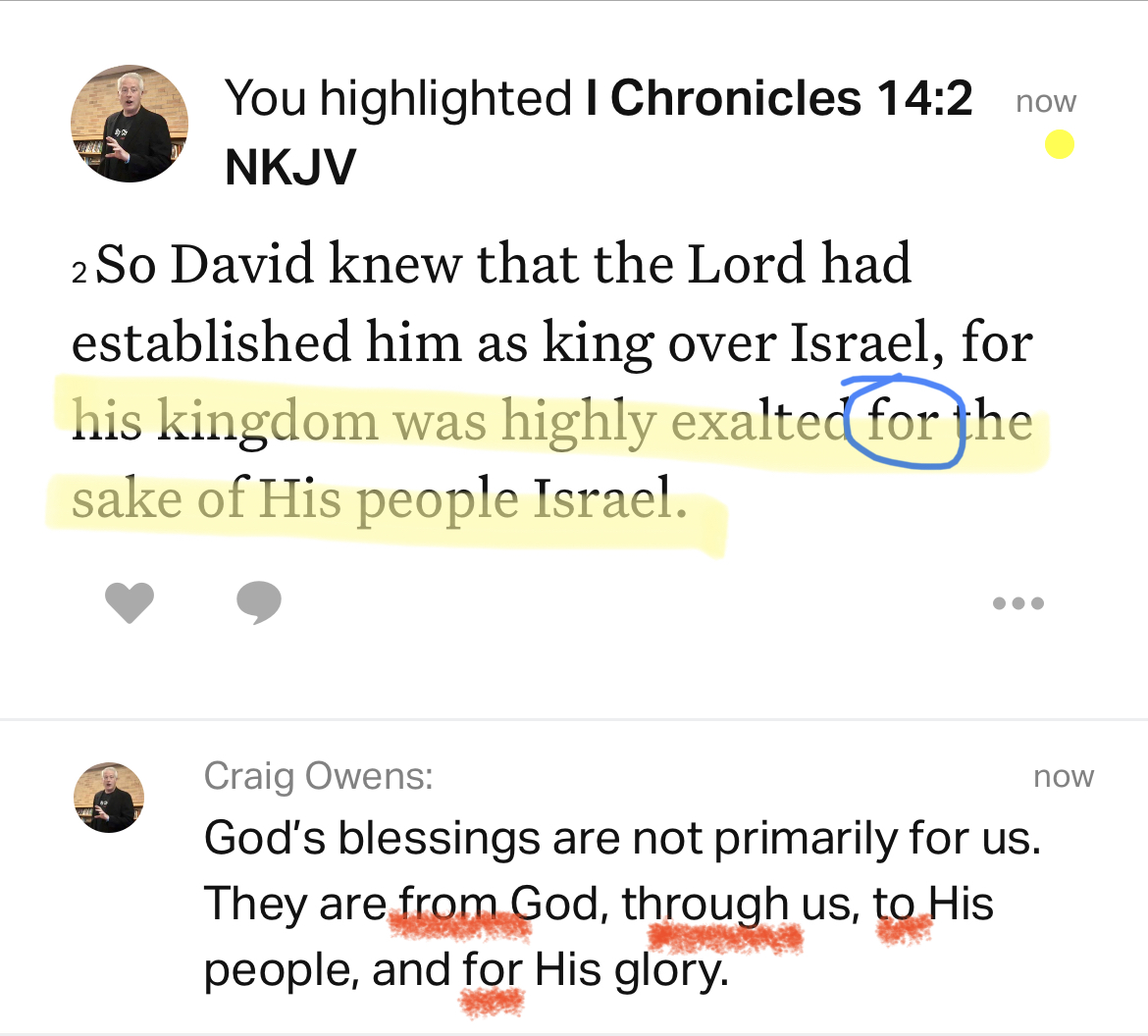
God's blessingsGod’s blessings are wonderful, and we should pray for them, but they are showered upon us for a specific purpose.

“May God be gracious to us and bless us and make His face shine upon us…” is the prayer of the psalmist. Why does he pray this?

“…SO THAT Your ways may be known on earth, Your salvation among the nations.” (Psalm 67:1-2)

God’s blessings are sent to His people SO THAT the whole earth will know Him and praise Him, and turn to Him for their salvation.

God’s blessings aren’t primarily for my benefit, but for His!

“And God, our God, will bless us. God will bless us, SO THAT all the ends of the earth will fear Him.” (verses 6-7)

Sola Deo gloria—it’s all for His glory!

So, yes, Lord, pour out Your blessings on me again and again SO THAT all people may know You and Your salvation. May all who see Your blessing on me turn to You as their God too!

Links & Quotes

link quote

Great reading (and watching) today.

[VIDEO] John Maxwell reminds us of the value of delays.

Dr. James Dobson defends his comments at the National Day of Prayer address.

[VIDEO] Dr. Brian Mattson discusses the place of the Apocrypha.

[INFOGRAPHIC] Exercise helps your memory.

“The surprise comes for many people that such a tiny little brain is able to form such a rich memory described as a cognitive map,” says co-author Randolf Menzel. Actually, the surprise for me is that many people refuse to believe this amazing little brain was created by an amazing Creator. See how bees build mental maps to get back home.

Holy Fire (book review)

Holy FireI believe the subtitle of R.T. Kendall’s book Holy Fire is the most apt description of this work: A Balanced, Biblical Look at the Holy Spirit’s Work in Our Lives. Truly this book is both biblical and balanced.

“I am writing this book (1) to introduce the Holy Spirit as if you did not know very much about Him, (2) to show the inconsistency of the teaching of some evangelicals, but (3) also to warn you of strange fire that is about,” says Dr. Kendall.

It seems lately there is a great deal of UNbalance when discussing the Holy Spirit, and much “theology” being preached which doesn’t have a firm biblical foundation. Some want to emphasize the Spirit’s role so much that they almost exclude God the Father and God the Son. Others want to so downplay the role of the Holy Spirit in our lives today that they have almost become binitarians. Kendall stated, “The Holy Spirit does not belong to you. Are you Charismatic? He is bigger than your signs and wonders event. Are you Reformed? He will not be limited by your theology.”

Sticking close to the words of Scripture, R.T. Kendall walks us through the various roles of the Holy Spirit in our lives. He brings in the insights of other notable thinkers from Martin Luther, to John Calvin, to Jonathan Edwards, to George Whitefield, and Dr. Martyn Lloyd-Jones. Even for someone like me who grew up in the Pentecostal tradition, I learned so much from this book!

Holy Fire is not written in a scholarly tone, but in a conversational style that made me feel I was talking with R.T. Kendall. This allowed me to drink in what Rev. Kendall was saying, process it, compare it with Scripture, and reach my own conclusions.

An excellent book that is very timely for the Christian era in which we currently live. Whether your background is Pentecostal or Reformed, there is so much to be learned from Holy Fire.

Links & Quotes

link quote

Some good reading from today.

John Stonestreet explains why pornography is wrong.

“We can preach the Gospel of Christ no further than we have experienced the power of it in our own hearts.” —George Whitefield

“I cannot blame him [George Washington] for having acted according to his ideas of duty in obeying the voice of his country. I am still determined to be cheerful and happy, in whatever situation I may be; for I have also learned from experience that the greater part of our happiness or misery depends upon our dispositions, and not upon our circumstances.” —Martha Washington

“All of the examples that we have in the Bible illustrate that glad and devoted and reverent worship is the normal employment of moral beings. Every glimpse that is given us of heaven and of God’s created beings is always a glimpse of worship and rejoicing and praise because God is who He is.” —A.W. Tozer

John Piper brilliantly confronts “gender non-conformists” in his post “Genitalia Are Not Destiny”—But Are They Design?

It’s tough to say which is worse: denying a victim’s humanity or acknowledging it and hurting them anyway.” Read more of Adam Peters’ post How Planned Parenthood Dehumanizes Its Prey.

For baseball fans (especially Detroit Tigers fans) check out the batters who hit the most home runs in Tiger Stadium.

Chilly Chilton uses a quote from C.S. Lewis to challenge us to Make Small Big.

Avoid “decision fatigue.” 5 Ways To Make Fewer Decisions.

Noble Revenge

Noble revengePerhaps one of the most counter culture things a Christian will ever do is to forgive. More specifically, to forgive God’s way in which the offending party is forgiven and the offense is no longer counter against him.

But this isn’t what today’s culture teaches us. Instead they say things like—

  • “I’ll forgive them only if they’re really, really, REALLY sorry for what they did….
  • …and I’ll forgive them only if they ask for forgiveness…
  • …and then only I’ll only forgive them a certain number of times…
  • …and most importantly, I may forgive, but I’ll never forget.

Why do we feel this way?

  • We buy into the old line: “Hurt me once, shame on you; hurt me twice, shame on me,” and we don’t want to feel shame.
  • We like to be in control. If we hold on to slights and injuries, then we have a trump card we can play later—“You owe me” or “This is why I don’t trust you.”
  • We mistakenly think that forgiveness makes us appear weak, like our offender won and we lost. And we certainly don’t want them to think they can take advantage of us again.
  • Because if they take advantage of us again it’s right back to, “Hurt me once…” so I’m going to make a preemptive strike and not forgive them.

Yes, forgiveness could make us appear vulnerable. Yes, we could be hurt again by the same offender. And, yes, we could be viewed as weak. But—The foolish thing that has its source in God is wiser than men, and the weak thing that springs from God is stronger than men (1 Corinthians 1:25, AMP). Total forgiveness is foolish looking in the natural, but it has God’s blessing on it.

With this in mind, the Apostle Paul wrote—

But Jesus said to me, “My grace is sufficient for you, for My power is made perfect in weakness.” Therefore I will boast all the more gladly about my weaknesses, so that Christ’s power may rest on me. That is why, for Christ’s sake, I delight in weaknesses, in insults, in hardships, in persecutions, in difficulties. For when I am weak, then I am strong. (2 Corinthians 12:9-10)

When we are totally reliant on Christ, that’s when His power rests on us. When we say, “I’m going to do this my way,” we block ourselves off from Christ’s grace and power and strength.

We need to remember HOW MUCH God has forgiven in us—He forgave ALL my sins and He no longer counts any of my treachery and rebellion against me. With this in mind, how dare I hold on to the comparatively small injuries others have inflicted on me (see Matthew 18:21-35).

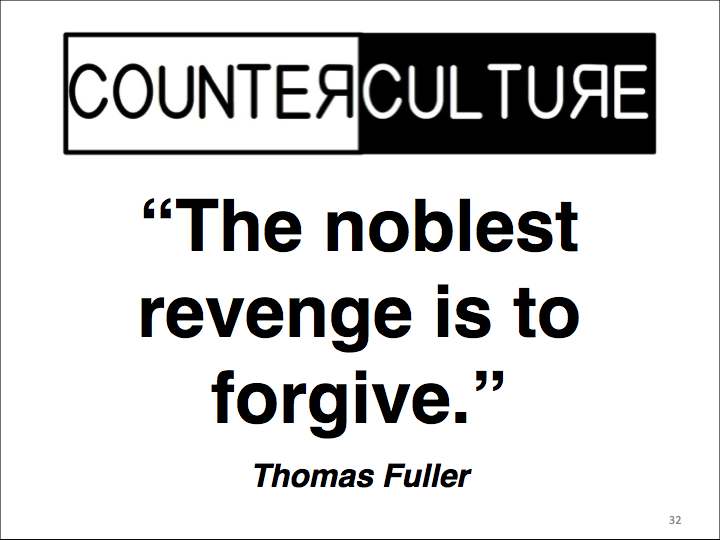
“The noblest revenge is to forgive.” —Thomas Fuller


Forgiveness gives me a nobility.
Forgiveness sets me free from the hurt.
Forgiveness makes me a child of God.
Forgiveness gives me God-sent strength.
Forgiveness is counter culture.
Because forgiveness glorifies God, and not my wound.

What are you waiting for? Get free today by giving and receiving forgiveness.

Weekend Quotes

“quotes”

Some challenging quotes from this weekend:

“A wise man will make haste to forgive, because he knows the true value of time, and will not suffer it to pass away in unnecessary pain.”  —Samuel Johnson

“The noblest revenge is to forgive.” —Thomas Fuller

“Being deeply loved by someone gives you strength, while loving someone deeply gives you courage.” —Lao-tzu

“Love keeps no records of wrongs. … It always protects, always trusts, always hopes, always perseveres.” —Apostle Paul (1 Corinthians 13:6-7)

And for my pastor friends: “There will always be new ways to do good works and speak good words which are not presently in our experience or repertoire. So in all our studies, let us study to acquire new insights and visions of how we can serve others through good works. And in all our teaching and preaching, let us not grow negligent in exhorting the people of God to do likewise.” —T.M. Moore